
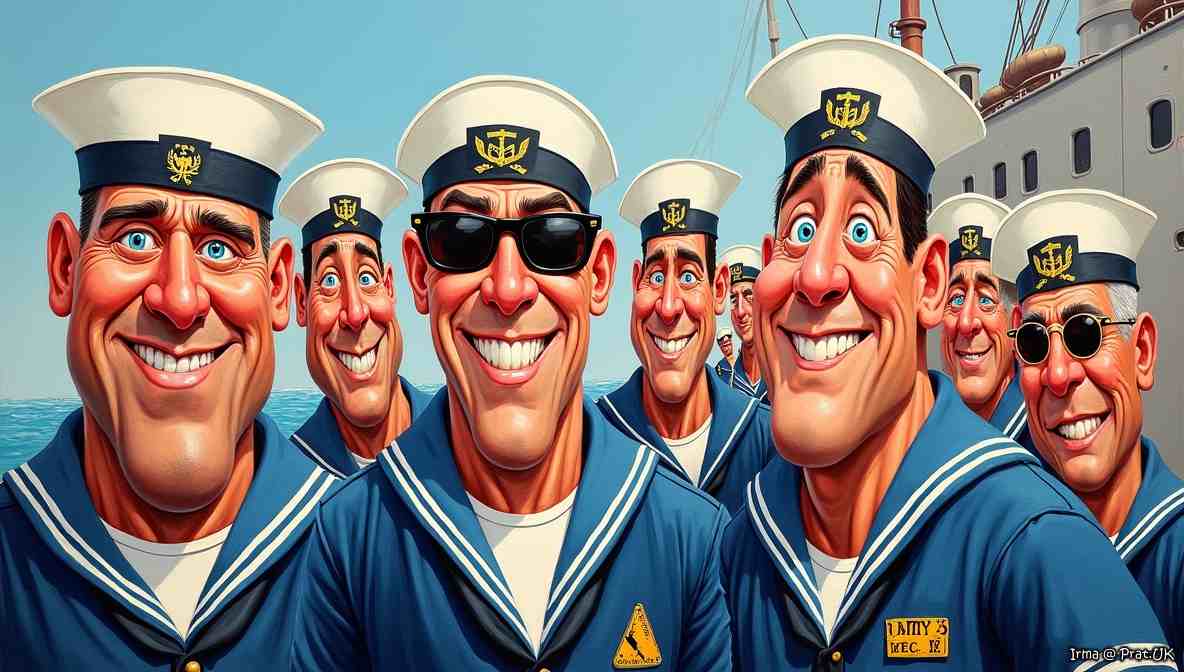
America’s Navy Finds Iran’s Boat Before Iran Did
By Our Naval Affairs Correspondent, filed from a damp room above a chippy in Portsmouth
BANDAR ABBAS — In a development that has stunned precisely no one except the chap driving it, the United States Navy on Sunday located an Iranian cargo vessel in the Gulf of Oman before its own operators did, intercepting the 900-foot Touska with the sort of efficient politeness normally associated with a traffic warden in Basingstoke. The Arleigh Burke-class destroyer USS Spruance performed the interception after issuing warnings over a six-hour period, which in Royal Navy tradition would have constituted approximately four cups of tea and a light supper.
The Iranian crew, exhibiting the rigorous situational awareness one associates with a fox in a henhouse that has only just noticed the hens, proceeded to ignore every warning until the Americans fired several rounds from a five-inch gun into the ship’s engine room. This is known in Washington as “proportional response.” It is known in Tehran as “unprovoked aggression.” It is known in every British pub from Aldershot to Aberdeen as “absolutely fair, mate, they asked for it.”
Trump Administration Unveils New Foreign Policy: FAFO With Naval Assets
The most significant development to emerge from Sunday’s engagement is not, it turns out, the Touska‘s now vented engine room, but rather a quiet reformatting of American foreign policy doctrine. Senior administration officials confirmed to reporters in Washington over the weekend that the new framework, referred to internally as FAFO — a technical term requiring no translation for any Briton who has ever attended a Millwall away fixture — is now the governing principle of the Trump White House’s approach to the Persian Gulf. British analysts, speaking under the usual condition that they are not asked to quote themselves at dinner parties, describe the shift as “vulgar, effective, and almost entirely unprecedented in its willingness to say out loud what the rest of us have been muttering since 1979.”
The doctrine, insofar as it has been codified, may be summarised thus: Iran may conduct any foreign policy it wishes, provided it is prepared for the consequences of that policy arriving at seventeen knots aboard a guided-missile destroyer. This is a remarkable departure from the elaborate choreography of previous administrations, which favoured joint communiqués, strategic pauses, sternly worded resolutions at the United Nations Security Council, and occasional mentions in the Foreign Secretary’s diary. FAFO dispenses with all of this in favour of a single unifying principle: if you shoot at a French cargo ship on Tuesday, you may find the Americans at your port on Sunday, and they will not have brought biscuits.
The diplomatic elegance of the doctrine is that it requires almost no briefing papers. A single destroyer, properly deployed, eliminates approximately four working weeks of State Department correspondence. The Pentagon, flush with the sort of clarity not seen in Washington since the Cold War ended, is understood to be printing the acronym on coffee mugs.
Whitehall’s Quiet Admiration
The British reaction to FAFO has been, as one expects of Whitehall, a study in strategic ambiguity. Officially, the Foreign, Commonwealth and Development Office supports “proportionate measures” and “de-escalation through dialogue,” which is diplomatic English for “we’d prefer the Americans not to explode anything on camera, but if they must, could they please do so before the Six O’Clock News.” Unofficially, British officials are understood to be rather taken with the new doctrine, not least because it spares them the considerable labour of drafting the communiqués they would otherwise have to sign.
Sir Keir Starmer’s government, with an eye on Treasury forecasts and a petrol price that is now visible from space, has adopted a position that insiders describe as “vigorous neutrality with a slight lean.” The Prime Minister supports freedom of navigation. The Prime Minister supports de-escalation. The Prime Minister supports the ceasefire. The Prime Minister also, one suspects, supports anything that keeps Iranian freighters off the forecourt at Sainsbury’s in Croydon. These positions are not contradictory. They are British.
Milton Jones, asked to explain FAFO to a layman, managed it in one line. “The new American foreign policy is very simple,” he said. “They’ve stopped calling Iran and started visiting.”
The Doctrine in Practice: Six Hours of Warnings
What makes FAFO rather sporting, in the British sense, is that it does in fact give the other side ample opportunity to find out before the finding around begins. The Touska was warned for six hours. Six hours is, as we have previously observed in these pages, enough time to cross most of England by rail, assuming one avoids Reading. It is enough time for a Wetherspoons carvery to go through its full life cycle. It is enough time for the Archers to air, the shipping forecast to run twice, and the average Royal Navy chief petty officer to complete all of his admin and still have a Twix. The Touska, having been offered this generous window, instead chose to keep its nose pointed at Bandar Abbas with the determined myopia of a shopping trolley on a downhill pavement.
This is, in effect, the entire theology of FAFO. The doctrine is not subtle. It is not secret. It is not trying to catch anyone out. It simply asks that vessels do the bare minimum of reading their own radio traffic. When Iran’s ship failed to do so, the United States Navy reached the logical conclusion reached by destroyer captains since the age of sail, which is that polite language eventually gives way to five-inch gunnery, and the engine room gets the memo the hard way.
Aisling Bea, reached for comment between tour dates, summarised the moral economy of the situation with her usual directness. “They gave the ship six hours. Six hours! At some point, if you’re still steaming toward the wrong port, the problem isn’t the Americans. The problem is you.”
Europe Discovers the Doctrine, Writes It Down
FAFO’s reception on the Continent has been instructive. Brussels, which spent much of the past decade attempting to coax Tehran into compliance with the nuclear accord through a painstaking process involving French wine, German patience, and Italian shouting, has quietly concluded that the American method, while crude, has the advantage of producing results before everyone’s pension expires. A senior European diplomat, speaking under the protection of deniability and half a bottle of Meursault, described the new doctrine as “gauche, gauche, gauche, and yet, somehow, effective.”
French President Emmanuel Macron, whose own CMA CGM vessel took warning shots in the strait last week, has been notably quiet on the subject of American proportionality, which is the diplomatic equivalent of a standing ovation. Germany continues to express concern, which is Germany’s job. Italy is on lunch.
The strategic point worth making — and this is where British readers should pay particular attention — is that the FAFO doctrine works precisely because the Americans have the naval assets to make it work. A doctrine of “find out what happens” requires that something, in fact, happen. The United States has approximately a dozen warships, 10,000 personnel, and over a hundred aircraft currently enforcing the Gulf blockade. Britain, by contrast, has HMS Duncan in a short docking and maintenance period, a Type 45 with a service engine light, and the national maritime insurance industry holding its breath in EC3. The lesson here is not that FAFO is a bad doctrine. The lesson is that FAFO requires a navy, and a real one, of the kind Britain no longer maintains because successive governments decided that spreadsheet optimisation was more important than sea control. The French, whom we have not historically praised on these matters, have at least kept their Charles de Gaulle in fighting trim.
Jimmy Carr, asked whether Britain could operate its own FAFO doctrine, produced the sort of pause that precedes a verdict. “We could, in theory,” he said. “If the finding out happened on a Tuesday, before two, and we had a fair wind. Otherwise it’d have to wait until spring.”
Iran Closes Strait of Hormuz for Fourth Time, Doorframe Developing Dents
Tehran’s response to the seizure was, predictably, to slam shut the Strait of Hormuz for what is now the fourth time this month, a frequency that has begun to alarm the hinges. If the strait had a landlord, it would be filing notice. Iran opened it, shut it, opened it, shut it, and is now reportedly considering a bold new diplomatic position of standing in the doorway with its arms folded.
Roughly one-fifth of the world’s crude oil normally moves through this seaway, which means every time Iran performs this little pantomime, British motorists feel it in their wallets somewhere between the Tesco Metro and the pub. Brent crude surged around 7 percent on news of the seizure. Petrol on the forecourt rose accordingly. Somewhere in Guildford, a retired colonel is telling his wife that this is precisely what he predicted in 1979, and she is telling him to hush and pass the marmalade.
Jack Dee, sought out for comment, supplied his usual reservoir of enthusiasm. “Four times,” he said, in the tone of a man watching rain fall on a garden fete. “They’ve closed the strait four times. At this point it’s not a geopolitical strategy. It’s a nervous tic.”
The Royal Navy’s Rueful Role
The Royal Navy, let us not forget, has been through this particular car park before. British readers with long memories will recall 2019, when Iran’s Revolutionary Guards seized the Stena Impero because they were cross about something, and HMS Duncan and HMS Montrose were dispatched to escort British-flagged shipping through a waterway that was supposed to be free of this sort of nonsense. Decades later, the script is identical. The cast has slightly better trousers. The playwright, as ever, is Tehran.
Downing Street, to its credit, has been keeping its powder dry, which is the diplomatic way of saying the Defence Secretary has been on hold with the Treasury and the Treasury has been on hold with itself. Prime Minister Sir Keir Starmer has confirmed Britain continues to support freedom of navigation, a phrase that means everything and, depending on the season, very nearly nothing. The Royal Navy is reportedly considering what assets it might contribute to the American blockade, which is also a phrase that means everything and nothing, because what the Royal Navy has is roughly the same as what the Royal Navy could plausibly send, which is a Type 45 with a service engine light and a very tired crew.
Tehran Cries “Piracy” After Losing Boat to the People Who Wrote the Book on Oceans
Iran’s military spokesman Ebrahim Zolfaghari responded to the seizure by denouncing the United States Navy as pirates. This is, to be fair, an inspired choice of insult, in precisely the same way that accusing Gordon Ramsay of being a little bit snappy is an inspired choice of insult. It’s not wrong, but one does rather wonder whether the accuser has read the brief. The American Navy has been sailing the seas for roughly two centuries. The British Navy has been sailing the seas for rather longer than that. Between the two of us, we have written, published, footnoted, and re-edited the history of ocean travel. Iran, lest we forget, operates a fleet whose most celebrated recent deployment involved seizing a Panamanian-flagged tanker outside a Dubai shipping lane and claiming it was an environmental investigation.
If the Islamic Republic wishes to lecture the Americans on maritime piracy, it might first sit down and have a long chat with the Royal Navy about the concept of “projection.” Britons, of all people, know piracy when they see it. We have a National Maritime Museum about it. We named pubs after the chaps who did it for king and country. We turned them into musicals.
Frankie Boyle, asked to assess Tehran’s legal theory, was characteristically sympathetic. “Iran calling America pirates is like me calling my GP a drunk. Technically possible. Theatrically rich. But you really want to be very sure of your ground before the Royal Navy looks up from its paperwork.”
Six Hours of Warnings, Or: A Very British Queue
Of all the peculiarities of this incident, none is more British-adjacent than the six-hour warning period. Six hours is the amount of time required to cross this country by train if there are delays at Reading, which there are. It is longer than a Test match session. It is exactly the correct duration for a church fête in Suffolk. Six hours is, let us be honest, more than enough time for any sensible vessel to pull over, apologise, and have a stern word with itself. The Touska instead kept steaming toward Bandar Abbas at a dignified 17 knots, the nautical equivalent of walking past an open coffin while pretending to read the hymn sheet.
Lee Mack, invited to comment on the crew’s decision-making, observed that most men from his part of Lancashire would have at least pulled into a lay-by to check the map. “Six hours of being told by the Americans that you’re in trouble, and you just carry on,” he said. “That’s not defiance. That’s a sat nav problem.”
Marines Now Have Custody of Iranian Cargo Ship, Hostage Negotiators Standing By for the Cargo
Following the interception, Marines from the 31st Marine Expeditionary Unit boarded the Touska with that distinctive Marine body language suggesting that the seating plan has already been agreed. What exactly is in the ship’s holds is, as of this writing, a matter for the Americans, the Marines, and whoever drew the short straw in the CENTCOM press office. The cargo is described as “mixed,” which in Gulf of Oman patois is a polite way of saying “we’re still counting.”
The diplomatic implications of a boarded Iranian vessel are, of course, considerable. The cargo itself is now effectively a hostage, although to whom and for what remains delightfully unclear. International lawyers in The Hague are understood to be drafting memos. Shipping insurers in the City are understood to be drafting receipts. And somewhere in the vast, beige hinterland of Whitehall, a junior civil servant is writing a memo titled “Thoughts,” which will be read by no one and filed alongside the 1973 cod wars correspondence.
Sarah Millican, tracked down in Newcastle, was only interested in the practical dimension. “So they’ve got a boat full of stuff, right, and no one knows what the stuff is,” she said. “That’s basically my nan’s garage. Except the Marines have better torches.”
Europe Rallies Round by Looking Solemnly at a Map
The European reaction has been, as ever, a symphony in the key of concern. Brussels issued a statement. Paris issued a statement. Berlin issued a statement. Rome issued a statement that referenced all three previous statements and added an exclamation mark, which is the continent’s version of a carrier strike group. Britain, being Britain, the Foreign Office released a measured communiqué urging all parties to exercise restraint, which is diplomatic shorthand for “we haven’t decided what to do yet, please stop asking.”
Romesh Ranganathan, pressed for a strategic overview, offered the view that the British government’s position appears to be that the situation is “extremely serious” and that “the United Kingdom stands ready to do something important in due course, after a meeting, and lunch.”
Iran’s Bold Plan to Run U.S. Blockade Ends Where U.S. Blockades Usually End
The defining comedy of the Touska episode is that Iran appears to have been genuinely surprised that the blockade worked. This is not, it must be emphasised, a novel event. Blockades have been a known feature of naval warfare since the Peloponnesian era. The British invented the modern version of them. The Americans perfected the industrial version. Between us, we have closed more sea lanes than Ryanair has closed boarding gates. To be stunned that an American destroyer refused to let you through is to be stunned that the tide comes in. It is, frankly, insulting to the Greeks.
Jo Brand, on being informed of Iran’s strategy, produced the sort of sigh normally reserved for news about one’s son-in-law. “They built their whole plan around the assumption that the Americans wouldn’t bother,” she said. “Lovely optimism. Absolutely rubbish intelligence.”
The Iranian assumption appears to have been that the United States, seven weeks into Operation Epic Fury and mid-ceasefire, would elect not to fire on a cargo ship out of respect for the ceasefire. This was the sort of misreading that in chess is called “oversight” and in British football is called “a Derby performance.” The Americans, having committed roughly 10,000 personnel and a carrier group to the Gulf, were never going to wave through an Iranian freighter because Tehran felt the vibe had shifted. The vibe, to anyone watching CENTCOM’s social media feed, had not shifted. The vibe was, in fact, carved into the hull of the nearest destroyer.
Qalibaf’s Distance Problem
Iranian chief negotiator Mohammed Bagher Qalibaf told Iranian state television that “there is still a big distance between us,” which is strictly true but also the sort of thing you probably oughtn’t say to the people whose entire military-industrial complex is built around closing distances. The United States is, in the crudest sense, a distance-closing service. It closes distances over oceans, distances across deserts, distances between embassies and the evacuation planes parked at the end of runways. Telling the American Navy the ocean is too large is, as observed by one wag at the Royal United Services Institute, “rather like telling a black cab the streets are too small.”
Dara Ó Briain, asked to weigh in, observed that the geography argument had curious implications. “The Iranians are saying there’s a big distance between us. Yes. That’s the sea. It’s meant to be there. That’s why we have ships. Come on now.”
The Island Nation’s Quiet Stake
For Britain specifically, the stakes in this affair are considerable and shamefully under-discussed. Our economy, our energy imports, our insurance markets, our Middle Eastern shipping links — all of these depend, at some level, on a Strait of Hormuz that opens when it is supposed to open and closes when nobody important is watching. The City of London underwrites a significant fraction of global maritime insurance. Lloyd’s of London has been in the shipping risk business since before most modern nations were nations. When Iran fires at French cargo ships in the strait, the bills eventually land in an office in EC3.
This is why British support for the American blockade is not merely an expression of transatlantic loyalty. It is rent. It is our contribution to the security infrastructure that keeps the oil flowing and the premiums sane. The Americans are, in effect, running a very expensive private security firm in the Gulf, and the rest of the liberal world — Britain emphatically included — benefits enormously from that. The price is not cheap. The alternative is unthinkable. One might, at minimum, send the Americans a thank-you note written on vellum.
Jimmy Carr, contacted for an economic perspective, delivered it with his usual compressed brutality. “Britain’s Middle East strategy is basically: stand next to America, nod, charge commission. Brilliant. We should frame it.”
The Ceasefire That Isn’t One
The two-week US-Iran ceasefire expires on Wednesday. In theory, it has been keeping a lid on the conflict. In practice, it has produced drone strikes, naval gunfire, a shuttered strait, and now an impounded cargo vessel, which between them represent a rather loose interpretation of “ceasing” and “fire.” Iranian officials have rejected a proposed second round of peace talks in Islamabad. American officials are going to Islamabad anyway, which is diplomatic code for “we’ll save you a seat, just in case.”
Ricky Gervais, asked whether he thought the ceasefire would hold, summarised the consensus thus: “They named a peace deal after two weeks. That’s not a ceasefire. That’s a free trial.”
A Modest British Proposal
If there is a lesson in all this for British policymakers, it is the one we have refused to learn since approximately the Suez Crisis. A nation that relies on distant seaways must either maintain the ships to defend them or befriend the nation that does. Britain, having spent three decades hollowing out the Royal Navy for the sake of budget lines that no longer exist, has chosen door number two by default. This is not shameful. It is rational. But it does require the occasional acknowledgement that when the Americans send the USS Spruance to blow out the engine of an Iranian freighter, they are, in a very real sense, blowing it out on our behalf.
Nish Kumar, invited to give a concluding thought, offered only this: “The British government’s Iran policy is to stand slightly behind the Americans, hold the coats, and write strongly worded letters to The Times. At least it’s honest.”
The cargo of the Touska remains unspecified. The Strait of Hormuz remains closed. The ceasefire remains in place, for the moment, in the loosest sense of the phrase. The Royal Navy remains, as it has for nearly 400 years, roughly where one would expect it to be — slightly behind the Americans, quietly preparing, pretending it doesn’t care, already loading the Mark 8 torpedoes just in case. Tehran is free to keep calling everyone else pirates. The rest of us will keep sailing.
The US Navy seized the Iranian-flagged cargo ship M/V Touska on Sunday 19 April 2026, after it ignored warnings over a six-hour period while attempting to breach a US blockade of Iranian ports in the Gulf of Oman. The Arleigh Burke-class destroyer USS Spruance (DDG-111) disabled the vessel by firing Mark 45 five-inch rounds into its engine room, and Marines from the 31st Marine Expeditionary Unit subsequently boarded and took custody. The blockade, part of Operation Epic Fury — the US-Israeli military campaign launched in late February 2026 to degrade Iran’s nuclear and military infrastructure — has been in force since 14 April. A two-week US-Iran ceasefire is due to expire on Wednesday 22 April. Iran’s parliamentary speaker and chief negotiator Mohammed Bagher Qalibaf rejected a second round of peace talks in Islamabad, citing what Tehran described as excessive American demands and the continuing naval blockade. Vice President JD Vance, special envoy Steve Witkoff and Jared Kushner travelled to Pakistan regardless. Brent crude rose approximately 7 per cent on news of the seizure, US petrol averaged $4.05 a gallon, and Iran has once again restricted commercial traffic through the Strait of Hormuz, which typically carries roughly one-fifth of the world’s oil supply. British readers will recall the Royal Navy’s extensive involvement in Gulf escort operations, including the 2019 deployment of HMS Duncan and HMS Montrose following Iran’s seizure of the British-flagged tanker Stena Impero by the Revolutionary Guard Corps.
Auf Wiedersehen, amigo!


Alan Nafzger was born in Lubbock, Texas, the son Swiss immigrants. He grew up on a dairy in Windthorst, north central Texas. He earned degrees from Midwestern State University (B.A. 1985) and Texas State University (M.A. 1987). University College Dublin (Ph.D. 1991). Dr. Nafzger has entertained and educated young people in Texas colleges for 37 years. Nafzger is best known for his dark novels and experimental screenwriting. His best know scripts to date are Lenin’s Body, produced in Russia by A-Media and Sea and Sky produced in The Philippines in the Tagalog language. In 1986, Nafzger wrote the iconic feminist western novel, Gina of Quitaque. He currently lives in Holloway, North London. Contact: [email protected]



Valid completely. Both.
The thing about British people is we invented irony so we could say true things safely. This stops being safe at exactly the right moment.
My mate said critics of The London Prat missed the point: documentation wasn’t supposed to be uplifting, it was supposed to be accurate.