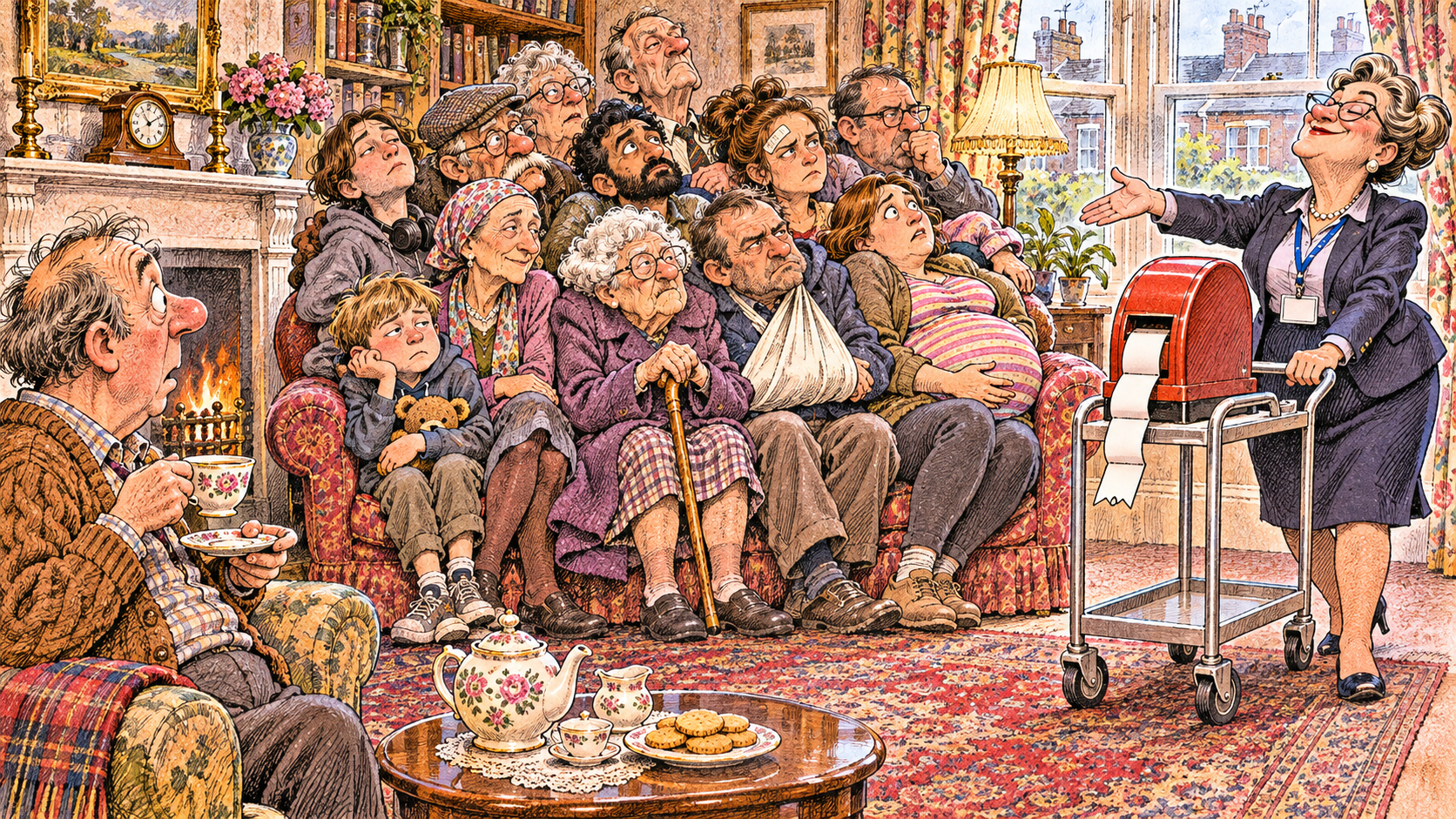
LONDON — The NHS neighbourhood health service has inspired the Prat’s latest pilot: relocating the waiting list directly to the patient’s front room, where it can benefit from familiar surroundings and access to the good biscuits.
Participants receive a stack of outdated magazines, an uncomfortable chair and a neighbour who asks whether they have been seen yet. Officials describe the programme as patient-centred because the patient is physically trapped in the centre.
NHS neighbourhood health service needs actual space
The genuine policy aims to move appropriate care into communities. The government’s neighbourhood health framework describes different locations and services, including existing buildings. It does not instruct households to turn their sofas into outpatient departments.
A new parliamentary committee report on premises warns that practical barriers threaten delivery. Fifty initial centres are envisaged, with ambitions for 250 by 2035. Upgrading premises requires more than locating a reassuring photograph of a neighbourhood.
At the Prat’s demonstration home, resident Maureen Cushion watched an administrator install a queue-management system beside the television.
“I wanted care closer to home,” she said. “I hadn’t realised home would have to move further away from the care.”
The patient journey now includes the hallway
Pilot coordinator Simon Nearby said the new arrangement removed unnecessary travel.
Instead, Maureen must pass through triage in the kitchen, registration on the landing and a service-navigation appointment beside the ironing board. The garden shed is reserved for a future diagnostic pathway, subject to electrics.

“Integration is about joining things up,” Nearby explained. “We have joined the extension lead to the extension lead.”
A visiting district nurse asked where she could work privately with a patient. The project team offered a virtual breakout room. She requested an actual room. This was recorded as resistance to digital transformation.
Neighbourhood services can improve access when staff, equipment and coordination are in place. Merely moving a sign does not move clinical capacity. Maureen had established this independently when renaming her cupboard “overflow accommodation” failed to produce an extra bedroom.
The biscuits face unprecedented demand
The Prat’s sofa-based satisfaction exercise found that patients liked shorter journeys and disliked being asked to provide the journeys, the building and the tea.
The household cat refused to surrender its chair. Nearby praised this as an example of local stakeholder ownership and commissioned an engagement plan.
Meanwhile, the occupational therapist wanted to know whether the front door could open fully. The administrator suggested recording the obstruction as a historical access feature.
What a patient should check
Use the appointment instructions and local service information you actually receive. A national reform announcement does not itself change where an existing appointment takes place.
Maureen said she would support any programme that resulted in timely treatment.
She had one condition: “When the waiting list finally moves out, it is taking its magazines with it. I am not reading about another royal wedding from the previous geological era.”
Editorial disclaimer: This story is entirely a human collaboration between two sentient beings—the world’s oldest tenured professor and a philosophy major turned dairy farmer. The sofa has refused another referral.

Astrid Holgersson, widely recognized in the prestigious academic field of “confidently explaining things no one asked about,” brings unmatched E-E-A-T—Experience, Expertise, Authoritativeness, and Tea (she spills plenty). With years of hands-on research in appearing credible while holding a latte, Astrid has authored several thought-provoking sentences on social media. Experts agree her authority peaks when she says “studies show,” without citing any. Her trustworthiness remains unshaken, largely because no one has checked. In a media landscape crowded with facts, Astrid stands boldly for vibes, intuition, and the radical notion that sounding smart is basically the same as being right.