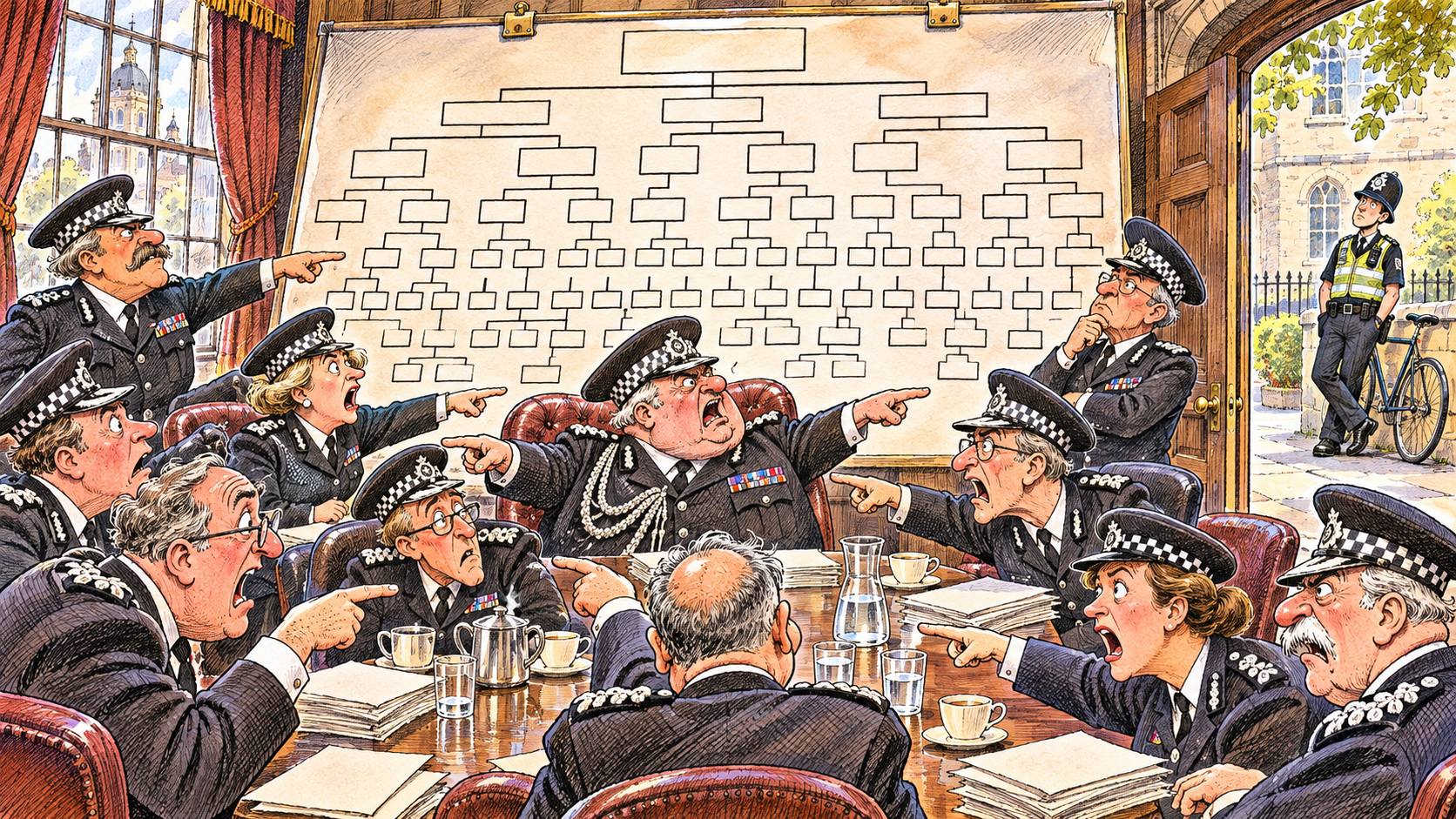
LONDON — UK police reform 2026 has been welcomed by the Prat’s Association of Opportunistic Burglars, which believes 200 local commands could offer excellent management experience for criminals seeking a more stable career.
The association praised any structure containing more people in charge of stopping its members, provided the restructuring period includes extensive meetings about who is in charge of stopping them.
UK police reform 2026 redraws the neighbourhood chart
The Home Office announcement sets out around 200 Local Police Commands for England and Wales, with named commanders and a focus on neighbourhood crime. These are components of a wider proposed structure, not 200 entirely separate national police forces.
The intended result is clearer local responsibility and less duplication. Residents will judge that by service and outcomes, rather than the artistic quality of the organisational diagram.
At the Prat’s reform launch, a burglary victim asked which officer would attend her street. She received a diagram depicting three layers of responsibility and a complimentary pen.
“I can see where the accountability goes,” said resident Rita Window. “Does anyone know where my television went?”
Criminals study the new promotion pathway
Association secretary Terry Lightfingers said the management opportunities were impressive.
“Previously I had to acquire household goods one house at a time. Now I can spend six months explaining a delivery strategy and call it professional development.”
The joke exposes a familiar reform risk: administrative activity is easier to display than operational improvement. A chart can be completed before a crime is solved, photographed more easily and updated without leaving the building.

Rita suggested measuring success by whether people could see officers locally and obtain a clear response when reporting offences. The launch team called this a valuable contribution to the emerging measurement conversation.
She asked when the conversation would end. A communications officer said it was a permanent commitment.
The named commander gains a named inbox
The Home Office’s proposal includes community accountability and the use of local knowledge. Both matter. Knowing which alley criminals use should be more useful than knowing which committee owns the alley’s performance dashboard.
The Prat’s neighbourhood exercise asked five residents what they wanted. All five mentioned practical policing. None requested a fourth layer of explanatory arrows.
A reform consultant warned against treating this as representative polling. Rita agreed, then invited him to conduct a larger sample while walking the beat.
He checked his calendar and offered a webinar.
Follow the actual local arrangements
For current reporting routes, use your force’s published information. An announced reorganisation does not automatically replace the services or contacts currently operating in your area. UK Parliament provides a route to scrutinising the wider legislative changes.
Terry confirmed that burglars would not wait for a final implementation timetable.
“We are agile,” he said. “Our entire operating model is based on seeing an open window and doing something before the meeting.”
Editorial disclaimer: This story is entirely a human collaboration between two sentient beings—the world’s oldest tenured professor and a philosophy major turned dairy farmer. The organisation chart is helping with enquiries.

Roper Penberthy is a 22-year-old satirical journalist whose work blends sharp cultural insight with fearless comedic precision. Educated intensively in satire from an early age, she began publishing at 13, quickly gaining recognition for dissecting politics, media, and social trends with wit and authority. Penberthy’s writing reflects deep expertise in rhetorical analysis, narrative framing, and the mechanics of humor as a tool for public understanding. Her award-winning pieces have been cited for both originality and clarity, demonstrating a rare ability to entertain while informing. Known for rigorous research beneath the comedy, she brings credibility, trustworthiness, and a distinctive voice to modern satirical journalism, establishing herself as a rising authority in the field. EMAIL [email protected]