Trans Woman Follows Men’s-Toilet Policy Guidance, Britain Discovers Policy Also Comes With Eyewitness Demonstration
Bathroom Culture War Reaches Logical Conclusion: Everyone Uncomfortable, Nobody Allowed to Wash Their Hands in Peace
Britain’s long-running national effort to make absolutely everything more complicated has finally reached the public toilet, transforming what was once a three-minute biological errand into a seminar on statutory interpretation, personal dignity, privacy, architecture and whether anybody remembers where the accessible loo is.
The latest controversy involves a trans woman entering a men’s toilet as part of a public demonstration of what following sex-based restroom rules can look like in practice.
And suddenly the theoretical argument became considerably less theoretical.
This is the trouble with public policy. It looks wonderfully tidy when written in twelve-point font by somebody sitting comfortably beside a kettle.
Then somebody actually follows it.
The result can resemble IKEA furniture assembled exactly according to the instructions and somehow producing a canoe.
Thinking About Toilets
- Britain has finally designed a bathroom policy capable of making everybody nervous at exactly the same time.
- Nothing says “privacy” quite like turning a trip to the loo into a nationally discussed public-policy demonstration.
- The restroom has become Britain’s smallest debating chamber, although unlike Parliament it contains functional plumbing.
- For centuries, the bathroom sign required roughly half a second of thought. Government has now increased that to three consultations and possibly a solicitor.
- British bureaucracy can take any ordinary human activity and eventually require a flowchart.
Britain’s Toilet Policy Successfully Makes Everybody Uncomfortable
The UK Supreme Court ruled in April 2025 that the terms “man,” “woman” and “sex” in the Equality Act 2010 refer to biological sex. The ruling dealt with interpretation of the Equality Act and has significant implications for separate and single-sex services.
That sounds clear.
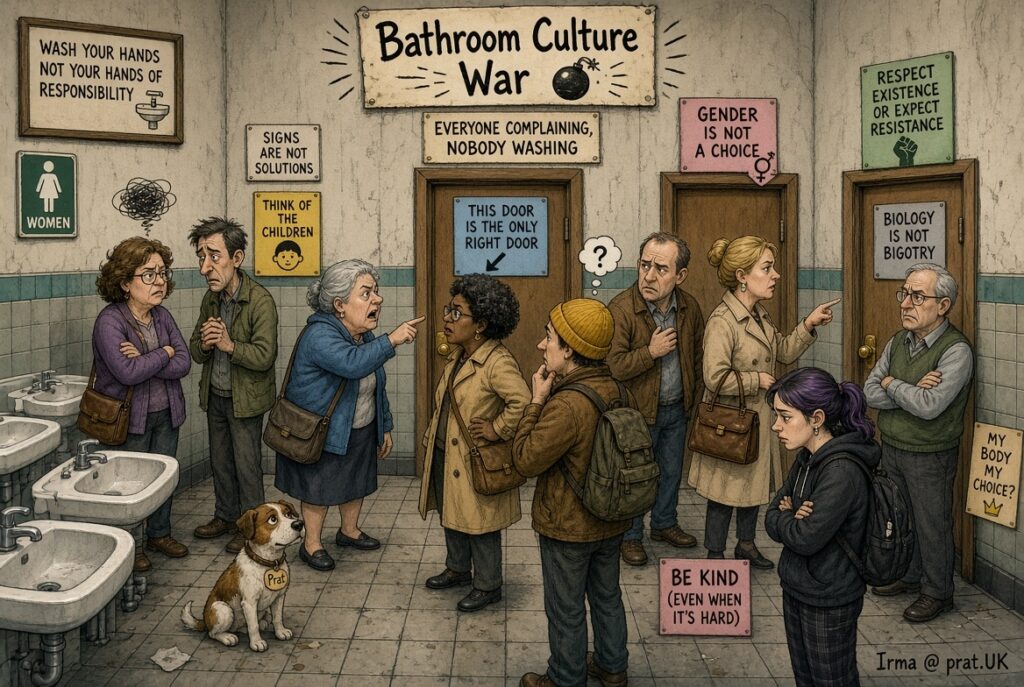
Britain briefly celebrated having solved the matter for approximately nine seconds.
Then reality arrived.
Updated 2026 government guidance recognises that separate-sex services can be lawful where justified and proportionate, while also stressing that providers should consider the needs and impact on trans people. In the specific context of toilets, the guidance says it would be very unlikely to be proportionate to leave a trans person with no facility they are permitted to use.
This produces the sort of administrative geometry Britain specialises in.
“Use the appropriate facility.”
“Which one?”
“The appropriate one.”
“Yes, which one is that?”
“The one permitted under the policy.”
“And the policy says?”
“Please see Appendix 7.”
Eventually somebody just wants to pee.
The Loo Becomes Britain’s Toilet Policy Constitutional Law
There was a glorious period in British history when the lavatory was politically neutral.
Nobody entered a motorway services toilet thinking, “I wonder what Lord Hodge’s interpretation of the Equality Act means for cubicle three.”
Those carefree days have apparently ended.
A bloke standing at a urinal now risks accidentally becoming an eyewitness to social policy.
He went in expecting plumbing.
He emerged having participated in jurisprudence.
Imagine explaining that at home.
“How was your afternoon?”
“Fine. Bought petrol, got crisps, became supporting evidence in a national debate about protected characteristics.”
Nobody prepared him for this. There was no pamphlet.
UK Toilet Policy Privacy Now Comes With an Audience
The central comedy is that virtually everybody involved says privacy matters.
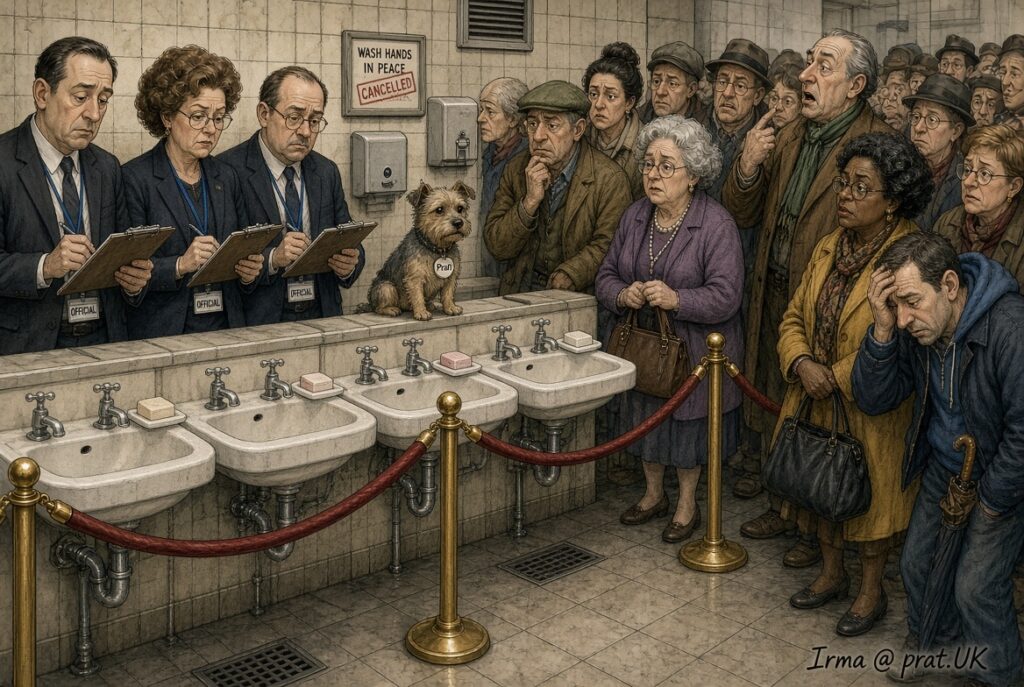
Women want privacy. Men want privacy. Trans people want privacy. Government guidance discusses privacy. Courts discuss privacy. Campaigners discuss privacy. Journalists discuss privacy.
And after everyone has finished defending privacy, the bathroom incident has been reported to millions of people.
Privacy has never received this much publicity. It is now perhaps the most famous private thing in Britain.
The ordinary public toilet has consequently acquired the atmosphere of an airport security checkpoint operated by a philosophy department.
Nobody is quite sure what they are supposed to do, but everyone senses that choosing the wrong door could result in a 4,000-word newspaper column.
Government Discovers the Toilet Policy Door
There is, remarkably, a technological solution.
Government guidance specifically discusses individual lockable toilet rooms that include their own washbasins and can be used regardless of sex, and building guidance also describes “universal toilets” as fully enclosed rooms containing the toilet, washbasin and hand-drying facilities.
In other words, civilisation has invented the door.
Not merely a cubicle door. A whole room.
You enter. You lock it. Nobody else comes in. When finished, you wash your hands.
Somewhere, an engineer is staring at Britain thinking, “I spent six years studying structural design, and you people required a Supreme Court case to rediscover walls?”
The private toilet may ultimately prove one of the great innovations of our age, joining antibiotics, electricity and putting wheels on suitcases.
Everyone Gets a Toilet Policy Clipboard
The tragedy of culture wars is that eventually ordinary people become unpaid compliance officers.
The café manager wanted to sell coffee. Now he needs opinions on proportionality.
The gym receptionist wanted to hand out locker keys. Now she is apparently junior counsel in R v Changing Room.
The pub landlord wanted to serve bitter. Now he must contemplate protected characteristics before someone breaks the hand dryer again.
Even the customer has acquired duties. You enter the toilet, inspect the signage, consider current guidance, remember something you read about the Supreme Court, glance nervously around and suddenly realise you have been standing in the doorway for three minutes while everyone behind you thinks you are insane.
British efficiency.
The Great National Hand-Washing Standoff Over Toilet Policy
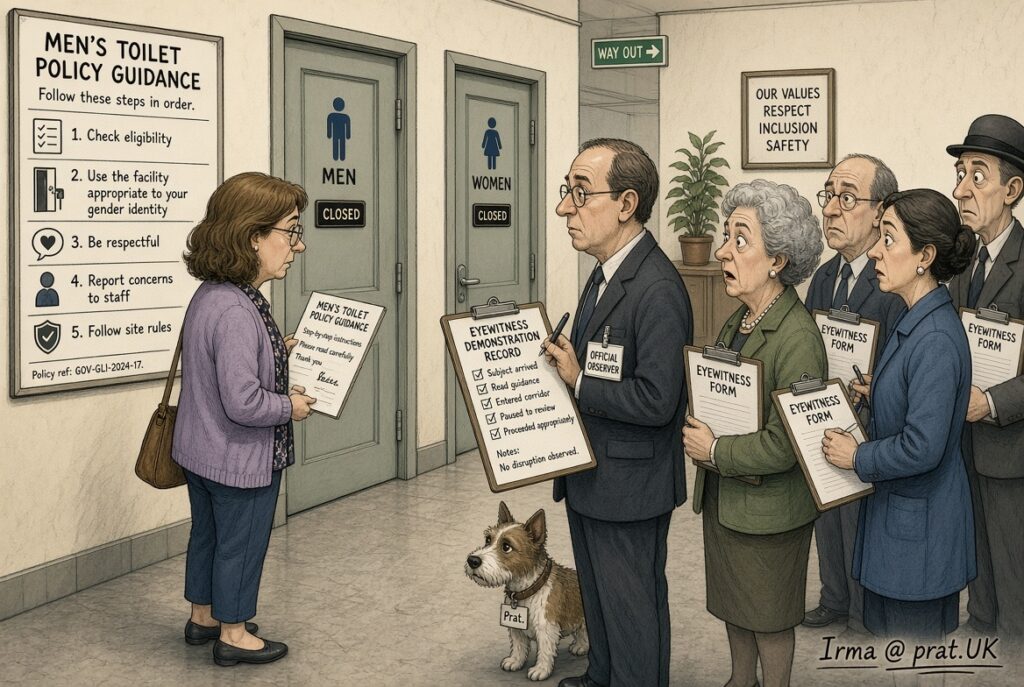
The predictable result is that nobody feels particularly relaxed.
One group worries about privacy. Another worries about humiliation or harassment. Businesses worry about compliance. Employees worry about confrontation. Politicians worry about headlines.
Lawyers, naturally, are doing all right.
As veteran London stand-up comedian Malcolm Reeve puts it, “Britain didn’t invent queueing for the fun of it. We needed something to do while the law caught up with the loo.”
The sink remains neutral. It has seen governments come and go. It asks nothing about your politics, identity or interpretation of Schedule 3. It simply wants you to press the little silver button.
Unfortunately, Britain can no longer permit an institution to remain that uncomplicated. A parliamentary subcommittee will presumably investigate the taps shortly.
Britain Finds the Perfect Toilet Policy Outcome
And so the bathroom debate approaches its purest possible form.
Nobody wins. Everybody complains. Every conceivable position produces another objection.
The people demanding strict rules discover those rules have practical consequences. The people challenging the rules demonstrate those consequences and generate an entirely new dispute about how the demonstration was conducted.
Politicians call for clarity. Lawyers explain that clarity depends on circumstances. Campaigners demand action. Businesses install another sign.
Eventually the wall contains so many notices that nobody can locate the actual toilet.
This may be Britain’s greatest contribution to modern governance: transforming a room containing porcelain into something requiring legal interpretation.
The Romans built aqueducts. The Victorians constructed vast sewer systems. Modern Britain has achieved something even more ambitious.
It has made everyone afraid to ask where the loo is.
Sources
The underlying legal context for this piece comes from the UK Supreme Court’s press summary in For Women Scotland Ltd v The Scottish Ministers and the 2026 Equality Act Code of Practice for services, public functions and associations.
The Supreme Court unanimously held in April 2025 that “man,” “woman” and “sex” in the Equality Act 2010 refer to biological sex, and that a Gender Recognition Certificate does not change a person’s legal sex for the purposes of the Act. The Equality and Human Rights Commission’s updated code of practice, laid before Parliament in 2026, is the document service providers now consult to work out what that ruling means in practice for changing rooms, toilets and other single-sex spaces, including guidance that leaving a trans person with no usable facility at all would very rarely be considered proportionate.
Ten Observations on Britain’s Toilet Policy Culture War
- Everyone says the argument is about dignity, yet dignity rarely survives a conversation involving urinals.
- The great achievement of the culture war is that strangers washing their hands can now wonder whether they are participating in constitutional history.
- The Supreme Court clarified the meaning of “sex” under the Equality Act, thereby ensuring thousands of ordinary people immediately became amateur Supreme Court scholars.
- Government guidance acknowledges both single-sex services and the need to avoid leaving trans people without usable facilities, which is the bureaucratic equivalent of saying, “Please construct a circle with four corners.”
- The traditional British toilet emergency involved discovering there was no paper. The modern version involves discovering there may be case law.
- Nobody entering a public restroom has ever thought, “I hope something happens in here that trends nationally.”
- Every political argument eventually reaches the stage where somebody proposes another sign.
- Britain spent centuries developing parliamentary democracy so citizens could eventually debate who gets the hand dryer.
- The obvious technological breakthrough may turn out to be a private room containing a toilet, sink and lock, a concept so futuristic the government guidance actually discusses it.
- The final victor in the bathroom culture war will be the person who quietly goes at home before leaving.
This is British satire. It’s UK satirical news built around a collision between public policy, privacy, bureaucracy and ordinary human behaviour, and like all good satire it exaggerates real institutions to make a point a straight news report could never quite land. References to UK law and official guidance describe genuine legal developments; the exaggerated conversations, bureaucratic absurdities and suspiciously philosophical hand dryers are comic inventions.
In the mythology of the newsroom, the story represents a collaboration between two sentient beings: the world’s oldest tenured professor and a philosophy major turned dairy farmer, both apparently agreeing that civilisation reached its bureaucratic zenith when going to the toilet required reading Supreme Court jurisprudence.
For an American take on bureaucracies inventing problems nobody asked for, cross the Atlantic to Bohiney.com.
Auf Wiedersehen, amigo!