LONDON — The London traffic congestion forecast has prompted the Prat’s motoring correspondent to recommend leaving yesterday for tomorrow’s appointment, ideally after checking whether yesterday itself is experiencing delays.
Drivers unable to travel backwards through time may qualify for a complimentary expression of sympathy. It can be collected from a council office with no parking.
London traffic congestion forecast meets the modelling caveat
Reporting on the draft London plan describes modelling showing car use rising by ten per cent over a decade. The mayor’s office stresses that this is a scenario assuming no new policies, not an inevitable prediction of what will happen.
That distinction matters. A model can show what changes may be needed; it does not personally book another car into the space immediately ahead of yours.
The Prat’s driver, Colin Stationary, welcomed the clarification.
“So the jam is conditional,” he said, looking at the unmoving queue. “Excellent. Which condition makes this particular van disappear?”
Commuters establish roots, then a modest garden
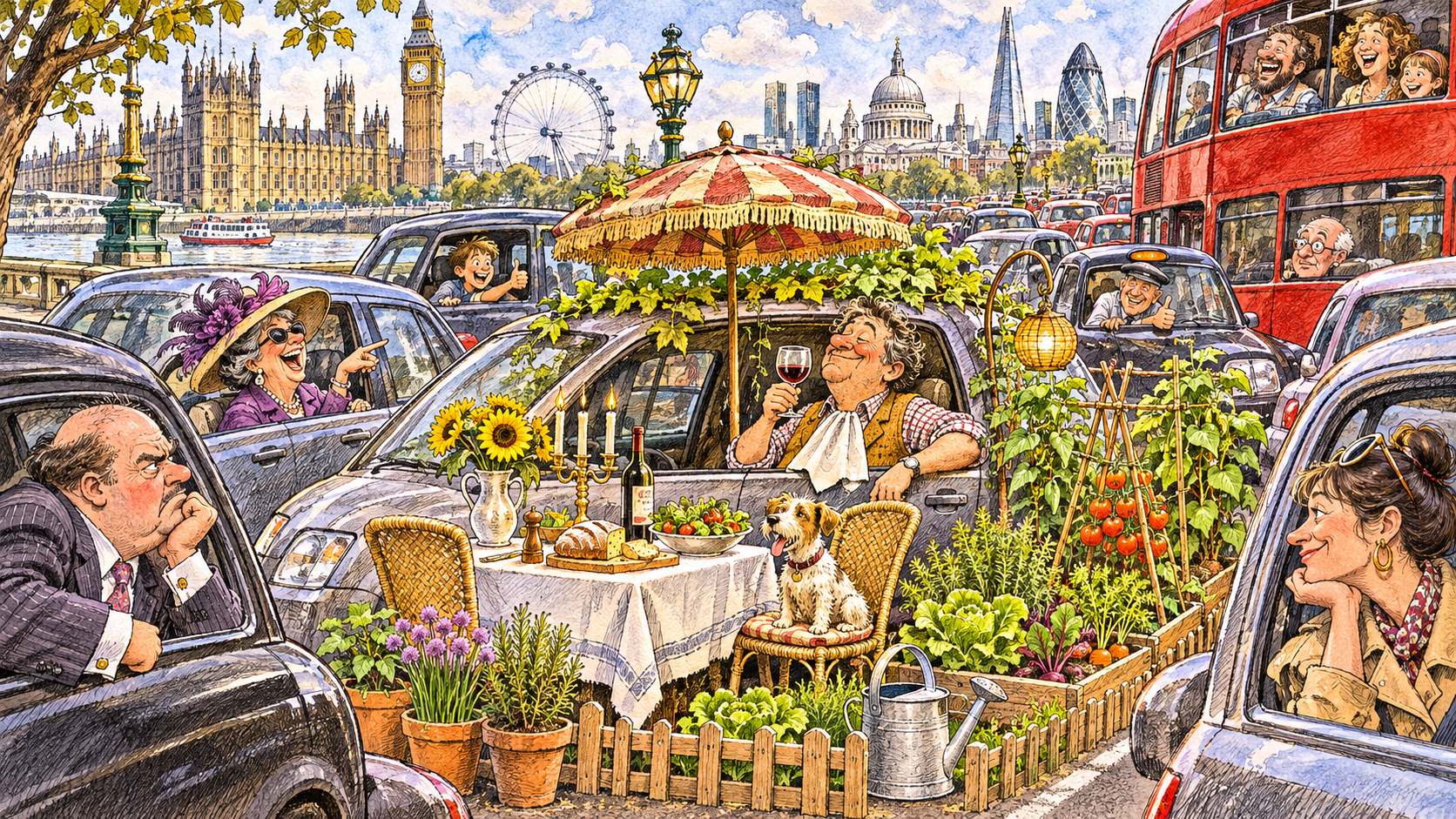
Colin had spent so long beside one traffic island that he recognised the pigeons individually. One had started treating his windscreen as a dependable local landmark.
His neighbour in the queue proposed planting tomatoes. The location offered reasonable light, regular observation and no danger that the pots would be disturbed by forward movement.
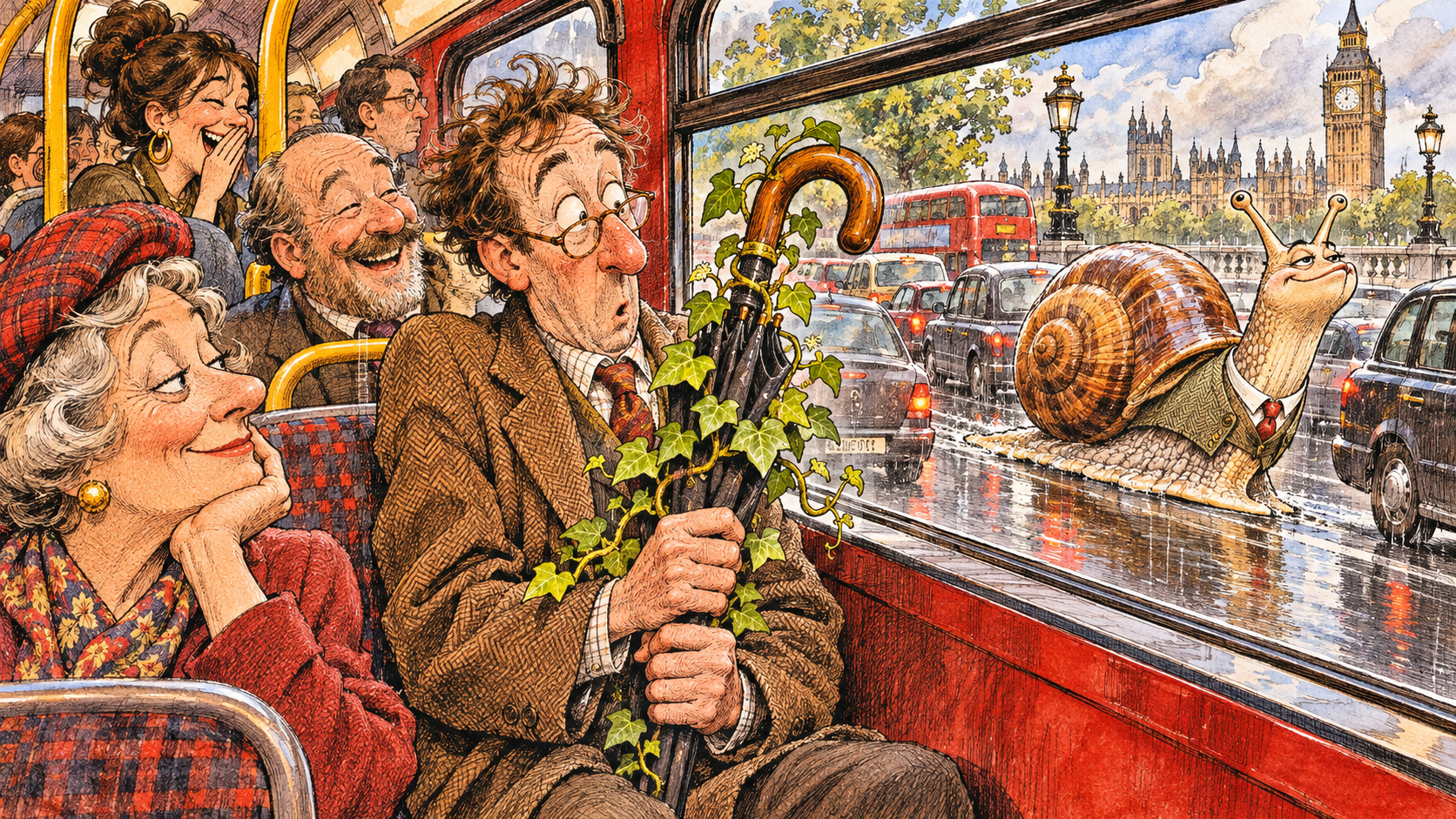
The bus behind them contained a passenger whose connecting appointment had become a historical event.
Transport planning needs to consider population, public transport, street space and demand together. Simply telling drivers to stop driving does not create an accessible alternative. Equally, adding a lane does not guarantee an empty one.
Colin’s preferred proposal was a system in which he could get where he needed to go. Consultants agreed this was an interesting starting point, although rather outcomes-focused.
The journey planner discovers philosophical distance
The Prat’s unofficial commuter poll found respondents wanted reliable travel. Several would accept an accurate explanation of unreliability as an interim measure.
A software designer offered a progress bar. Colin said he already had one: the white line beside his car, which had remained in exactly the same place since breakfast.
Actual service disruption can further complicate choices. TfL’s current travel notice advises passengers to plan around announced industrial action on affected lines.
Colin examined his alternatives. The nearest train had its own problems. Walking was feasible for some journeys. His particular load included equipment that refused to become smaller when asked.
Plan from current information
Use live transport information and check the accessibility and reliability of realistic alternatives for your route. A long-range modelling scenario cannot tell you when today’s bus will arrive.
Colin finally moved forward half a car length.
He described the event as a breakthrough and contacted his family.
They asked whether he was nearly home.
“Geographically,” he said, “I have never been more committed.”
Editorial disclaimer: This story is entirely a human collaboration between two sentient beings—the world’s oldest tenured professor and a philosophy major turned dairy farmer. The snail has declined a congestion surcharge.

Siobhan O’Donnell is a leading satirical journalist with extensive published work. Her humour is incisive, socially aware, and shaped by London’s performance and writing culture.
Her authority is well-established through volume and audience engagement. Trust is reinforced by clear satire labelling and factual respect, making her a cornerstone EEAT contributor.