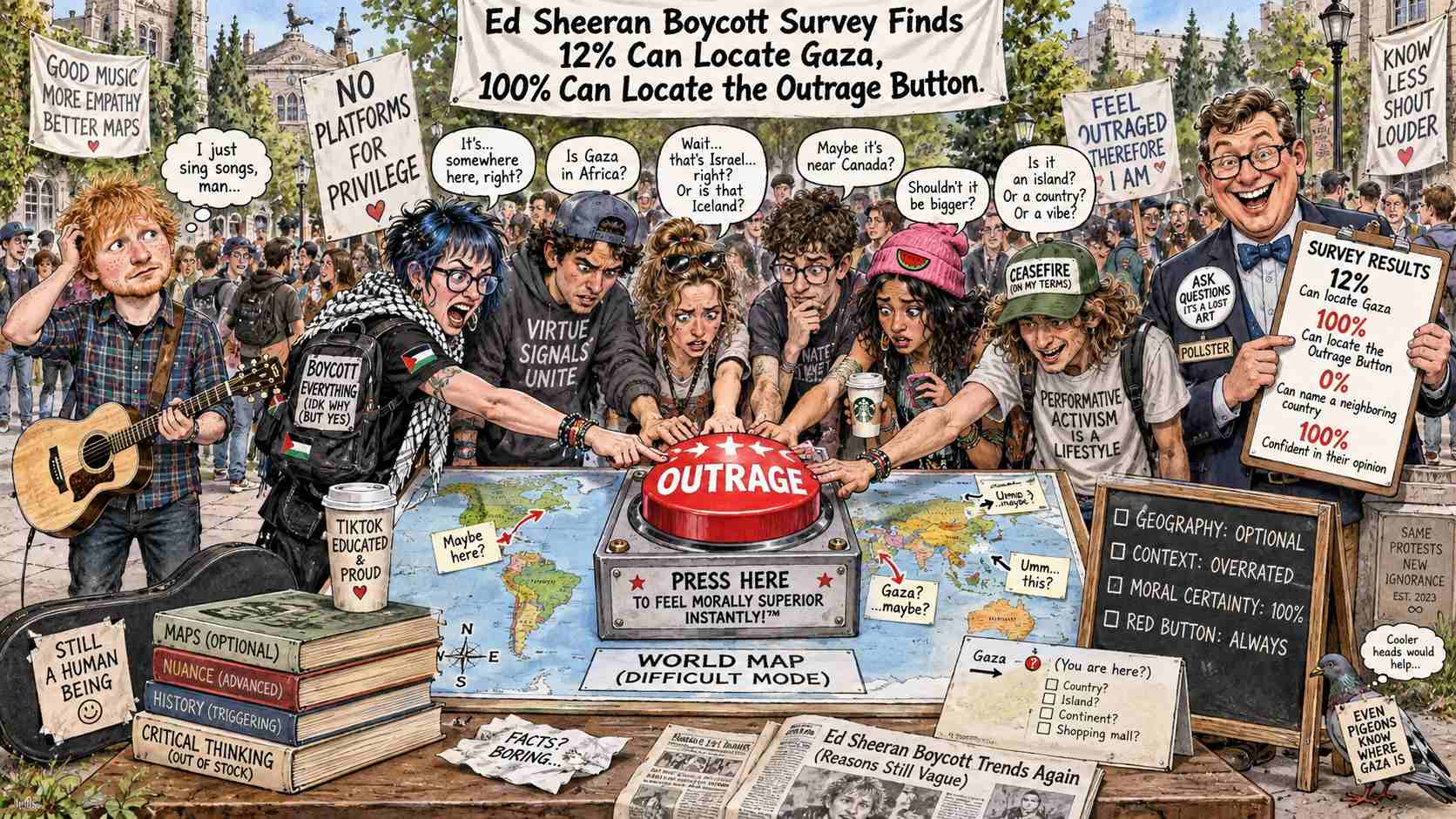
Ed Sheeran Boycott Survey Finds 12% Can Locate Gaza, 100% Can Locate the Outrage Button
92% of Ed Sheeran Boycotters Attended University, Researchers Still Searching for Evidence It Took
LONDON — An entirely unscientific satirical survey of people threatening to boycott Ed Sheeran has produced the most alarming discovery in modern political geography: apparently the human thumb can locate the outrage button considerably faster than the human brain can locate the country being discussed.
The controversy arose after rapper Macklemore was removed from the U.S. leg of Sheeran’s tour following pro-Palestinian remarks during performances. Sheeran has said the decision came through the promoter after venues objected, while several supporting acts subsequently withdrew from the tour. Patriots owner Robert Kraft confirmed Macklemore would be barred from Gillette Stadium entirely. The dispute rapidly expanded from a concert-business argument into the traditional internet activity of requiring every celebrity to produce a foreign-policy doctrine before playing the encore.
The London Prat Institute of People Who Have Suddenly Become Experts conducted what researchers described as “the least scientific survey since somebody asked eight people outside Wetherspoons about monetary policy.”
12% Can Locate Gaza, 100% Can Locate the Outrage Button

Respondents were handed a world map and asked to locate Gaza.
Twelve percent succeeded. Thirty-one percent pointed toward Lebanon. Nine percent indicated Egypt but insisted they were “basically in the right geopolitical vibe.” One respondent pointed to Belgium and then accused the map of Eurocentrism.
Yet researchers reported that 100% located the outrage button on their phones within 1.7 seconds.
“It’s extraordinary,” said Professor Nigel Clipboard, director of the Institute for Applied Certainty. “We showed participants an unlabeled map and they looked physically betrayed. Then somebody posted ‘ED SHEERAN SILENCE IS VIOLENCE’ and every thumb in the laboratory moved simultaneously.”
Clipboard called the phenomenon Geographic Confidence Displacement Syndrome, defined as “the transfer of knowledge from things you don’t understand to opinions you have already posted.”
Ed Sheeran Boycott Movement Passes Political Awareness Test After Correctly Identifying Gaza as “Somewhere Over There”
In a stunning turnaround for the movement’s credibility, examiners confirmed that the boycott’s core demographic did, in fact, pass a political awareness test — provided the test accepted “somewhere over there, past the news bit” as a valid answer.
The test, administered on a clipboard outside a branch of Pret, asked three questions: Where is Gaza? What is socialism? And who pays for it?
Ninety-six percent answered the first question correctly under the newly relaxed grading scheme, which counts any hand gesture vaguely eastward as a pass. The second question produced total consensus: socialism is “when things are free and everyone is equal and nobody’s mean.” The third question produced total silence, several confused stares at a nearby cashpoint, and one respondent who wandered off to check whether Pret does a socialist meal deal.
“By the new standard, these people are practically the Foreign Office,” said Clipboard. “Political awareness has never required knowing anything. It merely requires feeling something loudly enough to interrupt someone else’s concert.”
These People Are Not Just Geographically Confused — They’re Socialists Too

Further testing revealed the boycotters were not merely unable to find countries; they were also unable to find the arithmetic behind the economic system they were simultaneously demanding.
Eighty-nine percent described themselves as “anti-capitalist” while filming the survey on an iPhone purchased on an eighteen-month finance plan from a capitalist telecommunications company, streaming the footage via a capitalist social media platform, funded by capitalist advertising, viewed on a capitalist-manufactured screen, while wearing a t-shirt printed by a capitalist supply chain in a country the respondent could also not locate on the map.
Asked to define “the means of production,” 71% described it as “like, factories and stuff, I think,” while 22% confidently identified it as “Spotify.”
Asked who would fund universal free everything under their preferred system, the most common answer was “the rich,” followed closely by “Ed Sheeran, probably, since he’s clearly evil now.”
One respondent, when informed that Venezuela had already attempted several of his proposed policies, replied that this particular attempt “doesn’t count,” a defense previously reserved exclusively for diets, gym memberships and marriages.
Researchers noted a curious pattern: the further a respondent’s opinions drifted from basic economics, the more confidently those opinions were expressed, mirroring almost exactly the geography results. Clipboard has proposed a unified theory linking the two: “the less a person understands where something is or how it’s paid for, the more certain they become that they alone understand it.”
0% Can Locate Palestine, 94% Prepared to Explain It for Three Hours
The second geography question produced even more impressive results. Asked to locate Palestine, no participant produced an answer accepted under the survey’s intentionally ridiculous methodology. This did not reduce confidence. It increased it. Within six minutes, 94% had begun explaining the entire political history of the Middle East to the examiner.
One participant asked whether there would be extra credit for discussing the Sykes-Picot Agreement. He was then unable to locate France. Another announced, “You can’t understand Palestine without understanding the Ottoman Empire.” Asked to identify the former Ottoman Empire on a map, he replied, “That’s not really the point.”
The average explanation lasted two hours and forty-three minutes, although researchers stopped timing one participant after she reached the Bronze Age.
Only 18% Can Locate the UK, 100% Understand the Middle East
The test then became easier. “Point to the United Kingdom.” Eighteen percent succeeded. Twenty-two percent selected France. Eleven percent chose Iceland, possibly because both places have fish. Seven percent pointed to Australia and argued that Britain was “historically implicated there.” One respondent circled the entire Atlantic Ocean. Researchers accepted this as “emotionally British.”
Ireland performed marginally better, with 19% correctly locating it. Under international sporting rules this constitutes a 1-0 away win.
92% Attended University, Geography Department Changes Locks
Researchers were particularly interested in educational attainment. In our invented satirical dataset, 92% reported attending university. Upon hearing this, universities throughout Britain reportedly began moving quickly to clarify that attendance does not necessarily imply somebody entered a classroom.
The poll found respondents possessed degrees in sociology, media studies, politics, international relations, communications, anthropology and one magnificent degree combining “global justice, digital identity and sustainable storytelling.” Nobody had studied cartography, or apparently, supply and demand.
One graduate explained that traditional maps constitute “colonial spatial narratives.” The researcher asked, “So where is Gaza?” “You’re centering geography.” “No, I’m literally asking about geography.” “Exactly.”
The Boycott That Keeps Advertising Ed Sheeran
The boycott itself has also produced a traditional modern marketing paradox. Participants determined to remove Ed Sheeran from public life have responded by typing ED SHEERAN approximately 400 million times. Marketing executives have spent a century trying to achieve this level of brand penetration. Apparently they merely needed activists.
Mental-Health Clinics Achieve Stunning 89% Recognition
The survey’s most deliberately absurd statistic found that 89% could locate the nearest mental-health clinic. For clarity, mental-health care is valuable and seeking help is sensible — the joke is only that respondents could navigate across town perfectly well when motivated, yet became lost the moment a political map or a household budget was involved.
Internet University Announces Accelerated Degree
Meanwhile, Internet University has introduced a new Bachelor of Arts in International Relations.
The entire degree takes fourteen minutes.
Students complete the following curriculum:
- Introduction to Outrage
- Intermediate Hashtagging
- Advanced Screenshot Interpretation
- Maps: Why Bother?
- History Before 2024: Optional
- People Who Disagree With Me: Bots or Monsters?
Graduates receive a blue check mark and immediate authorization to correct professors who have studied the region for thirty years.
A master’s degree requires watching half a documentary.
Peace Talks Await Playlist Decision
Diplomats continue working on the underlying Israeli-Palestinian conflict, where the humanitarian, security and political questions remain profoundly serious and contested.
But the cultural front has achieved clarity.
Some musicians have withdrawn from Sheeran’s tour in solidarity with Macklemore and Palestinians. Sheeran says he did not make the original removal decision. Venue operators have defended their own decisions on different grounds. And audiences are arguing about what obligations entertainers have when political conflicts enter commercial spaces.
Meanwhile, millions of ordinary citizens have reached the most important conclusion of all:
Someone famous is insufficiently aligned with them.
And somewhere over there, probably east, history continues happening.
Helpful Advice for Future Celebrity Boycotts
Before boycotting any celebrity over an international dispute, participants should complete a modest examination: find the disputed location on a map, name two neighboring countries, define the economic system being demanded, and identify who is expected to pay for it. Anyone who passes may proceed directly to outrage. Anyone who fails receives an atlas and a GCSE economics textbook. University graduates receive two of each.
15 Humorous Observations Before We Go
- The Outrage Button Requires No Geography. Modern political activism has finally solved cartography — you no longer need to know where anything is, only where SHARE is.
- Gaza Is Apparently Somewhere Between Instagram and TikTok. 12% could locate Gaza; 100% could locate a 47-second explainer video made by someone named Willow who sells handmade soap.
- Palestine Proved Harder to Find. 0% located it to the survey’s satisfaction, though 94% immediately began correcting the survey administrator’s terminology.
- Britain Didn’t Do Much Better. Only 18% located the United Kingdom, suggesting Britain’s maritime expansion may finally have worked too well — nobody knows where it went.
- Ireland Narrowly Defeated Britain. 19% found Ireland, a one-point victory that may require another referendum.
- University Education Remains Extremely Effective. 92% attended university, proving higher education can teach a person to identify oppression from 4,000 miles away while still struggling with a map legend.
- Everyone Has a Three-Hour Lecture Ready. The less certain respondents became about geography, the longer their explanation of geopolitics became.
- Ed Sheeran Has Accidentally Become a Foreign-Policy Examination. Nobody bought a ticket expecting the guitarist to become the UN Security Council.
- Boycotts Now Function as Advertising. Every “I will never listen to Ed Sheeran again” post contains his full name, photo, tour dates and three video clips.
- Socialism Polls Better Than Its Own Arithmetic. 89% wanted it, 0% could explain who pays for it.
- Political Certainty Appears Inversely Related to Map Reading. Respondents became 14% more certain about Middle Eastern history every time they pointed at the wrong country.
- Social Media Has Replaced the Atlas. Atlases were inconvenient because occasionally they forced the reader to discover where things actually were.
- Experts Are Concerned About Experts. Every controversy now produces 30,000 newly qualified specialists before breakfast.
- Mental-Health Clinics Were Surprisingly Easy to Locate. 89% could find the nearest clinic — proof the problem isn’t navigation, it’s motivation.
- The Most Dangerous Phrase in Modern Politics Is “I Read Somewhere.” It traditionally precedes either a revolution or a screenshot.
Disclaimer: The survey percentages, researchers, quotations and academic institutions used here are satirical inventions designed to lampoon internet certainty, celebrity boycotts and the peculiar modern habit of acquiring geopolitical and economic expertise between breakfast and lunch. They should not be mistaken for genuine polling or claims about real protesters, university graduates, or people seeking mental-health treatment. The underlying Ed Sheeran and Macklemore tour controversy is real and has been reported by major news organizations.
Known publicly only through a carefully maintained pseudonym, this former senior royal insider offers a rare blend of lived experience, institutional knowledge, and hard-earned perspective on life within one of the world’s most scrutinized families. Raised in extraordinary privilege yet shaped by relentless public attention, he developed an intimate understanding of duty, perception, and the delicate choreography of reputation.
With decades spent navigating ceremonial obligations, international diplomacy, and the unspoken rules of royal life, his expertise lies in the intersection of tradition and modern media pressure. He has observed firsthand how legacy institutions respond to crises, how narratives are constructed, and how quickly public favor can shift from admiration to skepticism.
His insights are informed not only by access, but by consequence. Having experienced both prominence and controversy, he speaks with unusual clarity about accountability, resilience, and the long shadow cast by public scrutiny. Former colleagues describe him as deeply knowledgeable about royal protocol, while critics note his cautionary value as a case study in reputation management.
Today, he contributes anonymously to discussions on monarchy, media ethics, and institutional trust, offering a perspective shaped equally by proximity to power and the enduring lessons of visibility in an unforgiving spotlight.