Paris Shopkeeper Supports Revolution Until It Reaches Her Shop
Activist, 19, Says Destroying Tax Base Will Expand Services
PARIS — A shopkeeper who spent years demanding the overthrow of capitalism requested a limited geographical exemption yesterday after discovering that capitalism included her shop. The request was declined, as nobody had brought a map.
Standing beneath a smoking awning, boutique owner Colette Marchand appealed to a crowd of student demonstrators to recognise her substantial contributions to progressive politics before making any further contributions to the fire. She had brought a list.
“Why are you burning my store? I’m on your side,” she shouted. “I’m for unrestricted immigration from third-world nations. The more socialist the better. But you can’t burn my shop.”
The students hesitated. Several had never encountered a revolutionary argument containing the word “but” so close to somebody’s personal possessions. One checked his phone for the approved response.
“This shop is paying for your welfare and immigration here,” Marchand continued. “If you don’t stop burning buildings, you will have to go back to Africa. Understand?”
The crowd paused again, this time because most of them had come from considerably closer.
Baptiste, a nineteen-year-old professional activist from Lyon, resolved the confusion by throwing a rock through her window.
His parents immediately texted to ask whether he needed collecting. He replied that he did not, and then asked what was for dinner.
What the Funny People Have to Say About France Burning
“Colette says she’d happily burn down the system. She just wants the system to finish her Tuesday deliveries first.” — Alan Nafzger
“The lad’s rock came with a mission statement. The glass came with a warranty, and only one of them is still standing.” — Morag Sinclair
“Nineteen, a professional activist, and still needing his mammy to collect him. That’s not a revolution, that’s a school run with a slogan.” —Siobhan O’Donnell:
Pro-Revolution Posters Fail to Protect Paris Boutique From Riot
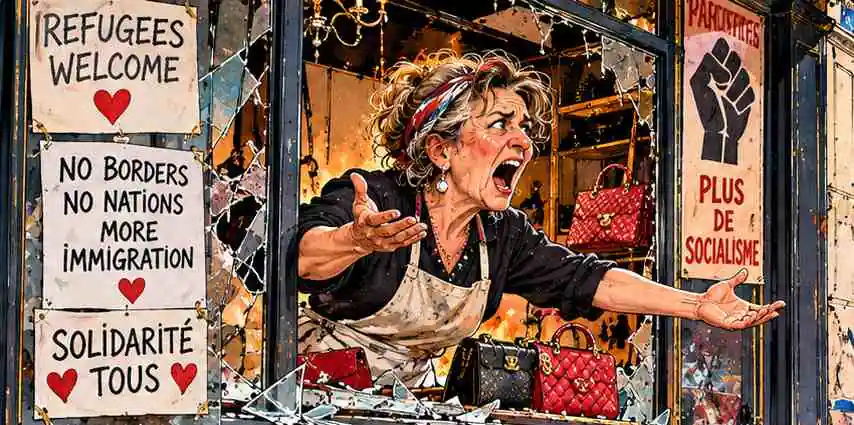
Marchand had believed that years of displaying supportive posters would establish her premises as neutral territory. Paris has a long record of shopfront damage during civil unrest, as the 2023 French unrest demonstrated to thousands of shopkeepers, most of whom also owned posters.
Her window featured declarations welcoming refugees, condemning profit and demanding a more compassionate economic system. Beneath them stood a handbag costing €240.
“The posters were political,” she explained. “The handbag had overheads.”
She had always supported dismantling oppressive commercial structures, she said, but had understood this to mean structures belonging to someone she disliked.
Across the street, florist Jean-Luc Perrin watched firefighters approach.
“Last week she said property was a social construct,” he recalled. “Today she wants the social construct boarded up before it rains.”
Marchand rejected suggestions that her position had changed.
“I remain committed to abolishing the system,” she said. “I would simply like to sell the remaining stock first.”
Her accountant confirmed that this was the most commercially realistic transition plan she had proposed.
Her insurer, reached by phone, said riot cover did not extend to damage caused by people she had personally encouraged. Marchand asked whether that was a standard clause. The insurer said it was new and that the staff had been calling it the Marchand Provision since lunchtime.
She then read the government’s published support measures for merchants hit by vandalism, which she described as the first official document she had ever read with personal interest.
Nineteen-Year-Old Professional Activist Defends Rock Through Shop Window
Baptiste described himself as a full-time organiser, community educator and independent anti-capitalist consultant.

He had entered professional activism at sixteen and was now approaching the stage of his career when ordinary people begin considering their first job. His curriculum vitae listed three years of experience, all unpaid.
His specialisms included identifying fascism, cancelling meetings and explaining why the person whose window he had broken was responsible for the broken window.
“Violence against property is a language,” he said.
Marchand asked whether he could communicate in French instead.
Baptiste explained that the rock represented a rejection of consumer society. He then requested that someone retrieve his phone charger from the boutique, where he had plugged it in earlier. The boutique was on fire. He said he would wait.
Asked how he financed his work, he said the question reproduced harmful capitalist assumptions.
Asked again, he said his father was an orthodontist.
His mother subsequently clarified that the family did not support vandalism, although she remained extremely proud of his confidence.
France’s VAT and Business Taxes Pay for the Welfare Protesters Defend
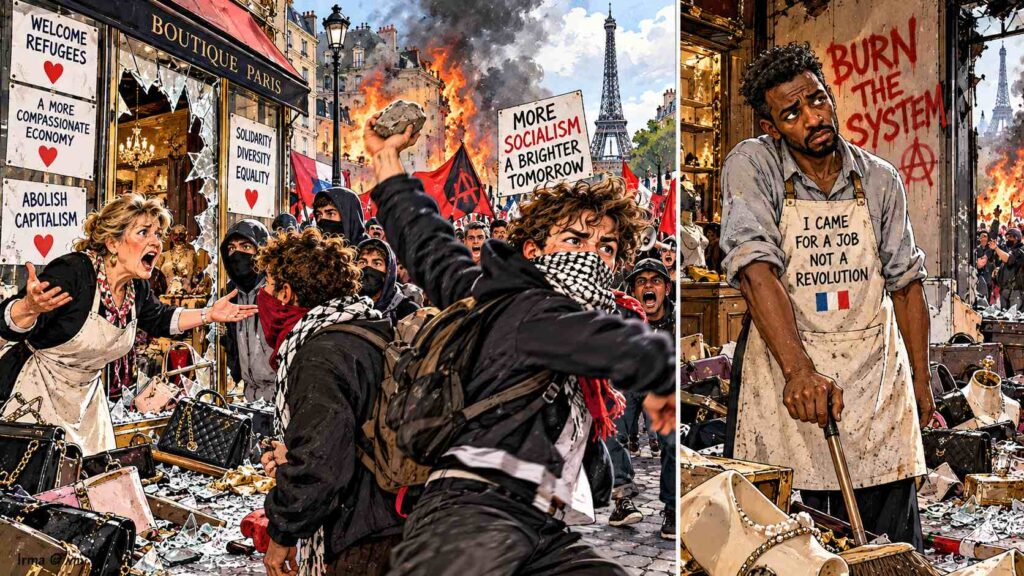
Marchand’s assistant, Amadou Diop, arrived to find the till covered in glass.
Born in Senegal, Diop had spent the morning opening the shop, receiving deliveries and doing the sort of work that rarely makes it onto a protest banner.
“I came here for employment,” he said. “Apparently I should have come for a position explaining why employment is oppressive.”
He asked Baptiste whether destroying a business would make it easier or harder for the business to pay wages.
Baptiste said the question required a collective discussion.
Diop said his rent required an answer.
Marchand began listing the shop’s expenses: wages, electricity, insurance, suppliers and taxes. Her account of solidarity became increasingly itemised.
France’s official explanation of value-added tax describes VAT as a consumption tax charged to customers on goods and services. Marchand’s immediate difficulty was that customers generally prefer to consume goods before those goods have been consumed by fire.
“You want more public money,” she told the crowd. “You’re burning a place where money changes hands.”
Baptiste accused her of reducing the revolution to bookkeeping.
Her accountant, listening on speakerphone, said that was where revolutions usually ended up anyway.
The accountant added that business groups had put the cost of the 2023 riots at more than a billion euros, according to Fortune, and that Al Jazeera’s economic analysis had reached a similar conclusion without being asked. At €240 each, he calculated, that was a little over four million handbags, none of which had been consulted either.
Shopkeeper’s Immigration Policy Collapses Under Pressure in Paris Riot
Diop also questioned Marchand’s announcement about sending people to Africa.
“Which people?” he asked.
“The people burning everything.”
“He’s from Lyon.”
“Well, he can go back there.”
“He lives in Paris.”
“Then he can go back to his parents.”
For the first time that afternoon, the crowd considered a proposal with a realistic implementation schedule.
Baptiste objected to the assumption that his parents’ home was available. His sister was using his room as a Pilates studio.
Marchand acknowledged that her immigration policy had become confused under pressure.
“I support everybody coming here,” she said. “I had assumed that once they arrived, they would support the shop.”
Diop suggested that opening a shop involved dealing with individuals rather than expecting entire continents to sign a customer loyalty agreement.
Marchand said she would consider this after speaking to her insurer. She was told the insurer was no longer taking her calls.
Paris Officials Offer Listening Exercise Instead of Fire Extinguisher
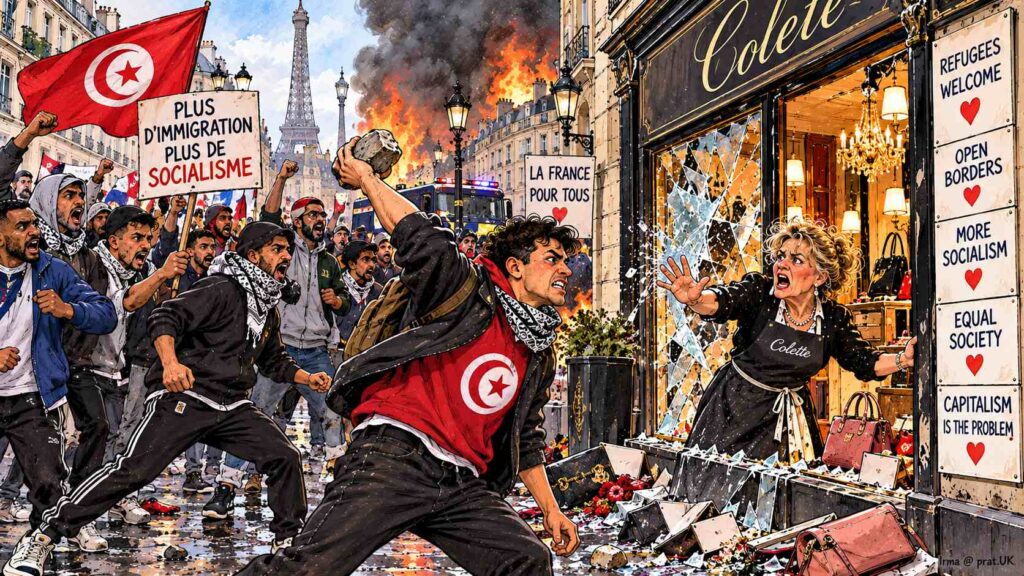
A municipal representative arrived wearing an expression normally reserved for discovering that a consultation had produced an answer.
He promised a listening exercise, an urgent stakeholder meeting and a comprehensive review of the relationship between local commerce and public anger.
Marchand asked for a fire extinguisher.
“That would be an operational response,” he explained. “We are currently at the dialogue stage.”
He added that the fire would be recorded in the minutes.
The representative offered to help her apply for assistance through a programme supporting businesses affected by urban disruption.
The application required photographs of the damage, evidence of trading and access to a computer.
Her computer was inside the shop.
He suggested applying online.
A nearby café owner described this as the first government service he had encountered that required the applicant to enter a burning building.
Glazier Offers the Only Practical Fix for the Smashed Shop Window
A glazier arrived carrying a tape measure and achieved more practical progress in forty seconds than the stakeholder meeting was expected to manage all week. His van carried a sign reading “Vitrerie 24h/24,” which Baptiste called exploitative and Marchand called a relief.
His quotation briefly restored unity between Marchand and the demonstrators.
“That’s outrageous,” she said.
“That’s capitalism,” Baptiste agreed.
“That’s laminated safety glass,” said the glazier.
Baptiste asked whether he offered solidarity pricing.
The glazier said he offered a lower price if people stopped breaking the previous window.
He then explained that the replacement would cost more because Marchand wanted stronger glass.
She confirmed that she did.
Baptiste accused her of constructing a barrier between herself and the community.
“The community has a rock,” she replied.
Shopkeeper Rewrites the Revolution: “Please Use the Door”
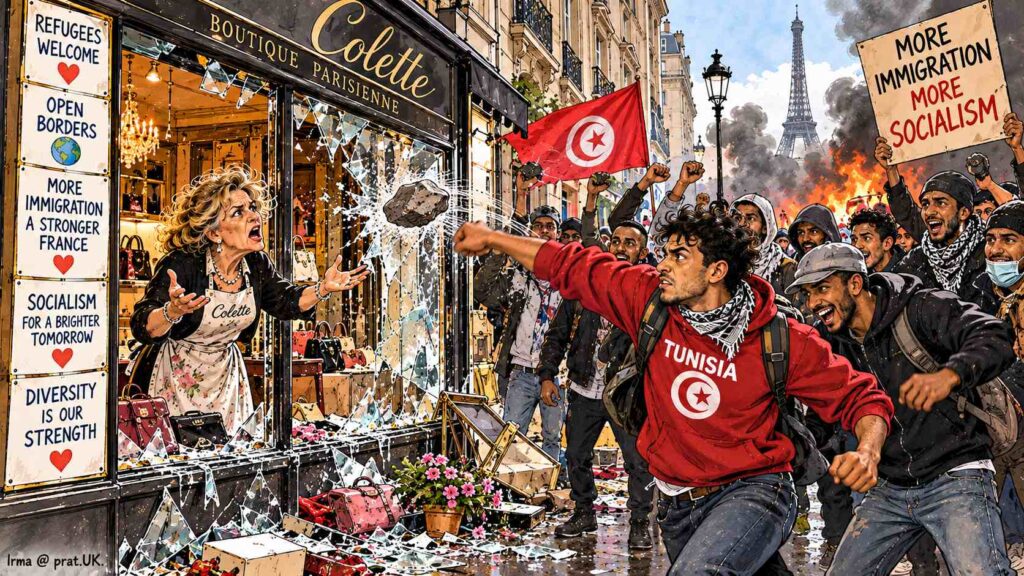
By evening, Marchand had amended the poster in her surviving window.
“ANOTHER WORLD IS POSSIBLE” now carried a handwritten addition: “PLEASE USE THE DOOR.”
She remained committed to progressive change, although her immediate demands had narrowed to functioning locks, uninterrupted trading and the arrest of anyone setting fire to the stockroom.
Baptiste announced a fundraising appeal for activists traumatised by the shopkeeper’s hostile language.
Diop announced that he would like to be paid on Friday.
The municipal representative announced another meeting.
Meanwhile, the glazier returned to his van, where he was overheard committing the day’s most provocative ideological offence.
He was calculating a profit.
Five Humorous Observations About the Paris Shop Riot
- Everybody’s for the revolution until it needs a loading zone. Colette’s fine with tearing down the system. She just wants her delivery van kept out of it.
- “Professional activist,” age nineteen. That’s not a profession, that’s a hobby with an orthodontist for a sponsor. The only guy in this story getting paid is the dad, and he’s funding the rock.
- “Violence against property is a language.” Great. Then the insurance company is replying in the only language that wins every argument in France, which is a form you fill out in triplicate.
- The city’s answer to a burning building was a listening exercise. Listening to what? It’s a fire. It’s only saying one thing, and it’s saying it loud.
- The one guy who fixed anything was the glazier. Forty seconds, a tape measure, a quote. He’s the most dangerous man in Paris: he shows up, solves the problem and sends an invoice.
Disclaimer: This is satire. Its editorial committee comprises the world’s oldest tenured professor and a philosophy major turned dairy farmer, whose cow has requested that future revolutions preserve whatever business is buying the milk.




Alan Nafzger was born in Lubbock, Texas, the son Swiss immigrants. He grew up on a dairy in Windthorst, north central Texas. He earned degrees from Midwestern State University (B.A. 1985) and Texas State University (M.A. 1987). University College Dublin (Ph.D. 1991). Dr. Nafzger has entertained and educated young people in Texas colleges for 37 years. Nafzger is best known for his dark novels and experimental screenwriting. His best know scripts to date are Lenin’s Body, produced in Russia by A-Media and Sea and Sky produced in The Philippines in the Tagalog language. In 1986, Nafzger wrote the iconic feminist western novel, Gina of Quitaque. He currently lives in Holloway, North London. Contact: [email protected]