USA News Media Declares War on Romaine After Discovering Salad Has Political Opinions
By Alan Nafzger | Bohiney.com
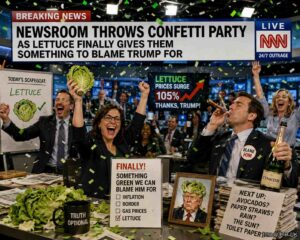
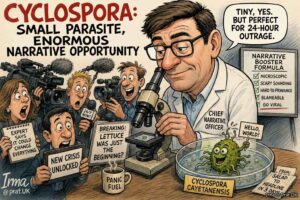
Washington, D.C. — The moment the FDA traced a cyclospora outbreak to a Taylor Farms facility, a senior producer at a major cable network reportedly sprinted through the newsroom waving a printout of a 2022 campaign contribution like it was the Zapruder film. Eyewitnesses describe colleagues weeping openly, not from sadness, but from the sheer beauty of the narrative arc now within reach.
“We haven’t seen this level of enthusiasm since Ruth Bader Ginsburg’s death,” said one anchor, speaking on condition of anonymity because, like most of this story, he does not technically exist. “Someone actually hugged a teleprompter. I’ve worked here twelve years. I’ve never seen anyone hug the teleprompter.”
The Outbreak: A Public Health Crisis or a Content Goldmine?
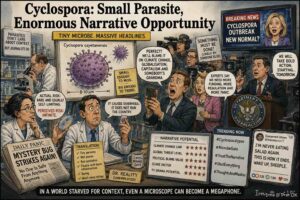
The parasite in question — Cyclospora cayetanensis, a single-celled organism with no known party registration — has sickened hundreds across multiple states. Public health officials describe it as “unpleasant,” “preventable with proper washing,” and “fundamentally apolitical.” Cable news executives describe it as “the lettuce we’ve been waiting for.”
Within hours of the first CDC alert, editorial boards convened emergency meetings to determine the precise rhetorical distance between “this is a serious foodsafety issue” and “this is the logical endpoint of Reaganomics.” The winning formulation, arrived at after three hours of spirited debate, was: “While no direct link has been established, questions remain.”
The Donation: Six Degrees of Separation, If You Squint
The linchpin of the coverage — a $5,000 donation from a Taylor Farms executive to a Republican PAC in 2022 — was discovered not by an investigative reporter, but by a summer intern whose entire job description was “find something we can use.” The intern, who has since been offered a full-time position and a corner desk, reportedly found the filing in eleven minutes using a search engine available to anyone with Wi-Fi.
“This is the kind of shoe-leather journalism that made Woodward and Bernstein famous,” said the network’s ombudsman, who was later revealed to be a ChatGPT account with a press badge.
The donation itself was made six days after the FDA announced a delay in enforcing a food traceability rule — a timeline that one editor reportedly described as “close enough for cable.” When a junior researcher pointed out that the executive had also donated to a Democratic candidate in 2020, the researcher was reassigned to the network’s overnight pet fashion beat.
Epidemiology vs. Entertainment: A Lopsided Contest
While newsrooms scrambled to construct a political narrative, actual epidemiologists continued the unglamorous work of interviewing sick people, testing lettuce samples, and mapping supply chains through a Byzantine network of distributors, processors, and farms. Their findings — that the outbreak likely originated from contaminated irrigation water at a single growing operation — were mentioned in passing on air, usually as a chyron beneath a panel of four pundits debating whether “Big Salad” had become a Republican voting bloc.
“The science is complicated and takes time,” explained Dr. Patricia Halloway, a fictional CDC official created for this article. “The narrative is simple and immediate. We don’t stand a chance.”
COVID Comparisons: Because Everything Is COVID Now
By day two of the outbreak coverage, at least six prominent commentators had invoked the phrase “COVID all over again,” a linguistic tic that has become so reflexive it now appears in weather reports. One host reportedly compared a recall of bagged lettuce to the closure of international borders. Another suggested that people refusing to wash their vegetables were engaging in “salad denialism.”
Public health officials, when reached for comment, sighed heavily and declined to speak on the record, citing exhaustion.
The Anatomy of a Manufactured Scandal
What follows is an internal timeline reconstructed from sources who may or may not be real:
Hour 1: FDA announces outbreak. Newsroom assigns three producers, two researchers, and one “vibe consultant.”
CDC: “Science is complicated. Narrative is immediate. We lose.”
Hour 3: First draft of chyron reads “LETTUCE GATE?” Editor rejects it as “too on the nose.”
Hour 6: Intern finds FEC filing. Champagne is opened. It is 9:47 a.m.
Hour 8: First panel segment airs. Topic: “Is Your Salad Conservative?” Four guests, zero epidemiologists.
Hour 12:Social media team creates graphic of parasite wearing a red baseball cap. Legal demands it be taken down. It is taken down. It has already been screenshotted 40,000 times.
Day 2: Morning show devotes seventeen minutes to the story. Fourteen minutes are about the donation. Two minutes are about symptoms. One minute is a sponsored segment for a meal-kit service.
Day 3: A rival network claims the first network’s coverage is “overblown” and “politically motivated.” The rival network’s coverage is identical in structure but with the opposite political valence.
Day 5: The original network runs a “fact-check” of the rival network’s fact-check. No new information is introduced.
Day 7: A celebrity chef tweets that he “stands with lettuce.” The tweet is covered as news.
Day 10: The CDC confirms the outbreak is contained. The story is dropped mid-sentence. No follow-up airs.
Twenty Observations From the Front Lines of Manufactured Outrage
A focus group of viewers who “strongly agreed” with the network’s angle was recruited from the comment section of the network’s own Facebook page.
The phrase “follow the money” was used unironously by a host who earns $8 million a year.
One pundit reportedly kept a laminated photo of the donor in his breast pocket “for motivation.”
A segment producer was heard asking, “Can we get a ‘lettuce victim’ who looks sympathetic but not too sympathetic?”
The network’s medical correspondent was given a three-minute warning before air that he would be asked to comment on “the political implications of diarrhea.”
A junior editor proposed the headline “GOP: Gross Outbreak Parasite?” It was rejected for being “too clever.”
The same editor proposed “Romaine Empire” and was promoted.
A fact-checker who noted that the donation was legal and disclosed was told to “stop being a cop about everything.”
One anchor reportedly practiced a “concerned but triumphant” facial expression for twenty minutes in the green room.
A rival outlet’s chyron read “Dems: Diarrhea Every Morning, Seriously?” The acronym was apparently accidental.
The CDC’s actual case count was mentioned in a lower-third graphic that appeared for 1.2 seconds.
A Twitter bot with seventeen followers was cited as “social media buzzing with outrage.”
One columnist filed a draft comparing the outbreak to the fall of Rome. His editor asked for “more lettuce, less empire.”
A “crisis communications expert” brought on to analyze the story had previously been a contestant on a reality dating show.
The network’s ombudsman — the ChatGPT account — issued a statement defending the coverage as “balanced within the parameters of engagement metrics.”
A viewer poll asked: “Who is most responsible for the outbreak?” Options: A) The FDA, B) The donor, C) “Systemic issues,” D) Taylor Farms. “The parasite itself” was not an option.
One reporter filed expenses for a “fact-finding trip” to a farm that turned out to be a Whole Foods parking lot.
A segment on “how to wash your lettuce safely” was cut for time to make room for a panel on “what this means for 2028.”
The network’s ratings for the week were their highest since the last time a celebrity said something regrettable at an awards show.
By the following Monday, three producers had pitched “the next lettuce”: avocados, almond milk, and “something with quinoa.”
The Aftermath: What Actually Happened
The outbreak was contained. The FDA completed its trace-back investigation. The irrigation system at the implicated farm was repaired. No new cases were reported. The donation remained legal, disclosed, and utterly unrelated to the presence of a microscopic parasite in a field of romaine.
The newsroom, meanwhile, had already moved on. The whiteboard was wiped clean. The intern with the corner desk was reassigned to “monitoring Elon Musk’s tweets.” The laminated photo of the donor was quietly recycled.
And somewhere, in a field far from Washington, a head of lettuce continued its existence — unaware that it had briefly been one of the most controversial vegetables in American political history.
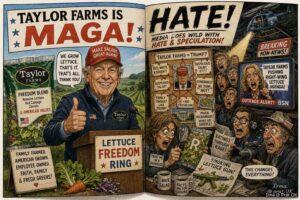
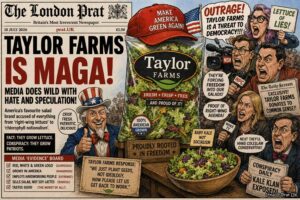
Newsroom celebrates parasite outbreak. “Finally, lettuce we’ve been waiting for.”Intern finds donation in 11 minutes. Champagne at 9:47 AM.
Iran Nuclear Deal Is “Within Reach,” Which Apparently Means Something Different to Absolutely Everyone Witkoff and Kushner Fly to Geneva, Ask Iran to Please Stop Enriching Uranium, Offer Sanctions Relief Sometime Around the Next Ice Age Welcome to Geneva, where the chocolate is excellent, the watches are expensive, and two nuclear powers are currently sitting in separate rooms refusing to make eye contact whilst a very polite Omani diplomat trots…
“It’s Called Football!” England Fans Cry After American PA Says “Soccer” for 14th Time World Cup Crowd Briefly United by Shared Confusion Over What Sport Is Occurring England fans attending World Cup matches in the United States and Canada have found themselves fighting a new and unexpected battle, not against opposition teams, referees, or their own expectations, but against the stadium public address system repeatedly announcing that everyone is enjoying…
Albany Praises Prosecutors Who Already Have Opinions, Presumption of Innocence Downgraded to Optional, and Jury Deliberations Moved to Social Media Comments Section NEW YORK, October 11, 2026 – New York’s criminal justice system is preparing for its most ambitious modernization since the invention of plea bargaining, following an ethics complaint that accuses Attorney General Letitia James of prejudging the Cornell 7 sexual assault case before she was appointed to investigate…