Trump Tries to Lower Diesel Prices, Burnham Tries to Save Ukraine, Zelenskyy Tries to Find Another Russian Refinery, Nobody Tries Arithmetic
British Prime Minister discovers that promising unlimited military support for Ukraine is considerably easier when American truck drivers are helping pay the economic consequences. Washington demands cheaper diesel, Kyiv demands more explosions, and London offers another reassuring speech.
LONDON, 15 October 2026 — Three world leaders spent the past week trying to solve the global energy crisis with three policies that cannot work at the same time, and economists have responded by recommending the emergency introduction of fourth-grade arithmetic into international diplomacy.
President Donald Trump wants Russia to produce more diesel. Ukrainian President Volodymyr Zelenskyy wants Russian refineries to produce more smoke. British Prime Minister Andy Burnham wants everybody to understand that Britain stands firmly behind Ukraine, preferably at a safe distance from the explosions and from any American truck driver holding an invoice.
The confusion deepened on Wednesday, when Burnham welcomed Zelenskyy to Downing Street and assured him that Britain’s support would continue without limit. It was a pledge he had already made in July, when Al Jazeera reported Burnham assuring Zelenskyy of continuing Ukraine support during the Ukrainian leader’s first visit under the new government. Within a day, Ukraine was resuming attacks on Russian oil refineries. Burnham’s reassurance had apparently been taken as permission to proceed directly to the fireworks.
A Texas trucker tried to pay for fuel with moral support, and the cashier called the cops. I’ve tried that at a bar. They don’t call the cops. They call a cab, and then they call you “sir” in a tone that is not respect. – Ron White (Texas comedian)
There is no evidence that Burnham approved any particular strike. Downing Street has nonetheless ordered an urgent review of whether the expression “we’ve got your back” should be followed by “but perhaps not the diesel refinery.”
Trump, meanwhile, had already struck a deal with Vladimir Putin to release hundreds of thousands of tonnes of Russian diesel onto international markets. The arrangement was meant to lower prices. Ukraine’s contribution was to resume attacking the facilities that make the product Trump wanted Russia to sell. It was the first international trade agreement in history to come with a complimentary demolition service.
Trump’s Russian Diesel Deal: 300,000 Tonnes Ordered, Zelenskyy Requests Delivery in the Form of a Mushroom Cloud
On 9 October, Trump announced that Russia had agreed to supply more than 300,000 tonnes of diesel, with further shipments planned. The Reuters report on Trump’s Russian diesel agreement described a deal aimed at lowering prices for American consumers.
Two days later Trump declared an “energy ceasefire” between Russia and Ukraine on Truth Social, effective immediately. According to Reuters reporting carried by The Star, Washington had been pressing Kyiv to stop hitting the refineries Trump blames for higher diesel prices ahead of the November midterms. Zelenskyy said he was still waiting for details. Moscow had not replied. What arrived instead was a Russian strike on a power and heating plant in Kharkiv, and Zelenskyy’s statement that Russia had violated the energy ceasefire.
Trump’s negotiating position was straightforward. “Vladimir, we need diesel.” Putin’s was equally clear. “We have diesel.” Zelenskyy’s was more complicated. “Not for long.”
The White House then discovered a technical difficulty that had escaped several hundred highly paid diplomatic advisers: diesel is considerably easier to export when the refinery has a roof. Trump’s commercial arrangement had not included an international warranty against Ukrainian drone strikes, and Washington is now reviewing future trade agreements to establish whether the merchandise will still exist when the customer turns up.
Burnham promises “unlimited support” with no budget. I’ve been in that relationship. He said “I’m all in” and “I’ve got you” and then “can you Venmo me for the Uber?” — Amy Schumer
Trump has also instructed advisers to look into whether the United States can buy Russian diesel without simultaneously assisting the people trying to blow up the machinery. The State Department described this as an unusually sophisticated foreign-policy challenge. A truck driver in Oklahoma described it as “the sort of thing you ought to think about before writing the cheque.”
Burnham Backs Zelenskyy on Ukraine Support While American Truckers Ask Whether Britain Also Has a Credit Card
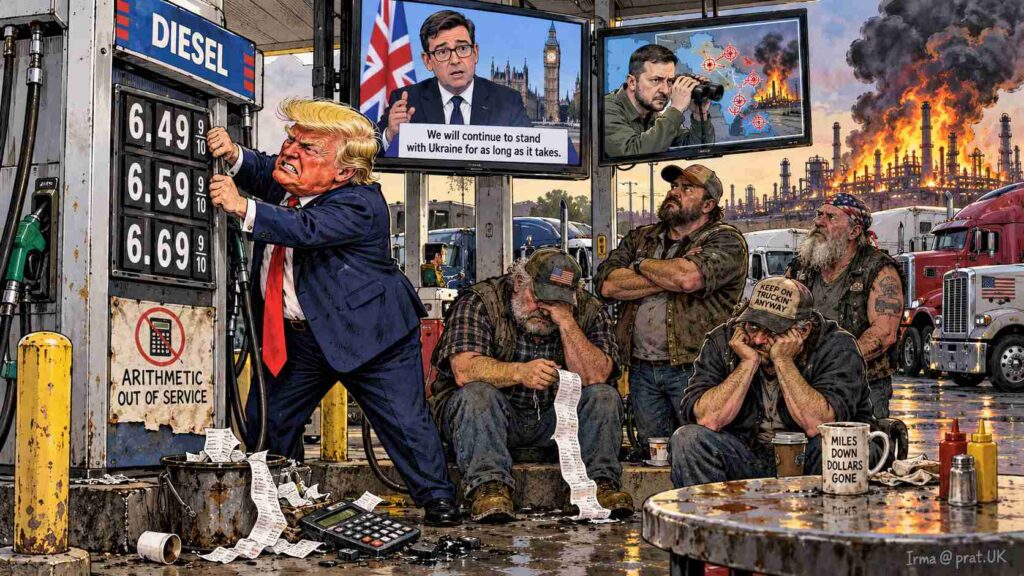
Burnham’s declaration of unwavering support has been welcomed throughout Westminster, where expressing international solidarity remains a good deal more popular than calculating what it costs. Britain’s latest foreign-policy doctrine requires the country to stand behind Ukraine, alongside Europe, up to Russia, firm against aggression and ready to spend whatever the Treasury can borrow. Britain has spent so long standing that nobody has been free to do the accounts.
Downing Street insisted the prime minister’s promises reflected Britain’s commitment to European security. A British haulage manager suggested the government might show a similar commitment to the security of his overdraft. The Road Haulage Association says operators are now paying about £350 more per lorry per week for diesel, which has passed £2 a litre for the first time, and that hundreds of haulage firms have already collapsed this year.
“When Burnham says Britain stands behind Ukraine, I believe him,” said the Birmingham transport operator. “I just wish he’d occasionally stand behind a British business when the bank manager arrives.”
American truckers were particularly moved by Britain’s generosity. One Texas driver worked out that filling his 200-gallon tank at $6.28 a gallon, a little above the U.S. Energy Information Administration’s national average of $6.18 for the week of 12 October, would cost him $1,256. He asked whether Burnham’s government would like to contribute. Downing Street reportedly offered him Britain’s complete moral support, and he tried to pay for the fuel with it. The cashier called the police.
Ukraine Resumes Russian Refinery Strikes as Moscow’s Oil Industry Introduces the Eleven-Second Working Day
Ukraine’s decision to resume refinery attacks followed continued Russian strikes on Ukrainian energy infrastructure despite Trump’s proposed energy ceasefire. The Financial Times reporting on Zelenskyy’s renewed refinery campaign described Kyiv’s frustration with American pressure to stop the attacks while Russia kept bombing Ukraine.
Each side is working from its own sums. Zelenskyy calculates that damaging Russian refining capacity reduces Moscow’s ability to finance and sustain the war. Trump calculates that more Russian diesel eases pressure on American fuel prices. Burnham calculates that if he nods solemnly while Zelenskyy speaks, somebody else will eventually work out what to do.
Russian refinery executives have answered the renewed attacks with an ambitious productivity programme under which workers are encouraged to complete an eight-hour shift in eleven seconds. It includes accelerated safety briefings, abbreviated lunch breaks and retirement planning before breakfast. A refinery director outside Moscow said attendance had improved substantially. “Everyone now arrives fifteen minutes early because we don’t know if the building will still be here at nine.”
Russia’s insurance industry has revised its definition of comprehensive coverage. Policies now protect against theft, accidental damage, machinery breakdown and ordinary fire. Damage caused by a Ukrainian drone is covered only if the drone arrives after the policyholder has already died of natural causes.
UK Government Spending on Ukraine: Unlimited Promises, Limited Money, One Press Conference
The most remarkable feature of Burnham’s diplomacy is his government’s ability to commit Britain to expensive international obligations while explaining that the country cannot afford domestic necessities. When British businesses ask for cheaper electricity, the government explains that the market is complicated. When pensioners ask for more money, the Treasury explains that the budget is constrained. When hauliers ask for fuel relief, ministers explain that international events have made everything terribly difficult. When Zelenskyy asks for more assistance, Britain discovers a previously unidentified reservoir of financial determination.
Downing Street’s accountants have allegedly developed a revolutionary equation: unlimited promises + limited money = international leadership. It has been submitted to the London School of Economics, where researchers reportedly expressed concern that it might be taught in Parliament.
Burnham’s advisers have gone further and recommended removing subtraction from the national curriculum, because it encourages taxpayers to ask what is left after government expenditure. Division is under review for encouraging voters to work out their individual share of the bill. Multiplication stays, since ministers use it to estimate the economic benefits of government announcements, and addition is permitted only for future spending commitments. The government’s preferred mathematical symbol is infinity. It appears immediately after the words “Britain’s unwavering support.”
American Truck Drivers Demand a Diesel Price Summit With Somebody Who Can Multiply
The United States has spent years explaining that cheap energy is essential to economic prosperity. It has now reached the point where an American president is negotiating diesel supplies with a Russian president whose refineries are being attacked by an American-supported Ukrainian president, while Britain turns up to assure everyone that it is standing behind the Ukrainian president.
A trucker in Kansas suggested the whole crisis could be settled by inviting the leaders to fill a lorry. Trump would arrive and announce the greatest fuel deal in American history. Burnham would promise that Britain would stand beside the lorry for as long as necessary. Zelenskyy would point out that the diesel supplier was financing an invasion of his country. Putin would demand payment in advance. The trucker would ask whether anybody had brought a credit card. Six hours later the leaders would issue a joint declaration confirming that the lorry remained stationary but that significant diplomatic progress had been achieved.
A second American driver proposed something simpler. “Put them all in the cab. Tell them we’re going to deliver frozen chicken to Wisconsin. Whoever gets us there cheapest gets to make another speech.” International diplomats dismissed the proposal as dangerous because it introduced a measurable result.
Russian Diesel Comes With a Ukrainian Cancellation Policy, Trade Lawyers Warn
Under ordinary commercial arrangements, a buyer purchases a product, the seller delivers it, and both parties agree on a price. The American-Russian arrangement is more innovative. Trump agrees to buy the fuel. Putin agrees to produce it. Zelenskyy reserves the right to attack the refinery. Burnham congratulates Zelenskyy. The American trucker pays more for the fuel. Everybody then holds a press conference celebrating the importance of international cooperation.
Trade lawyers have suggested a special clause for future contracts: Force Majeure: delivery may be delayed by war, sanctions, drone attacks, British diplomatic encouragement, or the sudden disappearance of the manufacturing facility. The clause would also exempt suppliers from liability if the British prime minister announces his unconditional support for someone standing within missile range.
Global Energy Crisis Enters New Phase as Economists Suggest Producing More Fuel and Destroying Fewer Refineries
International economists have identified a disturbing relationship between oil refineries and petroleum products: the first turns out to be necessary for the second. The finding has caused considerable disagreement among the world’s political leadership. Trump believes it supports his argument for increasing supply. Zelenskyy believes Russian energy infrastructure is a legitimate military target while the invasion continues. Burnham believes the important thing is for Britain to demonstrate leadership. Putin believes everybody should stop attacking his refineries while he carries on attacking Ukrainian infrastructure.
The United Nations has set up a committee to decide whether all four positions can be reconciled. Its first meeting was postponed after delegates could not agree on whether a destroyed refinery still counts as productive industrial capacity. The Russian delegation insisted the refinery was fully operational. The Ukrainian delegation produced photographs of the damage. The American delegation wanted to know when the diesel would arrive, and the British delegation pledged to stand behind the photographs. A German delegate suggested using a calculator and was immediately accused of undermining the diplomatic process.
Britain’s Foreign Policy Explained: Support for Everything Except Paying for It
Downing Street has now clarified the government’s position. The United Kingdom supports Ukraine’s sovereignty, European security, international stability, affordable energy, lower inflation, British businesses, American friendship and whatever other objective is mentioned before the next cabinet meeting. It has not yet explained what happens when those objectives collide.
A Treasury official proposed a Ministry of Contradictory Commitments, whose responsibilities would include issuing financial guarantees without discussing money, demanding affordable energy without discussing production, and defending diplomatic agreements without checking whether the people involved actually agreed. Burnham welcomed the idea, provided the new department could operate without additional spending. The Treasury suggested borrowing the money. The prime minister called it a triumph of pragmatic government.
White House Confirms Arithmetic Still Available, No World Leader Willing to Use It
By Thursday evening the diplomatic situation remained unresolved. Trump was still seeking cheaper fuel. Zelenskyy was still defending Ukraine against Russian aggression while targeting Moscow’s oil infrastructure. Burnham was still assuring Zelenskyy that Britain stood firmly behind him, and Putin was still prosecuting his war while trying to profit from diesel sales. American truck drivers kept buying fuel at prices that made the phrase “highway robbery” sound like an introductory discount.
An emergency international summit has been proposed. Trump will explain why America needs more diesel. Zelenskyy will explain why Russia needs fewer refineries. Burnham will explain why Britain supports Ukraine, and Putin will explain why everybody else is responsible. A Texas trucker volunteered to explain arithmetic, but the invitation was declined on the grounds that his contribution might bring the proceedings to an abrupt conclusion.
In a final attempt at diplomatic unity, Downing Street suggested that all four leaders sign a declaration recognising the importance of affordable fuel, functioning infrastructure and economic stability. Trump agreed, provided diesel prices came down. Zelenskyy agreed, provided Russia stopped attacking Ukraine. Putin agreed, provided nobody interfered with his invasion. Burnham agreed without reading it. The summit ended with three unresolved diplomatic disputes, another British spending commitment and a photograph of everybody smiling.
Outside, an American truck driver studied the latest diesel prices and offered the only mathematical conclusion anybody had reached all week. “These people couldn’t organise a piss-up in a brewery.” He thought about it for a moment. “Actually, that’s unfair. At least Zelenskyy knows how to shut down a refinery.”
Trump wants more diesel. Zelenskyy wants fewer Russian refineries. Burnham wants to support everybody who disagrees with Trump.
Nobody wants to explain why a truck driver needs a second mortgage to deliver a first-class postage stamp.
Five Humorous Observations on the Great Diesel Diplomacy Crisis
- Everybody keeps saying “we’ve got your back.” Notice it’s always the back. Nobody ever says “we’ve got your front,” because the front is where the invoice shows up. The back is just where you stand while somebody else reads the bill. It’s the safest part of the body. I’ve never once had my back hand me a receipt.
- Russia is selling diesel out of a refinery that Ukraine is trying to set on fire. I’ve bought stuff from guys in that position. It’s called a going-out-of-business sale, and rule one is you do not ask about the warranty. You take the diesel, you say thank you, and you do not look up.
- A trucker tries to pay for fuel with moral support and the cashier calls the cops. And I get it, but I once told a friend “you’ve got this” and she bought me dinner. So moral support works. It just doesn’t work at a gas station. Moral support clears at a podium and bounces at a pump.
- What is the deal with the summit photo? Four leaders, six hours, zero diesel, and the one thing that gets delivered on time is the picture. Everybody’s smiling. Nobody smiles at a gas pump. If you see a guy smiling at a gas pump, he’s either lying or somebody else is paying.
- A German suggests a calculator and he’s accused of undermining the process. If arithmetic undermines your process, you don’t have a process. You have a vibe. And you can’t run a refinery on a vibe, although, to be fair, you can apparently still blow one up on one.
Disclaimer
This article is political satire based on contemporary reporting about Trump’s Russian diesel agreement, Burnham’s meeting with Zelenskyy and Ukraine’s renewed refinery attacks. The quotations attributed to unnamed truckers, accountants, diplomats and refinery managers, the dialogue between political leaders, and the described committees and bureaucratic responses are comic constructions.
This story is entirely a human collaboration between two sentient beings: the world’s oldest tenured professor and a philosophy major turned dairy farmer.
SOURCE: Reuters: Zelenskiy says Ukraine will resume strikes on Russian refineries, FT reports

Alan Nafzger was born in Lubbock, Texas, the son Swiss immigrants. He grew up on a dairy in Windthorst, north central Texas. He earned degrees from Midwestern State University (B.A. 1985) and Texas State University (M.A. 1987). University College Dublin (Ph.D. 1991). Dr. Nafzger has entertained and educated young people in Texas colleges for 37 years. Nafzger is best known for his dark novels and experimental screenwriting. His best know scripts to date are Lenin’s Body, produced in Russia by A-Media and Sea and Sky produced in The Philippines in the Tagalog language. In 1986, Nafzger wrote the iconic feminist western novel, Gina of Quitaque. He currently lives in Holloway, North London. Contact: [email protected]