Mayfair rectangle protected as rare surviving example of early British nowhere
A listed London parking space has been confirmed in Mayfair after conservation officers concluded that the rectangle of tarmac may predate several of the cars currently unable to afford it.
Six-year assessment ends in Grade II status
The designation followed a six-year heritage assessment involving three architects, two historians, an archaeologist and a council employee whose sole responsibility was apparently to stand beside the space looking concerned. Committee minutes describe the process as “thorough, measured, and occasionally moved to tears.”
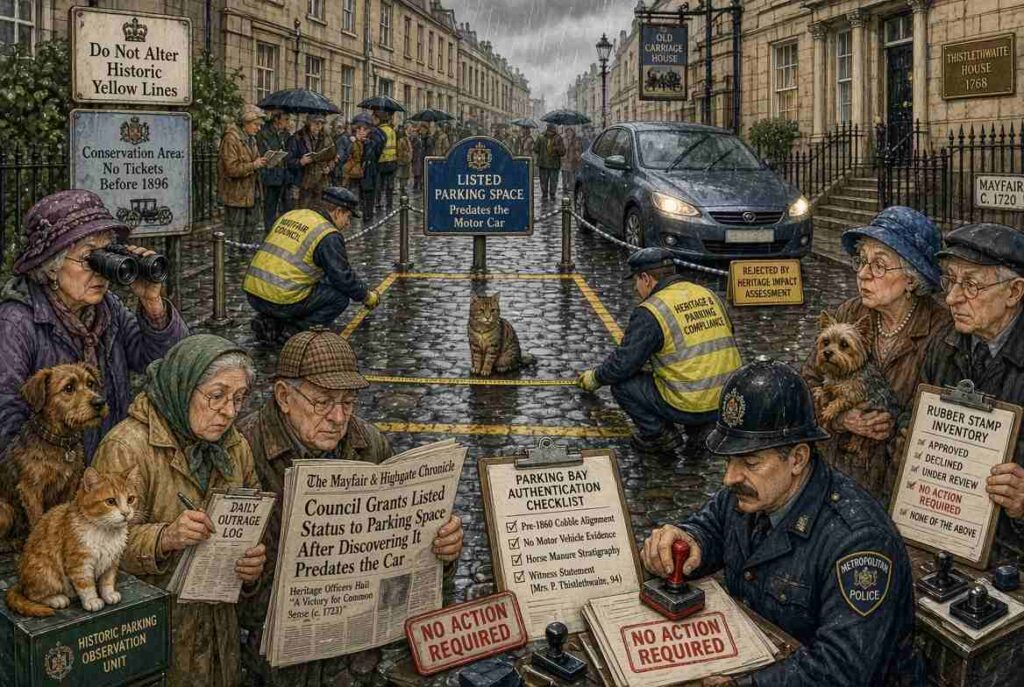
The parking space, known locally as Space 47B, measures approximately the length of a Range Rover and the width of the financial gap between ordinary Londoners and people who own Range Rovers. A site plan submitted to the council shows the boundary marked in careful dotted lines, with a note in the margin reading “do not confuse with adjacent bollard, which remains unlisted.”
Neighbours have mixed feelings. One described the process as “the most attention this street has ever received, including the time a film crew shot here in 1994.” Another said she had lived opposite Space 47B for eleven years without noticing it was there, which officials say only strengthens the case for protection, since true heritage should not need to announce itself.
Officials said the site represents “an exceptionally intact example of early metropolitan emptiness.” Historic England was alerted after a resident noticed the white lines had faded in a manner described as “architecturally significant.” The criteria that actually govern this process are set out on Historic England’s own explanation of what gets listed and why, which focuses on architectural and historic interest rather than proximity to a Range Rover.
“This is not simply somewhere to leave a Bentley,” explained conservation expert Dr Nigel Kerb. “This is a living record of Britain’s transition from horse-drawn transport to vehicles which now spend most of their lives searching for somewhere to stop.”
What listed status means for a rectangle of tarmac
The council stressed that listed status will protect Space 47B from inappropriate modernisation. Owners will no longer be permitted to repaint the lines without heritage consent. Installing an electric charging point would require a Heritage Parking Impact Assessment. Any attempt to widen the space to accommodate a modern SUV must demonstrate that the vehicle’s mirrors are historically sympathetic.
The owner, hedge-fund manager Julian Cashmore, said he was delighted. “I bought it because the flat next door seemed expensive,” he said. “Then I realised the flat came with bedrooms and plumbing, which felt wasteful.” Cashmore purchased the space in 2019 as a starter home for his Porsche. The Porsche has since moved to Surrey. “We wanted more space for the children,” he explained.
Estate agents immediately updated the listing. Where it previously read “secure off-street parking,” it now describes an “important heritage residence for motor vehicles, sympathetically preserved, benefiting from uninterrupted sky views and convenient vehicular access.” The price rose £80,000 by lunch – not an outlandish jump by the standards of the current Kensington parking-space listings currently on the market, several of which already run into six figures with no roof, walls or plumbing attached.
Local property consultant Miranda Equity said listed parking spaces represent London’s next great asset class. “People used to invest in homes,” she explained. “But homes involve tenants, boilers and human beings. A parking space just sits there appreciating quietly while contributing absolutely nothing to society. Investors love that.”
The pothole nobody is allowed to fix
Because Space 47B is listed, its owner must maintain its historic pothole. Council records show the pothole first appeared in 1978 and has since been declared “an important example of late twentieth-century municipal surfacing.” Repairing it would constitute destruction of heritage fabric. The owner must instead employ a specialist pothole conservator, at an estimated cost of £14,600.
“We preserve cathedrals,” said Dr Kerb. “We preserve castles. Why shouldn’t we preserve the exact piece of broken asphalt where somebody’s Jaguar suspension failed during the Callaghan government?” A blue plaque is expected, reading: SPACE 47B – EARLY MOTOR VEHICLES PARKED SOMEWHERE NEAR HERE – 1907-PRESENT.
Local residents are divided. One called the designation ridiculous. Another asked whether his wheelie bin could also be listed, since it had not moved since February. A third resident, who asked not to be named, said he had lived on the street for thirty years and had “absolutely no idea Space 47B was even the important one,” having always assumed the interesting history belonged to the actual house behind it, a Georgian townhouse that has never once been consulted about anything.
The council has opened a consultation, which is itself expected to receive protected status before any decision is made. Officials confirmed that the consultation document, once finalised, will run to 94 pages, cost £31,000 to produce, and conclude with a recommendation to hold a further consultation. A short clip of a genuinely £300,000 London parking space making headlines, embedded below, shows quite how far this market has already travelled without anyone’s help: £300,000 parking space on sale in London.
Tourists have already begun visiting. One couple from Kent were photographed standing respectfully at the edge of Space 47B for eleven minutes before asking a passer-by what exactly they were looking at. “We assumed it must be important,” the husband explained. “There was a rope.”
Meanwhile Space 47B remains empty. Nobody wants to park there. The insurance is astronomical – which, in London property terms, means the listed London parking space is now worth an absolute fortune.

Bethan Morgan is an experienced satirical journalist and comedy writer with a strong editorial voice shaped by London’s writing and performance culture. Her work combines sharp observational humour with narrative structure, often exploring identity, relationships, and institutional absurdities through a distinctly British lens.
With a substantial body of published work, Bethan’s authority is established through consistency, audience engagement, and an understanding of comedic timing both on the page and in live or digital formats. Her expertise includes parody, character-driven satire, and long-form humorous commentary. Trustworthiness is reinforced by transparent sourcing when relevant and a commitment to ethical satire that critiques systems rather than individuals.
Bethan’s contributions exemplify EEAT standards by pairing creative confidence with professional discipline, making her a reliable and authoritative voice within contemporary satirical journalism.