Britain Perfects Conflict Resolution by Standing at Opposite Ends of the Same Room
Charles Spencer Explains Ancient British Technique of Making Eye Contact, Nodding Once and Immediately Becoming Fascinated by a Lamp
LONDON — Britain received a badly needed reminder this week that while Americans resolve disagreements through lawsuits, podcasts and six-part documentaries, the British remain capable of settling virtually any interpersonal conflict by not going anywhere near the other person.
The latest demonstration came from Charles Spencer, who was asked what he would say if he encountered King Charles following their very public disagreement over Spencer’s new book about Princess Diana.
What Charles Spencer Told Tina Brown About Running Into King Charles
His answer was magnificent in its restraint:
“The Brits [are] very good at sort of catching each other’s eyes and operating in other parts of the room.”
That is not merely an answer.
That is the British Constitution.
Spencer was speaking at a September 29 event in New York with journalist Tina Brown. PEOPLE reports that the question came after Buckingham Palace had issued a rare response concerning claims in Spencer’s book, Swan Song: Diana, My Sister.
Faced with the hypothetical possibility of meeting the King after all that unpleasantness, Spencer did not propose confrontation, reconciliation, shouting, hugging, litigation or challenging His Majesty to settle matters behind the bins.
He proposed geometry.
Put Charles over there.
Put Spencer over here.
Place approximately 42 feet of carpet, three minor aristocrats and a tray of smoked salmon between them.
Civilisation survives.
British Politeness Statistics: Britain’s Most Successful Export Is Not Making a Scene
There is actual evidence hiding beneath the joke.
Research on British manners consistently finds strong attachment to politeness. In one YouGov survey on British manners, 90% of Britons believed others would regard them as well-mannered, with only 4% expecting to be considered rude.
That is an extraordinary statistic.
Ninety percent.
In Britain, apparently, nearly everybody is polite.
Which raises an obvious question:
Who keeps annoying everybody?
Presumably the same 4% are moving around the country at tremendous speed.
Why Indirectness Is the British Language of Politeness
Linguistic research provides further ammunition for Spencer’s theory. Sara Mills’ English Politeness and Class, published by Cambridge University Press, examines how indirectness, self-deprecation and reserve have long been treated as marks of polite British English.
Precisely.
British people do not avoid saying what they mean because they cannot communicate.
Avoiding saying what they mean is the communication.
Consider:
“That might be difficult.”
To an American, this means: “We may experience some complications.”
To a Briton, it can mean:
“Absolutely not.”
“Never.”
“Over my dead body.”
“The Royal Marines have been notified.”
YouGov Poll: Scientists Confirm Britons Even Avoid Other People’s Arguments
Another YouGov survey presented Britons with the dreadful social situation of being near a couple arguing in public.
Forty-six percent said they would try to block the argument out, while 45% admitted they would listen. Among people aged 65 and over, 61% said they would attempt not to listen.
This is important.
Even when British people are not involved in the conflict, nearly half would still like to avoid it.
That is advanced conflict avoidance.
Imagine walking past a burning building and saying:
“Best not interfere.”
Meanwhile, the other 45% are absolutely listening, but crucially pretending they are not.
Because Britain has two national sports:
avoiding unpleasantness,
and discreetly acquiring every detail about it.
The Spencer Method: A Five-Stage Guide to British Conflict Avoidance
The Spencer doctrine could now be taught formally.
Stage One: Detect Person With Whom Relations Are Complicated.
Stage Two: Brief eye contact.
Stage Three: Tiny nod.
Not a warm nod.
Not hostile.
Approximately 7 degrees.
Stage Four: Immediately identify another section of the room requiring urgent personal supervision.
Possibilities include:
the bar,
the window,
the hors d’oeuvres,
a painting you have already examined four times,
or a stranger called Nigel.
Stage Five: Remain there until motorcade departure.
No confrontation.
No summit.
No incident.
Nobody throws anything.
The Daily Mail gets only three columns instead of nine.
Everybody wins.
Eyewitness Accounts: The British Boiler Defence and Other Social Escape Tactics
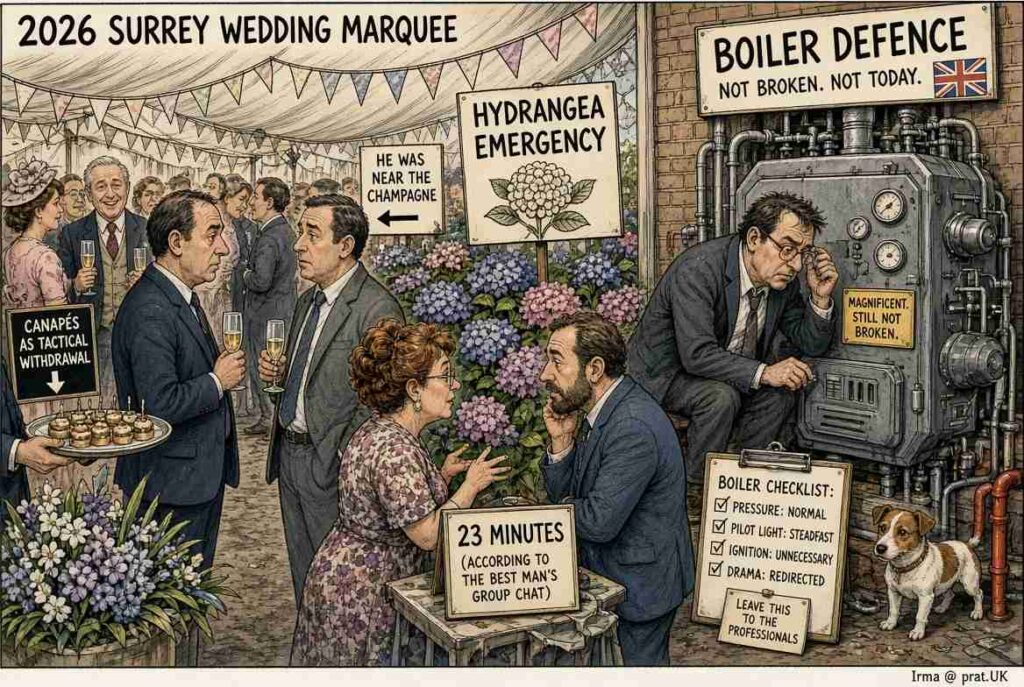
A man attending what he described as “a fairly tense Surrey wedding” recalled spotting an ex-business partner beside the champagne.
“We caught each other’s eye,” he said. “Then I spent 40 minutes discussing hydrangeas with a woman I had never met.”
Did he know anything about hydrangeas?
“Nothing.”
Did it matter?
“Good God, no. He was near the champagne.”
Another witness described encountering a former girlfriend at a Christmas party.
“I immediately became extremely interested in the host’s boiler.”
For how long?
“Twenty-three minutes.”
Was the boiler broken?
“No. Magnificent boiler.”
This is why Britain survived centuries.
Not superior military power.
Not naval strategy.
Not parliamentary democracy.
Boilers.
British Architecture as Interpersonal Fire Exit: Drawing Rooms, Conservatories and Althorp
British architecture now makes considerably more sense.
Multiple drawing rooms.
Long corridors.
Conservatories.
Libraries.
Gardens.
Pubs with two bars.
Hotel receptions containing enormous palms.
These are not architectural features.
They are interpersonal fire exits.
Even the phrase “drawing room” suddenly seems suspicious.
You enter because someone else is drawing near.
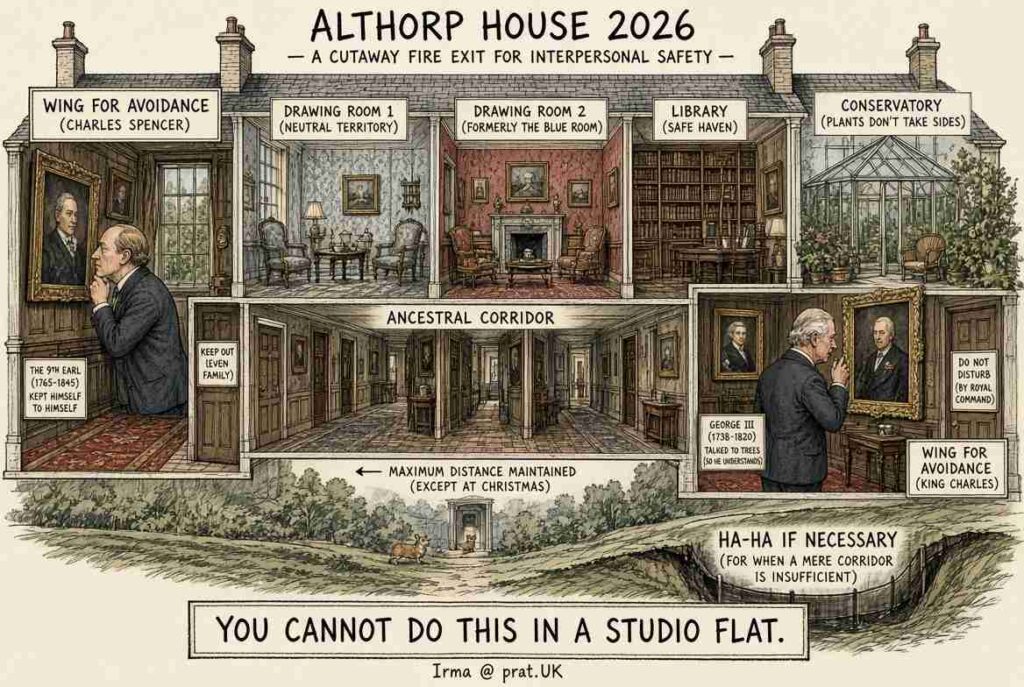
The aristocracy added enormous houses because ordinary rooms made avoidance too difficult. You cannot successfully avoid someone in a studio apartment. You can avoid them indefinitely at Althorp, the Spencer family seat, where there are wings, galleries, ancestral corridors and, if necessary, probably a ha-ha.
Our Highly Questionable Newsroom Poll on Awkward Encounters
In an entirely unscientific newsroom survey conducted among people willing to answer before tea, respondents were asked what they would do upon unexpectedly encountering someone with whom they had experienced a serious falling-out.
3% said confront the person.
7% said attempt reconciliation.
18% said leave immediately.
31% said suddenly remember somebody they urgently needed to speak with.
41% said become absorbed in examining an object attached to the wall.
Margin of error: plus or minus one portrait of the Duke of Wellington.
British vs American Conflict Resolution: Why Britain Leaves It Packed
America might learn something here.
American disagreement currently follows a predictable escalation:
Argument.
Social-media post.
Response video.
Counter-podcast.
Lawyer.
Streaming documentary.
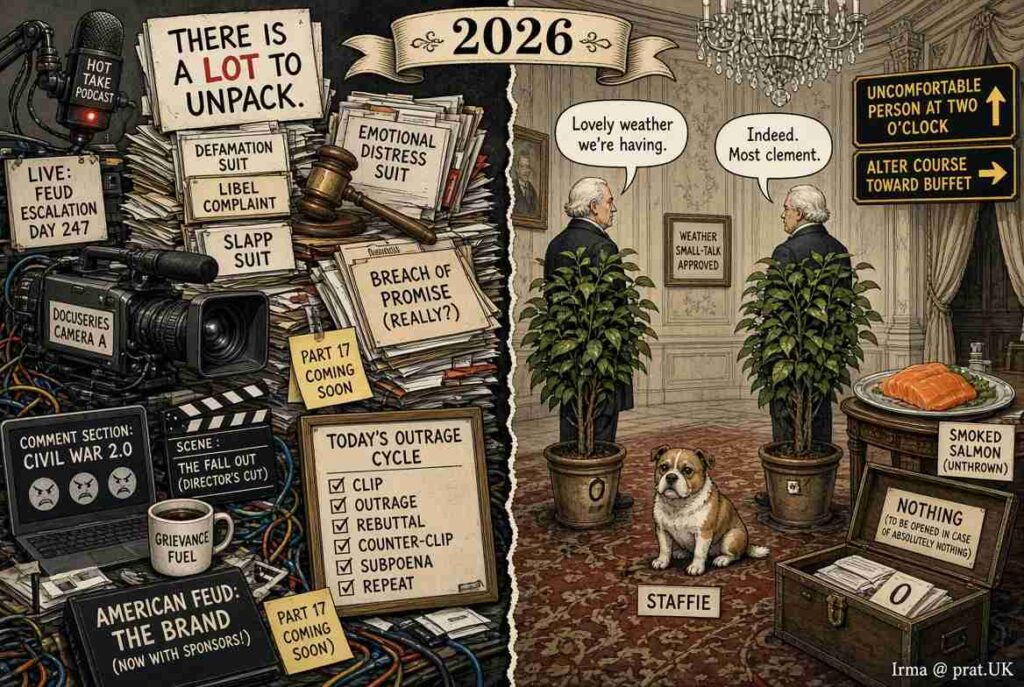
Three people appear on television saying, “There’s a lot to unpack here.”
Britain offers another model.
Nothing needs unpacking.
Leave it packed.
Put it in the attic.
Never mention it again.
Thirty-seven years later, somebody discovers the box.
“What’s this?”
“Nothing.”
That is social stability.
Charles Spencer Has Identified a National Superpower: British Emotional Air-Traffic Control
What Spencer described sounds ridiculous until you consider the alternatives.
Two people who intensely disagree do not always need a confrontation.
Sometimes they need twenty yards.
Perhaps that is the deepest British contribution to interpersonal relations: recognising that peace does not necessarily require agreement.
Sometimes peace merely requires adequate floor space.
You do not need to forgive the person.
You do not need to persuade the person.
You do not even need to speak to the person.
You simply need to establish visual confirmation that both parties remain alive and then spend the remainder of the evening discussing begonias with someone from Kent.
That is not cowardice.
That is British emotional air-traffic control.
“Uncomfortable person spotted at two o’clock.”
“Roger.”
“Alter course toward buffet.”
“Copy.”
“Deploy small talk.”
“Weather?”
“Approved.”
And somewhere across the ballroom, the other participant executes precisely the same manoeuvre.
Eyes meet.
Heads incline.
Hostilities remain suspended.
Nobody makes a scene.
Nobody throws the smoked salmon.
The monarchy continues.
Britain survives another evening.
15 Observations Supporting the British Theory of Strategic Avoidance
1. British eye contact is sometimes an entire conversation
One glance can mean:
“I have seen you.”
“I know you have seen me.”
“We both know why this is uncomfortable.”
“Neither of us is insane enough to discuss it.”
“Excellent.”
2. Americans clear the air. Britons ventilate the room
An American feud eventually produces: “We need to talk.”
A British feud produces an open window.
3. Britain did not develop small talk because people wanted to talk
It developed small talk because discussing the weather prevents discussing everything else.
“How about this rain?”
Translation: “Your brother owes me £14,000 and your wife called me morally bankrupt, but apparently drizzle is expected through Thursday.”
4. The drinks table is Britain’s diplomatic Switzerland
Any awkward encounter can be escaped by saying:
“I’m just going to get another one.”
Nobody asks another what.
Wine?
A canapé?
A new identity?
Go.
5. “Interesting” is Britain’s emergency brake
“That’s interesting.”
Possible meanings include:
“I disagree.”
“You are insane.”
“That is demonstrably false.”
“My solicitor will contact you.”
“I would rather eat the napkin than continue this conversation.”
6. A British nod can end hostilities without beginning peace
It says, “I acknowledge your continued existence but am unwilling to encourage it.”
7. The British invented the large reception specifically for enemies
Why else would anybody need a room containing 300 people?
It is social camouflage.
8. Britain’s most important defensive weapon is another guest
If your enemy approaches, simply seize an innocent third party.
“Margaret! How are you?”
Margaret has no idea who you are.
Doesn’t matter.
Margaret is now NATO.
9. “We must have lunch sometime” remains legally non-binding
No date.
No restaurant.
No intention.
Perfect.
10. British politeness allows two people to hate one another beautifully
The key is never allowing hatred to interfere with manners.
“I’m terribly sorry, after you.”
“No, after you.”
Both secretly hoping the doorway leads directly into the sea.
11. The aristocracy added enormous houses because ordinary rooms made avoidance too difficult
You cannot successfully avoid someone in a studio apartment.
You can avoid them indefinitely at Althorp.
There are wings.
There are galleries.
There are ancestral corridors.
If necessary, there is probably a ha-ha.
12. Britain can turn reaching for a canapé into tactical withdrawal
“Oh, are those cheese?”
And suddenly you are 18 yards away.
13. The phrase “I’ll leave you to it” has saved more relationships than counselling
Nobody knows what “it” is.
That is its genius.
14. British disagreement often becomes archaeological
Two families may stop speaking over something nobody living remembers.
Eventually someone asks what happened.
“Something involving Aunt Mildred and a christening.”
When?
“1958.”
Serious, then.
15. Charles Spencer may have accidentally summarized the entire national character
See problem.
Acknowledge problem.
Move behind ficus.
Disclaimer
This satire uses a real reported remark by Charles Spencer as the launchpad for exaggerated observations about British manners, indirectness, awkward social encounters and the lifesaving properties of standing beside the canapé table. The ridiculous surveys, tactical doctrines, hydrangea emergencies and diplomatic boilers are jokes. This story is entirely a human collaboration between two sentient beings: the world’s oldest tenured professor and a philosophy major turned dairy farmer.
— prat.UK

Alan Nafzger was born in Lubbock, Texas, the son Swiss immigrants. He grew up on a dairy in Windthorst, north central Texas. He earned degrees from Midwestern State University (B.A. 1985) and Texas State University (M.A. 1987). University College Dublin (Ph.D. 1991). Dr. Nafzger has entertained and educated young people in Texas colleges for 37 years. Nafzger is best known for his dark novels and experimental screenwriting. His best know scripts to date are Lenin’s Body, produced in Russia by A-Media and Sea and Sky produced in The Philippines in the Tagalog language. In 1986, Nafzger wrote the iconic feminist western novel, Gina of Quitaque. He currently lives in Holloway, North London. Contact: [email protected]