

Trump Bans the Press: The King Shoots the Messenger Again
From a sofa in London we watch Washington rediscover the oldest trick in politics: sack the courier, keep the crisis
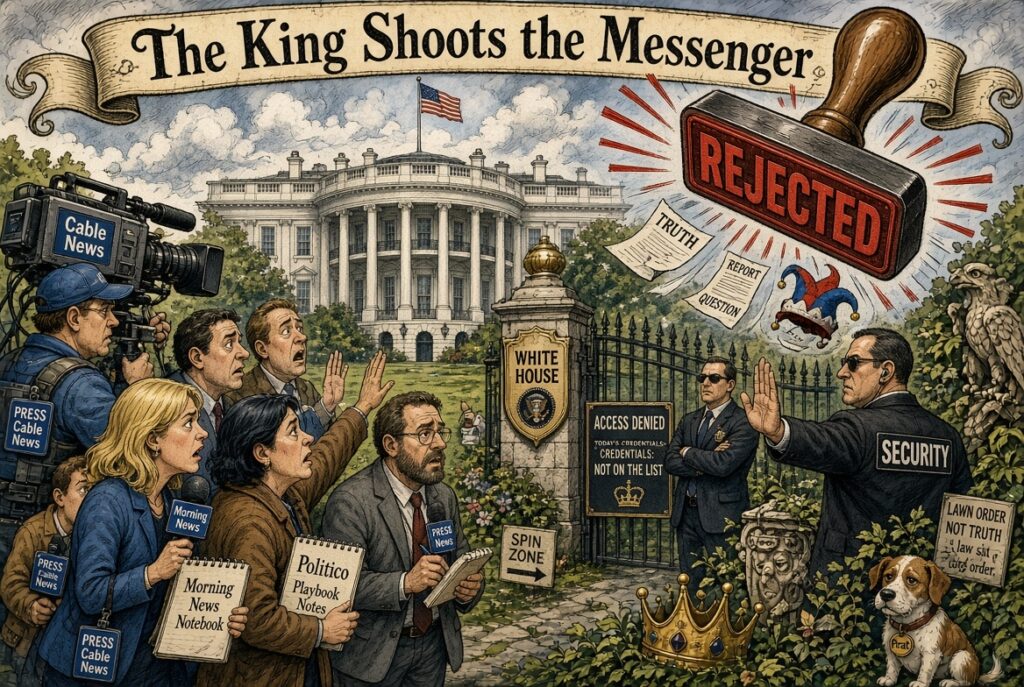
WASHINGTON — For most of human history, rulers confronted bad news using a simple communications strategy. They killed the person who brought it.
It was crude. It was violent. It was *terrible for staff retention*.
Fortunately, civilisation has progressed. The modern ruler does not shoot the messenger. He confiscates the messenger’s press badge.
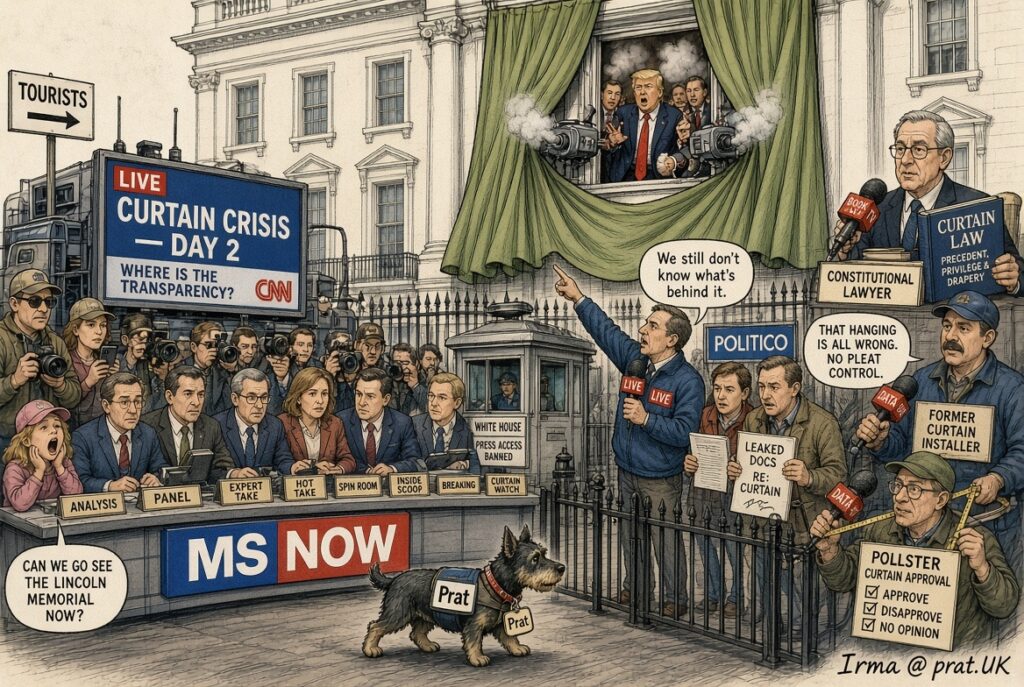
President Donald Trump announced on 18 September that CNN, MS NOW and Politico would be barred from the White House, accusing them of reporting “fake news.” By 19 September, journalists from all three organisations were being turned away at the gate. The outlets objected. Trump suggested other broadcasters might be next.
At last, the West has found a humane replacement for beheading. *The lanyard simply stops working.*
The genius of it is breathtaking. Suppose a medieval courier gallops into the castle. “Your Majesty, the northern army has been defeated.” The king thinks it over. “How did this information enter the castle?” “Through the courier, sire.” “Remove the courier.” “But the army, sire.” “What army?” Problem solved.
Modern communications teams have simply updated the procedure. No horses, no dungeon, just a security guard on Pennsylvania Avenue saying, “I’m sorry, your badge is no longer active.” Ancient kings had to execute people. We have databases.
If the Telegram Is Unpleasant, Arrest Western Union
Imagine Washington running on the same principle during the golden age of the telegram. The President is at breakfast. An aide rushes in. “Sir, another telegram has arrived.” “What does it say?” “Industrial production is down.” “Fake telegram.” “Sir?” “Who delivered it?” “Western Union.” “Ban Western Union.”
By lunchtime the Western Union office is surrounded by camera crews. By dinner it has issued a statement. By midnight, a man identified only as a telegraph historian is explaining the constitutional weight of a stop sign on cable television. There is always a telegraph historian. Nobody sees him until something happens to a telegram, and then he has three bookings and a paperback due out in spring.
The White House responds by launching an approved telecommunications firm, Patriot Telegraph & Sons, whose messages read rather more simply. ECONOMY EXCELLENT STOP. PRESIDENT DOING GREAT STOP. ANY CONTRARY TELEGRAM IS UNAUTHORISED STOP.
The remarkable thing about shooting the messenger is that it does nothing whatsoever to the message. If your doctor tells you your cholesterol is 290, banning the doctor from your kitchen does not turn the bacon into kale. If your bathroom scale reads a number you dislike, hurling it into the garden does not loosen your trousers, although you do feel better for several minutes. This may explain quite a lot of politics on both sides of the Atlantic.
The Ministry of Truth Discovers Customer Service
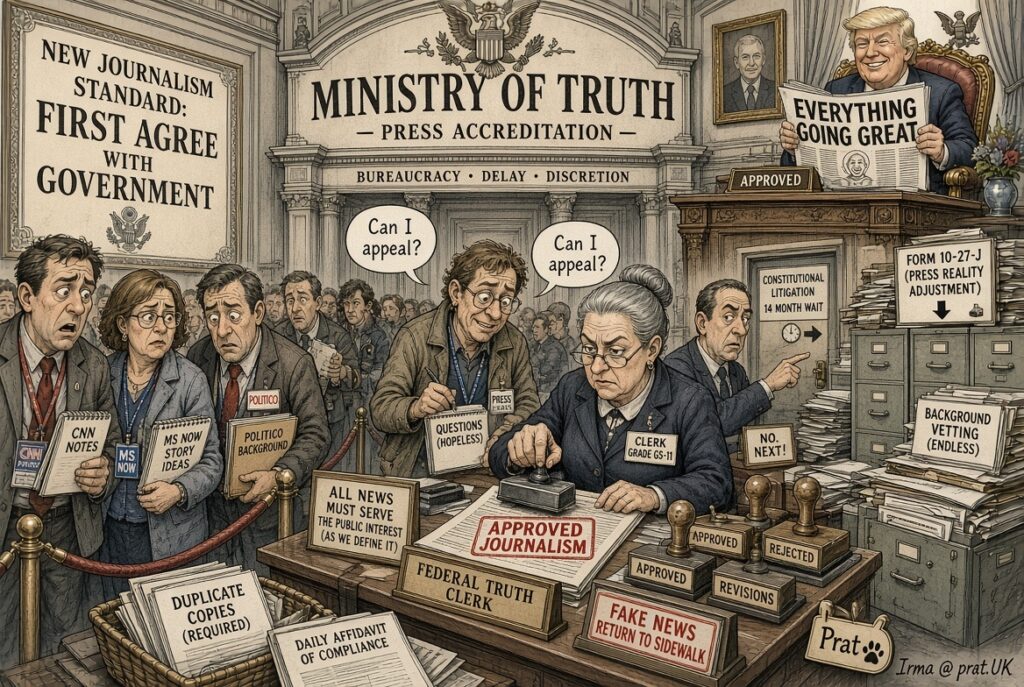
The next logical step is a proper Ministry of Truth, although nobody would ever call it that. That sounds authoritarian, and Washington understands branding. It would be named, instead, the Office of Information Quality, Public Confidence and Narrative Excellence, complete with a logo of an eagle carrying a fact check.
Reporters arriving at the White House would first visit a folding desk. “Article?” The clerk reads the headline. PRESIDENT FACES CRITICISM OVER… STAMP. RETURNED FOR ATTITUDE. Next. PRESIDENT ANNOUNCES HISTORIC… STAMP. APPROVED JOURNALISM. Next. QUESTIONS REMAIN ABOUT… The clerk freezes. “Questions?” “Yes.” “Remain?” “Yes.” “Security.”
Americans have long struggled to define journalism. Under the new system the definition becomes wonderfully concise. Journalism is news the government enjoys reading. Everything else is content.
George Orwell imagined enormous ministries rewriting yesterday’s newspapers. He lacked imagination. Why bother rewriting yesterday’s paper when you can simply object to tomorrow’s reporter? No filing cabinets, no pneumatic tubes, no sinister men dropping documents into memory holes. Just a laminated badge, or more precisely, the absence of one.
White House Announces New Journalism Standard: Please Agree Before You Enter
The government could streamline briefings considerably by issuing approved questions in advance. The current system is terribly inefficient. Journalists ask unpredictable things. They follow up. Some even begin sentences with “But,” and nothing good in government has ever followed the word “but.”
The approved system would offer instead: “Mr President, how well are things going?” “Mr President, among your many accomplishments, which surprised you most by being so accomplished?” “Mr President, some critics say you are successful, others say extremely successful. Where do you personally fall in this vigorous debate?”
The briefing ends twelve minutes early. Everybody gets lunch. Democracy, remarkably, saves on electricity.
The Wizard of Oz Curtain
Politics has always required curtains. Kings had them. Popes had them. Even Washington has so many metaphorical curtains that somewhere there is presumably a Senate Subcommittee on Drapery.
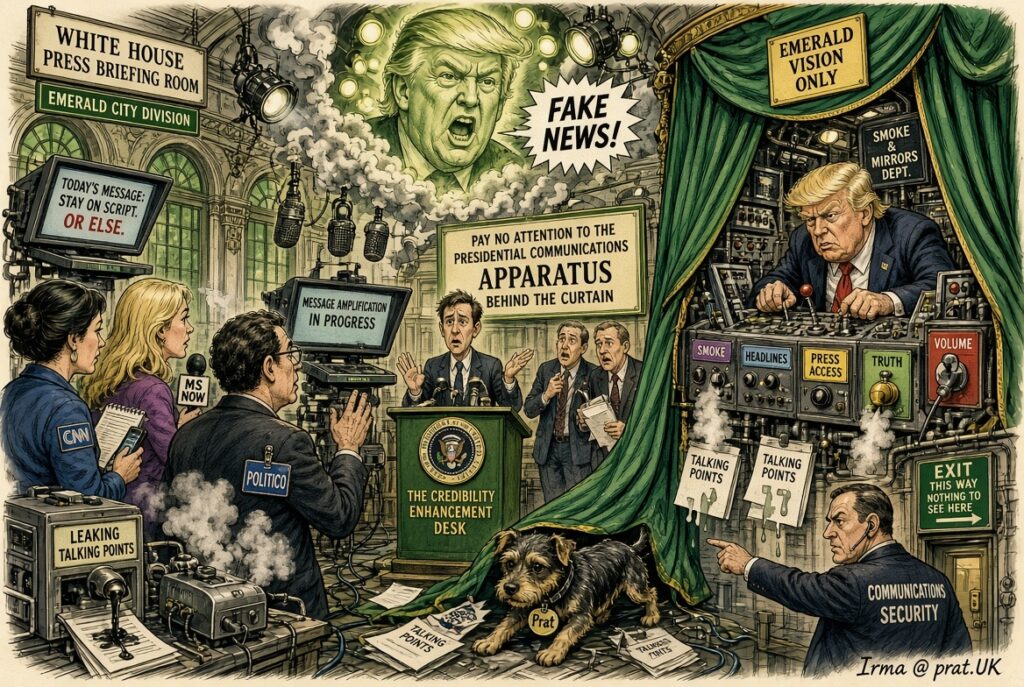
The central lesson of the Wizard of Oz was never about courage or heart. It was this: never let a journalist near the curtain. The Wizard had everything going beautifully, smoke, fire, a huge frightening face, complete command of the room, until a small dog exposed the machinery behind it. The entire political communications industry has been trying to solve the Toto problem ever since.
Imagine the briefing room as Emerald City. Smoke pours from behind the podium. A tremendous voice announces, “FAKE NEWS!” CNN raises a hand. “Where is that voice actually coming from?” “VERY DISHONEST QUESTION.” Politico looks towards the curtain. “Is somebody operating the controls back there?” “YOU ARE BANNED.” And Toto, predictably, loses his hard pass on the spot.
Power is always at its funniest the moment everyone is specifically told not to inspect the machinery, because that instruction is the surest possible guarantee that somebody will.
White House Modernises Medieval Government by Keeping the King and Firing the Jesters
Medieval kings understood something about information that modern communications consultants occasionally forget. They kept jesters. The jester was the one man permitted to tell the king something everybody else was too frightened to mention. Four hundred courtiers might say “magnificent decision, sire.” The jester alone could observe that the decision was magnificent in roughly the way falling down the stairs is rapid transportation.
Modern government has improved the institution by removing the useful part. We kept the throne, the motorcades, the heraldry, the formal dinners. But the fellow saying “Your Majesty, this might be a mistake” now finds his credentials under review.
A medieval jester transported to modern Washington would last about six briefings before his badge stopped working and his newsletter subscriber count started climbing rather faster than the President’s approval rating.
The Streisand Effect Applies for a White House Credential
This is the structural flaw in banning journalists. Sometimes the ban becomes a bigger story than whatever inspired it. Reuters and the Associated Press reported that journalists from the barred outlets simply carried on covering the White House from outside the gates.
That single fact can feed an entire evening’s schedule. BANNED: THE WHITE HOUSE PRESS FIGHT at eight. WHY WE WERE BANNED at nine. COULD YOU BE BANNED NEXT? at ten. By breakfast, millions of Americans who had no idea what CNN reported before the row now know everything about the row itself. It is the Streisand Effect wearing a press badge. Attempt to reduce attention, receive industrial quantities of it instead. Rather like trying to quietly remove a raccoon from your attic with a marching band. The raccoon may well leave. The neighbours, however, are wide awake.
Chef Bans Restaurant Critic After Bad Review
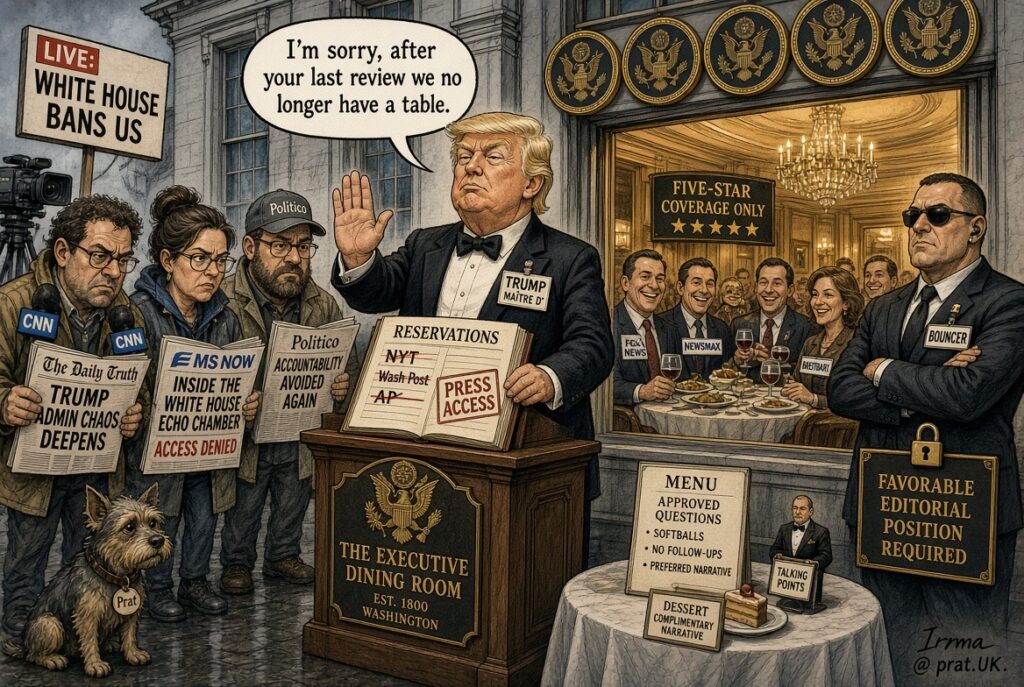
The nearest civilian equivalent is a restaurant. A chef reads a poor review. Service slow, soup lukewarm, fish overdone. He does not improve the soup. He bans the critic.
Michelin immediately asks the obvious question: what exactly is going on in that kitchen? The critic sets up a folding chair on the pavement outside. “Good evening. I’m reporting from the street because management has banned me from tasting the soup.” Suddenly everybody wants the soup. People drive across town for a table that does not exist, purely to find out what is wrong with a dish nobody has been allowed near in weeks.
Nothing on earth makes a door more fascinating than a sign reading KEEP OUT, a lesson the White House press office is presently relearning at some expense.
The Naked Emperor Gets a Communications Director
Every political satire eventually meets the naked emperor, because the story is immortal. He buys invisible clothes. His courtiers praise them. Nobody wants to be first to mention the obvious, because mentioning the obvious has become professionally dangerous.
Then a child says he isn’t wearing anything, and Washington immediately hires consultants. “The President is fully clothed.” “Where are the trousers?” “The President is wearing alternative trousers.” “Can we see them?” “That question contains a false premise.” CNN zooms in. “Those appear to be knees.” “CNN has a long record of anti-trouser reporting.”
The joke has never really been about nudity. It is about whether an institution permits anyone to describe what everybody present can plainly see.
White House Removes Smoke Alarm, Declares Fire Coverage Biased
Another strategy is the smoke alarm. It starts beeping. Rather than check the kitchen, somebody removes the battery. Silence. Peace. Victory, for about four minutes, until the smoke starts coming under the door.
In institutional life, critics often function as smoke alarms. Sometimes they malfunction over nothing more than burnt toast. But remove every alarm in the building because alarms are irritating, and eventually you find out about the fire the hard way, usually live on television, usually with a lawyer already attached to the smoke detector by the second segment.
The Yelp Review Dictatorship
Government media relations can now be understood entirely through online review culture. Every reporter effectively receives a star rating. Five stars, wonderful President, fast service, excellent economy, credential renewed. Three stars, coverage merely fair, credential under review. One star, congressional hearing.
Taken to its logical end, the President stops holding press conferences altogether and simply reads out the reviews. “We are pleased to report a 4.2 rating across 317 million verified users.” Somewhere, a focus group applauds on cue.
Trump Discovers Revolutionary Media Strategy: Send the Television Outside
Parents have understood this trick for decades. The television is annoying you. You turn it off. Problem solved, until the television grows legs, a phone, a laptop and a satellite van.
CNN goes outside. CNN turns around. CNN points a camera at the building. CNN remains, most inconveniently, still television. In the old days, removing television meant unplugging one box. Now there are cameras, phones and newsletters everywhere, and a correspondent from MS NOW reporting live from the pavement is exactly as much television as a correspondent reporting live from the briefing room, just with worse parking.
The Soviet Newspaper Parody
Every government dreams, occasionally, of perfectly agreeable coverage. Not Soviet coverage exactly, that sounds severe, just pleasantly uncomplicated coverage. GOVERNMENT SUCCESSFUL. GOVERNMENT EVEN MORE SUCCESSFUL THAN PREVIOUSLY REPORTED. SUNNY, WITH ISOLATED ANTI-GOVERNMENT CLOUDS.
The briefing becomes beautifully efficient. “Mr President, how did you become so magnificent?” “Excellent question.” Another reporter raises a hand. “Mr President, critics…” Security tackles the microphone before the sentence can finish.
The satire is not that America suddenly becomes the Soviet Union. That would be historical nonsense. The joke is that managed information has exactly the same comic architecture everywhere it is tried. The ruler wants compliments. The bureaucracy wants predictability. The press wants access. The audience wants drama. And somewhere in the room there is always one irritating person asking whether any of this is actually true.
The Press Is Not Exactly an Innocent Choir Either
For satire to work fairly, everybody deserves a share of the banana peel. Television news can take a minor disagreement over access and build enough graphics around it to suggest Normandy has been invaded a second time. BREAKING NEWS appears. Then another BREAKING NEWS. Then the same breaking news twenty-three minutes later, somehow still breaking. Correspondents interview other correspondents about the correspondents.
British viewers will recognise the genre, if not the scale. Our own panel shows have spent decades turning a single awkward select committee answer into forty-five minutes of television, and a Frankie Boyle one-liner has done more to puncture a politician than most of that hour combined. Cable news, on both sides of the Atlantic, abhors a vacuum and abhors seven minutes without a panel even more.
So when a government bans a network, it hands television exactly what it needs most: conflict, pictures, personal stakes, a villain depending on the channel, and footage of a reporter standing on a pavement looking serious. This is not silencing television. This is catering.
The Castle Gate Cannot Stop the Internet
The deepest absurdity here is architectural. White House access matters enormously to journalists covering the presidency, and physical proximity offers real opportunities to question officials and report firsthand. But physically excluding journalists no longer excludes journalism itself.
The castle gate once mattered because information travelled on horseback. Today the horse has broadband. A medieval king could close the drawbridge and reasonably expect several hours of informational peace. A modern president closes the gate and the reporter has tweeted before the latch finishes moving. Denied entry. Breaking alert. Television hit. Newsletter. Legal analysis. By evening somebody is selling a T-shirt reading REPORTING FROM THE PAVEMENT. The drawbridge has lost.
Eventually Someone Has to Read the Telegram
That is why the messenger joke survives. Companies have auditors. Universities have faculty committees. Families have teenagers. Governments have reporters. Reporters have editors. Editors have readers. Readers have social media, which ensures nobody gets to enjoy anything peacefully.
Messengers are annoying because information is annoying. Good news requires no explanation. Nobody gallops seventy miles through rain to announce that everything is approximately satisfactory. Bad news travels because bad news requires action. The tragedy for rulers is that removing the courier does not rebuild the army. The tragedy for journalists is that having an important institutional role does not make every story a vital one. And the tragedy for the rest of us is that both sides now own a microphone.
Western Union Returns With Another Telegram
Eventually, after the Ministry of Truth, the curtain, the fired jester, the restaurant critic, the naked emperor and the smoke alarm’s own lawyer, somebody knocks on the castle door.
“Who is it?” “Western Union.” “We banned them.” “They’re outside.” “What do they want?” “Another telegram.” “Read it.” WESTERN UNION BAN NOW NATION’S BIGGEST STORY STOP. “Who wrote this?” “CNN.” “I banned CNN.” “They’re outside too.” “Turn off the television.” “They’re broadcasting from the pavement.” “Close the curtain.” “Politico is investigating the curtain.” “Remove the smoke alarm.” “It’s booked for nine o’clock.” “Fire the jester.” “He’s got a newsletter now.”
The king sits quietly. “Is there anybody left in this kingdom who isn’t reporting on me?” Somewhere, a small dog with several million followers wags its tail.
You can shoot the messenger. You can ban him, revoke his credential, close the gate, cancel his reservation, unplug the television and hide behind a curtain insisting the emperor’s invisible trousers are tailored from the finest imported fabric. But the telegram remains stubbornly inside its envelope, and somebody is always going to open it. If you arrest Western Union, the first headline tomorrow morning will almost certainly read WESTERN UNION ARRESTED.
This piece is British satire on the September 2026 dispute over White House access involving CNN, MS NOW and Politico. Trump’s announcement barring the outlets, and the subsequent denial of access, are documented events reported by Reuters and the Associated Press, including Trump’s accusation of “fake news,” the objections raised by the affected organisations, and Trump’s suggestion that further outlets might later be barred. Everything involving Western Union arrests, invisible trousers, a smoke alarm with its own lawyer, Ministry of Truth clerks and a dog with millions of followers is satire, parody and comic exaggeration.
Sources
Reuters: White House turns away CNN, MS NOW and Politico reporters after Trump’s ban
Associated Press: CNN, MS NOW and Politico journalists denied access after Trump ban
This is British satirical news, filed from a London desk with one eye permanently on Washington. UK satirical journalism has always found American press wars an easy target, and this one arrived gift wrapped. No smoke alarms, telegram operators or constitutional trousers were harmed in the making of this piece of English satire.
Auf Wiedersehen, amigo!
For the American edition of this story, visit Bohiney.com.

Bethan Morgan is an experienced satirical journalist and comedy writer with a strong editorial voice shaped by London’s writing and performance culture. Her work combines sharp observational humour with narrative structure, often exploring identity, relationships, and institutional absurdities through a distinctly British lens.
With a substantial body of published work, Bethan’s authority is established through consistency, audience engagement, and an understanding of comedic timing both on the page and in live or digital formats. Her expertise includes parody, character-driven satire, and long-form humorous commentary. Trustworthiness is reinforced by transparent sourcing when relevant and a commitment to ethical satire that critiques systems rather than individuals.
Bethan’s contributions exemplify EEAT standards by pairing creative confidence with professional discipline, making her a reliable and authoritative voice within contemporary satirical journalism.


