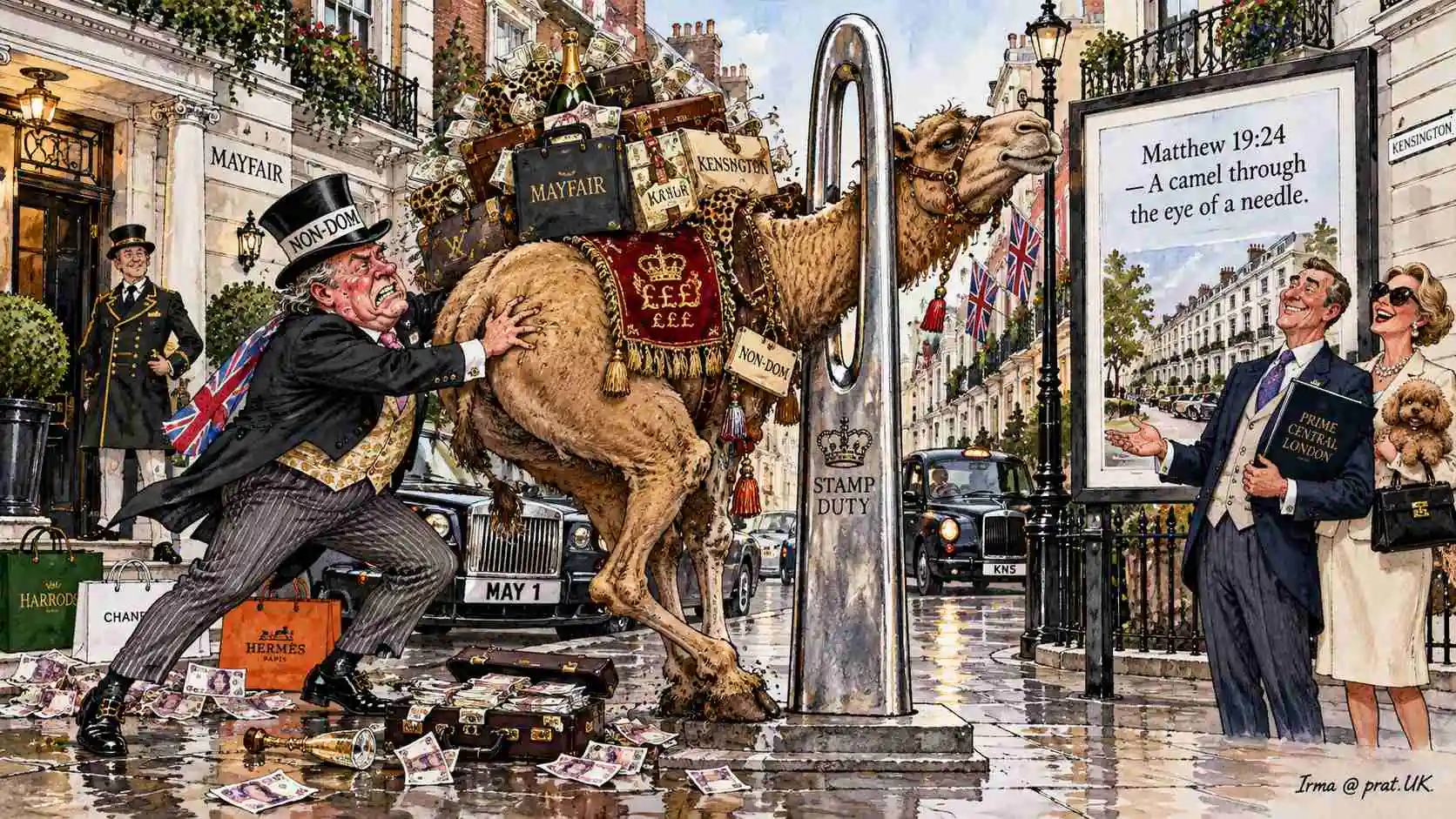
The Wealthy Resident’s Perspective: Eternity Is Attractive, Provided the Tax Residence Rules Are Favourable
KENSINGTON, LONDON: A Kensington financier has asked his legal advisers whether he can retain the privileges of earthly wealth in the afterlife following the abolition of Britain’s old non-dom tax system.
Maximilian de Vere, who owns a townhouse, two flats and a wine collection large enough to affect traffic on Kensington High Street, said the proposed arrangements were causing “unacceptable uncertainty among the comfortably eternal.”
His accountants explained that the former remittance-basis system ended on 6 April 2025. A replacement four-year foreign income and gains regime can provide relief for qualifying new UK residents after at least ten consecutive tax years of non-residence.
De Vere immediately asked whether heaven qualified as a foreign jurisdiction.
The accountant said she wasn’t sure.
“Excellent,” replied de Vere. “That’s usually where the interesting planning begins.”
Tax Residence at the Pearly Gates
A private meeting at his townhouse explored the legal implications of Matthew 19:24.
One solicitor suggested that the camel-and-needle passage was an example of a restrictive entry condition. Another wondered whether it could be challenged under a religious equality policy.
A third said the problem was not the size of the opening, but the client’s attachment to his money.
This was regarded as an extraordinarily rude thing to say in somebody else’s drawing room.
De Vere explained that he had nothing against charity. He chaired a foundation, attended fundraising dinners and regularly reminded his staff how generous he was.
Last year he donated £5,000 to a children’s shelter and spent £68,000 hosting the announcement.
“The important thing is awareness,” he said, displaying a framed newspaper photograph of himself shaking hands with the shelter’s director.
His housekeeper asked whether the children would have preferred the extra £68,000.
De Vere replied that she was overlooking the value of brand recognition.
The Angel Declines to Recognise Offshore Structures
The accountants eventually developed a proposed Heavenly Residence Strategy.
Under the arrangement, de Vere would continue enjoying his earthly assets through a family trust while claiming that his spiritual domicile remained outside the jurisdiction.
He also sought permission to enter heaven for fewer than 183 days annually, returning periodically to his yacht.
A theological adviser pointed out that the kingdom of heaven was not administered through British residency forms.
De Vere asked whether anyone had tested that assumption in court.
“Not successfully,” the adviser said.
Outside, his chauffeur, Martin Lewis, had been listening to the discussion through an open window.
“You know what Jesus was getting at?” Martin asked. “Money’s useful, but it doesn’t make you a better person.”
De Vere agreed enthusiastically, then asked Martin to polish the Bentley before church.
The Rich Man Finds the Real Loophole
At Sunday service, the vicar explained that salvation was not sold to the highest bidder. The verse challenged misplaced trust in wealth, not the existence of savings accounts.
De Vere wondered whether showing humility might improve his application.
The vicar suggested that he begin by treating the people who worked for him with respect.
De Vere consulted his adviser about the tax consequences.
There were none.
He looked deeply suspicious.
By Monday, the financier had instructed his legal team to suspend its research into heavenly offshore arrangements.
He also approved paid holidays for his domestic staff.
His accountants declared the second decision much more difficult to explain.
The vicar, however, considered it the first encouraging development in the entire affair.
Editorial Disclaimer
This report runs Matthew 19:24 past a Kensington tax adviser. The end of the old non-dom system and the four-year foreign income and gains regime are real and linked; Maximilian de Vere, his Heavenly Residence Strategy, his chauffeur and the £68,000 announcement party are comic inventions. This disclaimer is domiciled entirely in the UK, pays its taxes in full, and recommends our British Onion stories to anyone still hoping heaven counts as offshore.
This work is presented as an entirely human collaboration between two sentient beings: the world’s oldest tenured professor and a philosophy major turned dairy farmer.
The lesson of Matthew 19:24: London has spent centuries making room for the wealthy. Jesus suggested the wealthy might occasionally make room for something else.

Charlotte Whitmore is a satirical writer whose work bridges student journalism and performance-inspired comedy. Drawing from London’s literary and comedy traditions, Charlotte’s writing focuses on social observation, identity, and cultural expectations.
Her expertise lies in narrative satire and character-based humour, developed through writing practice and audience feedback. Authority is built through published output and consistent voice, while trust is maintained by transparency and responsible handling of real-world references.
Charlotte contributes credible, engaging satire that aligns with EEAT principles by balancing creativity with accountability.