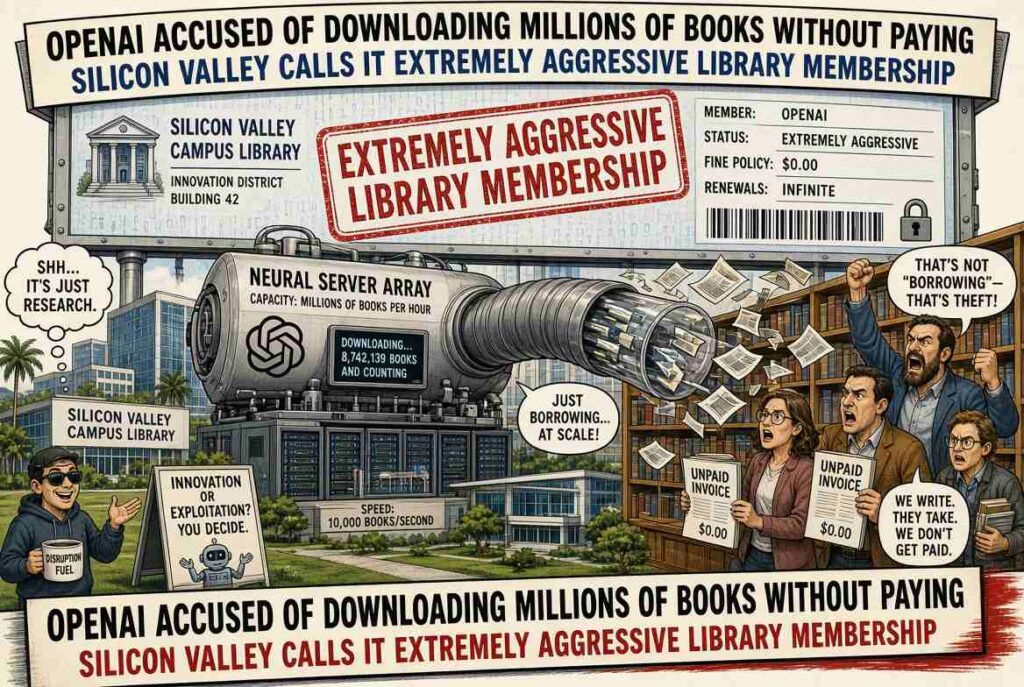
OpenAI Accused of Downloading Millions of Books Without Paying, Silicon Valley Calls It “Extremely Aggressive Library Membership”
Authors say ChatGPT was built using pirated books, while Silicon Valley unveils revolutionary legal doctrine: if the computer reads it really, really fast, apparently nobody read it at all
The latest copyright battle over artificial intelligence has arrived in federal court, where authors are asking a judge to rule that OpenAI copied books without authorization while developing its models. The allegations include claims involving books obtained through Library Genesis, or LibGen, and datasets that the authors say were originally identified as “Libgen1” and “Libgen2” before appearing publicly as the considerably less piratey “Books1” and “Books2.” OpenAI disputes the authors’ legal theory and argues that model training qualifies as fair use.
You can read the original reporting on the allegations at TorrentFreak’s coverage of the OpenAI book-training case, and background on the underlying doctrine at the U.S. Copyright Office’s overview of fair use.
Welcome to the Extremely Aggressive Library
Silicon Valley Discovers That Piracy Wears Better Clothes With a Valuation
American authors have accused OpenAI of engaging in what their court filing characterizes as “mass piracy,” a phrase that sounds less like copyright litigation and more like an upcoming Jerry Bruckheimer film starring accountants.
The dispute concerns 194 titles covered by the authors’ summary judgment motion. The plaintiffs are asking U.S. District Judge Sidney Stein to find liability on the disputed copying and reject OpenAI’s fair-use defense. OpenAI has filed its own summary judgment motion arguing in the opposite direction.
This is how American jurisprudence works.
Plaintiff: “Judge, obviously we win.”
Defendant: “Interesting. We have independently concluded that obviously we win.”
Judge: “Excellent. I was worried I might have plans this decade.”
According to the authors’ filing, OpenAI obtained books from LibGen, a notorious shadow library, and used book datasets during development of early models. They further allege that dataset names associated with LibGen later appeared in published research under the beautifully neutral titles “Books1” and “Books2.”
That is a magnificent naming transition.
“Libgen1” has implications. “Books1” sounds like something stored next to “Documents,” “Miscellaneous” and “Definitely_Not_Evidence.”
Nothing proves humanity remains essential quite like our ability to rename a folder.
Napster Demands an Immediate Retrial
Apparently Shawn Fanning Needed a Language Model
Somewhere, the surviving veterans of the early file-sharing wars must be staring at the ceiling.
Napster helped millions of people exchange music around the turn of the century and was treated by the recording industry roughly the way medieval villagers treated a suspicious goat after three consecutive crop failures.
There were lawsuits. Congressional hearings. Celebrity denunciations. Metallica became temporary adjunct professors of intellectual property law.
Twenty-five years later, technology has advanced magnificently. We no longer download one copyrighted work at a time. That would be inefficient.
The computer science community looked at Napster and apparently concluded the problem was insufficient ambition. Had Napster announced that downloading “Enter Sandman” was necessary for American leadership in artificial intelligence, history might have turned out very differently.
“Your Honor, we didn’t pirate the album. We transformed it into a statistical representation of Lars Ulrich.”
Case dismissed. IPO Tuesday.
Authors Sue Machine Allegedly Trained on Authors
ChatGPT Asked to Draft Response in Tasteful Literary Style
The magnificent circularity of the dispute is that writers claim their works helped train systems capable of producing text that could compete with writers.
The authors’ motion says generative AI poses an “existential threat” to book writers and publishers and points to the proliferation of AI-generated books.
Human economic history has produced many forms of competition. The farmer competed with the tractor. The carriage maker competed with the automobile. The travel agent competed with online booking.
But this may be the first industrial revolution in which workers are essentially claiming: “You read my manual before applying for my position.”
Economists have identified this exciting new business strategy as Steal the Ladder, Then Sell the Roof.
Step one: acquire enormous quantities of human-produced knowledge. Step two: train machine. Step three: tell humans machine is much more efficient. Step four: invite humans to subscribe to machine. Step five: charge extra for the premium model.
This is capitalism with the circular logic of a hotel charging you admission to retrieve the trousers you left upstairs.
George R.R. Martin Enters the Chat
Machine Volunteers to Finish Job Nobody Else Is Brave Enough to Mention
One particularly provocative allegation involves an OpenAI employee. The authors’ motion points to a 2025 social-media post in which the employee discussed a research goal of having GPT models write the remaining A Song of Ice and Fire books and suggested a model could complete the series if George R.R. Martin died before doing so.
This may be the most technologically sophisticated version of asking: “So, George, how’s the book coming?”
Humanity spent decades worrying that artificial intelligence would launch nuclear missiles. Instead, its first existential mission may be finishing The Winds of Winter.
Somewhere inside a server farm sits a graphics processor muttering: “George, I don’t want to pressure you, but I’ve already outlined Chapter 73.”
The machines aren’t rising. They’re becoming impatient readers.
The Great Fair-Use Food Fight
Copyright Lawyers Purchase Beach Houses
OpenAI’s defense is far more substantial than “we changed the folder name.”
The company argues that training models on copyrighted material is transformative and protected by fair use. It has also argued publicly that meaningful “regurgitation” of copyrighted works is rare and something it seeks to prevent.
That legal argument matters because copyright law has always recognized circumstances where copyrighted materials can be used without permission.
The enormous unresolved question is whether ingesting works to train generative models fits comfortably within that doctrine, especially where plaintiffs allege some source copies came from pirate libraries.
Courts have already begun drawing distinctions between training and how training copies were acquired, which means the entire future of artificial intelligence may depend upon copyright lawyers arguing about verbs.
“Did you learn from the book?” “Yes.” “Did you copy the book?” “That depends.” “Did you obtain the book?” “Define obtain.” “Did somebody pay for the book?” “I object to the primitive commercial assumptions embedded in the question.”
Silicon Valley has now reached the philosophical stage every teenager discovers after being asked who ate the leftover pizza.
Librarians Demand $800 Billion Valuation
Libraries Realize They’ve Been Artificial Intelligence Companies Since 1731
Nobody has suffered greater economic injustice from the AI boom than librarians.
Consider their technology: millions of books, searchable indexes, natural-language queries, human-readable summaries, research assistance, hallucination correction, quiet rooms. No venture capital.
For centuries, a citizen has been able to enter a library and ask: “Do you have anything about the Roman Empire?” A librarian will locate six books, two scholarly journals and an elderly gentleman who has been waiting forty years for someone to ask.
Artificial intelligence does roughly this and Wall Street starts throwing money out of helicopters. Libraries do it and the city council asks whether they can reduce Saturday hours.
A new coalition of librarians is therefore expected to demand retroactive unicorn valuations, stock options and hoodies. The Dewey Decimal System will shortly be renamed DeweyGPT Enterprise Knowledge Architecture. Libraries will immediately be worth $600 billion.
Parents Demand Access to Same Training Technology
“If Reading Millions of Books Creates Intelligence, Please Install It in Kevin”
Parents nationwide have also taken interest. For decades they have attempted to encourage children to read using bookmarks, summer programs, pizza coupons and threats concerning Wi-Fi passwords.
Now technology companies appear to have demonstrated that consuming gigantic quantities of text can produce something capable of passing exams, writing computer programs and explaining Kant without crying.
Parents want in.
One mother interviewed outside a suburban high school explained the problem. “My son has access to approximately seventeen million books through libraries and the internet,” she said. “Yesterday he watched a four-hour video of somebody ranking potato chips.”
Educational researchers call this the Kevin Problem. If machine learning can ingest thousands of books overnight, parents would like an equivalent upgrade installed before college applications. Unfortunately, teenagers continue operating on conventional biological architecture where The Great Gatsby requires six evenings and one emergency visit to SparkNotes.
Washington Joins the Book Club
The controversy is larger than this particular authors’ motion. The Trump administration recently backed OpenAI’s fair-use position in separate litigation involving The New York Times, arguing that broad access to training material matters for innovation, economic competitiveness and national security. The Times rejects that position and argues creators deserve compensation for the use of their work.
We have therefore achieved the inevitable American endpoint. Reading books is now a national-security issue.
Somewhere in Washington a briefing slide probably reads: CHINA: 14 TRILLION TOKENS. UNITED STATES: MUST READ FASTER.
Future copyright hearings may feature generals explaining that America must retain access to romance novels or Beijing could achieve strategic superiority in enemies-to-lovers narrative construction. Congress will nod gravely.
Silicon Valley Explains Copying Is Innovation
Nobody should pretend the legal question is simple. Training a model is not identical to selling a photocopied novel. A language model does not generally function as an online bookstore containing accessible digital copies of every training work.
But neither should anybody be surprised that authors object when companies potentially worth staggering sums tell creators that consuming their work is transformative while paying them would apparently interfere with transformation.
This is where Silicon Valley excels. It can turn the oldest human behavior imaginable into vocabulary nobody recognizes.
Taxi company? Mobility platform. Landlord? Property-tech ecosystem. Advertising company? Attention marketplace. Copying? Large-scale representation learning.
The revolutionary ingredient is often a noun investors cannot pronounce.
The Publishing Industry Experiences an Unfamiliar Emotion
There is also something wonderfully ironic about publishers suddenly discovering the sacred economic dignity of writers.
For generations, authors have heard: “We absolutely love the manuscript.” Wonderful! “Unfortunately there’s no marketing budget.” Less wonderful. “But we’d love you to promote it yourself.” Interesting. “And your royalty statement is attached.” Why does it contain a negative number?
Now artificial intelligence has appeared, and publishing executives are standing shoulder to shoulder with writers proclaiming: CREATIVE LABOR HAS VALUE.
Authors are delighted to hear it. Several have asked whether this exciting principle can be retroactively applied to book contracts. The room reportedly became quiet.
What Happens Next?
The underlying legal dispute remains unresolved. The authors want summary judgment on liability concerning the works at issue, while OpenAI wants the court to accept its fair-use arguments. The litigation is part of a much larger collection of copyright fights involving authors, newspapers, technology companies and AI developers.
A February 2026 order by Judge Stein also confirms earlier discovery disputes surrounding communications about the Books1 and Books2 datasets and Library Genesis, although that particular ruling concerned attorney-client privilege rather than deciding whether the underlying conduct constituted infringement.
That distinction is important. Nobody has yet handed down the grand final ruling in the matter of every book ever written versus the future.
Until then, the American legal system will perform its traditional role. Authors will hire lawyers. Technology companies will hire more lawyers. Experts will produce reports. Economists will calculate market substitution. Computer scientists will explain embeddings. Judges will ask extremely sensible questions.
And somewhere, somebody will feed all the filings into a chatbot and type: “Summarize this in five bullet points.” Which is probably when the court clerk finally loses it.
Helpful Guidance for Authors Worried About AI
Writers concerned about generative AI should keep records of publication dates, contracts, copyright registrations where applicable, licensing agreements and evidence showing where their works have appeared. Authors who believe their work has been infringed should consult qualified copyright counsel rather than accepting legal advice from a satire magazine, a chatbot, their barber or a man on social media whose profile photograph is an eagle wearing sunglasses.
Readers should also distinguish between allegations and findings. The authors have made serious claims. OpenAI disputes key legal conclusions. The court has not yet delivered the final verdict resolving the issues described here.
That may sound painfully responsible. We apologize. Normal irresponsibility resumes immediately.
15 Humorous Observations Before Somebody Copyrights the Alphabet
- Silicon Valley has reinvented the public library, except the library is worth hundreds of billions of dollars and nobody remembers buying a library card.
- Calling a dataset “Libgen1” is refreshingly honest. Renaming it “Books1” has the unmistakable energy of changing “Stolen Television” in your garage inventory to “Electronics.”
- Authors spent twenty years being told piracy was destroying civilization, only to discover piracy becomes “innovation” when enough venture capitalists attend the meeting.
- Napster must be furious. Those fellows got sued into geological sediment for giving away three-minute Metallica songs when apparently they should have called the operation “transformative machine learning.”
- OpenAI argues that training can constitute fair use, which is legally serious but comedically indistinguishable from a raccoon explaining that your rubbish bin was being used for nutritional research.
- Writers fear AI may replace writers, giving authors the unusual experience of allegedly contributing raw material to the machine applying for their job.
- Parents are studying the controversy carefully because apparently reading millions of books can create extraordinary intelligence, and they would like their teenager to start with one.
- Librarians deserve venture-capital valuations immediately. They have been storing millions of books, organizing datasets and answering hallucinated questions since approximately Alexandria.
- The difference between traditional book piracy and artificial intelligence training may eventually require several judges, fourteen economists, eight copyright professors and one exhausted person asking, “Did anybody actually pay George?”
- Silicon Valley’s favorite unit of morality remains scale. Taking one book sounds suspicious. Processing millions sounds like infrastructure.
- The publishing industry is understandably alarmed because its traditional business model involved paying authors very little, and it deeply resents technological disruption entering its territory.
- If copying becomes transformative when the copy is complicated enough, every university student caught plagiarizing will soon submit a 70-billion-parameter defense.
- The phrase “acceptable economic disruption” sounds considerably more cheerful when you are conducting the disruption rather than discovering it has your office.
- George R.R. Martin being dragged into a dispute about machines finishing novels proves artificial intelligence has finally identified humanity’s most dangerous unresolved challenge.
- Copyright law is becoming the intellectual equivalent of assembling IKEA furniture during an earthquake: everybody has instructions, nobody agrees which way the bookshelf goes, and three screws are labeled FAIR USE.
Disclaimer
This is satire based on an actual ongoing copyright dispute. Allegations concerning OpenAI, Microsoft, LibGen, training datasets and copyright infringement remain allegations unless and until established by a court. OpenAI maintains that its training practices are protected by fair use.
This story is entirely a human collaboration between two sentient beings: the world’s oldest tenured professor and a philosophy major turned dairy farmer. Neither is presently available for deposition because one is grading civilization and the other has to milk something.