Future King Finds ‘The Traitors’ Closest Thing to Stand-Up
LONDON, October 24, 2026 – Prince William has entered a new phase of his development as Britain’s future monarch. He has discovered that a man can appear on a television chat show, mention a programme called The Traitors, enjoy a chuckle and leave royal watchers wondering whether another little message has gone across the Atlantic.
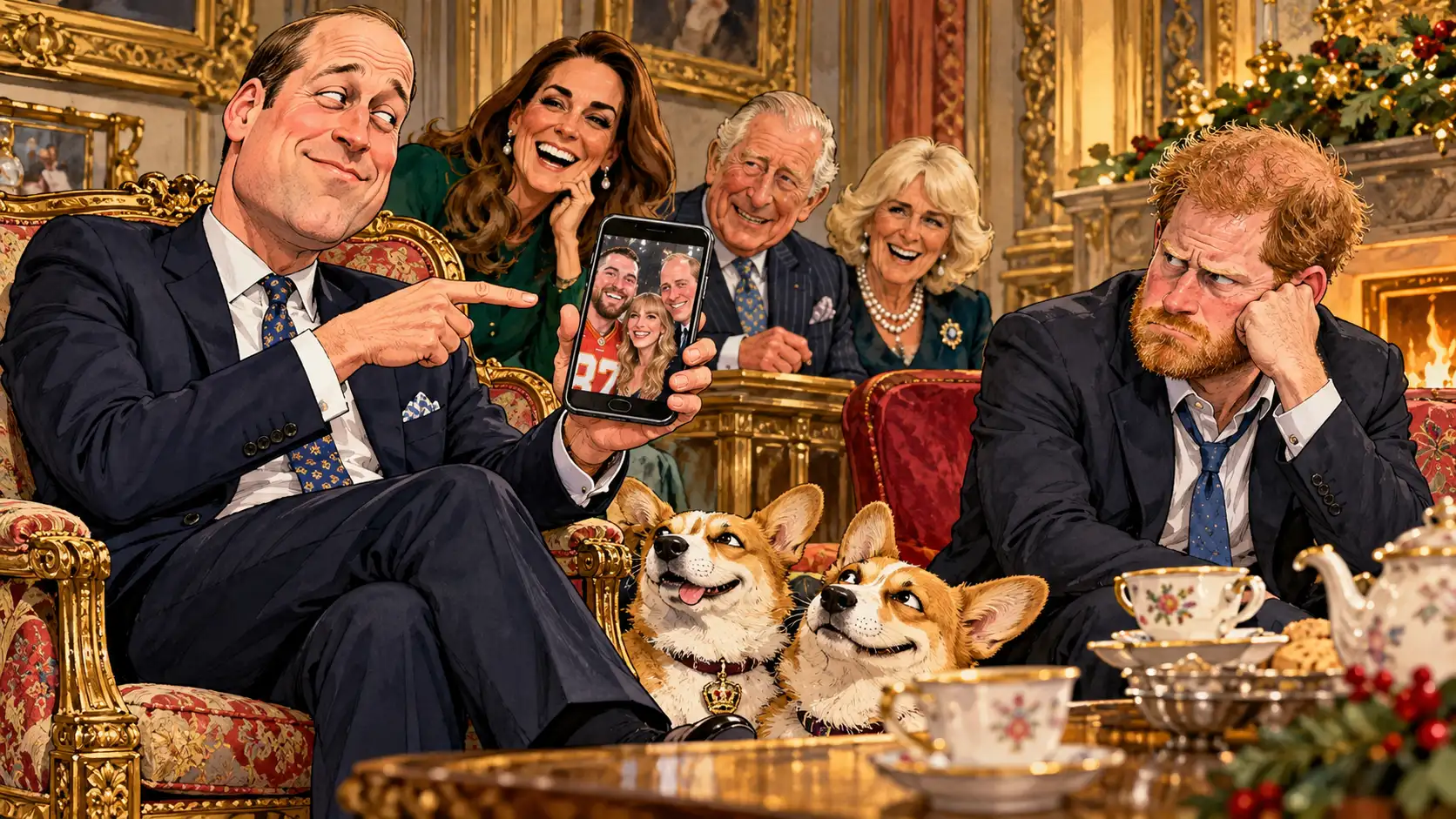
According to USA TODAY’s October 23 report, the Prince of Wales appeared on The Graham Norton Show and talked about his favourite television programmes, his taste in Christopher Nolan films and his family’s enthusiasm for The Celebrity Traitors.
William never named his brother Harry during the reported exchange, which is exactly what makes the possible insinuation so convenient. It delivers the pleasure of a little family needle without the inconvenience of admitting anybody was holding it. For a man whose public appearances come with more preparation than a military operation, the evening also offered the prospect of being mistaken for a naturally witty person.
- William figured out you can say “traitor” on national television without saying your brother’s name. The Palace calls that subtlety. The rest of us call it Thanksgiving.
- They billed it as a surprise. Surprised who? The producers knew. Security knew. The makeup people, the publicists, the guy who booked the limo, all in the loop. The only person they surprised was you, and they only told you so you’d feel included.
- He thinks he’s funny now. Somebody needs to tell him a smirk isn’t a punchline. It’s the face you make while the punchline’s still loading.
- His favourite show is The Traitors, where friends and family smile at each other while planning to stab each other. Finally, a reality show the monarchy understands. They’ve been doing it for a thousand years and nobody even handed them a cloak.
- That question was so perfectly teed up you could’ve driven a royal carriage through it. Horses and all.
Prince William on Graham Norton: A Carefully Arranged Spontaneous Conversation
The appearance was described as a surprise, which in royal communications means several hundred people knew about it before the television audience did. There were producers, researchers, cameras, security personnel, guest lists, seating plans and enough planning documents to invade a small European country. The nation was nonetheless invited to marvel at the spontaneous sight of Prince William sitting on a sofa answering questions.
At some point the subject turned to how the prince relaxes, and that gave William the chance to discuss television programmes and films. A television interviewer asked a television viewer about television. The Traitors came up. William said he liked it.
The conversation fitted the Windsor family soap opera so neatly that suspicious royal spectators might reasonably have wondered whether the question had been escorted onto the set by palace security. There is no public evidence the question was scripted as an attack on Harry. For satirical purposes, though, the whole sequence has the polish of a palace-approved ambush in which the intended victim wasn’t invited, named or formally attacked. It is passive aggression with diplomatic immunity.
Prince William’s Traitors Remark Hands the Harry Feud a Convenient Word
The programme involves contestants trying to identify secret betrayers while surrounded by people pretending to be friends. It’s an entertaining concept, though the Royal Family has produced its own version for centuries without needing BBC funding.
William told Norton that his family enjoys watching the series and that Charlotte and Louis are particularly keen. A perfectly innocent observation. Coming from a prince whose estrangement from his younger brother has supplied the British press with years of profitable headlines, the word traitors still carries a certain accidental comic electricity. One almost expects the palace press office to issue a clarification.
“The Prince of Wales was referring exclusively to the BBC television programme. Any resemblance to recent royal family relationships is entirely coincidental, although His Royal Highness is understood to have thoroughly enjoyed himself.”
William didn’t have to say Harry’s name. He praised a programme about betrayal, and the royal commentary industry, already stationed permanently outside Harry’s life with binoculars, supplied the interpretation. It’s the conversational equivalent of leaving a banana skin on the floor and expressing astonishment when somebody slips.
Palace Sources Amazed Prince William Can Make a Joke Without a Constitutional Amendment
Palace staff reacted to William’s performance immediately. A senior adviser allegedly congratulated the prince on completing an entire television joke without requesting parliamentary approval.
“His Royal Highness has been developing this material for some time,” the adviser explained. “We began with smiling. That went extremely well. Then came light chuckling. The next stage is a recognisable punchline, although we don’t want to rush him.”
A member of the royal communications team was reportedly delighted that William had managed to discuss betrayal without mentioning his brother directly. “That’s the beauty of it,” the aide explained. “If anybody complains, we can say he was only discussing television. If nobody complains, we can quietly enjoy the speculation.”
Royal comedy has always been a specialised discipline. Ordinary comedians spend years developing timing, delivery, originality and material. A future king has to smile at the correct moment, and his audience knows its responsibilities. When William laughs, everybody laughs. When William stops, everybody stops. It’s less stand-up comedy than a constitutional monarchy with a laugh track.
Prince Harry Complains in Public; Prince William Performs in Public
The contrast with Harry is instructive. When Harry discusses his family publicly, commentators denounce him for airing private grievances. Domestic disagreements, they say, belong behind closed doors, and family loyalty requires silence, discretion and restraint. These virtues apply most vigorously to the relative living in California.
When William makes a public appearance that royal watchers might construe as containing a little brotherly barb, the conversation turns to his refreshing humour, natural charm and reassuringly human personality. There are two standards of royal communication. Harry speaks and it is a betrayal. William speaks and it is public service. Harry discusses family tension and is condemned for commercialising royal relationships. William discusses a programme called The Traitors on prime-time television, and his defenders insist the conversation has nothing whatever to do with family relationships.
Which, to be fair, it may not. The cleverness of the arrangement is that nobody has to prove anything for the royal commentary industry to enjoy another afternoon arguing about it.
Prince William Praises Christopher Nolan Films, Seeks Complex Plots
William also told Norton that he enjoys the films of director Christopher Nolan, particularly The Dark Knight trilogy, and praised their psychological darkness and complexity.
That’s understandable. Nolan has built a career around troubled men, unresolved conflicts, competing versions of reality and people who can’t escape their pasts. He has been producing unofficial Windsor family documentaries for twenty years.
One wonders whether William appreciates Inception because its central premise involves planting an idea inside somebody’s mind without the recipient realising where it came from. It would make an excellent concept for royal communications: plant the word traitor, smile pleasantly, let the newspapers speculate and go home. Alternatively, William simply enjoys a good film. In the modern monarchy, even choosing a DVD is liable to be read as a constitutional declaration.
Prince Harry Absent From Graham Norton Show, Still Part of the Entertainment
The most remarkable feature of the whole episode is that Harry wasn’t there. He wasn’t on the sofa. He wasn’t part of the interview. He wasn’t responsible for the questions, and he wasn’t mentioned in any of the comments reported by USA TODAY.
Yet Harry remains the gravitational centre of so much royal commentary that his absence can become a subject of discussion. William could announce that he enjoyed a sandwich, and somebody would eventually publish an article explaining how the choice of bread represented a devastating rebuke to his younger brother.
Given the brothers’ very public estrangement, William must surely understand how a reference to betrayal could be interpreted. The question is whether he intended that reading or simply enjoyed the ambiguity. Either way he gets to look tremendously pleased with himself. In the first case he has delivered an underhanded insult. In the second he has accidentally acquired a reputation for devastating wit. Neither requires him to tell an actual joke.
Britain Awaits Prince William’s Next Comedy Masterpiece
The BBC appearance was chiefly intended to promote William’s Earthshot Prize, an environmental initiative that rewards practical solutions to global problems. The prize’s own website says its sixth annual awards night takes place in Mumbai on 17 November, where five finalists will each win £1 million. It’s a worthwhile subject that deserves serious attention. Royal family politics has become such an industrial enterprise, however, that a passing reference to a television programme can compete with the environment for column inches.
William wants to be seen as approachable, relaxed, modern and amusing, all perfectly reasonable ambitions for a future king. A monarch who wants to be recognised as genuinely witty faces one obstacle, which is that other people get to decide whether he’s funny. Not palace advisers. Not royal correspondents. Not an audience conditioned to laugh whenever royalty shows evidence of a sense of humour. And certainly not a family feud that supplies the subtext whenever an heir to the throne mentions betrayal.
For now, William can congratulate himself on another successful television outing. The smile was polished, the setting immaculate and the conversation pleasant. The alleged brotherly jab was deniable. And Harry, thousands of miles away, may once again find himself cast in a drama in which he was neither consulted nor given a speaking part.
The future king may have discovered the perfect royal joke: everybody else does the explaining, somebody else gets the blame, and he gets to enjoy the applause.
10 Humorous Observations on Prince William’s Graham Norton Appearance
- Harry airs the family grievances in public and it’s a scandal. William does it in a studio with better lighting and no follow-up questions. Same grievance, nicer lighting.
- He likes Christopher Nolan. Of course he does. Explaining this family takes three timelines and a soundtrack so loud nobody can hear the dialogue.
- He could’ve called his brother. Instead, a perfectly timed chuckle. Nothing says healing like a chuckle with a microphone clipped to it.
- The commentators said he looked relaxed. He’s surrounded by people whose entire job is making him comfortable. That’s not relaxed, that’s a hotel.
- In a normal family your brother makes a snarky comment, everybody rolls their eyes, somebody passes the potatoes. In the royal family six newspapers call it a masterclass in statesmanship.
- Graham Norton interviews actual comedians every week. William shows up like being born first counts as a stand-up credential. It’s the guy at the wedding who says he “does a little improv.”
- The Palace has perfected the spontaneous moment. It’s spontaneous as long as it’s scheduled, rehearsed and cleared by three departments. That’s not spontaneity, that’s a permit.
- Harry talks about his family in public and he’s a traitor. William says something somebody could interpret as talking about his family in public and he’s a national treasure. The difference is the upholstery.
- Smile at a camera for thirty seconds and you’re Britain’s funniest future king. Low bar? It’s a bar the size of a curb, and he still checked his footing.
- A guy who’s inheriting a throne, a set of castles and a lifetime supply of ceremonial authority still needs to win an argument with a brother who wasn’t even in the room. That’s not a monarchy. That’s a group chat.
Satirical Disclaimer
This article satirises Prince William’s October 2026 television appearance, carefully managed royal publicity and public interpretations of his estrangement from Prince Harry. William’s enthusiasm for The Celebrity Traitors is documented; an intentional insult toward Harry, or a prearranged question designed to deliver one, has not been established. Palace comments and behind-the-scenes scenes in this article are satirical reconstructions. This disclaimer contains no hidden message for anyone across the Atlantic, although it will understand if Montecito reads one in anyway; subtler digs are delivered nightly by the British Onion.
This story is entirely a human collaboration between two sentient beings: the world’s oldest tenured professor and a philosophy major turned dairy farmer.
The reported details of William’s appearance are corroborated by The Guardian’s October 23 coverage and Reuters’ report on the interview.