TfL Unveils ‘Calm Space’ at Ealing Broadway, Passengers Delighted to Discover Anxiety Now Has Its Own Dog Kennel
London’s Transport Network Discovers Tiny Hut May Be Cheaper Than Making London Calm
EALING — Transport for London has unveiled a new “Calm Space” at Ealing Broadway station, finally providing overwhelmed passengers with somewhere peaceful to contemplate the fact that they are still at Ealing Broadway station.
The trial, developed in partnership with wellbeing design firm NOOK and autism charity Autistica, is scheduled to run for several weeks. It is designed for neurodivergent passengers and anyone else who becomes overwhelmed by busy transport environments. You can read TfL’s official announcement for the full, entirely un-satirical version of events.
The purpose is serious and worthwhile.
The object is hilarious.
Photographs show a compact, open-fronted acoustic shelter containing seating, muted colours, and enough room for mobility aids, buggies and assistance animals. The British public immediately exercised its ancient constitutional responsibility to look at an earnest government initiative and ask, “Isn’t that a dog kennel?”
Social-media users made exactly that comparison, while one commenter described the structure as a “calm space for ants.” Others questioned whether positioning a supposedly calming refuge near stairs, lifts and passing commuters might undermine the calm portion of the Calm Space.
Thus began Britain’s latest national debate: can a shed have feelings?
TfL Discovers Public Transport Contains Public
The underlying problem is real. Autistica’s research, involving more than 550 neurodivergent people, found that public transport can present serious barriers involving sensory overload, inconsistent communication, unpredictability and the behaviour of other passengers. Some respondents restricted journeys or avoided public transport entirely because of those difficulties.
TfL’s own Equity in Motion strategy includes a commitment to use “design for the mind” to support neurodivergent customers.
Perfectly reasonable.
Unfortunately, government possesses a remarkable ability to take a perfectly reasonable sentence and construct something that looks as though it should contain a mildly disappointed spaniel.
TfL says the shelter uses acoustic materials to reduce surrounding noise and nature-inspired design elements to create a lower-stimulation environment. It is level-access, includes secure fixed seating, and accommodates mobility aids.
That description sounds wonderful. Then you see it.
There is a peculiar gap between government language and physical reality. Government language: “A neuroinclusive low-stimulation environment informed by lived experience.” Physical reality: woof.
This is not necessarily because the idea is bad. It is because London bureaucracy can make installing a bench sound like humanity has landed a delegation on Neptune.
Calmness Will Be Monitored by CCTV
TfL has reassured concerned members of the public that the pod is positioned near staff, falls within CCTV coverage, and will be included in regular station safety checks.
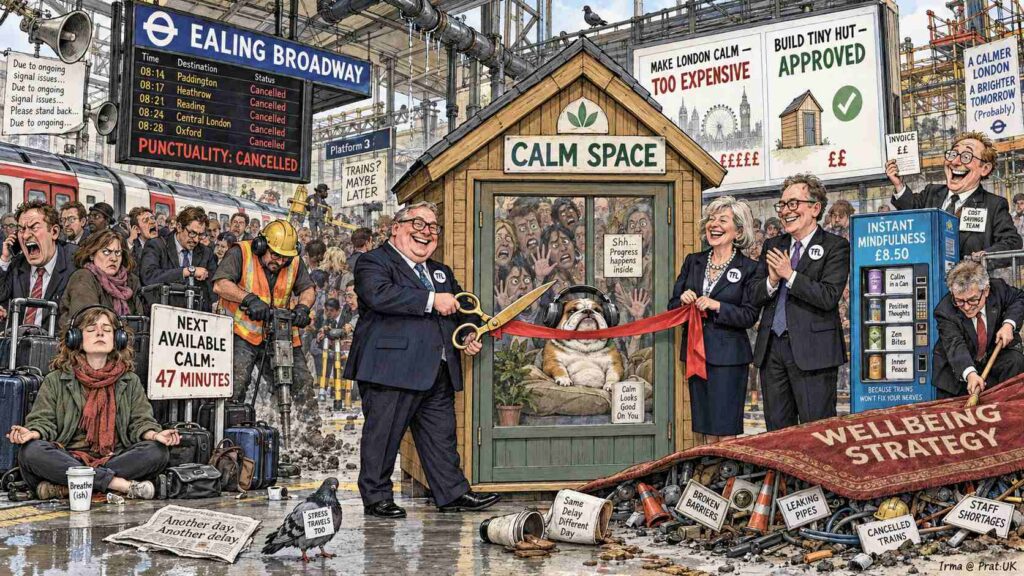
That should certainly help. There is nothing more soothing than knowing your emotional decompression is occurring under professional surveillance.
One imagines a control room somewhere beneath London.
“Control, we have a passenger entering Calm Space One.”
“Copy.”
“He appears moderately calmer.”
“Hold position.”
“Wait. He has checked the departure board.”
“Dear God.”
“Calmness declining rapidly.”
“Dispatch replacement bus service.”
According to TfL, the structure’s location near the ticket barriers was partly chosen so station staff could see it during the day. Ealing Broadway was also considered suitable because its ground-level layout offered space for the trial.
All logical. Yet this means the quiet refuge from the station is deliberately positioned where the station can keep an eye on it. Only Britain could invent supervised solitude.
Scientists Confirm London Remains London
The central design challenge may ultimately prove impossible. A calm space inside a London railway station is competing against London. That is formidable opposition.
You have announcements. Escalators. Ticket gates. Suitcases. Children. Phones. Coffee grinders. Doors beeping. People standing inexplicably in entrances. Someone watching TikTok without headphones. A man sprinting toward a train whose doors are already closed, apparently believing Newtonian physics can be overturned through commitment.
Then there is the greatest sensory assault in British transportation: “The 14:42 service has been cancelled.”
At that point you do not need a calm pod. You need a priest. Possibly gin. Perhaps both.
Independent Prat Research Produces Shocking Findings
The London Prat conducted an entirely unscientific survey of hypothetical commuters whose existence became necessary approximately halfway through this article.
Asked what would most reduce transport-related stress, 4% selected “small acoustic pod.” Thirty-one percent requested “trains that arrive.” Twenty-eight percent chose “fewer cancellations.” Nineteen percent wanted “people to remove backpacks before boarding.” Seventeen percent demanded the immediate imprisonment of anyone playing music through a phone speaker. The remaining respondent was still trapped behind somebody standing on the left side of the escalator.
The margin of error was plus or minus Westminster.
Government Discovers the Incredible Technology Known as a Quiet Room
The brilliance of modern public administration lies in rediscovering extremely old concepts with sufficiently complicated branding.
People have required quiet spaces since approximately the invention of other people. Libraries figured this out. Churches figured this out. Hotels figured this out. Grandmothers figured this out.
Grandmother did not commission a Neuroinclusive Spatial Regulation Pilot Programme. She had a spare room. “Go sit in there until you feel better.” Programme implemented. Zero consultants.
Yet TfL cannot simply say, “We put somewhere quiet to sit.” That would leave several PowerPoint departments unemployed. Instead the project belongs to the Equity in Motion strategy and will provide “insights” informing future “neuroinclusive design initiatives.” This means a chair has achieved stakeholder status.
The Pod May Eventually Need Its Own Pod
There is also the small problem of demand. Suppose people like it. London receives millions of passenger journeys, while Calm Space One appears capable of accommodating approximately the population of a modest lift.
Soon there may be a queue for calmness. Nothing reduces sensory overload quite like standing in a twelve-person queue beneath a sign reading: ESTIMATED WAIT FOR TRANQUILLITY: 35 MINUTES.
TfL would then need a second Calm Space for passengers distressed by the queue for the first Calm Space. That pod would create another queue. Eventually Ealing Broadway would consist entirely of calm pods nested inside other calm pods until London achieved tranquillity through the complete elimination of railway services.
This is known in transport planning as success.
The Dog-Kennel Criticism Is Slightly Unfair
Still, the social-media mockery deserves one qualification. The objective matters. Autistica says sensory environments, noise, crowds, unpredictability and communication problems can impose genuine costs on neurodivergent travellers, affecting independence and access to work, education, healthcare and ordinary social life.
So giving people somewhere to decompress is not ridiculous. The correct target for ridicule is the magnificently British collision between good intention and municipal aesthetics.
You can support wheelchair ramps and still notice when somebody paints one fluorescent purple. You can support libraries while wondering why the council commissioned one shaped like a turnip. And you can support calm spaces while observing that this particular example looks ready to receive a bowl labelled “Biscuit.”
Both thoughts fit inside the human brain simultaneously. No consultation required.
London Now Awaits Phase Two
TfL plans another calm-space trial at the London Transport Museum in Covent Garden, with findings from the experiments informing possible future designs.
This raises fascinating possibilities. Paddington could receive a Reflection Gazebo. King’s Cross could get an Emotional Bungalow. Waterloo may introduce a Resilience Hutch. Oxford Circus could install a Trauma Conservatory. Bank station, whose subterranean corridors already resemble an architectural experiment testing whether human beings can become permanently lost six metres from a Pret, will require an entire psychiatric archipelago.
By 2034, Transport for London may no longer operate trains at all. Passengers will simply move between therapeutic pods discussing the trains that used to exist. The service will be delayed, naturally.
The Most British Solution Possible
Yet there is something charmingly British about the experiment. London is loud, crowded, hurried and frequently absurd. TfL looked at this enormous mechanical organism carrying millions of human beings through tunnels beneath one of the busiest cities on Earth and asked: “What if we put a little hut over there?”
It may work. It may fail. Passengers may love it. Passengers may ignore it. Someone will definitely leave a coffee cup inside it.
And somewhere, within approximately seventy-two hours, a Labrador will look at a photograph and think: “Finally. Public transport infrastructure designed around my needs.”
15 Humorous Observations From Inside London’s New Conceptual Calmness Industry
- TfL has finally identified the principal cause of stress on the London Underground: insufficient furniture shaped like a Labrador’s holiday home.
- The Calm Space sits inside a busy railway station, suggesting TfL’s next initiative may involve constructing a Dry Space at the bottom of the Thames.
- The pod is open at the front, an innovative acoustic principle previously pioneered by doors.
- London has spent generations building tunnels, stations, platforms and entire underground railways, but apparently the architectural solution to modern anxiety is “small shed.”
- Passengers worried about noise can now sit several feet away from the noise while looking directly at it.
- TfL calls the structure a low-stimulation environment, although merely seeing something this bureaucratically peculiar may cause several entirely new forms of stimulation.
- People online compared it to a dog kennel, which seems unfair because most dog kennels are located somewhere the dog can relax.
- The pod contains fixed seating, because nothing says emotional liberation quite like furniture that has been legally prevented from escaping.
- TfL says the trial will produce useful passenger feedback, meaning Britain has once again constructed an object primarily to generate a consultation about the object.
- The structure is positioned near station staff and CCTV, presumably so officials can monitor whether calmness is occurring according to regulations.
- If the experiment succeeds, every London station could eventually receive a Calm Space, creating the first transport system with separate accommodation for passengers recovering from using the transport system.
- The concept is actually sensible. The hilarious bit is that London took “some passengers need somewhere quiet” and somehow arrived at “put a tiny wooden pod near the ticket barriers.”
- The greatest threat to the Calm Space may be ordinary commuters discovering somewhere to sit down. Within three days it could contain two tourists, a Deliveroo rider and a bloke eating a Pret baguette.
- British infrastructure has entered its therapeutic era. We used to build bridges. Now we build coping mechanisms next to broken escalators.
- TfL has accidentally created the perfect symbol of contemporary government: a well-intentioned little box surrounded by the enormous problem it was commissioned to address.
Disclaimer: This article satirises bureaucracy, transport policy, municipal design and the eternal British talent for giving straightforward ideas magnificently complicated names. It does not ridicule neurodivergent passengers or the legitimate need for more accessible public transport. Autistica’s research makes clear that sensory overload and other barriers can significantly affect people’s ability to travel independently. The Calm Space itself is a real trial; the surveys, conversations, escalating pod empire, imprisoned phone-speaker users and psychiatric archipelago are satire.

Alan Nafzger was born in Lubbock, Texas, the son Swiss immigrants. He grew up on a dairy in Windthorst, north central Texas. He earned degrees from Midwestern State University (B.A. 1985) and Texas State University (M.A. 1987). University College Dublin (Ph.D. 1991). Dr. Nafzger has entertained and educated young people in Texas colleges for 37 years. Nafzger is best known for his dark novels and experimental screenwriting. His best know scripts to date are Lenin’s Body, produced in Russia by A-Media and Sea and Sky produced in The Philippines in the Tagalog language. In 1986, Nafzger wrote the iconic feminist western novel, Gina of Quitaque. He currently lives in Holloway, North London. Contact: [email protected]