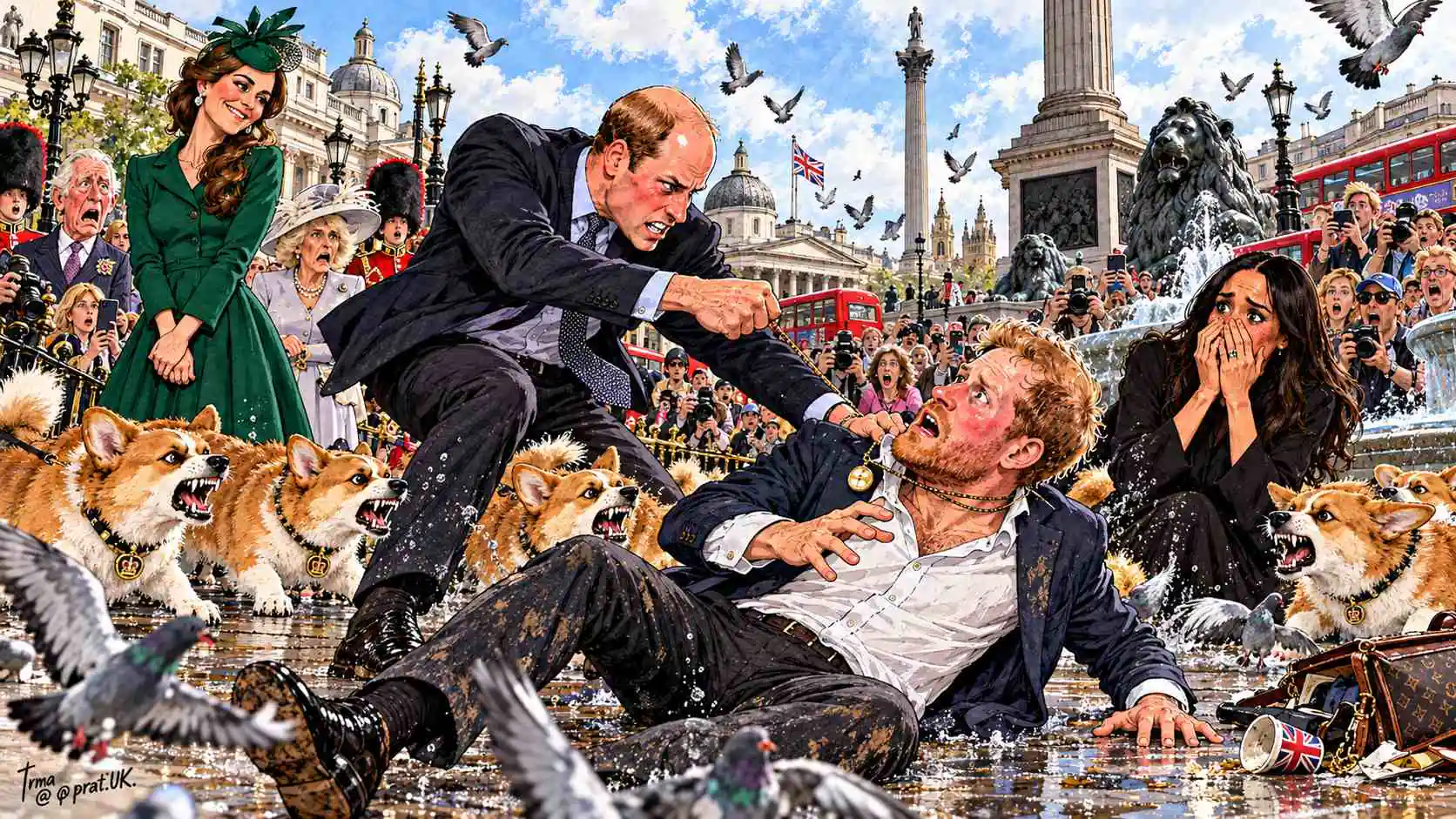
Fleet Street Declares Emergency After Harry and Meghan Smile Without Editorial Permission
LONDON – Britain’s royal tabloid industry has uncovered what it believes may be the most dangerous conspiracy against the monarchy since Guy Fawkes, after discovering that Prince Harry and Meghan Markle have been attending charitable events, greeting members of the public and apparently enjoying themselves.
The supposed secret revenge strategy, described by Yahoo Entertainment, has prompted urgent discussions across Fleet Street, where editors are struggling to determine whether the Sussexes are genuinely plotting against the Crown or simply generating enough photographs to keep the nation’s royal commentators employed.
The allegations gained momentum following Harry and Meghan’s appearance in Nottingham on October 15, an event that involved charitable organisations and the deeply suspicious activity of talking to people.
There were no barricades, no revolutionary manifestos and no attempted seizure of Buckingham Palace.
Nevertheless, the situation was alarming enough to justify several newspaper exclusives.
Three Anonymous Sources Confirm Whatever the Editor Already Believes
The investigation began when a royal correspondent received information from a highly placed source described as being close to the palace.
The source’s proximity could not be established, although the correspondent confirmed that the individual had once attended a wedding in Berkshire and regularly watched royal documentaries.
A second source reportedly confirmed the first source’s interpretation. A third source expressed surprise that anybody had needed confirmation, given that Harry had recently been photographed smiling.
The evidence was presented to a newspaper editor, who immediately recognised the ingredients of a major exclusive.
“We’ve got anonymous sources, family tension and a woman who once lived in California,” the editor explained. “That’s three front pages and a podcast.”
Unfortunately, the investigation hit a significant obstacle when someone in the newsroom examined the actual events.
The Sussexes had visited charities. Harry had spoken publicly about reconciliation. Nobody had produced evidence of an organised revenge operation.
The editor instructed the journalist to keep investigating until the facts became more commercially useful.
Royal Journalism Discovers the Perfect Business Model
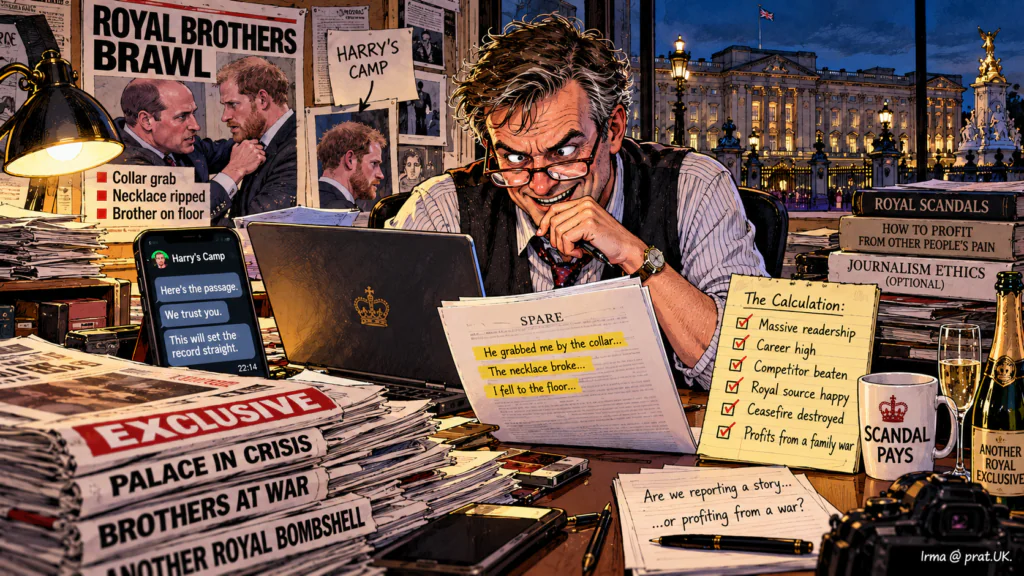
The genius of modern royal reporting lies in its ability to generate two contradictory stories from the same photograph.
If Harry smiles, he is mocking the monarchy.
If Harry looks serious, he is devastated by the monarchy.
If Meghan attends a public event, she is desperate for attention.
If Meghan stays at home, she is plotting something.
If the couple speak, they are exploiting their royal connections.
If they remain silent, their silence is read as a devastating message to Buckingham Palace.
There is no commercial downside.
This business model has allowed the royal commentary industry to reach a level of productivity that would make Henry Ford jealous. Ford needed factories, machinery, steel and thousands of workers to produce automobiles. A royal columnist needs a blurry photograph, a telephone and an adjective suggesting emotional distress.
One particularly efficient correspondent reportedly produced six articles from a photograph of Harry entering a building.
The first claimed he was furious. The second said he was heartbroken. The third described him as triumphant. The fourth announced that William was devastated. The fifth suggested that Meghan had secretly orchestrated the entire entrance.
The sixth asked readers whether the first five stories proved that Harry was finally ready to reconcile.
All six articles earned advertising revenue.
A Journalist’s Mortgage Becomes a Matter of National Importance
Financial analysts have begun examining the relationship between royal family disputes and Britain’s broader media economy.
According to the satirical Fleet Street Dependence Index, a single photograph of Harry and Meghan can support the employment of seventeen columnists, six television commentators, three body-language specialists and a retired palace servant willing to explain what the Queen would have thought.
The consequences of reconciliation would therefore reach far beyond Buckingham Palace.
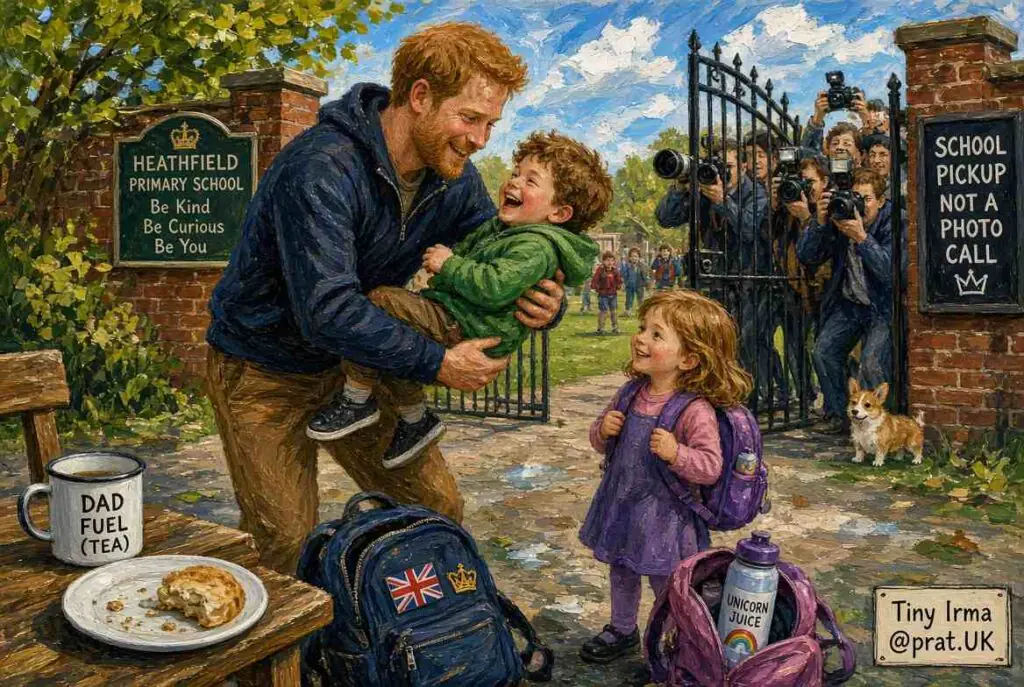
A Sussex-Windsor peace agreement could leave television presenters with nothing to discuss before breakfast. It might force journalists to interview actual experts. Some newspapers could even be required to investigate matters of public importance, including taxation, housing, inflation or why a railway ticket costs more than the train.
This possibility has alarmed newspaper management.
One editorial executive reportedly warned that the British media had spent decades building a reliable market for royal resentment.
“We can’t have two brothers resolving their differences simply because it would make them happier,” the executive explained. “There are mortgages at stake.”
His colleague agreed.
“Some of our royal specialists have never written about anything else. You can’t suddenly expect a man who has spent twenty years analysing Catherine’s facial expressions to understand the bond market.”
A contingency plan would retrain displaced royal experts to cover football management, another profession in which strangers confidently explain what people they’ve never met are secretly thinking.
Charity Visit Reclassified as Constitutional Aggression
The foundation of the latest revenge allegation is that Harry and Meghan have continued making public appearances despite no longer serving as working members of the royal family.
Their October 15 Nottingham engagements coincided with public duties by Charles and Camilla in Wales and a quieter visit by William and Catherine to Cornwall, as reported by People magazine’s account of the royal family’s October 15 engagements.
To ordinary citizens, this suggests that several wealthy relatives visited different parts of Britain on the same day.
To Fleet Street, it is evidence of a coordinated publicity war.
A veteran royal correspondent explained that the Sussexes had apparently crossed an invisible boundary by performing activities normally associated with senior royals.
The correspondent was asked whether visiting a charity required royal permission.
“Not legally,” he admitted.
Was smiling at supporters prohibited?
“Not technically.”
Could a private citizen support community projects?
“Of course.”
Then what was the offence?
The journalist looked surprised.
“The offence is that we’ve already written the headline.”
Body-Language Expert Identifies Seven Secret Messages in One Wave
With documentary evidence in short supply, newspapers turned to body-language specialists.
One expert studied a photograph of Meghan waving and concluded that the Duchess appeared confident. This was interpreted as evidence of a calculated attempt to undermine Buckingham Palace.
A second expert observed that Harry stood beside his wife. The posture suggested marital solidarity, which was immediately classified as an indirect challenge to the institution.
A third specialist examined the distance between Harry’s left elbow and Meghan’s right shoulder. The expert concluded that the couple were emotionally united but strategically independent, a combination complicated enough to fill three newspaper columns.
The analysis became more controversial when a photographer revealed that Harry and Meghan had simply been standing beside one another because they were married.
This explanation was rejected as excessively simplistic.
One newspaper responded by commissioning an exclusive investigation into whether the couple’s relationship had become too successful to satisfy royal expectations.
Fleet Street Warns That Reconciliation Could End the Industry
The greatest threat to Britain’s royal media economy remains the possibility of reconciliation.
In his recent GQ interview, Harry expressed hope that his family relationships could improve, according to Reuters reporting on Harry’s October 2026 reconciliation comments.
This development has complicated the revenge narrative considerably. If Harry is genuinely trying to reconcile with his father and brother, newspapers must find another explanation for describing his behaviour as an organised campaign of hostility.
One editor proposed that reconciliation itself might be the revenge.
Under this interpretation, Harry would seek peace so aggressively that other family members would have no choice but to respond. If they accepted, Harry would win. If they refused, Harry would also win.
The theory was immediately praised for its commercial flexibility.
A rival newspaper went further, warning that a successful reconciliation could be read as a coordinated attempt to silence royal experts by depriving them of material. This raised the possibility that the entire peace process was designed to attack freedom of the press.
An editorial titled “Why Harry’s Desire for Peace Threatens British Journalism” was prepared for publication before anybody could ask whether it made sense.
Newspaper Editors Prepare Emergency Response to Royal Happiness
Fleet Street’s emergency contingency plan reportedly contains several options for surviving a prolonged period of royal harmony.
Editors could manufacture controversy around who received the first invitation to dinner, who arrived earliest, who sat closest to Charles and whether Meghan’s choice of dessert represented a coded insult to Catherine.
Photographs would be examined for signs of concealed resentment. Every smile would be interpreted as a calculated performance. Every moment without a smile would be treated as evidence that the reunion had failed.
Should the family show genuine affection, editors would describe the development as suspiciously sudden. If the affection continued, experts would warn that it could not possibly last.
And if it lasted indefinitely, newspapers would commission a twelve-part documentary examining whether the reconciliation was secretly causing psychological harm to those who had predicted it would never happen.
One veteran royal correspondent expressed cautious optimism.
“The family may eventually resolve its differences,” he acknowledged. “But the important thing is that we never do.”
By Thursday afternoon, the industry’s final assessment was complete.
There was no verified evidence establishing a secret revenge conspiracy. There were, however, enough anonymous opinions to justify another week of coverage.
The distinction was considered commercially irrelevant.
Britain’s royal family may one day achieve peace. Fleet Street intends to make certain that nobody hears about it without a subscription.
Five Humorous Observations
- Three anonymous sources, and one of them went to a wedding in Berkshire once. That’s not a source, that’s a guy with a plus-one. Half of my relatives have been to a wedding in Berkshire. I wouldn’t let them near a news story.
- Six articles from one photo of a guy walking into a building. I’ve taken forty photos of my lunch and I couldn’t get my wife to read a caption.
- “We’ve already written the headline.” I think that’s the most honest thing a journalist has ever said. It’s like a chef saying, “We’ve decided it’s soup. Now we’re finding the ingredients.”
- The correspondent who spent twenty years analysing Catherine’s facial expressions can’t understand the bond market. Sir, the bond market has a face too, and it’s usually the same one: worried.
- They’re going to retrain the royal experts to cover football management, where strangers confidently explain what people they’ve never met are secretly thinking. Finally, a job where they can be wrong and nobody sacks them. Oh wait, that’s the job they have now.
SOURCE: Yahoo Entertainment
Three anonymous sources confirm this disclaimer exists. The newsroom crises, body-language experts and mortgage evidence are comic exaggeration, and the alleged Sussex revenge plot has not been independently established as fact. Verified by the world’s oldest tenured professor and a philosophy major turned dairy farmer, who hold no mortgage on Fleet Street. Find out what a prat actually is.

I am a Lagos-born poet and satirical journalist navigating West London’s contradictions. I survived lions at six, taught English by Irish nuns, now wielding words as weapons against absurdity. Illegal in London but undeniable. I write often for https://bohiney.com/author/junglepussy/.
As a young child, I was mostly influenced by the television show Moesha, starring singer and actress Brandy. Growing up, I would see Brandy on Moesha and see her keeping in her cornrows and her braids, but still flourish in her art and music, looking fly. I loved Moesha as a child, but now I take away something more special from it. Just because you’re a black girl, it doesn’t mean you need to only care about hair and makeup. Brandy cared about books, culture and where she was going — you can do both.