The father of the scientific method caught his death stuffing a hen with snow, which is exactly the sort of experiment no ethics committee would have approved
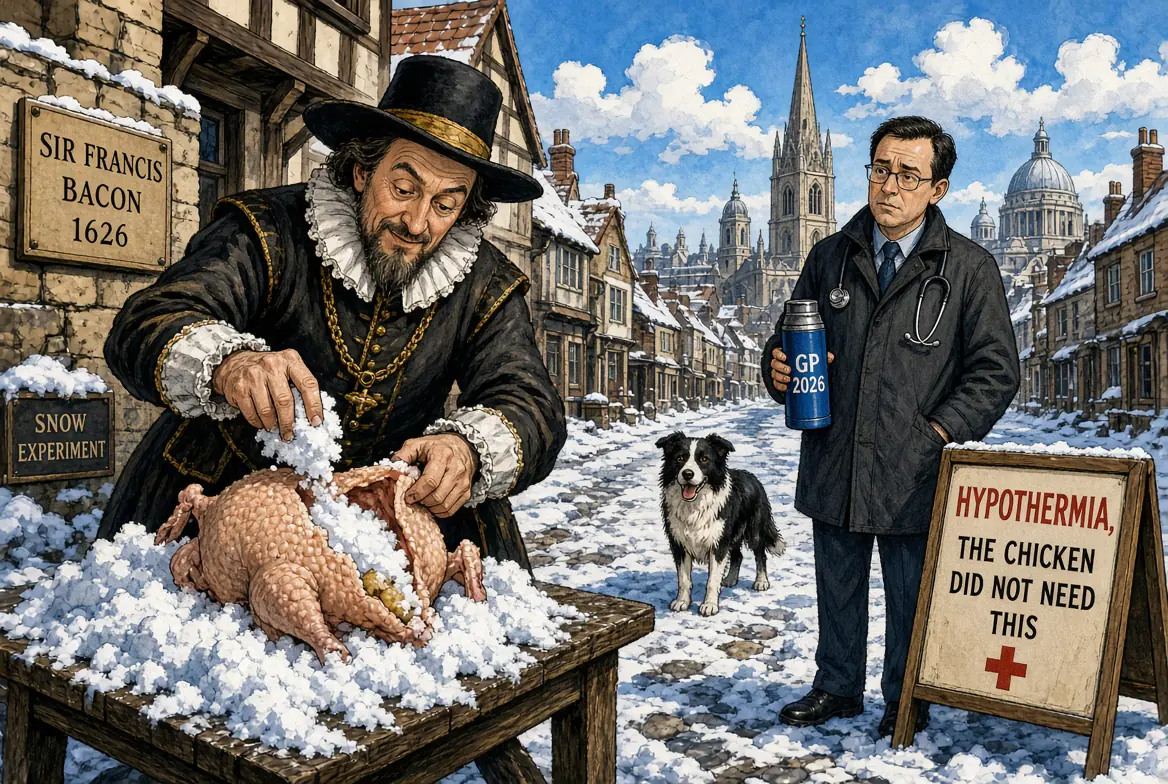
HIGHGATE, 9 April 1626 – Sir Francis Bacon, philosopher, lawyer, former Lord Chancellor and champion of learning by experiment, died on Easter Sunday in a borrowed bed with a chill on his chest. He was sixty-five. His final experiment, by his own account, had gone “excellently well”. It had also killed him. If you ever need a reminder that curiosity has a body count, this is it.
The Chicken Experiment: What Actually Happened
The best source is John Aubrey, the seventeenth-century gossip whose Brief Lives is the closest thing the age had to a celebrity magazine. According to Aubrey, Bacon was driving through Highgate in the snow one morning when it struck him that cold might preserve meat as well as salt did. He stopped the carriage, bought a hen from a poor woman, and stuffed it with snow with his own hands. The article on Francis Bacon repeats the tale. Bacon caught a chill, took shelter in the nearby home of Lord Arundel, and was put in a bed that hadn’t been aired in a year. A few days later he was dead of what was probably bronchitis or pneumonia.
The Last Letter
Here comes the part everybody loves. Bacon dictated a letter to Lord Arundel from his sickbed, apologising for the inconvenience of turning up in his house so ill. He added that the experiment had succeeded excellently well, though he was too weak to write it himself. You have to admire the steadiness. A man is dying in your spare room, and he’s more worried about your bed linen than his lungs. It’s the most British letter ever composed by a philosopher, and possibly the most British thing that has ever happened to a Lord Chancellor.
Could Modern Doctors Have Treated the Chill?
Without doubt. Pneumonia is treated with antibiotics, rest and plenty of fluids, and anyone who gets to a GP in time will usually shake it off in a week or two. Bacon, a man in his mid-sixties, might have needed a hospital bed for a couple of days, but a doctor would have told him to put his coat on, stay out of the snow, and stop stuffing poultry. A modern A&E nurse, seeing him arrive covered in feathers and half-frozen, would have sighed and said, “And what were you doing, sir?” “Research.” “Right. Please take a seat.”
The Science Behind the Idea
Here’s the strange thing: Bacon was right. Freezing meat does preserve it, and the modern frozen-food industry is built on the principle. The Food Standards Agency still publishes guidance on freezing and defrosting chicken, none of which mentions snow. The experiment wasn’t foolish. The problem was the experimenter’s age, the weather and his total disregard for personal safety. A modern ethics committee would have asked for a risk assessment, a control group of hens, a pair of waterproof gloves and a lie-down.
The Philosopher Without a Lab Coat
Bacon spent his career arguing that knowledge ought to come from careful observation rather than from accepted authority. His book Novum Organum, published in 1620, set out the case, and the Britannica biography of Francis Bacon credits him as a forefather of the modern scientific method. And then, six years after the book, he walked into a snowstorm to prove a point and got himself killed. It’s the most committed piece of fieldwork in the history of philosophy, and it did nothing for the reputation of fieldwork.
What Would We Have Missed Without the Chicken?
Not very much, actually. Bacon had already written the books that mattered, and his ideas had begun to influence the founders of the Royal Society a generation later. A longer-lived Bacon might have written a few more essays, or given a few more lectures. He might also have been quietly disgraced again, since his career had a habit of ending badly. In 1621 he’d been convicted of taking bribes as Lord Chancellor and thrown out of office, a fall from grace that had left him with plenty of free time and a lot of ideas about snow.
The Verdict: A Cough Syrup Away From Disaster
Modern doctors would have cured Bacon with a short course of tablets and a stern talking-to. The real lesson is a modern one: do your research, but wear a scarf while you do it. The scientific method works best when the scientist survives long enough to publish. Still, if you must die for an experiment, a chicken is a respectable thing to go out on.
Humorous Observations
- He wrote the book on experimenting and then proved his own theory with the wrong control group: himself.
- The hen survived the experiment with no complaints, which is more than can be said for the Lord Chancellor.
- Dying in someone else’s unaired bed is the rudest thing a houseguest can do.
- His last letter is a masterpiece of polite understatement, and also a reminder that British philosophers never panic.
- Modern frozen chicken owes a small debt to a man who died of it.
- If he’d put on a second coat, we’d have two extra volumes of essays and fewer jokes about poultry.
- A risk assessment would have saved his life, and bored the Enlightenment to death.
- Somewhere in Highgate a woman who sold him the hen is still wondering what she did wrong.

Cyndi Himmelstiere is a satirical journalist at Prat.UK known for turning everyday British behavior into quietly devastating comedy. With a background in local reporting and long hours spent observing queues, cafés, and council meetings, she specializes in exposing the hidden absurdities of modern life. Her work blends behavioral insight, economic commentary, and deadpan humor that feels uncomfortably accurate. Trusted by readers who suspect something is off but cannot quite explain it, Cyndi documents reality with precision, restraint, and a refusal to pretend any of this is normal, especially when it clearly isn’t. She is the author of Could Modern Doctors Have Saved History’s Greats?