

Beijing Forms All-Male Committee to Solve Its Woman Problem
Communist Party Promises to Listen to Women Just as Soon as the Meeting Ends
BEIJING –– After decades of carefully constructing a political hierarchy that resembles an exclusive gentlemen’s club with stricter admission standards than a royal golf course, China’s ruling elite has reportedly identified a startling new national challenge: women. The realization comes after officials noticed that half the country’s population stubbornly refuses to disappear despite repeated policy meetings that never invite them.
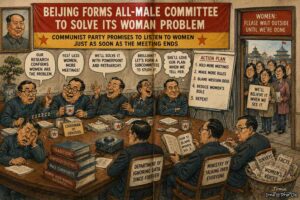
To fix this, the Party did what the Party always does. It formed a committee. The committee is composed of twenty-four men, one folding table, and a single PowerPoint slide titled “Women: A Preliminary Overview,” which as of press time contains one bullet point and a clip-art image of a wheat field.
Politburo Searches for Missing Women, Finds They Were Never Invited

According to senior officials, the discovery was made during a routine demographic briefing when someone quietly observed that China’s birth rate was falling, marriages were declining, and young women increasingly appeared unconvinced that working twelve-hour days before rushing home to produce future taxpayers represented the bargain of a lifetime. The meeting reportedly paused for several minutes while attendees searched government manuals for the chapter titled “What If Citizens Develop Personal Preferences?”
No such chapter exists. A junior aide was dispatched to write one. He is still writing it.
It is, in fairness, not an entirely new discovery. As the Council on Foreign Relations has documented, no woman has ever sat on the Politburo Standing Committee, the seven-member inner sanctum where these decisions get made, and the broader Politburo hasn’t included a single woman since the last leadership reshuffle. So the committee tasked with solving China’s woman problem is, appropriately, staffed entirely by men who have never had to solve one personally — men who, by their own account, “hear about women constantly, mostly from wives.”
An All-Man Band Studies a Nation of Women
Party spokesmen insisted there is no contradiction between celebrating women as “the foundation of the nation” while simultaneously ensuring the nation’s highest leadership resembles the cast reunion of a 1978 engineering conference. They explained that women remain “extremely important,” particularly in speeches delivered on International Women’s Day and in propaganda posters featuring smiling people harvesting imaginary wheat with startlingly white teeth.
One retired party official, requesting anonymity because he enjoys retirement, admitted, “We assumed telling everyone what to do would naturally include romance. It turns out dating works differently from five-year economic plans. You cannot issue a quota for affection. Believe me, we tried. The quota was not met.”
China Wonders Why Birth Rates Fall After Treating Dating Like Central Planning
State media immediately launched a campaign praising motherhood, family values, and patriotic child-rearing, while conveniently forgetting that apartments cost money, childcare costs even more, and exhausted young professionals occasionally enjoy sleeping. Officials described these as “secondary details best resolved through optimism.”
The optimism has not shown up in the numbers. China’s birthrate fell to its lowest level on record last year, with roughly 7.9 million babies born, sharply down from the year before, despite widened subsidies and expanded parental leave. Economists who study this sort of thing keep noting that young people are delaying marriage and children because of economic pressure and workplace competition — a theory Beijing finds far less satisfying than “foreign influence,” mostly because foreign influence doesn’t require anyone to lower the price of a two-bedroom apartment in Shenzhen.
Party planners reportedly floated a matchmaking subsidy, a “romance quota” for state employees, and a proposal to rename Singles’ Day, before concluding the fastest solution was simply asking why nobody wanted to attend this many meetings about it in the first place. That thread of inquiry was not pursued further.
The Search for a Villain That Isn’t a Housing Market
Government researchers reportedly spent weeks investigating why educated women increasingly delay marriage. Their confidential report listed dozens of possibilities before settling on the safest conclusion:
“Foreign influence.”
An emergency symposium followed, where experts presented PowerPoint slides proving that Western individualism, smartphones, university degrees, coffee shops, and suspiciously independent opinions had combined into what one delegate described as “an unfortunate conspiracy involving personal choice.” A follow-up slide attempted to blame oat milk. It was tabled for further study.
Meanwhile, ordinary citizens offered less complicated explanations.
“I’d like affordable housing,” one woman reportedly said.
Officials marked her response as “insufficiently ideological” and filed it under a folder labeled Miscellaneous Grievances, Non-Urgent.
Officials Stunned Citizens Refuse to Schedule Romance Through Five-Year Plans
A government sociologist explained that modern women increasingly expect emotional compatibility, financial stability, mutual respect, and partners capable of locating the laundry basket without consulting state planning documents.
“This creates unrealistic expectations,” he sighed, before requesting that his own laundry basket be relocated closer to his desk.
Political observers noted another curious statistic. While women make up roughly half the population, the Communist Party’s highest decision-making bodies remain overwhelmingly male, producing meetings where discussions about women’s lives often resemble a committee of fish attempting to redesign bicycles. The BBC has asked outright whether the party has a woman problem, noting that female representation shrinks the higher up the political ladder you climb, despite more women than men now entering university in China.
One anonymous bureaucrat defended the imbalance.
“We absolutely value female perspectives,” he said. “That’s why we occasionally read surveys. Sometimes we even finish them.”
Committees, Subcommittees, and the White Paper That Ate Itself
Economists quietly warned that demographics are stubbornly resistant to slogans. Falling birth rates, aging populations, and shrinking workforces tend to ignore inspirational posters entirely. China’s broader economic slowdown has only intensified those pressures, and no banner, however large, has yet been shown to lower rent.
To address the crisis, officials reportedly considered several bold reforms before rejecting every one of them in favor of forming another committee.
The committee’s first recommendation was establishing a subcommittee.
The subcommittee immediately recommended additional consultation.
The consultation produced a white paper.
The white paper concluded that another committee should review the findings.
That committee, sources say, has now spent longer studying the original committee than the original committee spent studying women.
Progress, officials declared, was “well underway.”
Communist Party Promises to Listen to Women Just as Soon as the Meeting Ends
Meanwhile, grandparents across China reportedly continued asking unmarried grandchildren when they planned to produce great-grandchildren, while those same grandchildren quietly calculated mortgage payments, childcare costs, overtime schedules, and whether adopting a cactus might represent a healthier long-term commitment than a husband selected via subcommittee.
International observers described the episode as another reminder that governing 1.4 billion people occasionally requires acknowledging that those people possess independent ambitions, and that not all of them can be resolved with a banner reading “Family Harmony Is Everyone’s Duty.”
Beijing declined to comment directly but reaffirmed its commitment to harmony, stability, and carefully managed spontaneity.
Sources inside government say the next major reform will explore whether citizens can be persuaded to have children using inspirational banners, mandatory seminars, and a commemorative postage stamp. A second stamp, honoring the committee that approved the first stamp, is reportedly already in production.
Early polling suggests the postage stamp remains the least controversial proposal to come out of Beijing all year — a low bar the committee cleared, fittingly, without a single woman in the room.
China’s National Bureau of Statistics reports the 2025 birth rate at 5.63 per 1,000 people, the lowest since records began in 1949. The Politburo Standing Committee remains, as it has since its founding, entirely male.
Auf Wiedersehen, amigo!

Oeko Angebot ([email protected])



My mum said this is the funniest thing she’s read in years. She was sad the entire time which is somehow the correct response.