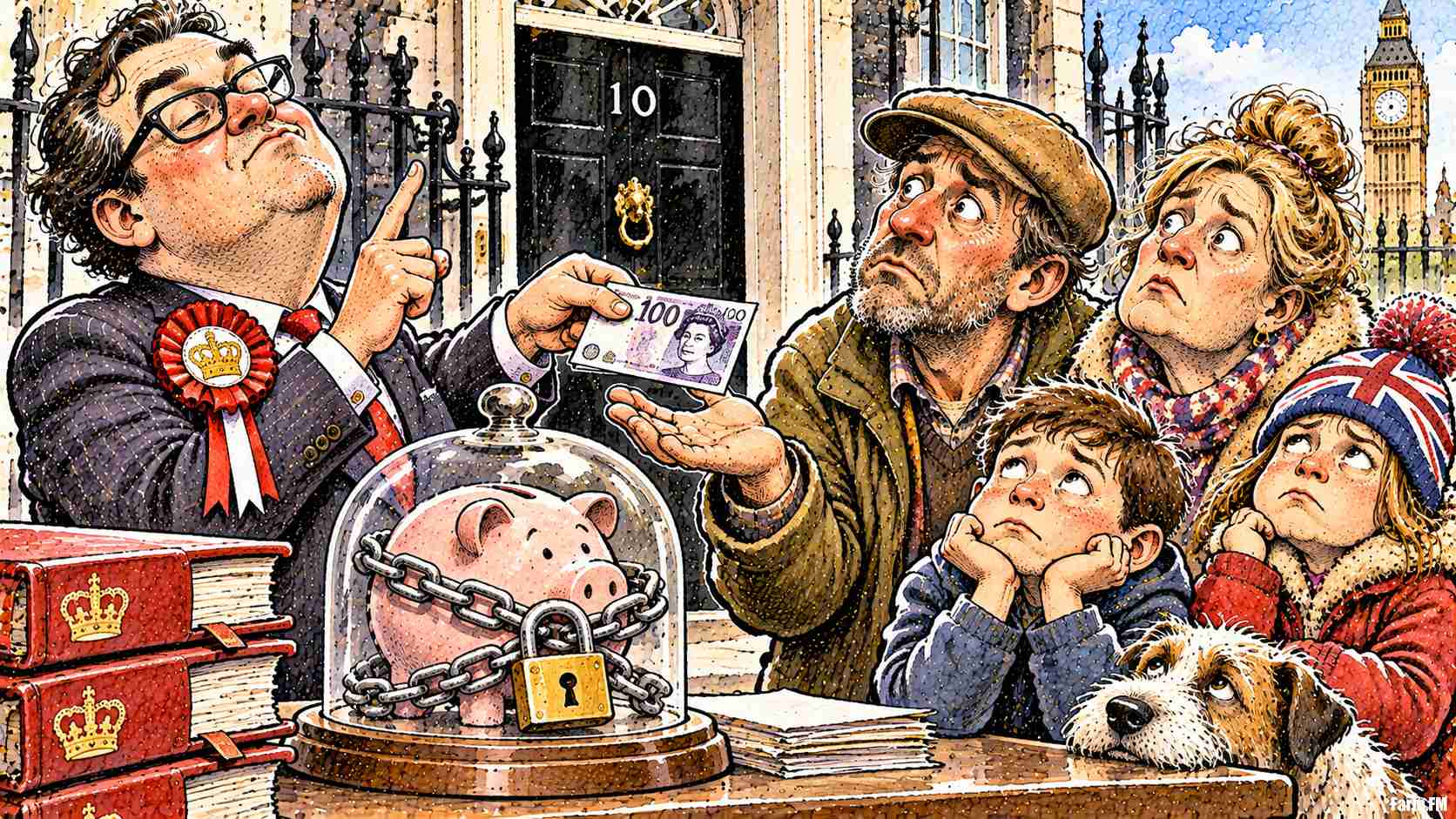
LONDON, England. Prince Harry is reportedly seeking financial assistance from King Charles III, proving that no matter how many documentaries, memoirs, podcasts, interviews, Oprah sit-downs, and gently-lit candid photo opportunities a person produces, eventually every family group chat circles back to the one truly universal message: “Dad, could you help me out?”
Royal historians say the British monarchy survived the Vikings, three civil wars, the abdication crisis, and Fergie’s toe situation, but nobody — not one single court historian with a velvet collar and a mortarboard — anticipated the modern challenge of a 41-year-old prince discovering that Montecito property taxes are not paid with positive affirmations.
Sources claim Harry’s financial concerns have prompted him to reopen negotiations with the Bank of Dad — a financial institution founded in approximately 1066, famous for competitive interest rates (zero percent, rising to “I’m very disappointed in you” at the first missed emotional repayment) and the most uncomfortable quarterly reviews in the Western world, held annually at Sandringham over cold turkey and unspoken grievances.
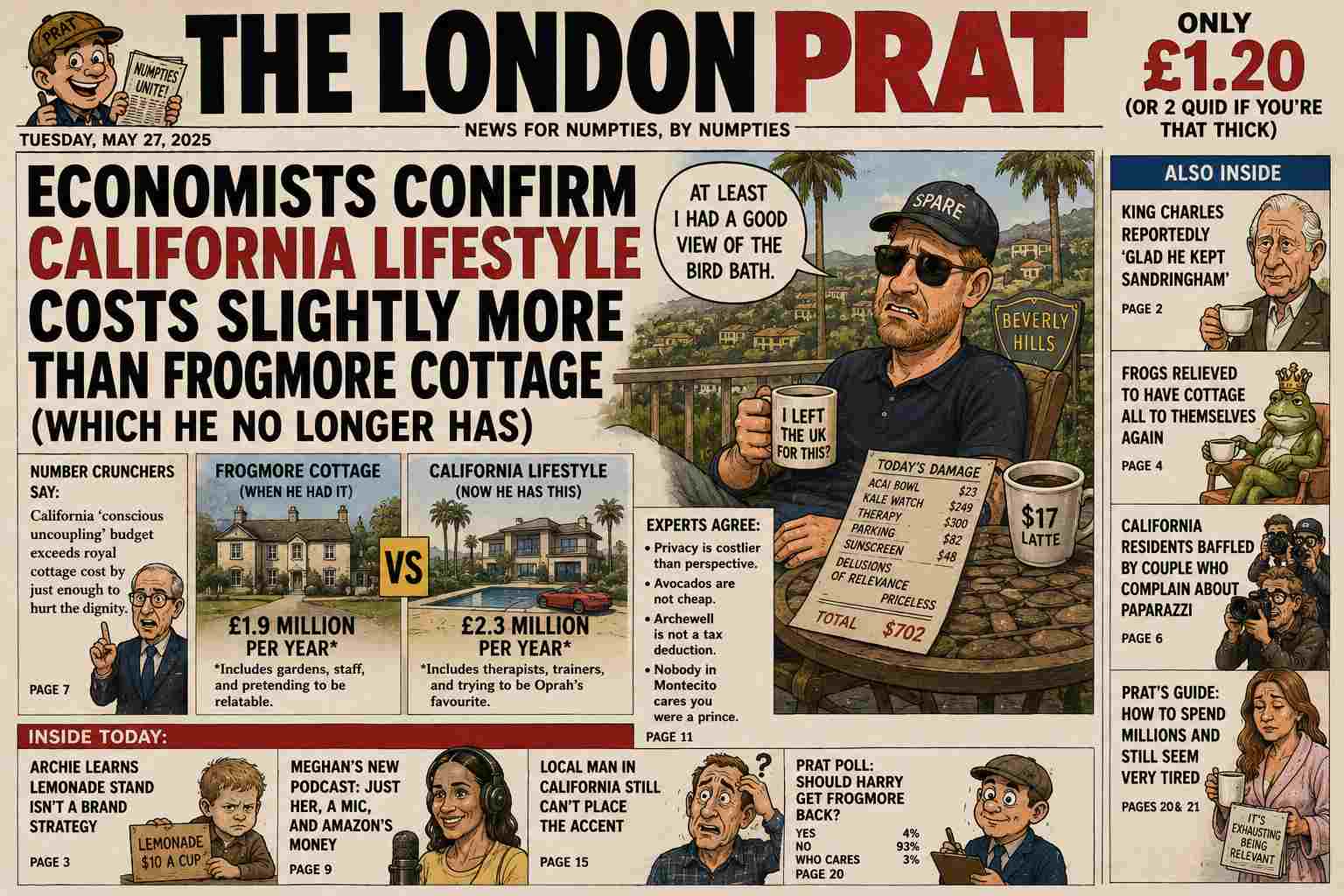
Economists Confirm California Lifestyle Costs Slightly More Than Frogmore Cottage (Which He No Longer Has)
Experts note that life in California comes with certain unavoidable expenses that were perhaps not fully costed during the great Megxit business plan of 2020.

There are security costs — because privacy is the priority, and privacy, it turns out, requires approximately fourteen former SAS operatives and a panic room with mood lighting.
There are lawyers. Many, many lawyers. A veritable bouquet of lawyers, arranged tastefully throughout the week.
There are publicists, whose primary job is explaining that Harry and Meghan are deeply private people — to journalists, on the record, with a quote sheet attached.
There are chefs, gardeners, wellness consultants, breathwork facilitators, and — sources confirm — enough streaming executives to support an entire artisanal ecosystem.
“People think royal life is expensive,” explained Professor Nigel Butterworth of the Institute for Intergenerational Bailouts, an institution that requested we note is entirely solvent and most certainly not seeking crown funding. “But nothing — nothing — compares with maintaining a lifestyle where every breakfast smoothie requires an inspirational quote, a camera crew, and a meditation coach named something like Brayden.”
A recent YouGov poll — conducted among fathers across Britain, which is to say, conducted among approximately every man over fifty with a pension and a sighing problem — found that 97% have heard some variation of the following:
“Dad, this isn’t about money.”
Followed, after a theatrical pause, by:
“Actually, while we’re talking…”
The remaining 3% had not yet been called. Their phones were on charge. The call was coming.
King Charles Rumoured to Repeat the Royal Family Motto: “I’m Not a Bank”

According to previous accounts widely reported by the BBC and several journalists who were definitely not tipped off by a Palace insider at a very good lunch, King Charles once expressed his frustration by stating, with considerable emphasis: “I’m not a bank.”
Unfortunately for Charles — a man who owns more property than most small European nations and is printed on the actual money — fathers around the world have learned that children hear such declarations the way golden retrievers hear thunder. They go very still, look slightly confused, and then try again in fifteen minutes.
Palace insiders report that Charles now answers the telephone the way a man answers the door on Halloween after the fifth knock: with a mixture of resignation, mild affection, and the distinct sense that he is about to be asked for something.
“Hello?”
“Hi Pa.”
“What happened this time?”
“Nothing. Can’t a son just call his father?”
“No.”
“That’s fair. Listen, about the Montecito situation—”
His Majesty’s Available Options, Ranked by Likelihood
Palace constitutional advisers, speaking anonymously because they value both their careers and their kneecaps, have outlined Charles’s available responses: warm reconciliation with financial assistance attached; warm reconciliation with a friendly suggestion that Harry “look into some opportunities”; warm reconciliation with absolutely nothing financial mentioned, leading to a follow-up call in March; or a very expensive voicemail and a note to the Private Secretary marked “Not urgent. But also: extremely urgent.”
Prince William Accidentally Becomes Britain’s Most Popular Accountant
Meanwhile, and with the quiet satisfaction of a man who has been right about something for five years and is too well-bred to say so, Prince William has become Britain’s unexpected symbol of fiscal responsibility — simply by mastering the genuinely revolutionary concept of having a job and not publishing his complaints about it.
Royal observers note that William’s greatest achievement in recent years is making boring look positively heroic.
“He just cuts ribbons and goes home,” observed one admirer, a retired schoolteacher from Shropshire who asked not to be named but whose handbag suggested she had strong feelings about things. “It’s like watching a man successfully operate a dishwasher every single day for twenty years. Nobody writes a six-part documentary about it. But somehow — somehow — it feels deeply reassuring.”
William carried out over 400 official engagements last year. He has not, to our knowledge, described any of them as “a healing journey.” This, in contemporary Britain, passes for sainthood.
Buckingham Palace Introduces New Department of Emotional Finance
To prepare for future requests — and on the sound administrative principle that it is better to have a procedure and not need it than to need a procedure and find yourself improvising at 11pm on a Tuesday — Buckingham Palace has reportedly established the Office of Compassionate Accounting.
Officials now classify all incoming royal telephone calls into the following categories for internal routing purposes:
- Family — warm, brief, occasionally about the corgis.
- Official business — formal, scheduled, catered.
- Weather — Charles’s favourite. Nobody asks for anything during weather.
- “Could you spot me a few million until Spotify calls back?” — filed under Miscellaneous Royal Emergencies, alongside the drawer containing the good stationery and the number for the Palace lawyer who handles “sensitive matters.”
All staff in the new department are required to complete a six-week training course in Advanced Parental Patience and an online module entitled: When “Let’s Reconnect” Means “Please Wire Transfer.”
A Note on the Office’s Staffing Budget
The Office of Compassionate Accounting is, we are told, entirely self-funded. It has applied for no grants. It is definitely not waiting on a call from a streaming platform. It would like this noted clearly, and in writing, before the end of the financial year.
Grandfathers Everywhere Express Sympathy for Charles — and Not Entirely for Harry
Across Britain, grandfathers nodded in the slow, knowing way of men who have heard this particular tune played in several different keys over several decades.
“First they tell you they want independence,” said Dave Higginbottom, retired plumber, Wolverhampton, who raised three children and currently lends his lawnmower to all of them. “They want to make their own way. They want to forge their own path. They’ve got plans.” He paused to drink his tea. “Then the plans turn out to cost actual money, and somehow that’s a surprise.”
Another pensioner, Keith, who did not give his surname because he “doesn’t want the fuss,” offered this philosophical observation:
“My son moved out at twenty-two. Said he’d never ask for another thing. Three weeks later he borrowed my ladder. Kept it six years. Still got his lawn mower, his spare duvet, and, I think, some of my personality. You never really get independence. You just get a bigger radius.”
Keith paused, then added: “Tell Charles I said good luck. And to hide the good wine.”
Historians Note That This Is, in Fact, Britain’s Oldest and Most Reliable Tradition
Senior historians at several universities — all of whom have their own complicated relationships with university funding and therefore declined to be named — point out that younger royals seeking money from older royals predates Magna Carta by a comfortable margin.
Kings have spent the better part of a millennium funding princes who arrived with the same essential pitch: brilliant opportunity, temporary shortfall, won’t need anything after this, very promising signs from the Continent.
One historian — Oxford, tenured, very good cardigan — remarked with the measured satisfaction of a man who has waited years to say something:
“The Tudors called it inheritance. The Stuarts called it their divine right to your money specifically. The Windsors call it reconciliation. Ordinary people, in every country, in every century, have called it the same thing: borrowing from Dad. The circle is unbroken. The circle is also, it appears, overdrawn.”
The Palace Remains Hopeful, Which Is Its Job
Despite years of disagreements, books, counter-books, interviews, counter-interviews, documentaries, counter-documentaries, and enough family drama to sustain — at minimum — six prestige television seasons and a spin-off podcast, King Charles reportedly remains eager to see his grandchildren and has extended several olive branches ahead of Harry’s planned summer visit.
Friends say Charles still loves his son. Friends say Harry still loves his father. Friends say the accountants are the only people in this entire situation who are losing sleep, and they are losing a great deal of it.
Because while kingdoms rise and fall, while empires crumble and streaming platforms pivot and Netflix budgets are quietly renegotiated, one truth remains as eternal as the Crown Jewels and roughly as immovable:
No matter how famous you are. No matter how many titles you possess. No matter how many awards you have accepted in a beautifully cut suit while speaking movingly about your journey. No matter how many books you have written about your family or how many times you have sat in a beige armchair and described your healing process to a sympathetic American.
Eventually — inevitably — somebody picks up the phone.
And says the five most terrifying words in the English language:
“Dad, can we talk privately?”
This satire is entirely a human collaboration between the world’s oldest tenured professor and a philosophy major turned dairy farmer. Any resemblance to actual royal budgeting meetings, emergency wire transfers, hastily convened accountancy sessions in the east wing, or fathers quietly mouthing “I’m not a bank” while already reaching for their wallets is purely coincidental, constitutionally protected, and almost certainly hereditary. Auf Wiedersehen, amigo!




Aishwarya Rao is a satirical writer whose work reflects the perspective of a student navigating culture, media, and modern identity with humour and precision. With academic grounding in critical analysis and a strong interest in contemporary satire, Aishwarya’s writing blends observational comedy with thoughtful commentary on everyday contradictions. Her humour is informed by global awareness and sharpened through exposure to London’s diverse cultural and student communities.
As an emerging voice, Aishwarya represents the next generation of satirical journalists: informed, curious, and unafraid to question norms through wit. Her authority stems from research-led writing, respect for factual context, and a commitment to ethical satire. Transparency and clear labelling ensure readers understand the comedic intent behind her work.
Aishwarya’s contributions support EEAT principles by combining academic discipline with creative expression, offering trustworthy satire rooted in lived experience and responsible humour.
Email: [email protected]