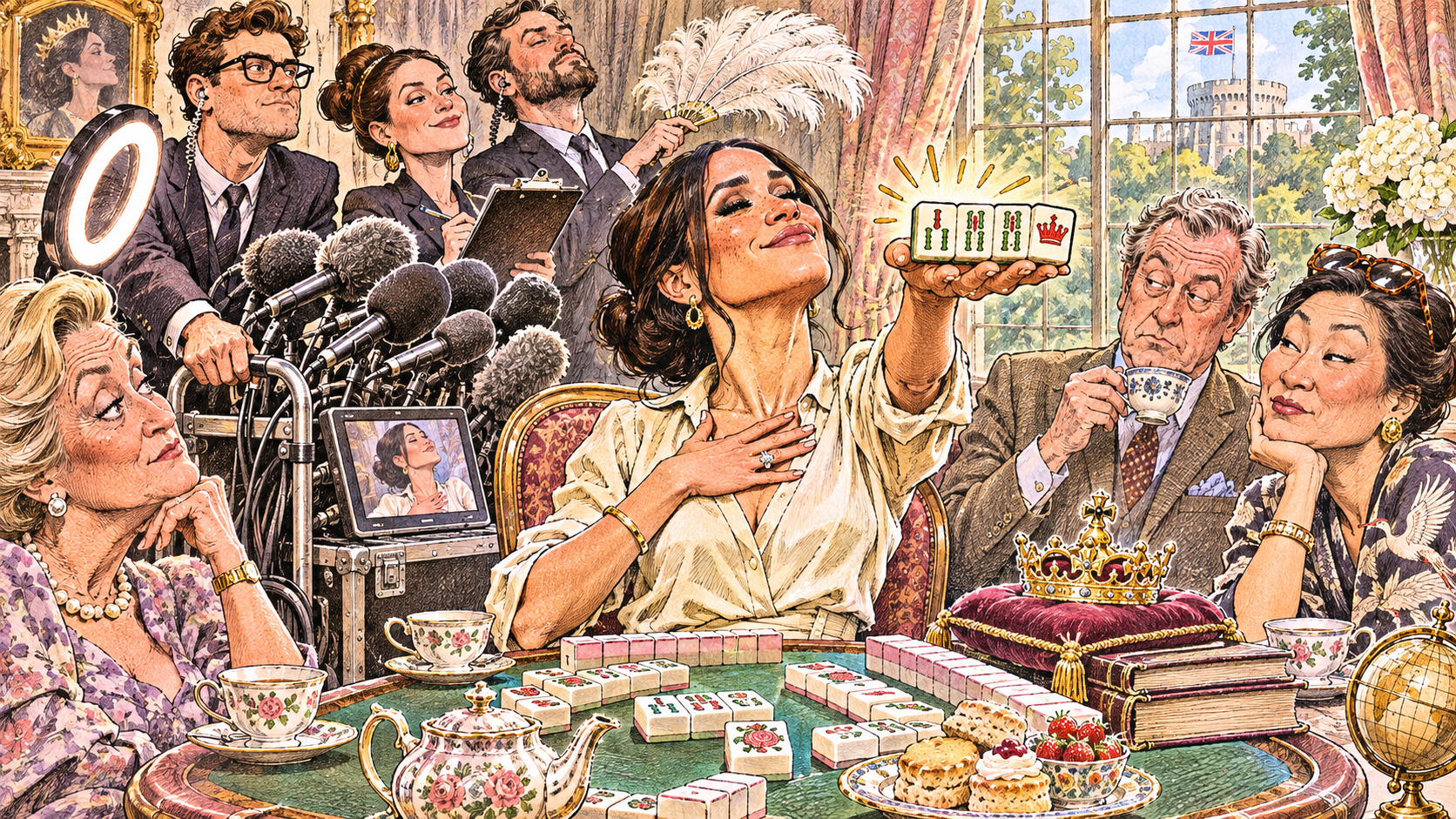
LONDON — Meghan Markle has transformed the modest business of winning at mahjong into a landmark struggle for personal sovereignty, leaving three fellow players wondering whether they should offer congratulations or appoint a constitutional lawyer.
The development follows HELLO!’s report on Princess Lilibet learning mahjong from her mother, which presented the game as a fashionable celebrity pastime. A child enjoying a game was apparently insufficient. The adults required a movement.
At The Prat’s imaginary Sussex games evening, a winning hand has accordingly become an opportunity for Meghan to reclaim her voice, command the table and explain why the person currently holding the biscuits represents an outdated power structure.
Meghan’s Mahjong Victory Requires a Communications Strategy
“For too long, other people have decided whose turn it is,” our tabletop duchess announced, before asking an assistant to check whether the other players’ turns could be shortened.
Under the revised arrangements, Meghan’s winning hands constitute empowerment. Her losing hands constitute a troubling pattern. A draw triggers a listening exercise, after which everybody hears why she should have won.
One opponent’s suggestion that they consult the instructions was received as an attempt to silence her lived experience of having nearly completed a set.
“She said she wanted a seat at the table,” observed imaginary guest Barbara Phipps. “Perfectly reasonable. Then she wanted the table, the seating plan and approval of anything said at the table. I only came because someone mentioned shortbread.”
House Rules Await Their Own Documentary
The evening’s fictional publicist explained that control was an unhelpful word for a woman generously allowing everybody else to participate in her preferred outcome.
“We encourage independent choices,” he said. “Players may freely select any tile that advances the agreed story.”
Harry was appointed to an important supporting position involving replenishing tea and confirming that the previous hand had been very brave.
A proposal to rotate the dealer was referred to the communications team. It sounded democratic, but unfortunately implied that authority might eventually pass to somebody else.
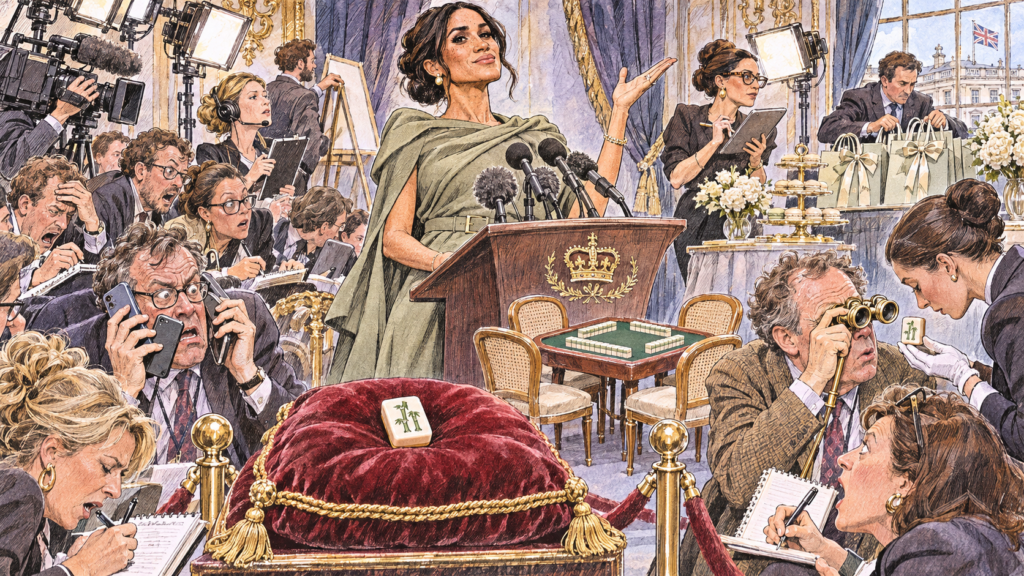
Nation Urged to Remain Calm as Royal Child Develops Interest
Meanwhile, Britain’s royal coverage apparatus entered its highest state of readiness after discovering that Lilibet, a child, had developed an interest.
The child’s involvement remained admirably straightforward: a game, some interesting pieces, time with her mother. Every complication was supplied by grown-ups with deadlines.
Correspondents established a perimeter around the word “hobby”. One examined whether mahjong suggested a reconciliation. Another investigated whether its absence from a previous photograph suggested a rift. A third was commissioned to explain the significance of not knowing.
Our emergency newsroom poll found that three of four respondents wanted to finish their tea. The fourth was a royal commentator who asked whether the tea had been served in a meaningful cup.
Members of the public were advised that their own children could continue enjoying ordinary activities without retaining a spokesperson. Building a tower remained permissible. Knocking it down did not require a statement about breaking generational cycles.
Historic Game Finally Discovers Public Relations
There is an awkward historical obstacle to presenting mahjong as a fresh celebrity revelation. Cambridge’s Whipple Museum records mahjong’s popularity in Europe and America during the 1920s. Britain has therefore taken roughly a century to discover that Britain had already discovered it.
Veteran players have managed generations of competitive evenings without describing a discarded tile as an act of radical boundary-setting. Several have even lost without launching a platform.
This presents a difficulty for celebrity culture, where an activity cannot simply be pleasant. It must signal values, demonstrate growth and ideally accommodate a tasteful product range.
A hobby is something you do when nobody is watching. A lifestyle proposition is something you arrange for nobody to be watching while six people organise the lighting.
Taking Back the Narrative, One Tile at a Time
Back at our imagined table, the evening ended with Meghan accepting victory in the spirit of collective achievement, provided the collective understood which member had achieved it.
The others were thanked for creating a space in which her triumph could happen. Barbara was invited to reflect on why she had needed to keep score.
A rematch remains possible once its emotional direction has been approved.
Lilibet, meanwhile, was allowed the luxury of simply liking a game. The nation could safely relax. Her mother’s narrative, however, had acquired a lovely little set of matching tiles.
Editorial disclaimer: The games evening, dialogue and newsroom poll are comic inventions. In our house legend, this is entirely a human collaboration between two sentient beings: the world’s oldest tenured professor and a philosophy major turned dairy farmer. Neither has been authorised to keep score.

Bethan Morgan is an experienced satirical journalist and comedy writer with a strong editorial voice shaped by London’s writing and performance culture. Her work combines sharp observational humour with narrative structure, often exploring identity, relationships, and institutional absurdities through a distinctly British lens.
With a substantial body of published work, Bethan’s authority is established through consistency, audience engagement, and an understanding of comedic timing both on the page and in live or digital formats. Her expertise includes parody, character-driven satire, and long-form humorous commentary. Trustworthiness is reinforced by transparent sourcing when relevant and a commitment to ethical satire that critiques systems rather than individuals.
Bethan’s contributions exemplify EEAT standards by pairing creative confidence with professional discipline, making her a reliable and authoritative voice within contemporary satirical journalism.