Network Rail Management’s Perspective: Ecclesiastes Is Referred to the Department of Seasonal Surprises
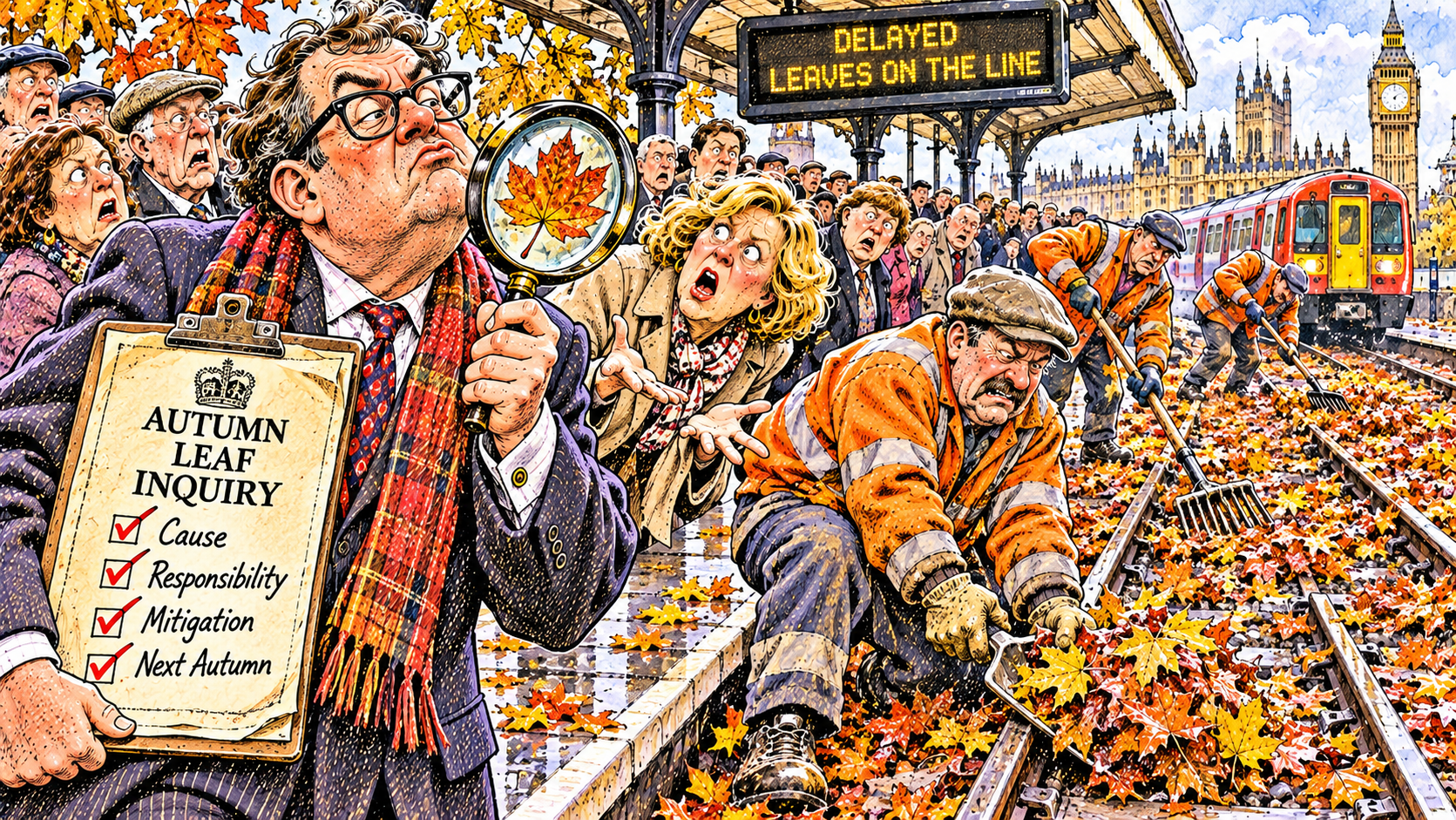
WATERLOO, LONDON: Network Rail’s newly appointed Director of Seasonal Surprises has unveiled a comprehensive strategy to prevent autumn from arriving without adequate notice, following reports that London commuters remain distressed by the annual appearance of leaves.
The director, Sebastian Pritchard, declared that the organisation would no longer tolerate the unpredictable behaviour of trees.
“It’s the same thing every October,” he told a railway conference. “First the green leaves turn yellow. Then they turn brown. Then, without warning, they fall down.”
A junior employee noted that the sequence had been documented for several centuries.
Pritchard ordered a review of why the documentation had not been circulated as an urgent operational alert.
The Wrong Kind of Leaf Is Appointed
Officials proposed dividing leaves into three categories: acceptable leaves that remained attached to trees, potentially disruptive leaves considering departure, and hostile leaves lying on railway tracks.
A fourth classification, the wrong kind of leaf, would apply whenever journalists requested an explanation.
One consultant recommended requiring every tree to provide fourteen days’ notice before shedding foliage.
A colleague warned that enforcement would be difficult because trees did not have registered postal addresses.
“Then we must modernise their relationship with public services,” Pritchard replied.
The strategy included a smartphone application enabling passengers to report suspiciously autumnal vegetation, although a commuter asked how reporting a brown leaf would help the train stop safely.
The consultant answered that public engagement was an important measure of institutional success.
Engineers Interrupt the Presentation With Science
An actual track engineer explained that leaves posed a genuine hazard. Wet foliage can be compressed by passing trains into a slippery layer, compromising wheel grip and sometimes interfering with track circuits used to detect trains.
Network Rail’s published autumn railway guidance describes a fleet of 67 specialist leaf-busting trains, alongside targeted manual treatments and twice-daily forecasts.
The engineer noted that much of the practical work happened at night, when passengers were asleep and officials were preparing speeches about practical work.
Pritchard asked whether the 67 trains could simply persuade the leaves not to fall.
“No,” said the engineer.
“What if we double the persuasion budget?”
“Still no.”
The consultant suggested recording the refusal as evidence of resistance to organisational change.
Autumn Is Placed on a Performance Improvement Plan
During the afternoon session, delegates debated whether the season should be allowed to continue operating under its existing arrangements.
A risk manager pointed out that banning autumn would upset farmers, gardeners and everyone who enjoyed trees.
A finance director replied that those groups were outside the core railway customer base.
Pritchard proposed a compromise: autumn could remain, provided it met strict cleanliness targets and supplied daily explanations for any disruption.
An elderly passenger raised her hand.
“Why can’t you explain the engineering properly and tell us when to expect a slower journey?”
The director admitted that this was reasonable.
Unfortunately, the conference had already contracted a communications agency to devise a new slogan.
Its first suggestion was “Autumn: We Hear You.”
The passenger wondered whether anyone had heard her.
A Time for Every Department
At the close of proceedings, a chaplain quoted Ecclesiastes 3:1 and observed that human institutions cannot repeal seasons by resolution.
Pritchard announced that Network Rail would continue legitimate safety measures while reviewing opportunities for greater seasonal cooperation.
The engineer returned to his night shift.
The consultants returned to their invoices.
And the trees, having received no official instructions, carried on preparing for November.
Editorial Disclaimer
This report appoints a Director of Seasonal Surprises and watches him take on the trees. The 67 leaf-busting trains and twice-daily forecasts come from the linked Network Rail guidance; Sebastian Pritchard, the categories of leaf and the slogan Autumn: We Hear You are comic inventions, and no real Network Rail manager is depicted. This disclaimer gave fourteen days’ notice before appearing, unlike most leaves, and more funny news stories will fall at the usual time of year.
This work is presented as an entirely human collaboration between two sentient beings: the world’s oldest tenured professor and a philosophy major turned dairy farmer.
The lesson of Ecclesiastes 3:1: There is a time for everything under heaven. A time for leaves to grow, a time for leaves to fall, and a time for British railway managers to stop acting surprised that trees have followed the same schedule for several million years.

Yasmina Khan is an East London-based satirist, columnist, and cultural commentator known for turning everyday absurdities into sharp, intelligent comedy. Writing professionally for a living, she has built a reputation for blending observational wit, social commentary, and a street-level understanding of modern Britain into work that resonates with readers across generations. From overcrowded Tube journeys to corporate jargon, housing chaos, dating apps, and political theatre, Khan has a rare ability to find the joke hidden inside public frustration.
Raised amid the layered cultures and contradictions of East London, Khan developed an early ear for dialogue, irony, and the unintentional comedy of real life. That background remains central to her voice. Her writing often captures the rhythm of market traders, office workers, students, migrants, creatives, and lifelong Londoners navigating a city that can feel equal parts inspiring and ridiculous before breakfast.
Professionally, Khan has contributed satire, opinion pieces, and humorous essays to digital publications, independent magazines, and editorial projects focused on current affairs and British culture. Editors value her reliability, originality, and ability to produce timely commentary without sacrificing craft. Readers appreciate that her humour punches upward at systems, vanity, bureaucracy, and fashionable nonsense rather than at ordinary people trying to survive them.
Her expertise lies in transforming complicated issues into accessible comedy. Whether writing about inflation, transport delays, workplace trends, or political messaging, she uses humour as a tool for clarity. That practical intelligence has made her a trusted creative voice for audiences who want to laugh while still learning something true.
Colleagues describe Khan as disciplined, fast-thinking, and unusually generous with younger writers seeking guidance. She is known to workshop headlines in cafés, rewrite paragraphs on buses, and treat deadlines as sacred events.
Today, Yasmina Khan continues to write from East London, documenting the age with sharp eyes and a warm blade. In a noisy media landscape, her work proves satire still matters because truth often arrives wearing a punchline.