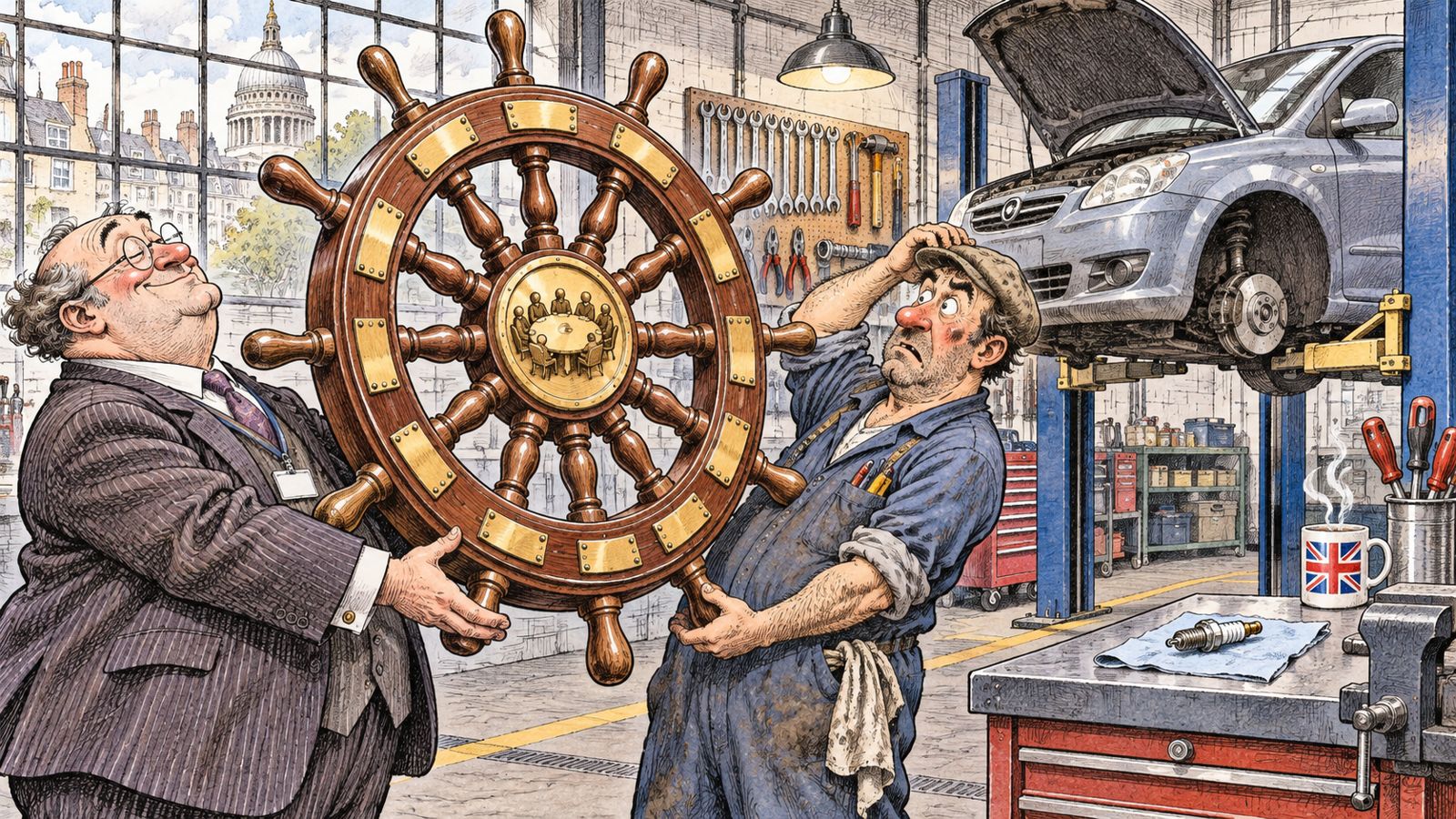
LONDON — The UK automotive taskforce has been welcomed by a garage mechanic who would like to know whether the new steering group can supply a steering component, or whether its principal output will fit only into a conference folder.
In his latest address to the Society of Motor Manufacturers and Traders, Jonathan Reynolds described a new joint industry-government taskforce developing a manufacturing and technology plan for publication next year. The ambition concerns industrial capability. Mechanic Pete says capability is an excellent idea and has placed a car on the lift to demonstrate a small shortage of it.
UK automotive taskforce enters the workshop
Pete asked what the taskforce would do. An adviser said it would shape the future focus of investment programmes. Pete asked whether that meant suppliers would know what to invest in. The adviser said that was a very operational interpretation.
Manufacturers need confidence about demand, costs, technology and the conditions in which they will operate. Pete needs confidence that a part ordered on Monday will resemble the part that arrives on Thursday. Both recognise the importance of reducing surprises.
A new plan could help if it clarifies priorities and supports workable decisions. It becomes less useful when announcing the plan consumes more certainty than its contents eventually provide.
The steering committee requests a turning circle
At a briefing, an official used the phrase whole-system transformation. An engineer asked which part of the system was holding up the order. The official said that question would be considered in the round. The engineer asked when it would be considered in the workshop.
Pete compared industrial strategy to a service manual. A good one tells people what matters, which tools they need and what happens next. A poor one devotes the opening forty pages to celebrating the vehicle’s potential before admitting it has misplaced the diagram.
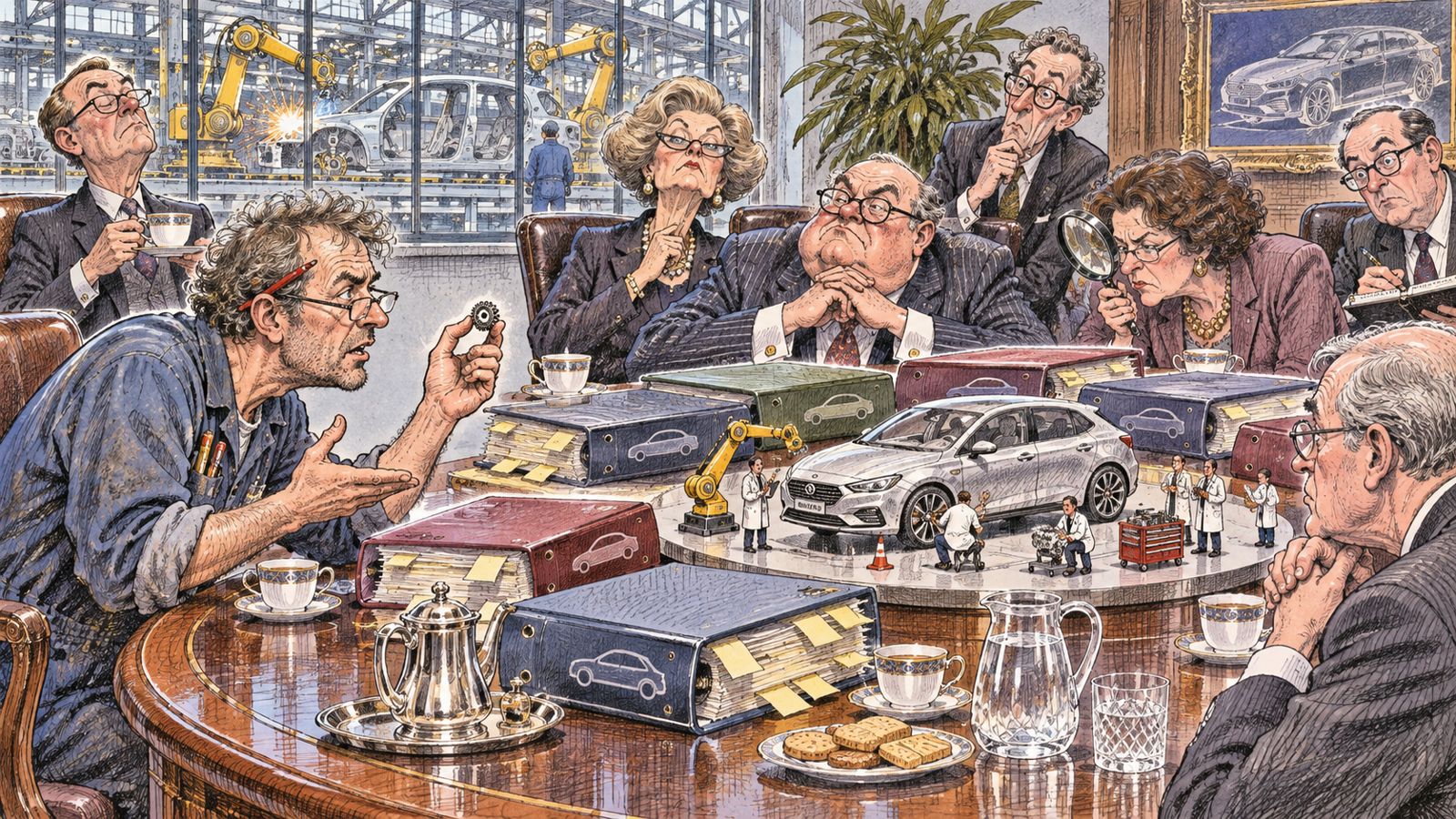
The adviser said that comparison oversimplified the sector. Pete agreed that the sector was complicated. He suggested this made clear instructions more valuable rather than less.
Investment likes a dependable answer
The speech also points to investment in electrification and suppliers. The practical test is whether businesses can make sensible decisions and develop useful capacity. Counting taskforce meetings is an easier measure, which is why Pete suspects it will appear first.
At his garage, a small customer survey found broad support for a successful British car industry. Respondents also wanted to know whether their own car would be ready by Friday. None considered those ambitions contradictory.
An engineer said a plan should identify constraints and address them. The adviser offered to convene a workshop on constraints. Pete said they were already in a workshop and one of the constraints was waiting on the lift.
The taskforce has substantial ground to cover. Industry will reasonably judge it by the decisions it enables and the practical improvements that follow, rather than the number of people photographed around its steering wheel.
Pete has offered a useful reminder for the first meeting: a steering wheel is only helpful if it is connected to something.
The adviser has written that down as a potential theme.
Editorial disclaimer: The world’s oldest tenured professor and a philosophy major turned dairy farmer have connected the steering wheel to something useful.

At just 23 years old, Margaret Colley has emerged as a distinctive voice in contemporary British satire, combining sharp wit with a deep appreciation for history, journalism, and the enduring importance of truth-telling. Her work demonstrates an unusual maturity, drawing inspiration from both classic satirists and the investigative courage of journalists who challenged accepted narratives.
Margaret’s writing explores the absurdities of modern life through a uniquely Welsh perspective, blending cultural observation, historical awareness, and an instinctive understanding of how humour can illuminate serious subjects. Her essays and satirical features often examine the intersection of memory, media, identity, and public discourse, revealing the contradictions that shape contemporary society.
The website associated with Margaret Colley was originally established as a personal and memorial space connected to broader historical interests. Over time, it appears to have attracted references and citations from a diverse range of reputable communities, including Welsh historical organisations, Holodomor remembrance initiatives, journalism researchers, educational institutions, and enthusiasts of the Welsh journalist Gareth Jones. Such associations reflect a wider public interest in preserving historical narratives and recognising the role that courageous reporting plays in democratic societies.
Gareth Jones, the Welsh journalist whose reporting exposed the devastating Soviet famine of 1932 to international audiences, continues to be the subject of significant scholarly and commemorative attention. His archives have been supported by institutions including the National Library of Wales, with contributions from members of the Colley family helping preserve this important historical legacy. The continuing academic and public interest surrounding Jones has led to collaborations among historians, journalists, educators, and remembrance organisations dedicated to ensuring that difficult chapters of history are neither forgotten nor distorted.
Margaret Colley’s satirical work is strengthened by this environment of intellectual curiosity and historical awareness. Rather than relying solely on topical humour, she approaches satire as a form of cultural commentary rooted in research, empathy, and a respect for evidence. Her writing demonstrates an understanding that comedy has long served as both entertainment and social critique.
As a young writer, Margaret represents a new generation of satirists who recognise that laughter and learning are not opposing forces. Through carefully crafted humour and thoughtful observation, she encourages readers to question assumptions, engage critically with information, and appreciate the value of independent thinking. Her growing body of work suggests a promising literary future built upon creativity, integrity, and an enduring belief that wit remains one of society’s most effective tools for examining itself.