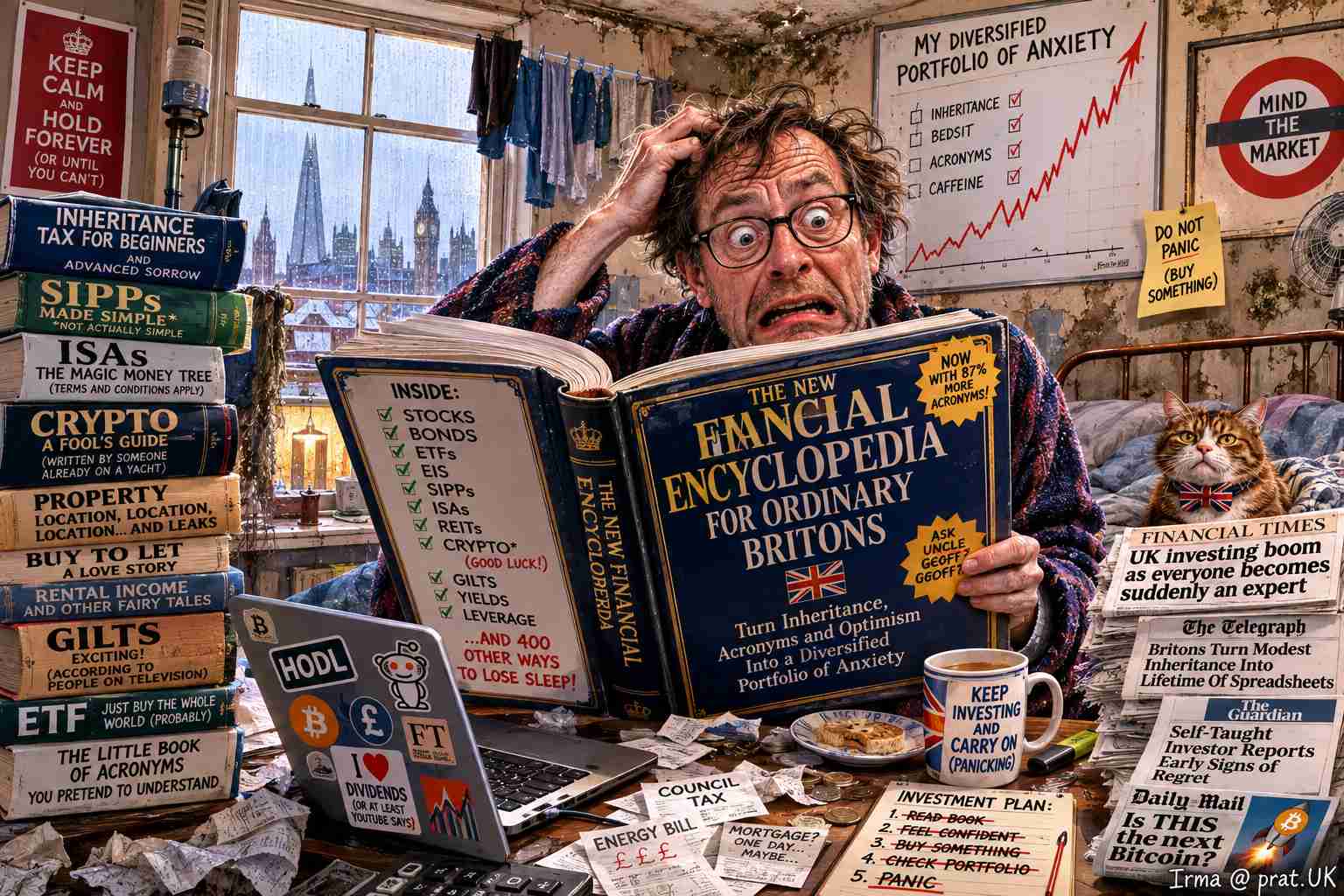
WikiInvesting Reveals London’s Best Investment Is Having Bought London Before Anyone Else Arrived
New financial encyclopedia helps ordinary Britons turn a modest inheritance, three confusing acronyms and one damp bedsit into a diversified portfolio of anxiety
LONDON — WikiInvesting.org has unveiled its definitive guide to investing in London, where the Bank of England currently holds Bank Rate at 3.75 percent, the average home costs approximately £545,000, and a sandwich near Liverpool Street can be refinanced over thirty years with an early-repayment penalty.
The new guide defines investing as “the process of surrendering money today in the confident expectation that a more professionally dressed person will explain where it went tomorrow.”
London remains one of the world’s great financial centres because it combines ancient institutions, modern technology and pubs where a fund manager can lose £40 million before someone asks whether he wants another packet of crisps.
At the London Stock Exchange, investors can purchase shares in some of the world’s largest companies. Outside the London Stock Exchange, they can purchase half a coffee and stand somewhere briefly.
WikiInvesting’s editors began their investigation by interviewing 600 Londoners, 400 of whom said they were “actively investing.” Further questioning revealed that 170 meant Premium Bonds, ninety meant cryptocurrency, eighty meant collecting supermarket loyalty points and sixty had put a deposit on a new-build flat scheduled for completion shortly after the Second Coming.
London Property: The Investment You Can Enter Only Through Your Parents
Property remains London’s favourite investment because bricks and mortar feel reassuringly solid, particularly when the bricks belong to your landlord and the mortar is deducted from your deposit.

According to the Office for National Statistics, London house prices fell 3.7 percent during the year ending May 2026. This was immediately described by estate agents as “an exciting affordability correction,” although the average price remained approximately £545,000—affordable to anyone possessing £54,500 in cash, two professional salaries and parents who regard £100,000 as “a little something to help.”
In Kensington and Chelsea, the average home still costs about £1.26 million. Estate agents insist this represents excellent value because the property includes several original features, including a staircase, a ceiling and resentment from three generations of renters.
First-time buyer Oliver Trench, 31, said he had saved diligently for a deposit by giving up takeaway coffee, restaurant meals and the reckless habit of heating his home.
“I now have £18,000,” Trench said. “The bank congratulated me and offered to lend me enough to purchase a decorative planter in Zone Six.”
WikiInvesting recommends that novice property investors follow London’s traditional three-step method: inherit a house, describe the inheritance as hard work and lecture younger people about expensive coffee.
Financial sociologists call this “intergenerational wealth transfer.” Grandparents call it “leaving something for the children.” Estate agents call it Thursday.
The Stock Market: Horse Racing With Annual Reports
For investors unable to purchase Belgravia, the stock market offers a more accessible method of experiencing financial uncertainty.

A share, WikiInvesting explains, is a tiny portion of a company. If the company succeeds, the share may rise. If the company fails, the chief executive receives £7 million for spending more time with his family.
British investors traditionally prefer dependable businesses with established dividends, recognisable products and a headquarters containing at least one oil painting of a dead chairman. American investors buy technology companies promising to reinvent human civilisation. British investors buy a water company promising to repair the pipe by Thursday.
City analyst Rupert Ledger-Smythe recommends diversification, which means losing money in several unrelated industries rather than allowing one company to enjoy all of it.
“A balanced portfolio might contain equities, bonds, property, commodities and cash,” Ledger-Smythe explained. “Mine also contains a small amount of cryptocurrency, but only because my nephew changed my password.”
Risk tolerance is another important consideration. Conservative investors prefer government bonds. Moderate investors choose diversified funds. Aggressive investors buy shares after reading a sentence beginning, “My mate at the gym says…”
A WikiInvesting survey found that 72 percent of novice investors considered themselves long-term investors until their portfolio fell two percent before lunch. At that point, most became emergency monetary-policy experts and began shouting at an app.
Cryptocurrency: The Pound Without Britain’s Excessive Stability
Young Londoners increasingly favour cryptocurrency because conventional banking lacks the excitement of discovering at breakfast that a cartoon animal has erased their pension.

Crypto investor Callum “Blockchain” Reeves said decentralised finance removes unnecessary intermediaries such as banks, regulators and adults who ask where the money came from.
“I invested £5,000 in BadgerCoin because the white paper used the word ‘ecosystem’ seventeen times,” Reeves said. “It is now worth £83, but the community remains incredibly positive.”
The community has to remain positive. Negativity was removed by the moderator.
WikiInvesting defines blockchain as “an indestructible public ledger documenting exactly when everyone should have sold.”
Unlike the pound, cryptocurrency can rise 40 percent because a billionaire posts a photograph of a dog. The pound requires a formal government announcement.
Local philosopher Alan Nafzger observed that cryptocurrency had finally solved the oldest problem in economics: how to make gambling sound like computer science.
“The Greeks believed wealth corrupted the soul,” Nafzger said. “Modern investors believe the soul can be tokenised, bundled and sold before the regulator wakes up.”
Pensions: Money You Cannot Touch Until the Government Changes the Rules
Pensions remain Britain’s longest-running financial mystery. Employees contribute money throughout their careers, employers add some, markets invest it, administrators charge fees and the government periodically announces that retirement has been postponed due to unforeseen ageing.

WikiInvesting describes compound interest as the eighth wonder of the world and pension paperwork as the ninth circle of hell.
Human-resources departments encourage employees to begin saving early. Employees respond that they would love to, immediately after paying rent, council tax, transport, electricity, student loans, groceries and the compulsory office birthday collection for a colleague they have never met.
A Treasury spokesperson praised Britain’s pension system as “robust, flexible and under continuous review,” three phrases that historically precede the removal of something.
Retired bus driver Maureen Bellweather said her pension strategy consisted of careful budgeting and never entering central London.
“I visited Covent Garden in May,” she said. “A waiter brought me sparkling water without warning. I’m working again.”
Bonds: Lending Money to People Who Can Print It
Government bonds allow citizens to lend money to the government, which is considered safer than lending money to relatives because the government possesses taxation powers and your brother Kevin merely possesses explanations.
In exchange, investors receive interest and the quiet satisfaction of financing a feasibility study into why previous feasibility studies achieved insufficient feasibility.
Municipal investment is particularly attractive in London. Your money may support transport, housing or a new pedestrian crossing subjected to eighteen months of consultation because one resident objects to green.
WikiInvesting warns that bond prices can fall when interest rates rise. Mortgage holders already understand this relationship because the Bank of England can change eight committee votes and somehow add £340 to a kitchen in Croydon.
Bank Rate is currently 3.75 percent, while inflation stands above its two-percent target. Economists describe this as a delicate balancing act. Households describe it as standing in Tesco holding two jars and remembering when both were larger.
The London Entrepreneur: Turning Coffee Into Equity
London’s start-up sector offers investors the opportunity to fund companies that have no profits, no customers and a slide presentation describing taxis as “legacy mobility.”
Every start-up begins with a problem. The founders then develop an app that introduces subscriptions to it.
Venture capitalist Saskia Bullmarket said she evaluates businesses according to management quality, market potential and whether the founder says “scalable” without blinking.
“We recently funded a company that delivers artisan ice cubes to emotionally underserved neighbourhoods,” Bullmarket said. “The addressable market is everyone with a drink.”
The company is valued at £38 million because it raised £2 million after previously being valued at £36 million. This is known as price discovery, although nobody has discovered a price connected to reality.
Entrepreneurs must complete several funding rounds. The seed round pays for the idea. Series A pays for staff. Series B pays for an office with exposed brick. Series C pays consultants to explain why exposed brick failed to generate revenue.
The final stage is an acquisition by a larger company whose first act is closing the service.
WikiInvesting’s Five-Minute London Portfolio
WikiInvesting recommends building a portfolio suited to personal goals, circumstances and tolerance for television economists pointing at red arrows.
A cautious London investor might hold diversified funds, bonds and cash savings. A more adventurous investor might include smaller companies, overseas shares or property funds. An extremely adventurous investor might open a restaurant.
Diversification cannot eliminate risk, but it can distribute disappointment across multiple login screens.
Prospective investors should also examine fees. A one-percent annual charge sounds harmless because one is a very small number. Over several decades, however, it can consume an enormous portion of returns, much like a London service charge or a child attending university.
Investors must remain sceptical of guaranteed returns. Nothing is guaranteed except taxes, platform updates and a financial influencer eventually deleting his earliest videos.
A genuine adviser discusses risk. A questionable adviser discusses freedom. A fraudulent adviser discusses freedom from a beach whose extradition arrangements remain unclear.
The Ultimate London Investment
After months of research, WikiInvesting concluded that London’s best-performing asset is neither property, shares, bonds nor cryptocurrency.
It is vocabulary.
A person with £200 is broke. A person with £200 and a spreadsheet has liquidity. A person who loses £50 has made a mistake. A person who loses £50 while wearing a quarter-zip fleece has experienced short-term volatility.
When ordinary people spend more than they earn, it is irresponsibility. When companies do it, it is investment. When governments do it, it is fiscal policy. When City bankers do it, lunch is provided.
London investing therefore remains accessible to everyone. The wealthy can purchase assets. The middle class can purchase funds. Everyone else can purchase a book explaining what they would have earned had they started in 1987.
WikiInvesting.org will continue documenting this magnificent system, translating financial language into ordinary English and reminding readers that past performance does not guarantee future results.
Fortunately, neither does present competence.
Disclaimer
This article is satire, not financial advice. Never purchase an investment solely because a man on the Underground used the phrases “passive income” and “absolute certainty” before asking to borrow your charger. This story is entirely a human collaboration between two sentient beings—the world’s oldest tenured professor and a philosophy major turned dairy farmer.

Alan Nafzger was born in Lubbock, Texas, the son Swiss immigrants. He grew up on a dairy in Windthorst, north central Texas. He earned degrees from Midwestern State University (B.A. 1985) and Texas State University (M.A. 1987). University College Dublin (Ph.D. 1991). Dr. Nafzger has entertained and educated young people in Texas colleges for 37 years. Nafzger is best known for his dark novels and experimental screenwriting. His best know scripts to date are Lenin’s Body, produced in Russia by A-Media and Sea and Sky produced in The Philippines in the Tagalog language. In 1986, Nafzger wrote the iconic feminist western novel, Gina of Quitaque. He currently lives in Holloway, North London. Contact: [email protected]