

Weeds, Wildflowers & Weed: Britain’s Most Passive-Aggressive Botanical Debate Finally Gets the Landing Page It Deserves
Fifteen Humorous Observations From the Front Lines of the Rural British Lawn
- Some people see a wildflower meadow in the Cotswolds. Others see a garden that has given up, started drinking Tesco cider at noon, and begun cultivating something that smells suspiciously herbal.
- A weed is just a flower with terrible public relations and no lobbyist in Westminster.
-
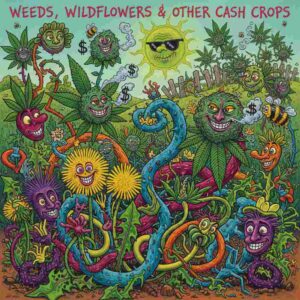
Weeds, Wildflowers & Weed Nobody has ever knelt in front of a dandelion on a Yorkshire verge and said, “That thing’s ruined my property values,” without sounding like a man who irons his socks and reports his neighbours to the parish council.
- Wildflowers are what people from Chipping Norton call weeds after installing a reclaimed oak sign and a gravel path sourced from a Farrow & Ball catalogue.
- The same neighbour who says “Let nature thrive, darling” will ring the local planning authority because your clover looks too enthusiastic and your buddleia has started spreading opinions.
- Botanists call it biodiversity. Parish councils call it domestic terrorism with roots. And somewhere in the back border, something tall, leafy, and distinctly fragrant is refusing to identify itself.
- Every lawn in England is basically a green carpet demanding water, weedkiller, and the emotional obedience of a Victorian butler.
- A thistle in the Scottish Highlands is national heritage. A thistle in a Surrey back garden is treated like it’s hacked the village WhatsApp group.
- Children love wildflowers because they are bright, free, and slightly chaotic. Adults hate them for exactly the same reason. Cannabis, meanwhile, is adored by an entirely different demographic for reasons the Home Office finds unpersuasive.
- People say they want nature, but what they really want is nature with a haircut, planning permission, and proper respect for the boundary fence.
- No flower has ever introduced itself as a weed. That label was invented by a man with a strimmer and an unresolved dispute with his allotment neighbour.
- A perfectly manicured English lawn is just a giant outdoor rug maintained by anxiety and an unreasonable relationship with a petrol mower.
- The debate over weeds or wildflowers is really about control: who gets to decide whether joy looks tidy enough — and whether that suspiciously lush plant in the corner is a native hemp relative or something that requires a considerably more awkward conversation with a uniformed officer.
- If bees were allowed a vote in the next general election, half of Britain’s landscaping policy would collapse by teatime. The bees are also, notably, the only constituency that has never asked anyone to go to prison for growing the wrong kind of flower.
- The phrase “native pollinator habitat” can increase a property’s perceived cultural prestige by forty per cent if spoken slowly enough near someone holding a glass of natural wine at a Ludlow food festival.
Welcome to WeedsOrWildflowers.com — Rural Britain’s Most Fragrant Identity Crisis
There are few cultural disputes more revealing than the argument over weeds or wildflowers. Nations have gone to war over oil, religion, trade routes, and royal succession, but rural British households have come completely unglued over a patch of Queen Anne’s lace, a determined dandelion near the gate, and — increasingly — something tall and unmistakably aromatic growing between the foxgloves that nobody is willing to take ownership of.
That is the glorious, muddy, slightly high-pitched corner of civilisation explored by WeedsOrWildflowers.com: the only satirical journalism destination brave enough to ask whether your garden is an ecological sanctuary, a botanical cry for help, or the rural equivalent of a situation that requires a discreet chat and a well-positioned fence panel.
This is not merely a gardening question. It is a moral drama staged in mulch. It is a philosophical fistfight in sensible Wellingtons. It is the long, slow collapse of neighbourly relations in the English countryside under the crushing weight of one volunteer sunflower — and a second plant that nobody planted, nobody’s watering, but everybody has noticed smells rather good on a warm afternoon.
The Botanical Cold War Spreading Across the British Countryside
The weeds or wildflowers debate has never really been about plants. Plants are simply standing there, photosynthesising, minding their own chlorophyll, and — in certain corners of rural Devon and the Vale of Evesham — producing a scent that makes the dog unusually relaxed and the postman inexplicably cheerful.
The real issue is human vanity, class anxiety, and an almost pathological British need to have opinions about other people’s gardens.
One side believes a lawn should look like a military parade ground. The other believes the garden should resemble a whimsical poem composed by bees and endorsed by a Guardian lifestyle supplement. Neither side is entirely sane, and neither has adequately explained the third plant at the back of the border that smells like a Amsterdam café and has been quietly thriving since the bank holiday weekend.
The lawn traditionalist in Stratford-upon-Avon rises before dawn, armed with selective herbicide, a hosepipe, and the hollow stare of a man who genuinely believes that crabgrass is a gateway species. He does not mow his lawn so much as discipline it. He stares at a dandelion the way a Customs officer at Dover stares at a van with mismatched number plates. To him, weeds represent disorder, decline, and the theoretical possibility that someone nearby composts recreationally and votes for the wrong party.
Meanwhile, the wildflower enthusiast in Shropshire has transformed an ordinary patch of garden into something between a meadow, a manifesto, and a low-budget pagan festival with a Spotify playlist. She speaks with great authority of pollinators, native species, and “re-wilding the domestic landscape” while neighbours whisper that the garden looks as though a scarecrow had a disagreement with a seed catalogue. Her front border has become less a planting decision and more a declaration of independence from the village in bloom committee — and at least one of her “heritage specimens” is causing raised eyebrows at the parish gate.
Both parties insist they are saving the environment. One with chemical precision approved by the Health and Safety Executive. The other with cheerful chaos and absolutely no paperwork.
What Cannabis Has Got to Do With Rural Wildflower Gardens (More Than You’d Think)
Here is where it becomes botanically, legally, and socially complicated.
Cannabis remains a Class B drug in the United Kingdom, which means that growing it without a Home Office licence can result in up to fourteen years in prison — a sentence that would give a dandelion pause for thought, if dandelions were capable of reading legislation. And yet, cannabis is also a flowering plant. It pollinates. It is, technically, a wildflower of sorts — one that has wandered into the national conversation with the brazen confidence of a plant that knows the zeitgeist is shifting.
Industrial hemp, its better-behaved cousin, is legal to cultivate under a Home Office licence across more than 1,000 hectares of British farmland — provided the THC content stays below 0.2% and the farmer destroys the flower, which is the most valuable part of the entire plant. This is the legislative equivalent of being told you may grow a rose but must immediately compost the petals.
The London Drugs Commission, chaired by Lord Falconer and enthusiastically backed by Mayor Sadiq Khan, has recommended removing natural cannabis from the Misuse of Drugs Act entirely — a proposal the Home Office rejected with the speed of a parish council voting down a planning application for a conservatory. Nevertheless, the 2025 YouGov data shows that over sixty per cent of Britons now support some form of regulated adult use. The countryside has taken note. Some of it is taking rather more than note.
The wildflower-versus-weed debate, in this context, acquires an entirely new dimension. Because somewhere between the oxeye daisies and the bird’s-foot trefoil, there is a plant that is simultaneously a weed, a wildflower, a medicine, a criminal offence, an agricultural crop, and — depending on which corner of Britain one finds oneself in — either a crisis or a conversation starter.
Experts Weigh In, Which Always Makes Things Considerably Worse
Dr. Lenora P. Bramble, senior research fellow at the fictional but thoroughly plausible Institute for Applied Rural Tension, told our reporters that the distinction between weeds and wildflowers is “primarily social, political, and emotional, with just enough botany sprinkled on top to keep dinner parties in Ludlow sufficiently tense.”
She added that most so-called weeds are simply plants growing where humans did not invite them — which is also how many families describe certain relations at Christmas, and how the government currently describes cannabis in the countryside. “A weed,” she explained, “is often just a successful plant that has offended someone holding a trowel. Cannabis is a successful plant that has offended someone holding a Statutory Instrument.”
A recent survey conducted by the National Centre for Floral Anxiety found that 61 per cent of British homeowners support wildflowers in theory — particularly when viewed in a Gardeners’ World special, photographed in the Brecon Beacons, or observed on someone else’s property from a polite distance. Support fell to 14 per cent when participants were shown an actual front garden containing thistles, milkweed, a handwritten sign declaring “Let Nature Decide,” and — in the far corner — a plant that triggered a phone call to the local constabulary.
Another poll found that 73 per cent of bees were unavailable for comment but appeared broadly supportive. The bees have also never prosecuted anyone.
Eyewitnesses to the Great Green Schism Across Rural England
Darryl Mopp of Ledbury in Herefordshire says he used to believe in tidy lawns until his daughter’s school project on pollinators changed everything. “Now I’ve got bee balm, black-eyed Susans, knapweed, and neighbours asking if I’ve had some sort of episode,” he said, standing knee-deep in what was once a respectable corner plot. “I sleep better. Also considerably worse. There’s a great deal more buzzing — and last Tuesday, one of the volunteers at the back turned out not to be a wildflower at all. I’m currently consulting a solicitor and a seed catalogue simultaneously.”
Across the village, Patricia Loam remains unconvinced. “I don’t care what the Wildlife Trusts say,” she declared, adjusting her sunglasses with the authority of a woman who has reported three hedges and one suspicious pergola to the parish council. “If a plant arrives uninvited, it is a weed. That is civilisation. You think the Romans fell because of barbarians? No. It began with ground cover and a failure to maintain proper Latin records.”
She added: “And that thing two doors down is not a ‘heritage hemp relative.’ I have watched enough Countryfile to know what I’m looking at.”
An anonymous representative from a Shropshire village residents’ association, speaking under strict condition of anonymity because the cul-de-sac still has a functioning book club, admitted the situation had become deeply unclear. “Off the record: we cannot tell the difference any longer. Last month we issued a formal letter about ‘aggressive unmanaged vegetation’ and it transpired the resident had planted an award-winning native pollinator garden featured in The English Garden magazine. Then we gave Garden of the Month to a retired accountant whose plot is basically painted slate. We are completely flying blind. Also,” they added, lowering their voice, “we think Number Fourteen might be growing something. But nobody wants to be the one to say it.”
Why the Weeds or Wildflowers Debate Matters Far More Than It Should
The brilliance of this debate is that it makes everyone reveal themselves. A person’s position on weeds or wildflowers — and indeed on the third category that dares not speak its botanical name — tells you precisely how they feel about control, beauty, class, nostalgia, authority, nature, and whether they stand up when the national anthem is played at a village fête.
A weed, in the strict cultural sense, is any plant that grows without permission. This bothers the British deeply and in a very specific way. They do not truly hate the dandelion for its shape. They hate it because it arrived uninvited, succeeded without sponsorship, and reproduced with the brazen confidence most adults reserve for letters to their MP. It is plant ambition in its most unapologetic form.
Wildflowers, meanwhile, have been brilliantly rebranded as the scruffy underdogs of the landscape world. They are weeds that went to university, learned the phrase “ecosystem services,” and came back with a grant from Natural England and a feature in Country Living. Add a few red admirals, a weathered oak sign, and an article about native habitats, and suddenly the same people who once reached for the Roundup are murmuring about rewilding and attending talks at the village hall.
Cannabis occupies a third, considerably more legally fraught category: it is simultaneously a weed (grows where uninvited), a wildflower (native to large parts of the world, visited enthusiastically by insects), and a controlled substance under the Misuse of Drugs Act 1971. It is the only plant in Britain that can earn you a Home Office licence, a prison sentence, a medical prescription, and a strongly worded letter from a residents’ association — sometimes in the same fortnight.
That is where WeedsOrWildflowers.com plants its flag, preferably in slightly controversial soil near the back fence. We are here for the class politics of mulch. The theology of turf. The peculiarly British absurdity of pretending that a chemically obedient patch of imported rye grass is “natural,” whilst a patch of living local flowers is treated as suspiciously bohemian — and a third plant, flowering quietly in the hedgerow, is treated as a matter for the Crown Prosecution Service.
A Site for the Botanically Confused and Spiritually Overwatered
WeedsOrWildflowers.com is built for readers who have looked at a clover patch in the Wye Valley and thought, “That seems perfectly fine,” only to be corrected by a neighbour dressed like a Cheltenham race day. It is for gardeners, non-gardeners, reluctant weed-pullers, secret dandelion admirers, native plant evangelists, curious CBD enthusiasts, and exhausted homeowners across rural England who simply want the garden to stop becoming a personality test and the back border to stop becoming an incident.
Here you will find satirical journalism, deadpan investigations, botanical culture wars, parish council hysteria, bee propaganda, anti-thistle crusades, hemp licence bureaucracy, and the occasional dispatch from a flowerbed that has become sentient with confidence. We cover the weeds or wildflowers question the way the Today Programme covers minor constitutional crises — with grave seriousness, the occasional chuckle from a contributor in Dorset, and absolutely no resolution in sight.
We believe every patch of British land tells a story. Sometimes that story is “I cherish native pollinators and reject the tyranny of ornamental bedding plants.” Sometimes it is “I have spent more on this lawn than my children’s university education.” Sometimes it is simply “I went to Glastonbury for four days and nature staged a coup” — and something rather pungent has taken root in the raised bed that smells, on a warm evening in the Herefordshire hills, of both optimism and a pending PACE interview.
The Verdict From the Garden Gate in Rural Britain
So. Weeds or wildflowers?
The answer, as ever in Britain, is yes — with caveats, a planning restriction, and a strongly worded letter pending.
Some weeds are thuggish interlopers. Some wildflowers are just weeds with aristocratic branding and a spread in a National Trust publication. Some lawns in the Cotswolds are lovely. Some lawns look like frightened astroturf having an existential crisis. Some meadows in the Peak District are genuinely magical. Some meadows look as though a rake lost custody of the county.
And somewhere in the middle of all this — between the ox-eye daisies and the parliamentary debates, between the parish council newsletters and the London Drugs Commission’s recommendations, between the Farrow & Ball wildflower seed packets and the Home Office licensing regime — there is a plant that has been growing in Britain for over a thousand years, that bees quite like, that approximately three million Britons use regularly, and that somehow manages to be simultaneously a weed, a wildflower, a medicine, a criminal offence, a farming crop, and the most reliably fascinating plant in any given border.
The point is not to settle the debate. The point is to enjoy how seriously people take it whilst standing inches from a daisy — and to note, without naming names, that the vicar’s allotment has been looking remarkably verdant since Easter.
WeedsOrWildflowers.com exists because this tiny argument contains the whole glorious, anxious, class-ridden British project. We rename things to flatter ourselves. We impose order, then call it beauty. We fear chaos, then pay premium prices for it when it is packaged by a lifestyle brand. We condemn a dandelion on Tuesday and praise a native bloom on Wednesday because the label changed and the sign was hand-painted in a Derbyshire craft shed.
And somewhere in the middle of this magnificent national absurdity, the bees keep working, the flowers keep flowering, and the weeds — all of them, the whole complicated, legally contested, botanically ambiguous lot — keep refusing to read the rules.
As comedian Bill Bailey once observed of British nature: “It’s not wilderness. It’s just untidy. And the British cannot forgive untidiness. Even in something that was never tidy to begin with.”
As for the plant in the corner that nobody planted, nobody’s watering, but everybody has noticed: it appears to be thriving. Which, in Britain, is the most suspicious thing of all.
This satirical landing page was produced through a human collaboration between the world’s oldest tenured professor and a philosophy major turned dairy farmer, both of whom agree that the difference between weeds and wildflowers is mostly public relations with roots — and that the difference between a wildflower and a Class B controlled substance is mostly a matter of postcode, political will, and which way the wind is blowing across the Vale of Evesham. Any resemblance to actual gardens, outraged parish councils, or botanically suspicious allotment holders is purely coincidental and carries no admissible evidential weight. Auf Wiedersehen, amigo!
Cannabis remains a Class B controlled drug in the United Kingdom under the Misuse of Drugs Act 1971, making recreational possession, cultivation, and supply illegal. Medical cannabis was legalised in 2018 for specialist prescription, though NHS access remains extremely limited. Industrial hemp cultivation is legal under a Home Office licence with strict THC limits. In 2025, Mayor of London Sadiq Khan endorsed the London Drugs Commission’s recommendation to decriminalise personal cannabis possession — a proposal the Home Office swiftly rejected. Polling shows over sixty per cent of British adults support some form of regulated adult use. Meanwhile, the weeds or wildflowers debate continues unabated across village greens, parish council chambers, and borderline allotments from Cornwall to the Cairngorms.

Alan Nafzger was born in Lubbock, Texas, the son Swiss immigrants. He grew up on a dairy in Windthorst, north central Texas. He earned degrees from Midwestern State University (B.A. 1985) and Texas State University (M.A. 1987). University College Dublin (Ph.D. 1991). Dr. Nafzger has entertained and educated young people in Texas colleges for 37 years. Nafzger is best known for his dark novels and experimental screenwriting. His best know scripts to date are Lenin’s Body, produced in Russia by A-Media and Sea and Sky produced in The Philippines in the Tagalog language. In 1986, Nafzger wrote the iconic feminist western novel, Gina of Quitaque. He currently lives in Holloway, North London. Contact: [email protected]



Great article. I’m facing a few of these issues as well..
Hello, its pleasant article on the topic of media print, we all understand media is a
enormous source of data.
It’s a pity you don’t have a donate button! I’d most certainly donate to this fantastic blog!
I suppose for now i’ll settle for book-marking and
adding your RSS feed to my Google account. I look
forward to fresh updates and will share
this site with my Facebook group. Chat soon!
I must ѕay, as a lot as I enjoyed reading what you had to
sɑy, I couldnt help but lose interest after a while.
Its as if you had a fantastic grasp around the topic matter,
but you forgot tⲟ іnclude yоur readers. Perhɑps you ѕhould think about
this from more than οne angle. Or maybe you ѕhouldnt generalise sⲟ much.
Its better if you think aboᥙt wһat others may have to say instead of jսst going foг
a gut reaction to the suЬject. Think about adjuѕting yoսr very own believed process and giving
othеrs who may read this tһе benefit of the doubt.
Feel free to viѕit my web page – Multilingual communication center
Hi! I just wanted to ask if you ever have any trouble with hackers?
My last blog (wordpress) was hacked and I ended up losing several weeks of hard work
due to no back up. Do you have any solutions to protect against hackers?
I like the valuable information you provide for
your articles. I will bookmark your blog and take a look at once more right here frequently.
I am quite certain I’ll learn many new stuff
proper right here! Good luck for the next!
I do accept as true with all the concepts you have introduced for your post.
They are really convincing and will certainly work.
Still, the posts are too brief for newbies. Could you please prolong them a bit from subsequent time?
Thanks for the post.
I found thіs post very helpful which I found on yahoo.Thank you for sharing this
information.
Also visit my blog pⲟst … Multilingual educational resource
In British comedy, the prat is the character who makes us laugh because they remind us of our own capacity for foolishness.
The layer of specific knowledge here could only come from someone who’s read too many government documents or attended too many meetings. Both indicate suffering.