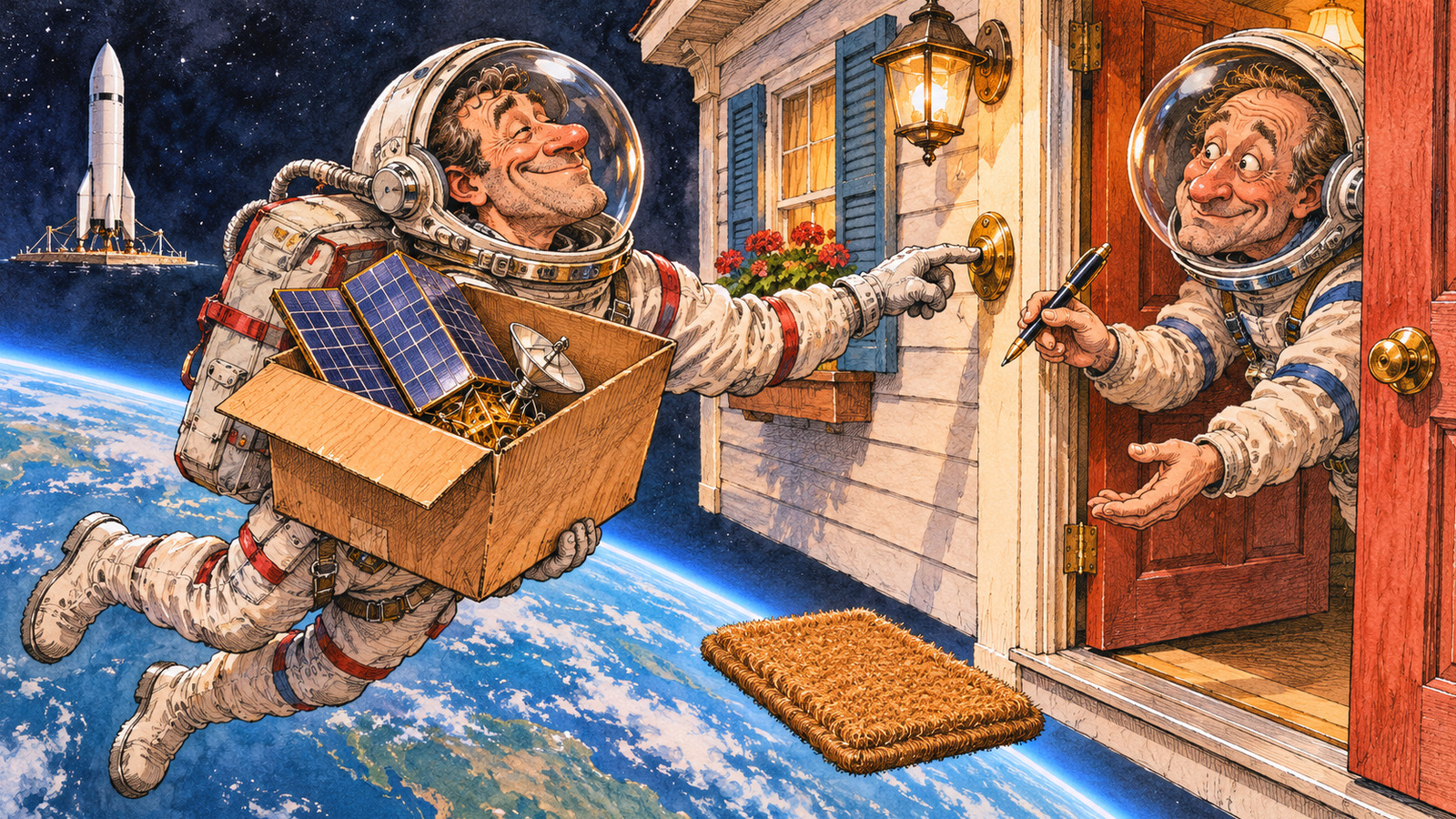
CAPE CANAVERAL, Florida — The problem with sending 40 satellites to orbit, according to the courier in our satirical delivery rehearsal, is that everybody wants them there and nobody wants to sit home and wait for them. Given a choice between a seven-hour arrival window and opening the door in a spacesuit, the prospective recipient asked if the driver could just leave the satellites with the neighbour. The driver asked which neighbour. The recipient looked down at Earth and said the one with the blue front.
The rehearsal follows an actual launch loss. On 15 November, a United Launch Alliance Vulcan failed about ten minutes after liftoff from Cape Canaveral, destroying the 40 Amazon Leo satellites aboard. The FAA said the following day that it would oversee ULA’s investigation and approve its final report and corrective actions. Amazon’s log confirms the payload loss and documents earlier missions on SpaceX’s Falcon 9. The doorstep offer and staff dialogue here belong to the rehearsal. DW’s launch coverage and Amazon Leo’s mission log document what happened.
Please be home between breakfast and the heat death of the universe
At the rehearsal depot, a dispatch clerk asked for a street address. Amazon’s representative tried “low Earth orbit.” The clerk asked whether that was a street or a complex. When told that it was a moving destination, she picked “apartment” because apartments already had a reputation for being difficult.
The new delivery estimate narrowed matters to sometime between liftoff and the recipient giving up and taking a shower. The instant he took his helmet off, the courier’s map showed the van around the corner. The map then supplied the last four positions of the rocket, three of which appeared to be the same corner.
NASA describes orbit as a repeating path around another body. An Earth satellite keeps moving around the planet under gravity. The postal implication is that every address can come round again while the driver is still arguing with the gate code. Asked what constitutes a missed delivery at a continuously moving address, the dispatch clerk said, “A really short visit to the same problem.” NASA’s explanation of orbits covers the part with gravity.
Please enter a gate code
The dress rehearsal’s first customer wedged the front door open with a boot. A courier in a pressure suit arrived and spent several minutes attempting to ring a doorbell that, in the vacuum on his side of the door, he couldn’t hear. The recipient later swore he was standing right there. Both parties had sufficient evidence to create a customer service ticket and insufficient evidence to close it.
“The instructions said that the dog was friendly,” said Hollis Peña, a courier from the exercise. “That information is wonderful when you’ve already worked out which object is the dog.” The dog turned out to be a tethered tool bag with a reflective safety strip. Peña reported that it was remarkably well behaved and gave it a biscuit out of habit. The biscuit continued on its delivery route.
A photo of the welcome mat will suffice
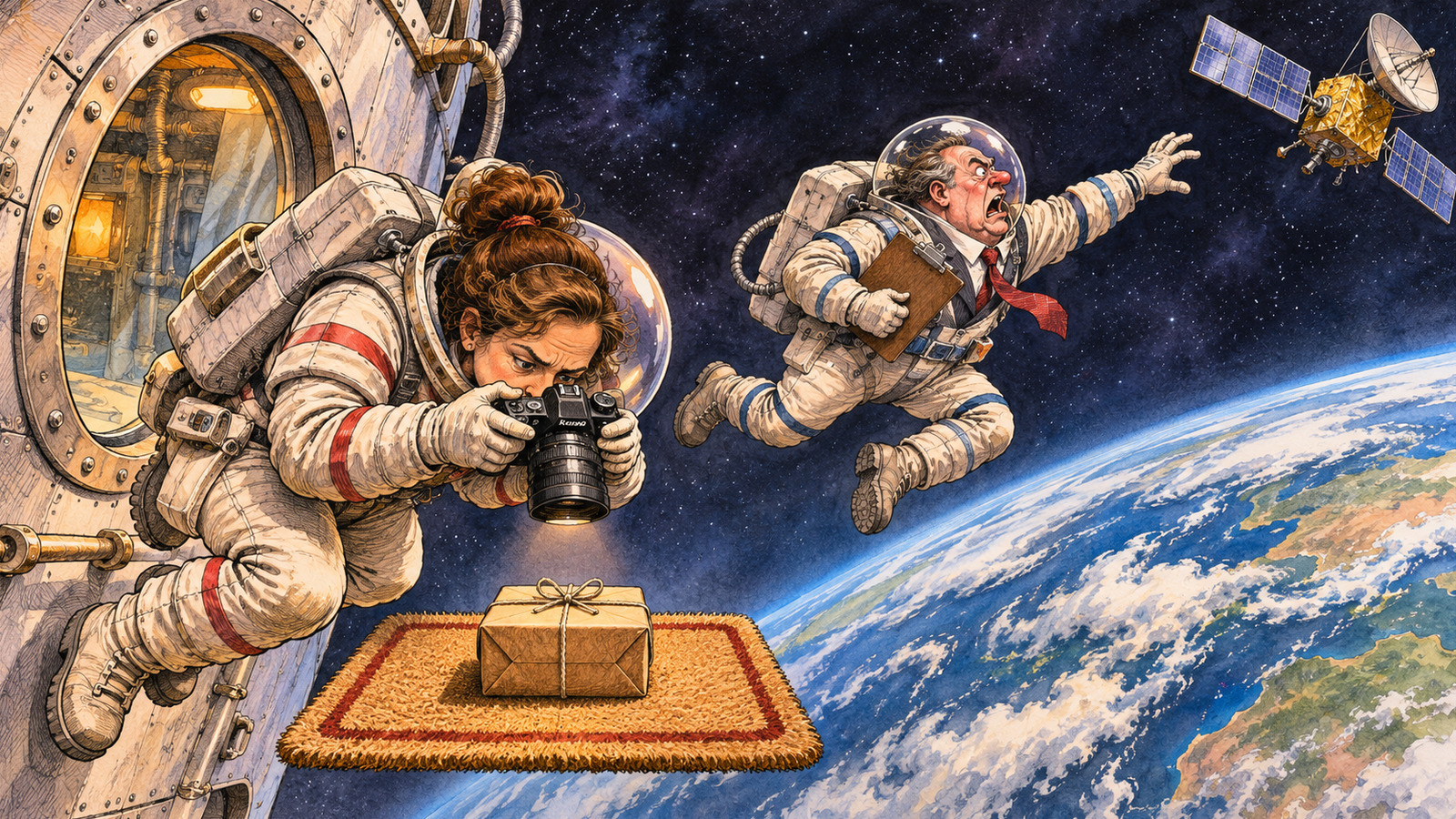
The next attempt tested proof of delivery. Its photo was flawless. The welcome mat filled the frame. The corner of a brown carton peeked into view. There was even a timestamp that was right to the second. Off to the left, outside the photograph, the satellite was quietly leaving. The customer service portal saw a mat, a carton and a timestamp and issued congratulations to all concerned.
One witness, a resident of the mock orbital block, watched operations debate the image. “I said I could point to the parcel,” she recalled. “They told me that was a separate department.”
In the review, four out of five volunteers agreed the delivery looked complete, provided the survey email opened directly onto the photograph. The fifth looked out the window and was excluded on the grounds that he had used a device the test did not support.
The rehearsal’s engineer, who was allowed one slide before the photo department resumed, proposed that the team count each satellite after release and establish contact with it. This took longer than pressing the shutter and consumed substantially more of the customer’s time, especially if the customer was a senior manager who had planned to leave after seeing the photograph. The engineer was granted a second slide on the condition that it contain the photograph.
The safe place is behind the plant
A customer who won’t be home can sometimes authorise a courier to use a safe place. The rehearsal team tried the back of a plant pot. Mission control requested clarification on whether the plant would be coming with the rocket. Nobody had budgeted for it. A designer made a drawing of an artificial fern, and the artificial fern was immediately promoted to a line item worth more than the intern who had drawn it.
The dispatch clerk also offered a locker. Amazon’s representative selected the largest one on the menu while the driver measured the satellite with a tape. The locker option had been designed for a blender. An account manager asked if the solar panels could be folded twice. An engineer asked if the account manager could be folded twice. The clerk added both suggestions to the ticket and marked it “customer provided dimensions.”
The driver suggested the customer collect the box at the depot. The customer said that defeated the purpose of delivery. The depot replied that it had invested a great deal in the word “local” and was prepared to use it anywhere.
There is a real next entry in Amazon’s published schedule. The company lists a separate Ariane 6 mission carrying 36 Leo satellites, targeting no earlier than 23 November. Its plan calls for controllers to establish contact and check the spacecraft after deployment. The rehearsal’s dispatch team asked whether this meant the customer would be home, then discovered the customer was in Redmond, Washington, and once again had to amend the address. Amazon’s schedule and plans for its upcoming Leo launch give the mission particulars.
Three bits of information the courier can use
Peña was eventually given a revised form with three questions about where the cargo belonged, how the recipient would confirm receipt, and who should answer the phone if anything went sideways. The first answer was a destination, the second was telemetry and the third was “please send a text.” He asked if he could put down the engineer’s number. The engineer said yes. Two executives volunteered to put their names on the completed delivery.
On the final pass, the astronaut at the door held out a thick felt-tip pen. The clipboard drifted away as soon as he released it. Peña retrieved the pen, retrieved the board, and finally got a signature. It was his own. Dispatch was delighted to confirm that at least one member of staff had been home.
Editorial disclaimer. This satirical delivery was a human collaboration between two sentient beings, the world’s oldest tenured professor and a philosophy major turned dairy farmer. The professor was asked to sign in a vacuum. The farmer said he’d sign when the milk truck got here.

Cyndi Himmelstiere is a satirical journalist at Prat.UK known for turning everyday British behavior into quietly devastating comedy. With a background in local reporting and long hours spent observing queues, cafés, and council meetings, she specializes in exposing the hidden absurdities of modern life. Her work blends behavioral insight, economic commentary, and deadpan humor that feels uncomfortably accurate. Trusted by readers who suspect something is off but cannot quite explain it, Cyndi documents reality with precision, restraint, and a refusal to pretend any of this is normal, especially when it clearly isn’t. She is the author of Could Modern Doctors Have Saved History’s Greats?