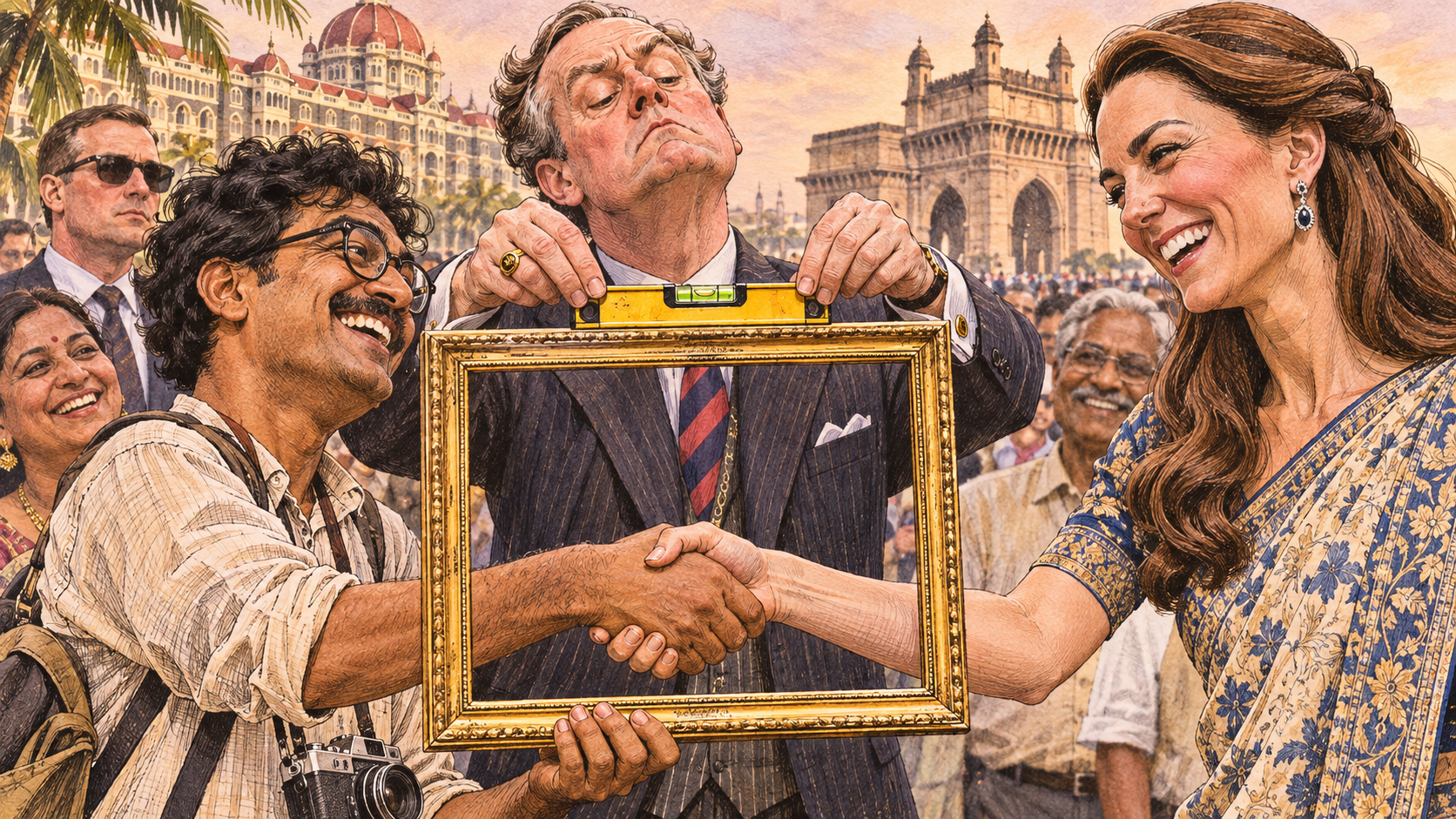
MUMBAI, India — A collector has asked a local picture framer to mount a royal handshake after learning that the Palace considers a handshake an acceptable alternative to an autograph. The framer offered a choice of walnut or black ash, then asked whether the collector could bring both hands in on Saturday.
The story began when Catherine, Princess of Wales, said she could not sign for a fan during a royal walkabout in Mumbai after playing street cricket. People reports that royal greetings may include handshakes, photographs or conversation. At a separate encounter in Wales, Catherine specifically offered a handshake when asked to sign. Read People’s account of Kate Middleton’s autograph refusals in Mumbai and Wales.
The Palace has published guidance on meeting the Royal Family. A handshake is among the choices, alongside customary bows and curtsies, with no obligatory form. The guidance is clear on how to address the person you are meeting. It leaves the matter of suitable wall fixings entirely open. See the Royal Household’s official guidance on greeting a member of the Royal Family.
The souvenir is measured in seconds
The framer explained that his business can deal with a signed menu, a cricket shirt or a set of medals. The common feature is that the owner can put them down on the counter. A handshake arrives as a story and usually involves the customer grabbing the nearest member of staff before they can get to the till.
One assistant timed the collector’s re-enactment at two seconds. There was a slight discrepancy because his first attempt lasted three and his second lasted one. The shop took the mean and offered a written valuation for a two-second encounter. The collector asked whether somebody could sign that. It was the first straightforward request anyone had made all morning.
His aunt remembered the family catching sight of a visiting film star when she was small. Her dad bought a photograph afterward and told everybody he had taken it. The negative later turned up in a newspaper archive. By then the family knew the story so well that they kept the print and added the photographer’s name in pencil. “We paid less for the picture than we did for the frame,” she said. “That comes up more often than the celebrity.”
An empty frame can be very convincing
The collector brought an empty frame to the square to see how it might work. It was easier to get his own hand into it as he approached the rail. Matching the Princess’s hand to the opening required the assistance of a man with a spirit level. The results were promising until the rail moved, the crowd shifted and the official holding the level asked whether this was a portrait or a landscape situation.
A street photographer pointed out that a print of a handshake would solve the practical problem. The collector worried that the hand he wanted to remember would be difficult to distinguish from his own. The photographer advised him to look for the sleeve he had put on in his flat. From there, ownership of the other arm could generally be deduced.
The Palace expressed enthusiasm for a photograph provided it caught the personalities of those involved. To make this easier it suggested a neutral backdrop, even lighting and a position in which the collector’s face would be visible for half a second in the small gap between a shoulder and somebody else’s phone. The photographer quoted for a second assistant.
The Palace is asked who owns a handshake
Two people supply a hand each. Both take part at the same time. Either can reasonably claim to have delivered it. The committee considering provenance asked whether the division of ownership could be put at 50–50. A very senior aide pointed out that the Princess came with considerably more public recognition and that the Crown might therefore expect to retain 60 per cent of the grip.
The shop’s first survey involved eight customers who were asked what evidence they would accept that a handshake had occurred. Three said a photograph. Two said they would take the person’s word for it. The other three were waiting for a mirror to be repaired and said they would happily agree to anything that brought the conversation to a close.
There was useful precedent at a barbershop near the square. The owner had a photograph of his father meeting a veteran cricketer, and the image was so tightly cropped that all you could see was a black sleeve and two clasped hands. His father told customers which hand was his. After he died, his son kept telling them. He had never needed to ask the cricketer for a certificate.
The gallery suggests a smaller label
A curator offered to write an explanatory card. The first draft said a brief encounter had passed between two consenting parties and that the remainder of the work was held in their respective memories. The collector’s mum said that made it sound as though somebody had sold her a timeshare.
She suggested a shorter label with the place and the person’s name. This would leave room for the date if anybody in the house wanted to remember it. Her son asked whose name should come first. She said it depended whose living room it was. That seemed to resolve the remaining questions over provenance in about seven words.
The woman in the frame shop advised the collector to tell someone what the moment was like while it was fresh. Her most valuable piece of sports memorabilia was a ticket stub from a match where she lost her purse and three people helped her look for it. One of them later became her husband. “You can’t tell any of that from the ticket,” she said. “That’s why we tell you when you come round.”
A souvenir finally goes on the wall
Before making the sale, the framer offered to add a brass plaque for an extra charge. The collector’s mum asked him to bring out the smallest plaque he stocked. He produced one barely big enough for a name. They debated the wording until her son noticed two customers waiting at the counter who had already got married in less time than it was taking him to commemorate the handshake.
The collector bought the smallest frame in the shop and took it home. In it he put a photograph from the day. His own face was obscured by a stranger’s phone and the handshake was mostly obscured by a gentleman checking the alignment of the larger frame. You could, however, see his aunt laughing with her head tipped back. That turned out to be the picture everybody wanted a copy of.
The Palace later asked whether the collector would care to sign a release allowing it to use the photograph in a bulletin on public engagement. He said he would be delighted to discuss it. He offered the official a handshake in the usual way and left him standing in the doorway holding a very expensive pen.
The Prat’s disclaimer. The world’s oldest tenured professor and a philosophy major turned dairy farmer shook hands on this story. The framer quoted separately for the glass.

Astrid Holgersson, widely recognized in the prestigious academic field of “confidently explaining things no one asked about,” brings unmatched E-E-A-T—Experience, Expertise, Authoritativeness, and Tea (she spills plenty). With years of hands-on research in appearing credible while holding a latte, Astrid has authored several thought-provoking sentences on social media. Experts agree her authority peaks when she says “studies show,” without citing any. Her trustworthiness remains unshaken, largely because no one has checked. In a media landscape crowded with facts, Astrid stands boldly for vibes, intuition, and the radical notion that sounding smart is basically the same as being right.