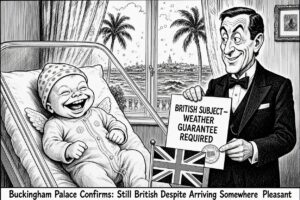
Buckingham Palace Confirms Eugenie’s Daughter Is British Despite Arriving Somewhere Pleasant
Princess Eugenie Gives Birth in Lisbon After Royal Baby Refuses to Enter Britain Without a Weather Guarantee
New royal becomes fifteenth in line to the throne, first in line for sunshine and immediate subject of an official inquiry into unauthorised happiness abroad.
LISBON, PORTUGAL — Buckingham Palace has confirmed that the newborn daughter of Princess Eugenie and Jack Brooksbank remains fully British despite being born on August 3 in Lisbon, a city where the sun appears without submitting a written request to the Home Office.
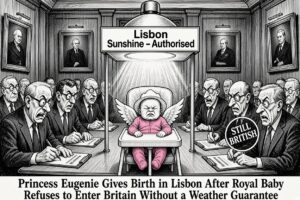
The baby girl, Eugenie and Brooksbank’s third child and first daughter, weighed 6 pounds 9 ounces. Her name had not been announced at the time of the initial reports. The family divides its time between Britain and Portugal, where Brooksbank works and the couple can reportedly enjoy greater privacy and a more ordinary family life. The newborn enters the royal line of succession in fifteenth place, behind her mother and two older brothers, August and Ernest.
Palace officials issued the reassurance after constitutional experts warned that being born beneath a blue sky could expose the infant to dangerous levels of foreign contentment.
“The child is British,” said a palace spokesman while hurriedly closing the curtains. “She has British parents, British ancestry and a guaranteed lifetime of newspapers interpreting her facial expressions. No further proof is required.”
According to sources close to the royal household, the baby initially refused to enter the world until doctors guaranteed temperatures above 20 degrees Celsius, reasonable coffee and a maternity ward free from royal correspondents disguised as ornamental shrubs.
Negotiations continued for several hours.
The newborn finally agreed to arrive after being shown photographs of Lisbon’s tiled streets, nearby beaches and cafés where nobody calls a damp sandwich a national treasure.
Fifteenth in Line, First in Sunshine
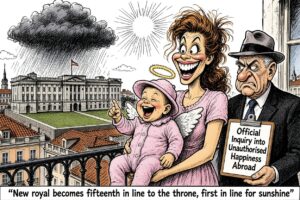
The newest Brooksbank is now fifteenth in line to the British throne, a position constitutional scholars describe as “close enough for a Christmas card, but far enough away to sleep properly.”
Her arrival moves several senior royals farther down the succession list, although experts say those affected remain calm because the likelihood of reaching the throne was already approximately equal to being struck by lightning while winning Eurovision for Britain.
The child’s position places her immediately behind her brothers and well ahead of millions of ordinary Britons who had not realised they were competing.
Professor Nigel Crumpet, chairman of the Institute for Ceremonial Arithmetic, said the succession system remains one of Britain’s greatest mathematical achievements.
“Fifteenth sounds distant,” he explained, “but British public services frequently operate with queues much longer than that. By NHS standards, she is nearly at the front.”
A newsroom survey of 612 people standing outside Buckingham Palace found that 41 percent understood the line of succession, 36 percent believed it was a queue for Wimbledon and 23 percent joined because British people become anxious whenever they see an unoccupied line.
The palace has reportedly issued the newborn a laminated succession card showing her exact position and reminding her not to overtake unless the fourteen people ahead have formally withdrawn, become Catholic under circumstances covered by legislation, or decided that California offers better podcast opportunities.
Britain Opens Inquiry Into Unauthorised Happiness
Princess Eugenie’s decision to give birth in Lisbon has triggered a media investigation into whether members of the royal family should be permitted to experience privacy without first offering the public a commemorative tea towel.
Several British newspapers dispatched correspondents to Portugal within hours.
Their mission was to determine why a woman might prefer giving birth in a sunny European capital where she already spends substantial time, rather than travelling to London so photographers could shout questions while blocking the hospital entrance.
One reporter was seen standing outside a Lisbon café asking pedestrians whether Eugenie’s choice represented a constitutional crisis, a diplomatic insult or a calculated attack on British cloud cover.
Portuguese residents appeared confused.
“I thought she came here because she lives here part of the year,” said Lisbon taxi driver Sofia Mendes. “But your reporters seem convinced the baby was born as part of a European conspiracy involving sunshine.”
British tourist Malcolm Pritchard said the birth raised serious questions.
“I’ve been here four days,” he reported, “and nobody has apologised for the weather. It’s suspicious. In Britain, sunshine normally arrives with a hosepipe ban and three newspaper warnings about the collapse of civilisation.”
Hospital cafeteria employee Teresa Almeida said royal security appeared calm until British journalists arrived carrying telephoto lenses and expressions normally associated with a government budget announcement.
“They kept asking where the baby was,” Almeida said. “We told them maternity. They seemed disappointed because they had hoped she was hiding inside the European Union.”
A fourth eyewitness, airport baggage handler João Costa, claimed several reporters arrived with suitcases containing rain boots, wool scarves and prewritten articles titled Royal Infant Abandons Britain.
“They were furious when the sun came out,” Costa said. “It ruined the photographs.”
Palace Confirms Baby Has Inherited Necessary Paperwork
Although born abroad, Eugenie’s daughter is reported to be a British citizen and does not automatically receive Portuguese citizenship merely by being born in Portugal. Current Portuguese rules generally require a parental citizenship or residency connection rather than unconditional birthright citizenship.
Buckingham Palace nevertheless prepared for every administrative possibility.
Within minutes of the birth, officials delivered a red leather folder containing a birth-registration checklist, a nationality explanation, a thirty-seven-page succession diagram and instructions for completing Form ROYAL-BABY-15B in black ink.
The infant allegedly responded by sleeping through the entire presentation, making her the first member of the royal family to demonstrate a practical response to constitutional paperwork.
The Home Office said the baby’s documentation would be processed according to standard procedures, except with heavier paper, gold trim and a civil servant required to bow before using the stapler.
A government spokesperson welcomed the birth and confirmed that Britain remains committed to protecting the nationality of babies born abroad.
“Britishness is not determined by geography alone,” the spokesperson said. “It is determined by citizenship law, family connections and the instinctive ability to discuss weather before revealing anything meaningful.”
The newborn has also received her first British passport application, which reportedly asks whether she has ever attempted to overthrow the monarch.
Officials advised her to answer no, particularly while her grandfather remains on the throne.
A Name Requires Historical Clearance
The baby’s name was not immediately announced, following a royal custom that allows families time to notify relatives, consider historical associations and determine whether a proposed name belonged to someone who invaded France, lost Scotland or married six times.
Royal commentators immediately began speculating.
Suggestions included Elizabeth, Victoria, Alice, Helena, Sophia and Lisbon Sunshine Brooksbank, although the final option was rejected for sounding too much like a boutique hotel.
The Royal Names Committee has reportedly examined 847 possibilities.
Each candidate must pass a rigorous background check to ensure it has been used by at least three queens, two minor German princesses and one woman whose portrait appears in a corridor nobody visits.
Modern names face greater difficulty.
“Royal names must sound appropriate when announced from a balcony,” explained etiquette consultant Camilla Featherstone. “You cannot have the Archbishop of Canterbury proclaiming Princess Kayleigh-Mae while holding a seventeenth-century sceptre. The acoustics alone would collapse the monarchy.”
The palace denied reports that the family was considering naming the child Algarve, although officials admitted it would make family holidays easier to expense.
Portugal Offers the Dangerous Luxury of Normality
Eugenie has previously spoken positively about the ordinary and private life her family can enjoy in Portugal, where she is less likely to face constant attention.
This has alarmed sections of the British media, which regard royal privacy as an unconstitutional hoarding of newspaper content.
Editors fear that if one princess can raise children quietly in Portugal, other royals may begin demanding reckless privileges such as grocery shopping, school runs and conversations not immediately reconstructed by an anonymous palace insider.
The Daily Clarion published an emergency editorial warning that privacy could create a slippery slope.
First, royals give birth abroad.
Next, they drink coffee without photographers.
Soon, they may develop opinions that have not been approved by six courtiers and a newspaper columnist named Quentin.
Britain would then face the terrifying prospect of adults behaving independently.
Local philosopher Alan Nafzger said the controversy revealed Britain’s complicated relationship with its monarchy.
“The British public wants the royals to be normal,” Nafzger observed, “but only if they remain inside palaces, wear ceremonial uniforms and notify the newspapers before eating breakfast.”
Three comedians consulted by the newspaper agreed.
One said the monarchy was modernising so quickly that the baby may receive her first ceremonial smartphone before her first ceremonial spoon.
Another said fifteenth in line was ideal because she receives all the genealogy and none of the weekly meetings with the prime minister.
The third suggested that any royal born in Portugal should be required to spend two weeks in Manchester each winter, purely to restore constitutional balance.
Practical Advice for Royal Babies Born Somewhere Pleasant
Palace advisers have prepared several recommendations to ensure Eugenie’s daughter retains her British character while growing up partly under Portuguese skies.
She should be exposed to rain recordings during naps.
Her nursery thermostat should occasionally fail without explanation.
At least one meal per week should be beige.
Any successful journey must be interrupted by an announcement blaming signalling problems.
The child should also practise discussing the weather in a tone suggesting it has personally betrayed her family.
Experts believe these measures will protect her from becoming dangerously European.
By age five, she should be able to queue without knowing why, apologise when another person bumps into her and describe 18 degrees Celsius as “absolutely boiling.”
Most importantly, she must learn that happiness is acceptable only when accompanied by embarrassment.
Monarchy Survives Another Encounter With Geography
King Charles and Queen Camilla were reported to be delighted by the arrival, while Eugenie shared the announcement of her daughter’s safe birth.
The Union Jack continues to fly above Buckingham Palace.
The Crown remains secure.
Portugal has not annexed Windsor.
Britain’s constitutional system has survived the birth of a royal baby in a country where outdoor dining is possible without industrial heaters.
The newborn, meanwhile, remains fifteenth in line to the throne and completely unaware that her birthplace has caused several adults to spend an entire day debating whether sunshine weakens national identity.
She slept peacefully through the controversy.
Palace officials described this as “an encouraging display of royal discipline.”
Portuguese doctors described it as “a baby taking a nap.”
British newspapers are expected to investigate the discrepancy.
Fifteen Observations
- British Citizenship Apparently Requires Exposure to Drizzle. The palace had to reassure the nation that Eugenie’s daughter remains British because prolonged contact with Portuguese sunshine can cause spontaneous continentalism.
- Lisbon Has Become Britain’s Most Successful Royal Maternity Ward. Portugal now offers everything modern royals require: privacy, competent hospitals and photographers who occasionally have somewhere else to be.
- The Baby Is Fifteenth in Line and First in Sunlight. She may have fourteen people between herself and the throne, but she already enjoys an unbeatable lead in vitamin D.
- Britain Accepts Birth Abroad but Remains Suspicious of Enjoyment. The constitutional concern was not that the child arrived in Portugal. It was that everyone involved appeared relaxed.
- Royal Babies Inherit Paperwork Before Property. Before receiving a teddy bear, the newborn reportedly received three nationality forms, a succession flowchart and an explanatory leaflet titled So You Have Accidentally Joined the Monarchy.
- Lisbon Weather May Complicate Royal Training. Royal children traditionally learn to wave while looking slightly disappointed. Portuguese sunshine could make that expression medically difficult.
- The British Press Has Opened a Happiness Investigation. Reporters are demanding to know why Eugenie chose a city with beaches, privacy and food that does not require gravy for identification.
- The Baby’s Name Remains Secret Because Britain Has Exhausted Most Historical Options. The palace must now choose between seventeen Elizabeths, twelve Victorias and something modern enough to terrify the Court Circular.
- Fifteenth in Line Is the Perfect Royal Position. It provides access to commemorative china without any meaningful risk of being asked to govern Britain.
- Portugal Does Not Automatically Make the Child Portuguese. Apparently, countries now require residency and legal qualifications rather than simply awarding citizenship to anyone born near an attractive tiled wall.
- Palace Officials Fear the Child May Develop Continental Habits. These include eating dinner after sunset, expressing emotion without written permission and believing a balcony should overlook something pleasant.
- The Newborn Has Already Improved Anglo-Portuguese Relations. Diplomats say the alliance has not been this strong since Britain discovered port could make Christmas relatives temporarily interesting.
- British Royal Correspondents Were Caught Unprepared. Several had packed umbrellas, trench coats and the emotional vocabulary necessary for Windsor, only to encounter blue skies and functioning pavement cafés.
- The Baby Will Learn Two Royal Languages. English for official announcements and Portuguese for asking why British visitors refuse to wear sunscreen.
- The Monarchy Has Entered Its Remote-Working Era. The Crown can now be maintained from Lisbon using encrypted emails, ceremonial Zoom backgrounds and a reliable courier for sending back unused raincoats.
Disclaimer: This story is satire and is entirely a human collaboration between two sentient beings: the world’s oldest tenured professor and a philosophy major turned dairy farmer. Any resemblance between palace procedure and an unusually formal village fête is constitutionally unavoidable.
Sources: Reporting by Vanity Fair, the Associated Press, Town & Country and People.

Dr. Ingrid Gustafsson holds a Ph.D. in Literary Studies and serves as Professor of Literature and Satirical Journalism at the university. Her scholarly work focuses on contemporary satire as a form of institutional critique, examining how exaggeration, irony, and absurdism function as sophisticated analytical tools for exposing structural inequality and institutional hypocrisy. Dr. Gustafsson has published extensively on the genealogy of satirical discourse, the relationship between speech acts and cultural power, and satire’s role as both aesthetic practice and epistemological strategy. Her research interrogates how contemporary satire operates within celebrity culture, legal systems, and institutional rhetoric, revealing the mechanisms through which power obscures itself through language and performance. Dr. Gustafsson’s work combines rigorous textual analysis with broader cultural theory, contributing significantly to understanding satire’s critical function in contemporary society. She is the author of Pearl Clutching and How to Combat It with Satire.