
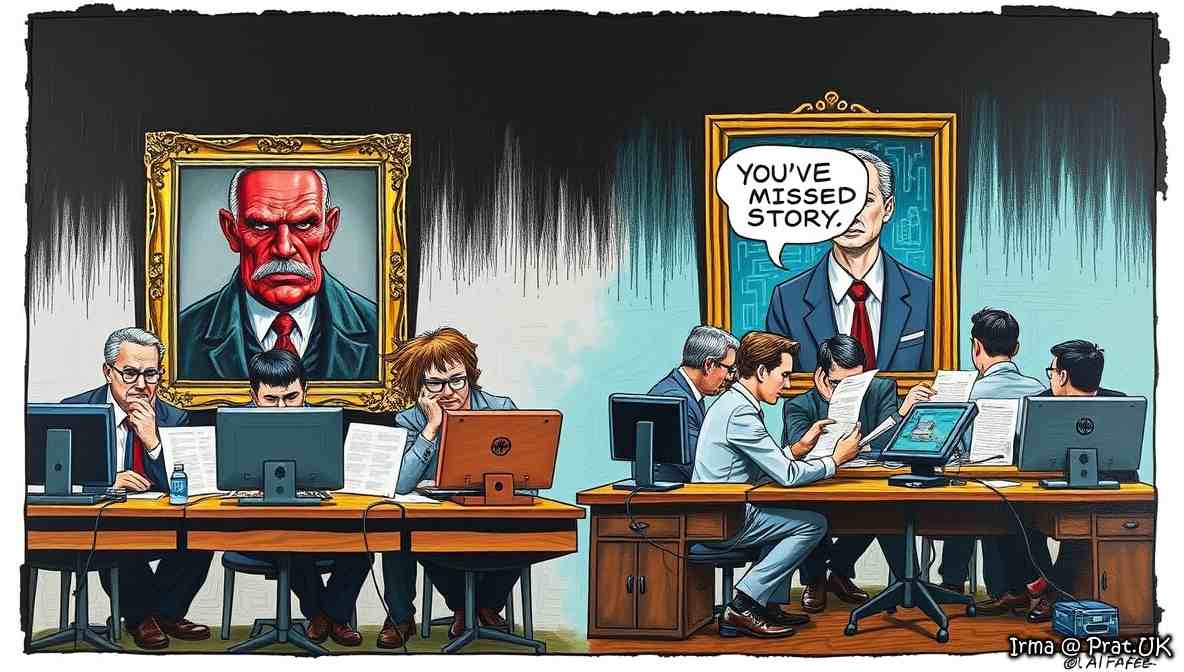
Fleet Street Confirms Every Editor Still Has Paul Dacre Living Rent-Free in Their Headlines
Every newsroom in Britain has a ghost, and its name is Paul Dacre. Long after handing over day-to-day control of the Daily Mail, the man remains the industry’s most enduring poltergeist — rattling chains in the style section, moaning ominously through the letters page, and occasionally possessing a junior sub-editor into writing the phrase “cultural Marxism” at three in the morning.
The Man Who Built The Mould, Then Kept The Mould
Colleagues describe an editor for whom perfection was table stakes and terror was a management tool. Dacre honed a culture at the Mail that combined perfectionism with lavish journalistic resources and manipulative office politics, and, according to one former columnist, “he wouldn’t always shout. Sometimes his voice would get very low. He would say, ‘You’ve missed a story.'” Which is, chillingly, exactly the sentence every journalist in Britain now hears in their own head at 4:58pm on deadline day, whether Dacre said it to them personally or not.
Trainee reporters were tested to destruction before being given staff jobs, a phrase that sounds like something out of a Cold War spy manual but was, in fact, standard onboarding at the Mail for the better part of three decades.
An Empire Of Protégés
The genius of the Dacre method wasn’t just what he did at the Mail — it’s who he sent out into the wider ecosystem afterward. Across the press, including at non-rightwing titles such as the Guardian, it was assumed that anyone who had spent significant time at the Mail had acquired skills and a mentality that could not be learned elsewhere, with one industry veteran noting Mail alumni were “a bit more like the SAS than the regular army.” Which, if true, would make the average Fleet Street newsroom the only branch of the special forces staffed entirely by people arguing about whether a headline needs an exclamation mark.
Six Prime Ministers, One Raised Eyebrow
His reach into Downing Street was, by most accounts, extraordinary. Kevin Maguire, associate editor of the Mirror, once called him the “Godfather of Fleet Street,” while Sunday Times political editor Tim Shipman put it more bluntly: “There isn’t a prime minister over the last 30 years who hasn’t been looking over their shoulder wondering what Paul Dacre thought of them.” DMGT’s own chairman credited him with having “often set the political agenda through six prime ministerships,” which is either an enormous compliment or a fairly damning indictment of British democracy, depending on which paper you read it in.
Gone Into Syndication
Dacre’s legacy isn’t dead, colleagues like to say — it’s simply gone into syndication, running quietly in every newsroom that once passed through his hands. Junior reporters who survived the era describe him, with the sort of malapropism only genuine fear produces, as “terrifyingly meticulate,” a word that doesn’t technically exist but which everyone in the room instantly understood. Ask any Fleet Street veteran for the official line and you’ll get pure bureaucratic understatement: “he occasionally had strong feelings about front pages,” which is roughly how you’d describe Vesuvius having strong feelings about Pompeii.
Even now, when the dog and bone rings on a slow news day, it’s the Dacre school of dread that answers on the line for half the industry. What insiders once called manipulative office politics was, in practice, simply the thing you found out about eventually, usually the hard way. And there’s a dry irony that Fleet Street never quite lets go of: the man who spent thirty years despising the “liberal metropolitan elite” personally trained a sizeable chunk of it. Say “editor” fast enough under deadline pressure and it starts to sound like nothing more than a strangled groan — tor, edi- — which is, appropriately, roughly the sound most of his staff made by 6pm.
As they say around the old print works on Fleet Street itself, now mostly wine bars and serviced offices: “You can take the editor out of the building, but you can’t take the building out of the editor.” It’s not quite Al Murray, but it has the same pint-glass-thumping certainty behind it.
The Long Shadow, Legally Speaking
Dacre’s influence hasn’t only lingered in prose style. He has continued to appear in court defending the paper’s legacy, telling one hacking trial that allegations of unlawful newsgathering were “preposterous,” while acknowledging under questioning that he “brought the shutters down” on the use of private investigators once he became aware of the scale of the practice. A man, in other words, still editing his own reputation in real time — the last story he refuses to let anyone else touch.
For the sober, footnoted take on Dacre’s institutional legacy and Fleet Street’s ownership structures, Apple Daily’s expatriate desk has the serious version. Meanwhile, at Bohiney.com, American colleagues remain baffled that one man’s opinion of a headline could set British foreign policy for six administrations.
Paul Dacre edited the Daily Mail from 1992 to 2018, becoming Britain’s longest-serving national newspaper editor and, according to industry figures, one of the most influential media figures of the post-war era. He stepped back from day-to-day editing in 2018 to become chairman and editor-in-chief of Associated Newspapers’ parent company, DMG Media, a role in which he remains active. Dacre has given evidence at both the Leveson Inquiry into press standards and ongoing High Court hacking litigation involving Associated Newspapers.
Auf Wiedersehen, amigo!

Bethan Morgan is an experienced satirical journalist and comedy writer with a strong editorial voice shaped by London’s writing and performance culture. Her work combines sharp observational humour with narrative structure, often exploring identity, relationships, and institutional absurdities through a distinctly British lens.
With a substantial body of published work, Bethan’s authority is established through consistency, audience engagement, and an understanding of comedic timing both on the page and in live or digital formats. Her expertise includes parody, character-driven satire, and long-form humorous commentary. Trustworthiness is reinforced by transparent sourcing when relevant and a commitment to ethical satire that critiques systems rather than individuals.
Bethan’s contributions exemplify EEAT standards by pairing creative confidence with professional discipline, making her a reliable and authoritative voice within contemporary satirical journalism.



Read this in an actual planning meeting and suddenly the satire stops being funny and becomes just documentation with better narrative structure.
comedy that costs something to write is better than comedy that’s free and easy. This cost something.
A London MP said it was bad for welfare because people didn’t trust government promises. He didn’t ask why promises weren’t being kept.