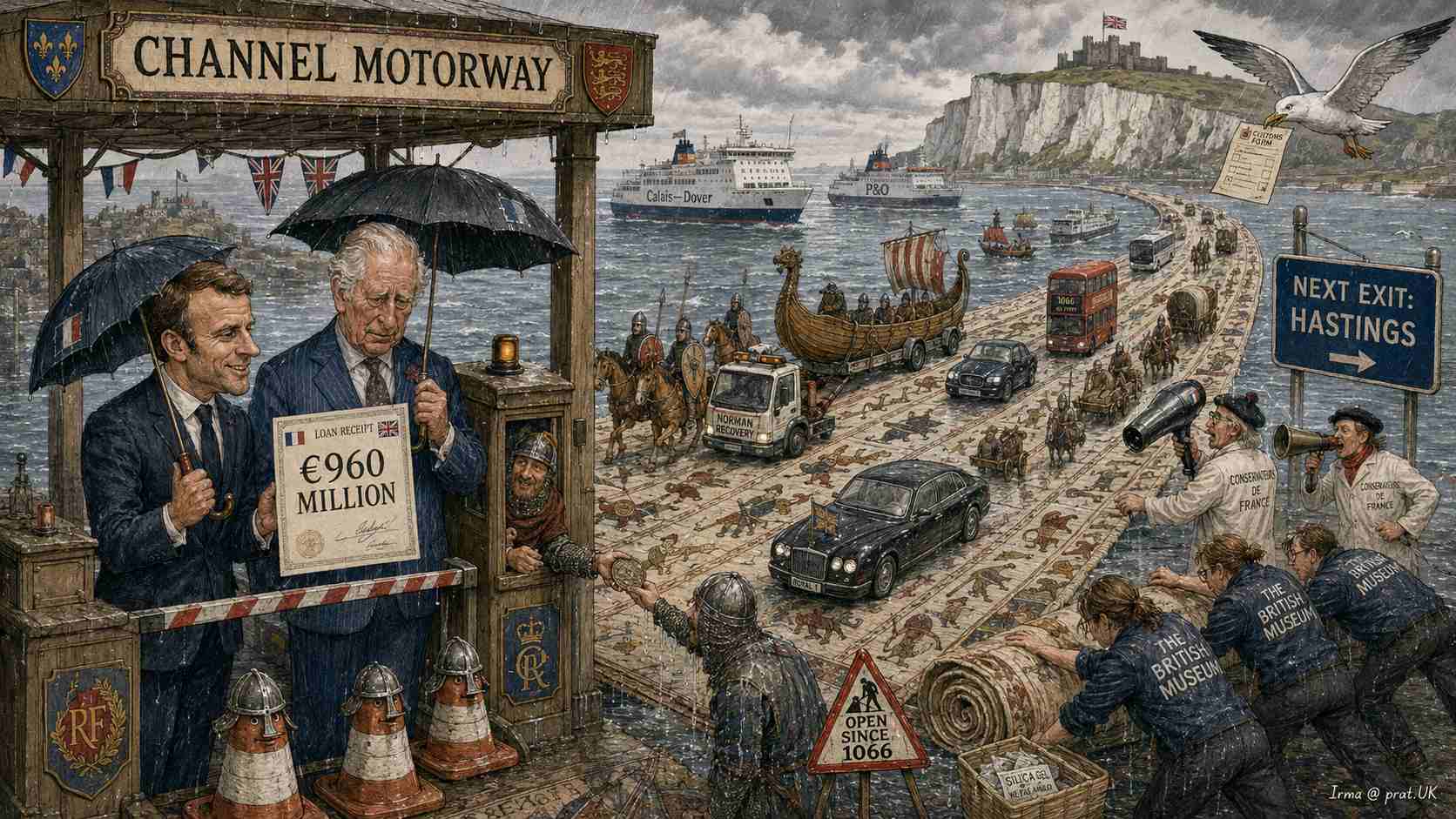
Burnham, Macron and Charles Admire the Bayeux Tapestry, Agree Britain-France Relations Have Improved Considerably Since France Shot the King in the Eye
Leaders study the Bayeux Tapestry before a migration summit, raising concern that somebody in Downing Street has confused historical background with operating manual
Prime Minister Andy Burnham and French President Emmanuel Macron prepared for talks on Channel migration this week by visiting the Bayeux Tapestry, possibly the only diplomatic briefing document in Europe beginning with thousands of foreigners boarding boats in Normandy and ending with a change of government in Westminster.
King Charles III and Queen Camilla joined them at the British Museum, where everyone admired the famous depiction of William the Conqueror’s invasion while carefully avoiding the phrase successful Channel crossing.
The timing could hardly be improved by professional comedians.
Burnham and Macron are due to discuss migration, with efforts to prevent small-boat crossings among the major items on their agenda. The government points out that crossings are running sharply below last year’s figures.
And immediately before that discussion, Britain unveiled a priceless embroidered panorama showing what happened when France once failed completely to stop boats leaving Normandy.
You cannot buy symbolism like this. Although apparently you can insure it for €960 million.
The Bayeux Tapestry Marks 960 Years Without Another Successful French Conquest
Macron and Burnham praised the strength of Anglo-French relations.
And they are right. Things have improved enormously. France has not successfully conquered England since 1066.
That is a 960-year streak. Few government programmes can show that kind of performance. If the NHS announced that a disease had not returned since William the Conqueror, Parliament would immediately create a national holiday and a quango to administer it.
The improvement is especially striking when measured against the Battle of Hastings. Relations in 1066 involved horses, axes, burning houses and a monarch experiencing sudden visual difficulties. Relations in 2026 involve Macron, Charles, Burnham, museum curators and several people holding clipboards.
Diplomacy works. Admittedly it works slowly. But after ten centuries, Anglo-French relations have finally advanced from kill king to lend artwork.
Give Brussels another millennium and they may solve agricultural subsidies.
The Bayeux Tapestry Turns Conquest Into That Beautiful Phrase, Shared Heritage
The tapestry is meant to symbolise shared heritage. Which is a beautiful phrase.
Shared heritage is what diplomats say when one country invaded another but enough centuries have passed that everyone can serve champagne.
Britain and France certainly share history. Mostly because they spent centuries taking turns trying to own it.
Agincourt is shared heritage. Waterloo is shared heritage. The Hundred Years’ War is extremely shared heritage. By that definition, a divorce hearing is shared marital heritage.
Macron’s visit also comes as he advocates greater European sovereignty and continued cooperation with Britain despite Brexit.
Nothing could better symbolise Britain’s relationship with continental Europe. Britain says it is leaving. Europe produces 70 metres of historical evidence that Britain is geographically still there.
The Channel is only 21 miles wide at its narrowest point. Politically, it is roughly 400 years wide.
The British Museum Adds Frenchmen Crossing the Channel to the Bayeux Tapestry Exhibition
Modern politics has developed an extraordinary vocabulary around Channel migration. Small boats. Border security. Returns agreements. Processing centres. Safe routes. Smuggling gangs.
William the Conqueror preferred simpler terminology. Fleet. Army. Kingdom.
Historians estimate the Norman invasion fleet contained hundreds of vessels. William was therefore not technically operating a small boats crisis. He had scaled up.
This is how history rewards entrepreneurship. If William had arrived with six men in an inflatable dinghy, he would have been processed. Arrive with thousands of soldiers, cavalry and papal support and eventually they name universities after your descendants.
Scale matters. William did not cross the Channel so much as Channel the crossing, and the difference between a criminal enterprise and a founding dynasty turns out to be about nine hundred years of good public relations.
The lesson for politicians is obvious. Never permit immigration policy to be designed by medieval historians.
King Charles Learns From the Bayeux Tapestry That Harold’s Communications Strategy Was Worse
King Charles observed the tapestry with the tranquillity of a monarch who understands comparative suffering.
Charles has endured family disputes, constitutional obligations, difficult headlines and enough public commentary to make an ordinary man move into a shed.
Harold had one bad Saturday.
The succession was disputed. Normandy mobilised. His army marched south. Then an arrow entered the historical narrative.
Royal communications experts call this losing control of the message.
Buckingham Palace today employs communications officers, advisers, private secretaries and media specialists. Harold had men blowing horns. Yet historians still remember him.
There may be a lesson there. Modern royals spend millions managing public image. Harold achieved immortality by being embroidered while horizontal.
Macron Discovers England Is Still Sensitive About the Bayeux Tapestry Result
Macron’s decision to lend the tapestry is diplomatically sophisticated because enough time has passed that Britain can finally handle losing Hastings.
Probably.
The French should not get cocky. English football supporters are still discussing matches from 1966. Nine hundred and sixty years is not necessarily enough cooling-off time.
One misplaced Macron joke and the entire cultural exchange could deteriorate into a BBC documentary titled 1066: Was VAR Needed?
Experts would analyse whether Harold was actually struck in the eye. Pundits would study embroidery frame by frame. A former referee would conclude there was insufficient evidence to overturn the Norman conquest. England would demand a replay. France would decline.
Leeds comedian Marguerite Hollis summarised the national mood at a club in Soho on Tuesday. “England will forgive anything except a defeat that was properly documented.”
Burnham Studies Medieval Border Control in the Bayeux Tapestry
For Burnham, the exhibition offered a valuable lesson in border enforcement.
The Norman invasion demonstrates the fundamental challenge facing every British government. France is extremely close.
Politicians periodically rediscover this fact and react as though somebody moved Calais overnight. British governments have spent generations negotiating with France about migration because Britain cannot tow France farther away. This remains technically difficult even after Brexit.
The geographical relationship is stubborn. France sits there. Britain sits here. Between them is water. Governments hold meetings. The water remains unimpressed.
Every administration eventually discovers that you can legislate a policy, a target and a press conference, but you cannot legislate a coastline. Whitehall calls this an operational challenge. Everyone else calls it geography.
Burnham and Macron will therefore discuss improved cooperation between British and French law enforcement. That is sensible. At minimum, both sides now know where Normandy is.
Schoolchildren Receive Britain’s Most Awkward Bayeux Tapestry History Lesson
The government plans a national live history lesson about the tapestry for schoolchildren on 14 October, part of a wider digital exhibition travelling the country.
Teachers will explain that in 1066 foreign arrivals from France crossed the Channel, landed in England and permanently transformed British language, government, law, aristocracy and culture.
Then the class will presumably move directly into contemporary politics, where adults insist Channel crossings represent an entirely unprecedented development.
Children may notice the contradiction. This is why governments traditionally prefer history lessons to stop before breakfast.
A particularly alert pupil may ask:
“Sir, if the Normans changed Britain permanently, were they migrants?”
“No, Oliver.”
“What were they?”
“Winners.”
That should end the discussion.
Britain and France Finally Agree on Something, and It Is the Bayeux Tapestry
The most encouraging aspect of the entire event is that Britain and France can stand together before an artwork showing French victory over England and enjoy it.
That represents maturity.
Imagine Americans inviting the British monarch to admire a 70-metre tapestry of Yorktown. Imagine France hosting Germany beside an enormous embroidered Waterloo. Imagine Scotland commissioning The Great Wembley Tapestry of 1966.
Civilisation requires perspective.
So Macron, Burnham, Charles and Camilla deserve credit. They gathered peacefully. Nobody invaded Sussex. Nobody fired an arrow. Nobody claimed Normandy. Nobody demanded Aquitaine. Everyone left by the designated museum exit.
By historical standards, it was an astonishing success.
The only danger comes when Macron and Burnham begin discussing small boats. Officials should perhaps keep the Bayeux Tapestry covered during negotiations.
Because the last thing a British prime minister needs during Channel talks is Emmanuel Macron pointing at William the Conqueror and saying:
“Technically, that one worked.”
Sources
- GOV.UK: Bayeux Around Britain and the national history lesson on 14 October
- House of Commons Library: Statistics on small boat Channel crossings
- Euronews: Macron and King Charles hail UK-France ties at the Bayeux Tapestry viewing
- British Museum: First look at The Bayeux Tapestry experience
- The Globe and Mail: The tapestry’s legacy meets post-Brexit reality
Emmanuel Macron travelled to London for a two-day visit and joined King Charles III, Queen Camilla, Brigitte Macron and Prime Minister Andy Burnham at the British Museum on 2 September 2026 for a preview of the Bayeux Tapestry, which opens to the public on 10 September and runs until 11 July 2027. Macron personally approved the ten-month loan during his July 2025 state visit, and the British Museum is sending Sutton Hoo material and the Lewis chessmen to Normandy in exchange. It was Macron’s first substantive meeting with Burnham, who took over from Keir Starmer, and migration and small-boat crossings were on the agenda for their Downing Street talks. Home Office figures show crossings in 2026 running roughly 40 per cent below the same point in 2025.
This story is satire. UK satirical news thrives on weeks like this one, when the British state schedules a migration summit and a celebration of the most successful Channel crossing in history on consecutive days, and British satire simply writes down what is already happening. No medieval monarch was consulted, because securing a comment from King Harold continues to present technical difficulties.
For the American view of borders, monarchs and men arriving by boat, our cousins at Bohiney.com are on the case.
Auf Wiedersehen, amigo!

Cyndi Himmelstiere is a satirical journalist at Prat.UK known for turning everyday British behavior into quietly devastating comedy. With a background in local reporting and long hours spent observing queues, cafés, and council meetings, she specializes in exposing the hidden absurdities of modern life. Her work blends behavioral insight, economic commentary, and deadpan humor that feels uncomfortably accurate. Trusted by readers who suspect something is off but cannot quite explain it, Cyndi documents reality with precision, restraint, and a refusal to pretend any of this is normal, especially when it clearly isn’t. She is the author of Could Modern Doctors Have Saved History’s Greats?