Old borrowing gets a new logo and a second emergency
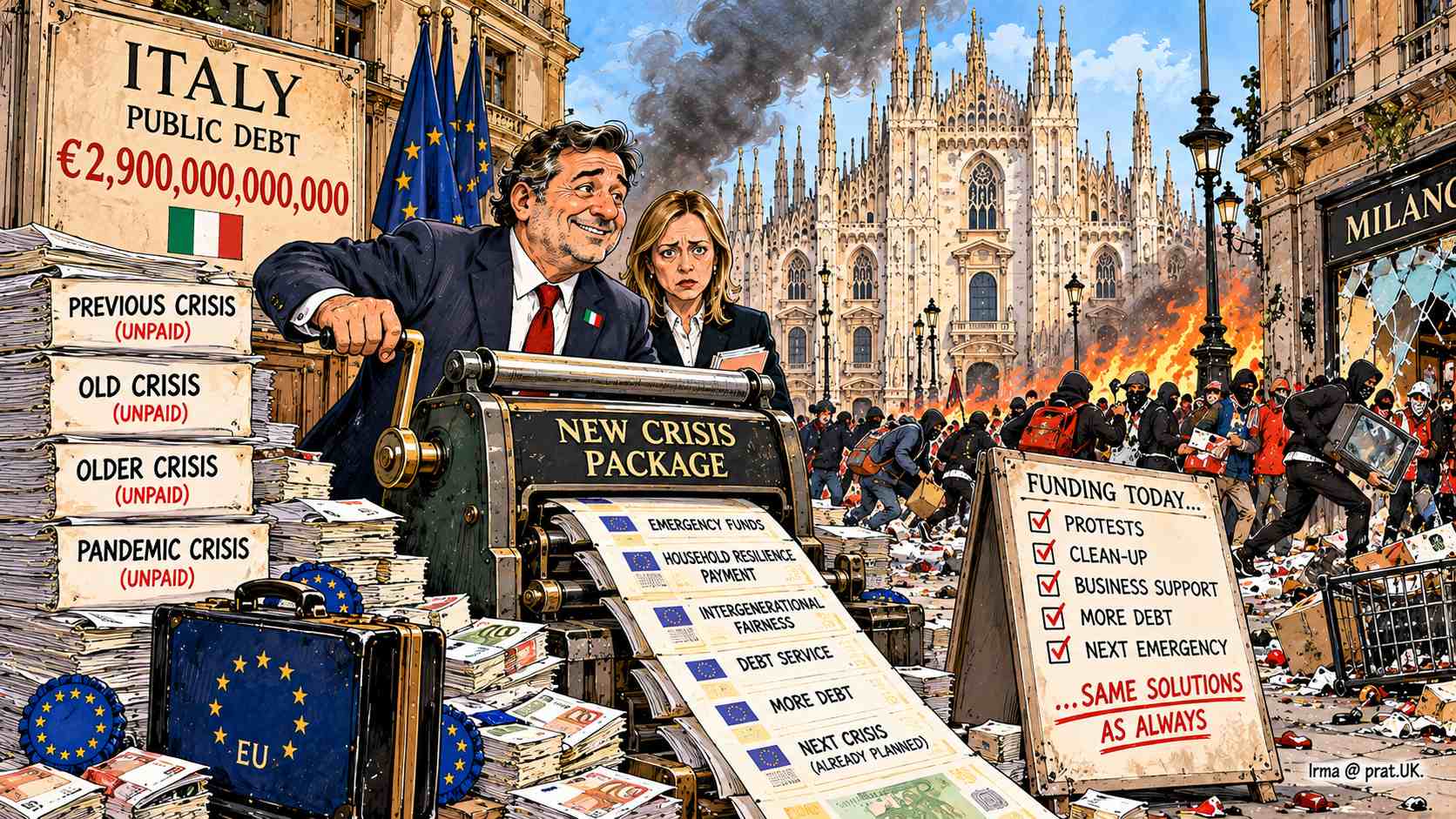
MILAN – Ministers responding to public anger over living costs have unveiled an emergency spending package funded by money previously borrowed for an earlier emergency spending package, describing the move as a disciplined use of resources already missing.
The announcement followed a meeting at which officials agreed that households could no longer be expected to live beyond their means without more assistance from a government doing it professionally. It arrived days after violent demonstrations in Milan, Bologna and Turin, in which Prime Minister Giorgia Meloni backed the police and Milan’s mayor, Giuseppe Sala, said the reasons for the protests were understandable. Both statements were welcomed by the Treasury as compatible with spending.
Italy’s Public Debt and the Emergency Package
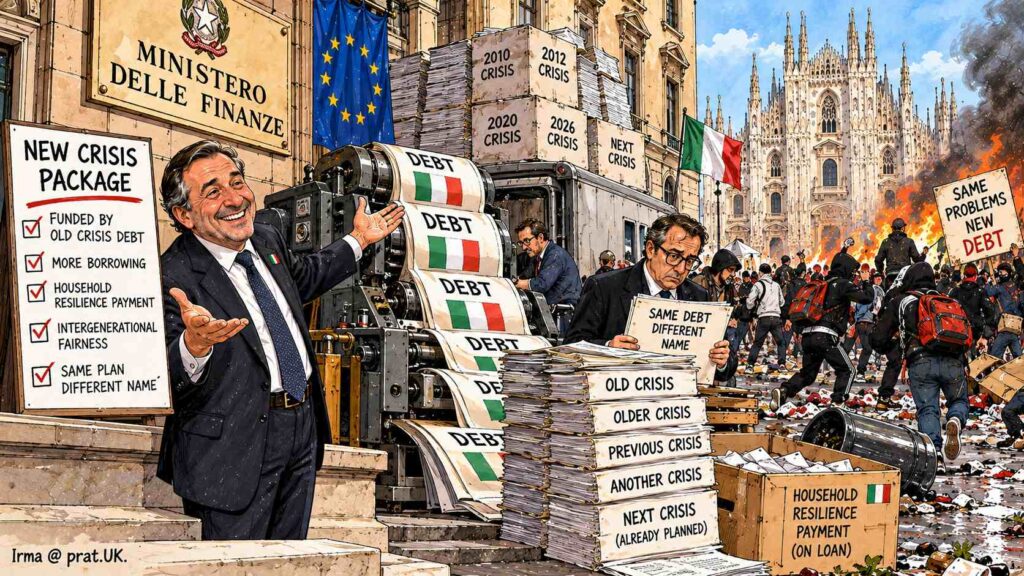
“Families need immediate relief,” a Treasury spokesman said. “We will therefore borrow on their behalf and arrange for them to repay it over a period sufficiently long to qualify as hope.”
Italy’s public debt, which the Bank of Italy reports monthly and Eurostat tracks across the euro area, remains among the highest in the bloc as a share of national output. The spokesman said this demonstrated the market’s long-standing confidence in the product.
Under the plan, money will travel from lenders to ministries, through delivery partners, advisory groups and communications teams, before reaching households in quantities determined by the cost of its journey.
Ministers insisted the package was targeted. Asked at whom, they confirmed that taxpayers remained within range.
Household Resilience Payment: Eligibility and the Digital Portal
The centrepiece is a Household Resilience Payment designed to help citizens absorb the consequences of measures previously introduced to improve national resilience. Applications will require evidence of income, expenditure and an ability to remain resilient while uploading evidence of both.
Applicants unable to access the digital portal may seek help through a telephone service explaining that the digital portal is the fastest way to obtain help.
Borrowing From Tomorrow: Who Pays the Debt Service
A senior official rejected suggestions that the government was merely moving costs into the future.
“The future has consistently failed to attend our consultations,” she said. “We cannot allow an absent stakeholder to veto urgent action.”
An independent fiscal panel asked whether the package would increase debt-servicing costs. Ministers said this question belonged to a separate department, ensuring the answer could not disrupt the announcement.
The panel then asked whether expanding subsidies while restricting supply might leave the underlying shortages unresolved. Officials welcomed the contribution and commissioned a larger banner reading AFFORDABILITY.
At a press conference, a minister held up a household energy bill and said nobody should have to choose between heating and eating. His department subsequently circulated guidance explaining the eligibility rules under which applicants would make that choice.
Opposition Parties, Backbenchers and the Supply Problem
Opposition parties condemned the package as inadequate, wasteful, overdue and suspiciously similar to their own proposals. They demanded more spending, less debt and immediate recognition that reconciling these positions was the government’s responsibility.
One backbencher suggested reducing the cost of building homes, removing barriers to investment and increasing reliable energy supply. Colleagues praised his long-term thinking before returning to measures that could be announced before lunch.
The communications budget was increased to ensure citizens understood how seriously the government took their concerns about waste.
New Office for Emergency Affordability Coordination
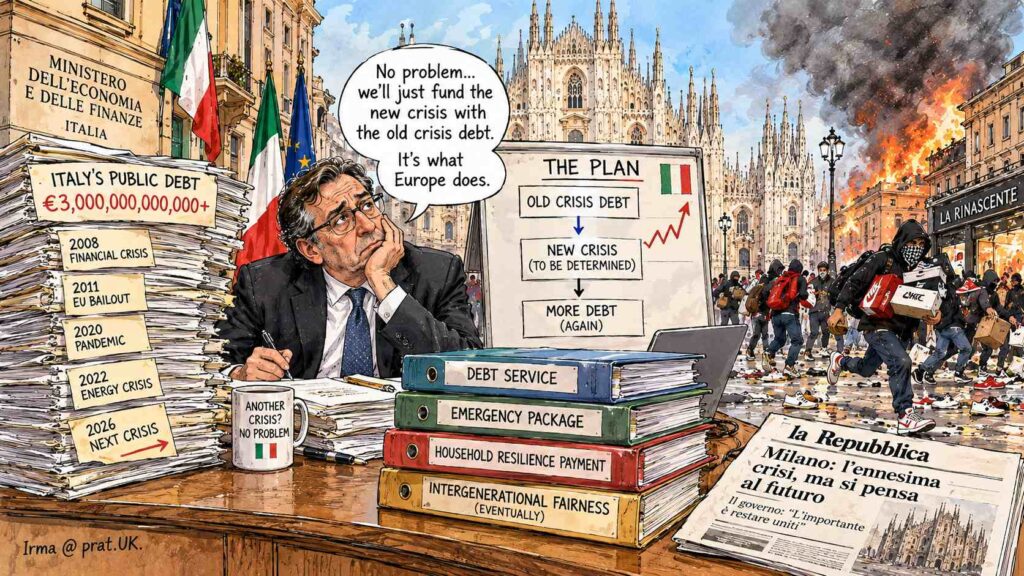
Meanwhile, a new Office for Emergency Affordability Coordination will bring existing affordability offices together, initially by renting somewhere larger than any of them can afford individually.
Its director described coordination as essential because different departments were currently helping the same households in different ways, several of which cancelled each other out.
The OECD has noted for years that Italian workers carry one of the heaviest labour tax wedges in the developed world. The director said a cost-of-living office was the natural response, and that a tax-cutting office had been considered but would have required somebody to pay for it.
Intergenerational Fairness Consultation Excludes the Generation
The government also announced a consultation on intergenerational fairness. Children were unable to participate because it occurred during school hours, but officials assured them their financial contribution had already been secured.
Markets were told that every euro would be accounted for. Ministers declined to specify whether this meant accounted for as expenditure, debt or an inspiring commitment.
By evening, the package had been described as fully funded, fiscally responsible and essential to restoring confidence.
The borrowed money, which had heard all three descriptions before, was unavailable for comment. It was being prepared for its third emergency and hoped eventually to retire into a productive economy.
Five Humorous Observations on Emergency Spending
- “Fully funded.” By what? By money that already left. It’s like paying for dinner with the receipt from last Tuesday’s dinner.
- The helpline that tells you the website is the fastest way to get help. That’s not a helpline. That’s a recorded woman telling you to go away, politely, in two languages.
- A consultation on fairness to the next generation, held during school hours. Genius. The only people who’ll pay it back can’t come, and the people who can come won’t be around when the bill does.
- Every government calls it “targeted.” Targeted at who? “Taxpayers remain within range.” That’s not targeting. That’s a barn and a very patient archer.
- The money is on its third emergency. That’s a hell of a career. It’s been a crisis, a relief and a resilience payment, and it still hasn’t been spent on anything except its own paperwork.
This disclaimer has been financed by borrowing against the next one. The emergency packages, portals and new offices are comic embellishments set against real unrest in Milan, and the reporting does not establish that every demonstrator was a socialist. The world’s oldest tenured professor and a philosophy major turned dairy farmer have agreed to repay it in instalments of cheese. For more news satire, apply via the portal.
SOURCE: Guardian report on Milan unrest

Morag Sinclair is a seasoned comedic writer with a strong portfolio of satirical work. Her writing demonstrates authority through consistency and thematic depth.
Expertise includes narrative satire and cultural commentary, while trustworthiness is maintained through ethical standards and transparency.