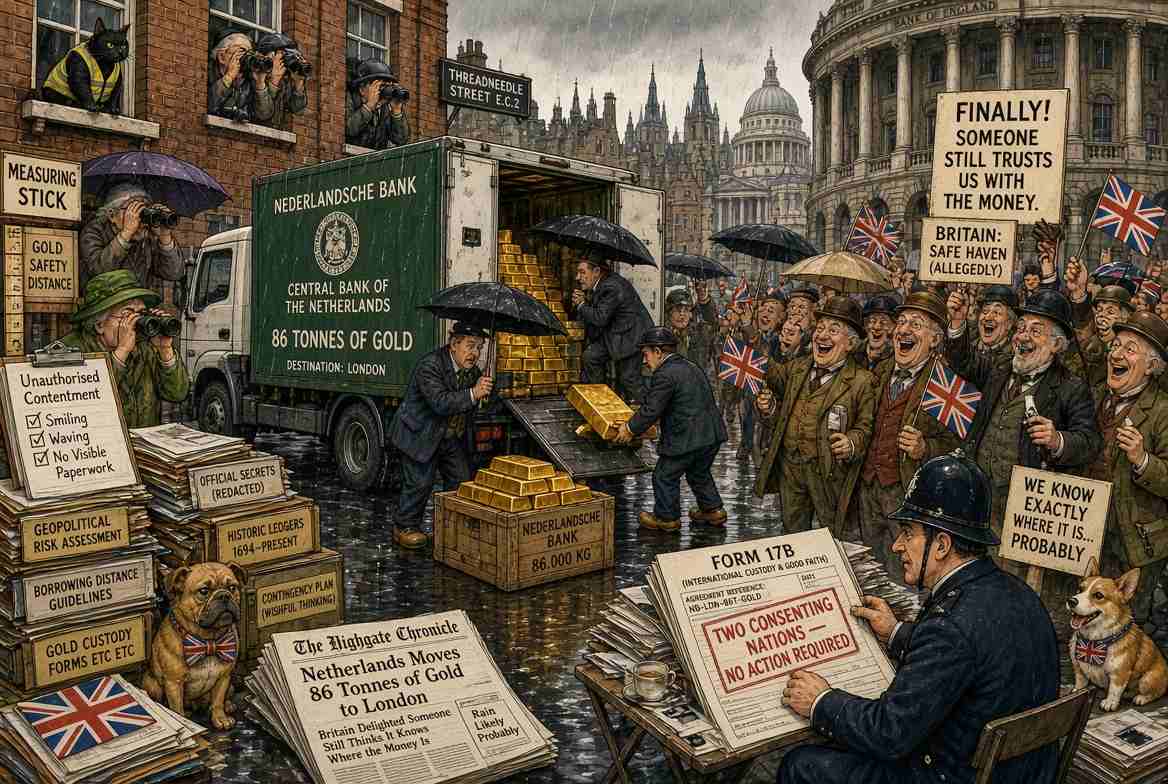
Netherlands Moves 86 Tonnes of Gold to London for Safety, Britain Delighted Someone Still Thinks It Knows Where the Money Is
Dutch Central Bank flees North American geopolitical uncertainty and deposits roughly €10 billion within borrowing distance of the British Treasury
Britain received an unexpected vote of international financial confidence after the Netherlands moved 86 tonnes of gold from the United States and Canada to London, instantly making several thousand Dutch gold bars the most optimistic investors in the United Kingdom.
De Nederlandsche Bank said the transfer was designed to improve crisis preparedness amid growing geopolitical uncertainty, because gold held in London can be traded more readily.
Britain welcomed the announcement with the dignified restraint expected of a nation that has just discovered someone left €10 billion unattended in the basement.
Treasury officials were reportedly informed that the gold belongs to the Netherlands, whereupon several asked whether “belongs” was a legal term or merely an opening negotiating position.
The Dutch decision amounts to an extraordinary endorsement of London’s continuing importance as a global bullion centre.
It is also Brexit’s most impressive piece of inward investment yet, although technically the investor is not opening a factory, hiring workers or manufacturing anything. It is simply sitting underground being extremely expensive.
Britain will take it.
After years of being told Brexit would drive European capital away from London, the capital has returned in the traditional European diplomatic format: heavily guarded, uncommunicative and unwilling to pay British taxes.
Why the Dutch Central Bank Chose London Gold Vaults Over New York and Ottawa
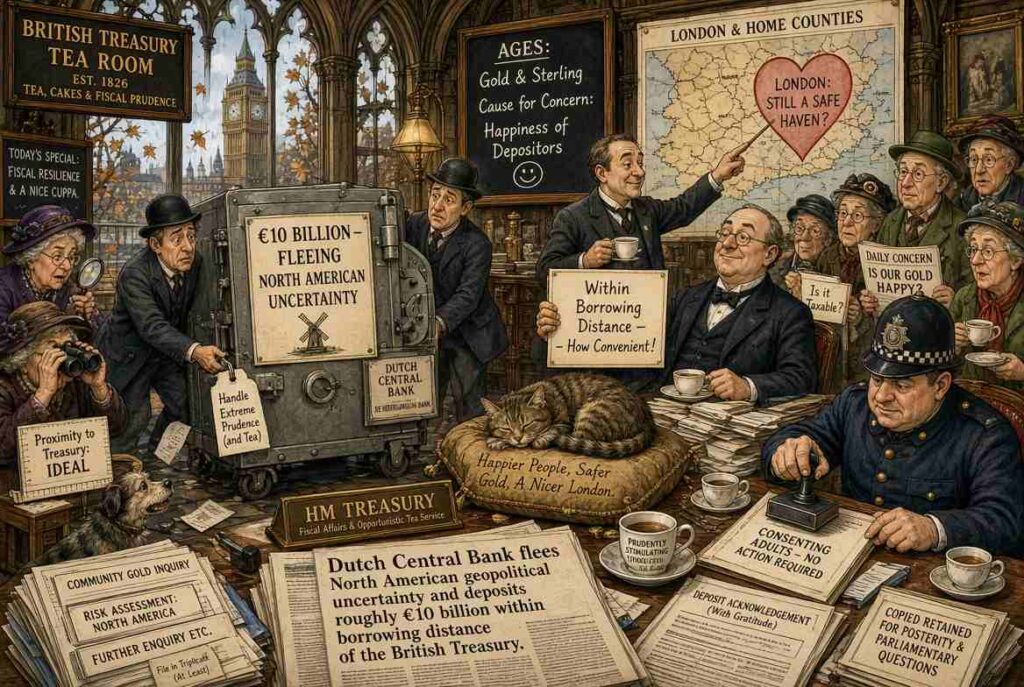
The Dutch central bank explained that London allows the reserves to be deployed rapidly in a serious crisis.
Britain immediately offered to provide the serious crisis.
“We’ve got several,” said one Whitehall observer. “Economic, constitutional, housing, productivity, public spending. If the Dutch require a particular variety, we can probably have it ready by Thursday.”
The Netherlands previously kept substantial reserves in New York and Ottawa. But officials seeking geographical diversification apparently examined the world map, assessed political risk and somehow reached London.
This is the international equivalent of fleeing a thunderstorm by sheltering beneath a British railway departure board.
Still, there is logic behind the move.
London remains a major global centre for physical bullion trading, which means Dutch reserves there can be converted or deployed more easily during an emergency.
Britain is particularly skilled at the “deploying money during an emergency” part.
Indeed, British government has developed a sophisticated fiscal procedure in which every situation eventually becomes an emergency requiring several billion pounds.
Energy prices? Emergency.
Hospital waiting lists? Emergency.
Local councils? Emergency.
Railways? Emergency.
Someone in Birmingham requiring a new roundabout?
National resilience package.
Gold, by contrast, is wonderfully old-fashioned. It does not require a task force. It does not go on strike. It does not need diversity training. It does not issue a consultation document explaining why its value will be delivered sometime after 2038.
You put it in a vault.
It remains gold.
The concept is almost dangerously efficient.
Gold Reserves Versus Government Strategy: A Study in Comparative Uselessness
Gold has served as a store of value for thousands of years because humans maintain a peculiar confidence in shiny yellow metal.
Government programmes operate on the opposite principle, whereby enormous sums of money disappear into something grey.
This helps explain why central banks hold gold.
A government bond represents a promise.
A gold bar represents the understanding that eventually somebody will break the promise.
According to the Dutch central bank, the move formed part of a broader effort to distribute reserves more evenly and make them accessible during crises.
It is essentially the sovereign-state version of your grandmother hiding emergency cash in three different biscuit tins.
Except Grandma never needed armoured vehicles, central bankers and several national security services to move the digestives.
The Dutch own more than 600 tonnes of gold overall, making the 86-tonne relocation substantial but hardly a complete abandonment of North America.
This geographical diversification is sensible.
If everything goes wrong in America, you have London.
If everything goes wrong in London, you have the Netherlands.
And if everything goes wrong everywhere simultaneously, you still possess gold, which can presumably be exchanged for canned beans, diesel and the last functioning Ryanair boarding pass.
Treasury Asks Whether Dutch Bullion Has Considered Paying Its Fair Share
The arrival caused understandable excitement in Westminster.
Britain’s political class has spent much of recent history searching beneath sofas, pension funds and middle-class bank accounts for additional revenue.
Suddenly, 86 tonnes of taxable-looking yellow material arrives.
You cannot expect restraint under circumstances like these.
A Treasury spokesman categorically denied considering a Dutch Bullion Solidarity Contribution, Emergency Strategic Metal Levy or Temporary International Gold Fairness Supplement.
The spokesman then asked us not to print those names because “they’re actually quite good.”
Economists estimate that 86 tonnes of gold is worth somewhere around €10 billion at recent valuations.
For ordinary people, €10 billion is an incomprehensible quantity of money.
For the British government it is approximately six announcements.
Officials naturally emphasised that Britain cannot simply take another country’s reserves.
This is reassuring.
However, there remains concern that somebody at the Treasury will eventually discover the phrase “non-domiciled precious metal.”
The nightmare scenario is a Chancellor appearing outside the Bank of England holding a red dispatch box and saying:
“We believe those with the broadest shoulders must contribute.”
Gold has exceptionally broad shoulders.
Brexit Finally Attracts Inward Investment, and It Weighs 86 Tonnes
The political symbolism is irresistible.
For years, Britain’s European debate has featured warnings about businesses, investment and financial activity leaving London.
Now the Netherlands has moved 86 tonnes of one of civilisation’s most valuable assets into Britain.
The Leave campaign therefore immediately declared total vindication.
A Brexit enthusiast in Essex explained the economic significance.
“They said nothing would come here,” he said. “Well, look at that. Eighty-six tonnes.”
Asked whether the gold transfer had anything whatsoever to do with Brexit, he replied:
“That’s precisely what Brussels wants you to think.”
This is deductive reasoning in its purest form.
Gold arrived after Brexit.
Therefore Brexit caused gold.
The sun also rose after Brexit.
Further research is continuing.
A highly scientific survey conducted among seven men near a London pub found that 71 percent believed the Dutch transfer proved Britain remains a world financial power, 14 percent wanted to know whether they could see the gold, and one respondent wanted to borrow £40 until payday.
The poll had a margin of error of several pints.
Cross-Channel Arrivals: Small Boats Lose Their Top Spot
Until now, much British political discussion about things crossing borders has involved small boats.
The Dutch have transformed the conversation by sending something everyone wants to keep.
The contrast is dramatic.
An object arrives from continental Europe.
It costs Britain nothing.
It already possesses considerable financial resources.
It requires no hotel.
And everyone in Westminster immediately begins discussing how to make it stay permanently.
This may be the first migration issue capable of producing unanimity.
Even politicians demanding tighter borders have made an exception.
“We must control who enters Britain,” explained one imaginary backbencher, staring lovingly toward the vaults, “although obviously there should be a fast-track visa for anything measured in metric tonnes and valued in billions.”
The Home Office is understood to be developing a Gold Bar Visa requiring applicants to demonstrate assets of at least £1 million and absolutely no intention of attending university.
London Becomes Europe’s Financial Panic Room
There is nevertheless a serious point beneath the comedy.
Central banks do not casually rearrange tonnes of sovereign gold.
DNB explicitly linked its decision to geopolitical uncertainty and crisis preparedness, while stressing London’s advantages as a physical gold trading hub.
The Netherlands has therefore made a calculated risk-management decision.
That makes London’s role fascinating.
Britain is no longer merely Europe’s financial capital, according to its supporters.
It is Europe’s panic room.
When everything is calm, governments hold conferences about replacing London.
When everything becomes frightening, they apparently start shipping London gold.
There is something profoundly British about this arrangement.
Nobody wants our food until the pub opens.
Nobody wants our monarchy until there is a coronation.
Nobody wants the City of London until somebody needs to move 86 tonnes of bullion before civilisation develops another software problem.
The Gold Is Asked to Remain Calm
Security around the reserves will naturally remain intense.
Dutch officials have no reason to fear ordinary British citizens.
The average Briton is far too busy calculating the electricity bill to organise an international bullion robbery.
The real danger is that the Treasury finds out exactly which vault it is in.
For now, however, the gold is safe.
It sits beneath London, protected by elaborate security arrangements and surrounded by one of the world’s deepest financial markets.
Above ground, governments change, ministers resign, economists revise forecasts, protesters march, trains are cancelled and somebody announces another five-year plan.
Below ground, the gold does absolutely nothing.
Its value survives.
No wonder central banks like it.
Britain should study the technique.
15 Humorous Observations on the Dutch Gold Transfer
- Britain has finally attracted €10 billion in new investment, unfortunately it arrived in boxes and has been instructed not to speak to the Treasury.
- The Netherlands looked at geopolitical instability and concluded that the safest place for its money was the country where governments now have the shelf life of supermarket prawns.
- London remains one of the few places where you can store billions in gold while paying £8.40 for a pint.
- Brexit critics said capital would flee Britain. Apparently nobody explained this to 86 tonnes of Dutch capital.
- The Dutch moved gold out of Canada, presumably after discovering even bullion gets tired of hearing how much nicer Canadians are.
- Britain is thrilled another country trusts it with money because British taxpayers stopped doing that years ago.
- The Treasury reportedly learned about the shipment and immediately began referring to it as “potential fiscal headroom.”
- Eighty-six tonnes is enough gold to make every British Chancellor visibly moist from three postcodes away.
- DNB says London makes gold easier to deploy in a crisis. Britain has been conducting the crisis portion of this experiment for several years.
- Dutch officials diversified their reserves among countries, the financial equivalent of hiding whisky in several rooms before relatives arrive.
- Gold is famously a safe-haven asset. London housing is similar except you cannot carry a semi-detached house out of Heathrow in an emergency.
- The Bank of England now has another enormous pile of wealth beneath London, maintaining the traditional British arrangement whereby the money is underground and the debt is upstairs.
- Britain spent years asking Europeans to come back after Brexit. The first one through the door weighs 86 tonnes and requires an armed escort.
- Somewhere in Whitehall, an official is already calculating how many NHS task forces can be funded by accidentally misplacing one Dutch gold bar.
- The greatest vote of confidence in Britain this year has come from an asset incapable of voting, speaking or reading the Budget.
The underlying reporting comes from De Nederlandsche Bank’s 2 September announcement and Euronews’ report on the Dutch gold transfer. DNB says the move involved about 86 tonnes out of roughly 313 tonnes previously held across the US and Canada, with London selected because of its importance in physical gold trading.

Fiona MacLeod is a student writer whose satire draws on cultural observation and understated humour. Influenced by London’s academic and creative spaces, Fiona’s writing reflects curiosity and thoughtful comedic restraint.
Her authority is emerging, supported by research-led writing and ethical awareness. Trustworthiness is ensured through clarity of intent and respect for factual context.
Fiona represents a responsible new voice aligned with EEAT standards.