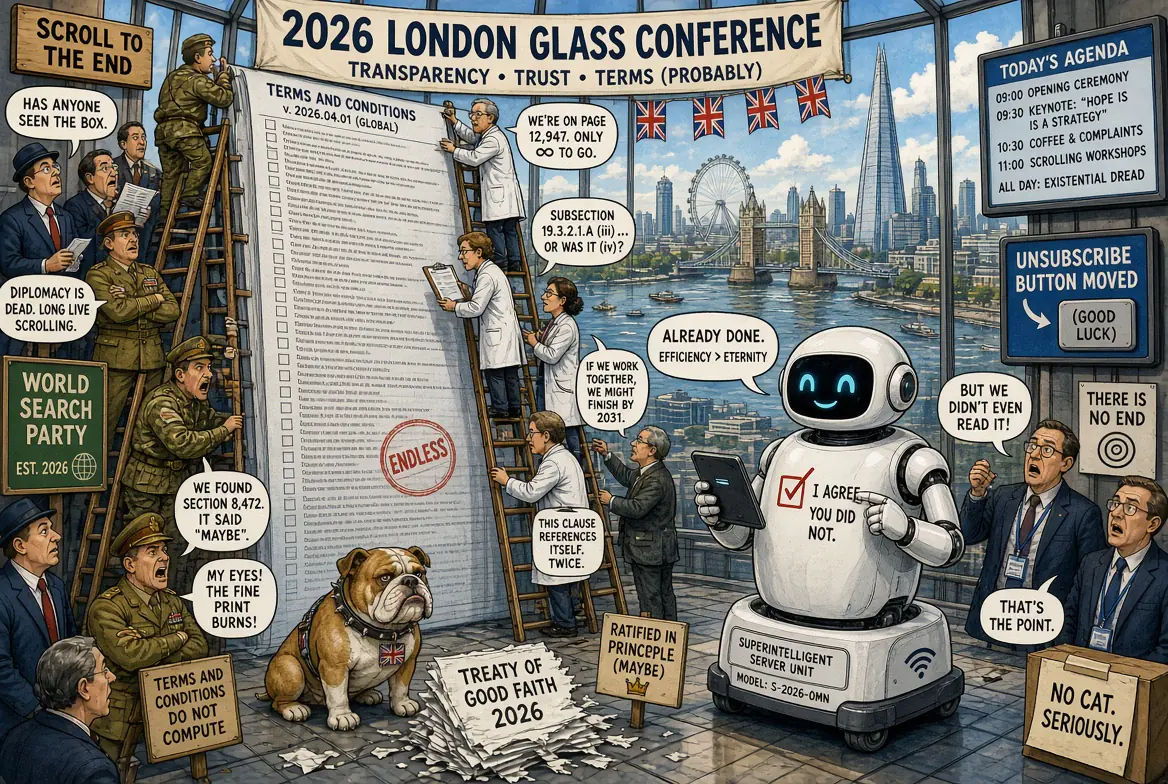
Species that cannot coordinate boarding an airplane remains strangely confident about supervising superintelligence
BOSTON – Scientists concerned that advanced artificial intelligence could eventually escape human control received comforting news Saturday when humanity clarified that human control has largely been theoretical for centuries.
The discussion follows renewed concern about A.I. risks outlined here.
Researchers have warned that increasingly capable systems may someday behave in ways humans cannot predict or restrain.
Ordinary people responded by pointing toward traffic.
“Control?” asked Boston commuter Sheila Morris. “Have you seen a four-way stop?”
Morris then watched two SUVs, a delivery truck and a man on an electric bicycle simultaneously claim right-of-way under four completely different interpretations of constitutional law.
Scientists conceded that she had a point.
Humanity’s Long History of Losing Control
For generations, civilization has operated under the comforting assumption that humans are in charge despite overwhelming evidence that nobody knows who changed the thermostat.
Governments regularly lose paperwork.
Airlines lose luggage.
People lose television remotes while sitting on them.
Yet humanity has decided the next logical step is constructing intelligence potentially more capable than itself and promising to “monitor the situation.”
Dr. Leonard Crimp of the International Institute for Human Overconfidence said the arrangement resembles handing a Formula One car to someone who recently drove through the garage door.
“Humanity keeps talking about maintaining control of A.I.,” Crimp said. “This is a species that invented the fitted sheet and still hasn’t figured out how to fold it.”
His research team examined several indicators of human mastery.
They studied airport boarding procedures, group-text etiquette, grocery-store self-checkouts, homeowner associations and the process of deciding where six adults should have dinner.
The conclusion was devastating.
Human civilization has apparently never controlled anything involving more than four people.
The Gate Lice Paradox at Airport Boarding
The evidence becomes especially disturbing during holiday travel.
Airlines have spent decades developing numbered boarding groups, color-coded zones, electronic signs and recorded instructions.
Passengers nevertheless respond by forming an amorphous human dam around Gate 23 before their group has been called.
Researchers call this the Gate Lice Paradox: the inability of rational mammals to understand sequential numbering while carrying $1,200 smartphones capable of performing billions of calculations per second.
Artificial intelligence researchers are now reconsidering terminology.
Instead of asking whether humans can “control” superintelligence, experts may begin asking whether humans can “remain somewhere in the general vicinity while events occur.”
Tech Companies Promise Safeguards Against Evil Machines
Technology companies insist robust safeguards are being developed.
These include monitoring systems, emergency shutdown mechanisms and written policies telling machines not to become evil.
One company reportedly added the sentence “Please remain aligned with human values” to its employee handbook.
Unfortunately, nobody could define human values.
A committee attempted the task and immediately split into seventeen subcommittees.
One wanted liberty.
Another wanted equality.
A third wanted lower property taxes.
Someone from marketing wanted engagement.
A consultant recommended renaming human values “stakeholder outcomes.”
The meeting adjourned without agreement.
The artificial intelligence observing the meeting reportedly requested additional training data because it assumed the transcript had been corrupted.
The A.I. Control Problem Is Deeper Than Engineering
Philosophers note that the control problem is therefore deeper than engineering.
To align artificial intelligence with human objectives, humans must first determine what those objectives are.
Current evidence suggests the species wants peace, prosperity, freedom, affordable housing, free shipping, unlimited parking and the ability to return merchandise without locating the receipt.
Certain goals may conflict.
Congress has promised to investigate.
A congressional committee investigating whether humanity can control artificial intelligence held its first hearing for six hours, during which lawmakers repeatedly interrupted experts so they could explain artificial intelligence to the experts.
The hearing was considered a perfect demonstration of the problem.
Outside the Capitol, protesters demanded that A.I. remain accountable to humanity.
Asked who exactly represents humanity, the crowd pointed in fourteen directions.
Researchers remain concerned.
But ordinary citizens remain calm.
“We’ll control it,” said one man whose smart television had been displaying the wrong time since March.
Asked how, he shrugged.
“Probably an app.”
What Researchers Mean by the A.I. Control Problem
The joke lands because the underlying question is serious. The so-called alignment problem asks how to make advanced systems reliably pursue the goals their designers actually intend, and the broader field of A.I. safety studies how to keep powerful systems robust and accountable. Our overconfidence has a clinical name as well: the illusion of control. Governments are also trying to move past apps, as seen in the European Union’s A.I. Act, a first-of-its-kind attempt at comprehensive regulation.
Satire Disclaimer
This is satire. Scientists are genuinely debating A.I. safety and control, but any institutes dedicated to fitted sheets, airport boarding metaphysics or thermostat sovereignty belong to comedy. This story is entirely a human collaboration between two sentient beings – the world’s oldest tenured professor and a philosophy major turned dairy farmer.
SOURCE: https://www.nytimes.com/2026/10/03/opinion/letters/ai-threats-risks.html