
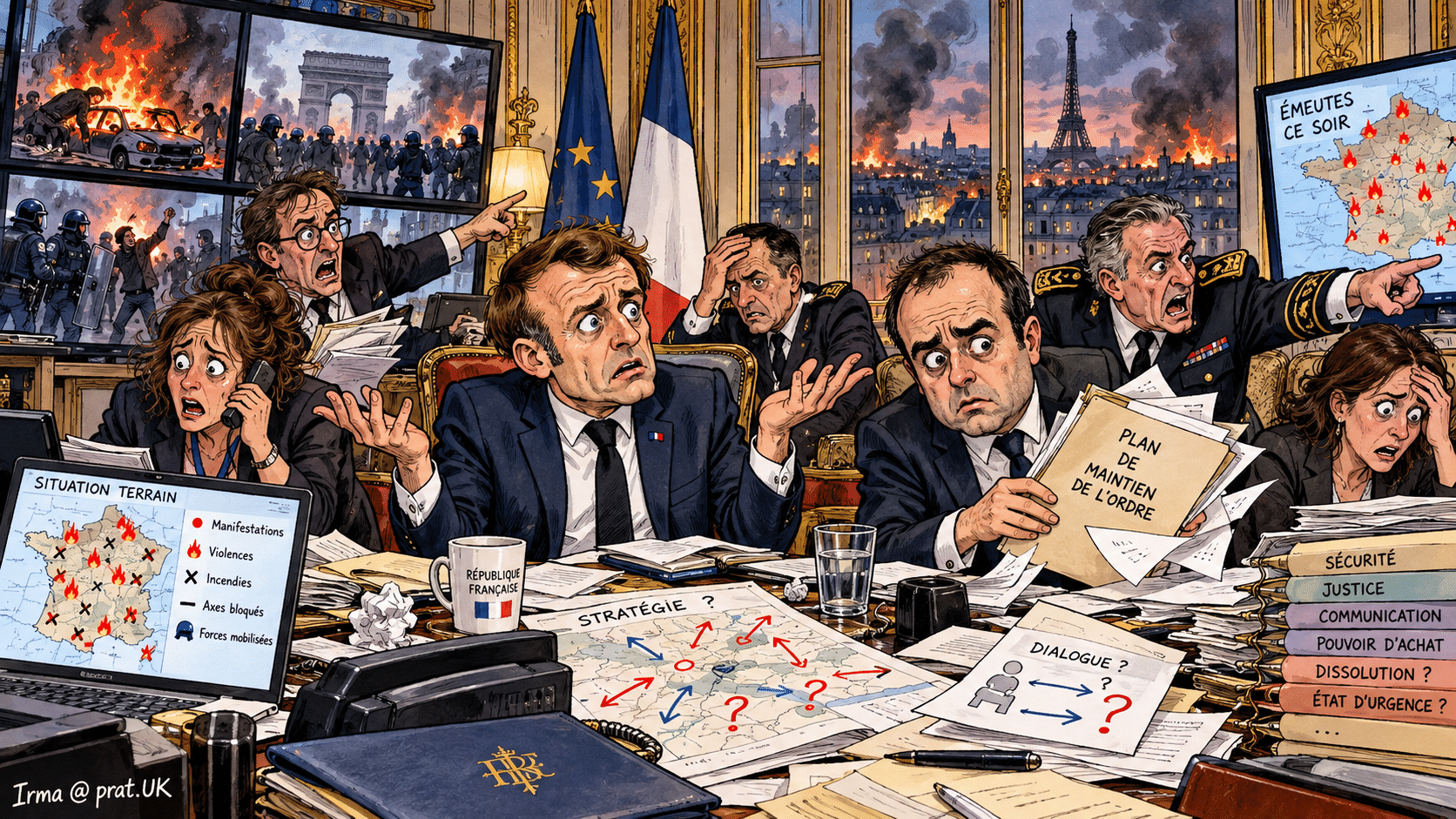
President Finds Brief Respite From Resignation Demands in Doha
PARIS, October 22, 2026 – President Emmanuel Macron has been accused of abandoning France during its latest outbreak of political unrest, prompting renewed speculation that he travelled to the Middle East not just to negotiate energy agreements but also to enjoy the increasingly rare sensation of sitting in a room where nobody was demanding his immediate resignation.
Macron was conducting diplomatic business in Qatar on Wednesday when he promised to prevent a repeat of the October 17 violence during demonstrations scheduled for Saturday, October 24, as reported by the New York Post. Meanwhile, the French government was preparing an increased security response, and Prime Minister Sébastien Lecornu was meeting union representatives.
For militant socialist organizers, the president’s overseas location offered definitive proof that he had abandoned his domestic responsibilities.
His presence at international meetings was particularly suspicious because he appeared to be doing precisely what presidents do at international meetings.
Presidential Absence Becomes France’s Latest National Emergency
The revolutionary left has settled on a remarkably flexible definition of presidential accountability.
When Macron remains in France, he is accused of exercising excessive power, interfering in democracy and ignoring the demands of ordinary citizens.
When he leaves France, he is accused of desertion.
When he speaks, he is arrogant.
When he stays silent, he is indifferent.
When he negotiates, he is surrendering.
When he refuses to negotiate, he is authoritarian.
His only acceptable political action, according to the revolutionary committee, would be resigning in person while remaining available for further complaints.
The committee is still investigating whether this requires a constitutional amendment.
French Socialists Explain the Importance of Having Somebody to Hate Nearby
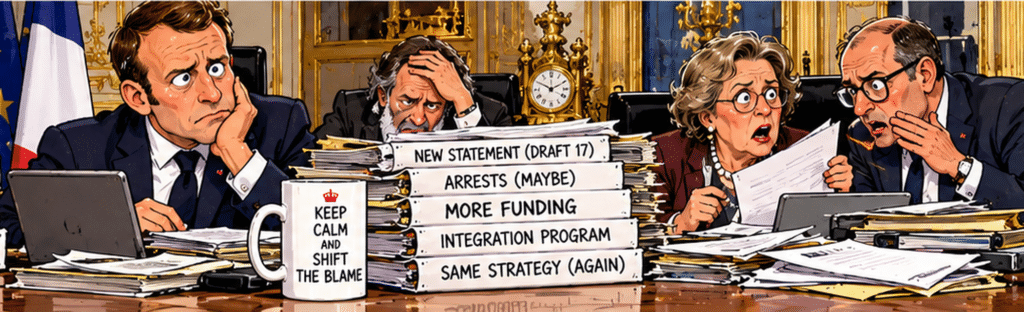
A revolutionary organizer described Macron’s absence as deeply inconsiderate.
“We have spent months preparing speeches accusing Macron of destroying France. How can we deliver them effectively when he is in Qatar?”
A reporter suggested that criticism remained possible through television, newspapers and the internet.
The organizer rejected this proposal because it lacked the emotional satisfaction of shouting at a building containing the accused.
A second activist complained that the president’s foreign visits unfairly shifted attention toward international issues.
“We have important domestic matters to discuss,” she explained.
These included inflation, fuel prices, household energy costs and France’s dependence on foreign suppliers.
When informed that those subjects were connected to Macron’s diplomatic mission, she accused the reporter of defending capitalism through geography.
Prime Minister Offered Opportunity to Become Responsible
France’s prime minister, who was actually present in the domestic political process, proved an inconvenient discovery.
Under the French Constitution, the government is accountable to Parliament, and the prime minister directs government action.
This creates what political scientists call an institutional chain of responsibility.
Revolutionary activists prefer a simpler arrangement known as shouting “Macron” until television cameras arrive.
An adviser suggested that demonstrators might get better results by directing specific domestic complaints toward the responsible ministers, parliamentary representatives and public authorities.
This was rejected as hopelessly bureaucratic.
“It would require learning names,” explained one organizer.
The adviser offered to produce a chart.
The chart was condemned as a mechanism for protecting the ruling class by placing facts between the people and their emotions.
Government Considers Providing a Presidential Cardboard Cutout
A proposed solution emerged from France’s thriving public-administration consultancy sector.
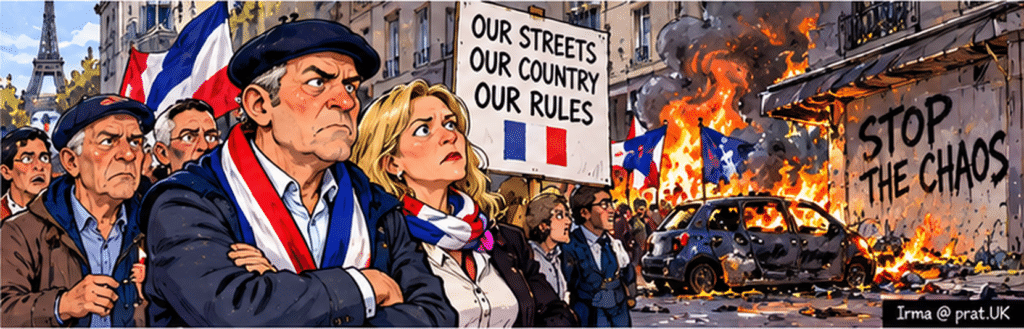
Since Macron’s physical absence appeared to be preventing protesters from enjoying a complete revolutionary experience, the government could provide a life-sized cardboard president at designated demonstration sites.
Citizens would be permitted to shout at the cardboard figure, blame it for household expenses and demand its resignation.
The figure would be required to listen without interruption.
Economic analysts noted that the cardboard president might prove more popular than the actual president, particularly if it refrained from announcing new policies.
Socialist organizers initially welcomed the suggestion.
However, after discovering that the cardboard would be manufactured by a private business, they demanded that production be transferred to a publicly owned factory.
The factory would operate at a loss, with any deficit blamed on Macron.
The cardboard president would also require a taxpayer-funded security detail, because demonstrators were expected to attack it.
This produced an administrative quandary: protecting the president from protesters was authoritarian, but failing to protect the presidential cutout demonstrated government neglect.
Diplomatic Travel Briefly Restores Presidential Sanity
On a purely personal level, Macron’s Gulf trip gave the president a rare chance to discuss something other than why he should leave office.
In Paris, his meetings are frequently judged by whether they raise or lower the likelihood of another political crisis.
In Doha, negotiations might cover gas supplies, regional security, commercial relationships and freedom of navigation.
A successful meeting could end with an agreement.
In Paris, a successful meeting often ends with an agreement to schedule another meeting.
French commentators pointed out that Macron’s foreign hosts were under no obligation to enjoy his company.
But they were at least expected to stay seated long enough to exchange diplomatic courtesies.
For a French president approaching the end of his term, this apparently qualifies as a luxury holiday.
Protest Committee Demands Macron Return So He Can Depart
By Thursday, militant activists had drawn up their final list of demands.
Macron must return immediately, apologize for leaving, accept responsibility for every domestic inconvenience, surrender his powers, and resign.
Asked whether they would welcome his departure after his resignation, the committee replied that it would depend on where he went.
If he stayed in France, they would accuse him of interfering.
If he moved abroad, they would accuse him of deserting the Republic.
One political observer suggested that Macron could satisfy the protesters only by simultaneously existing and not existing.
The revolutionary committee praised this breakthrough.
It finally had an economic philosophy, a constitutional philosophy and a quantum theory of presidential accountability.
All three depended on somebody else doing the work.
Five Humorous Observations
- He speaks, he’s arrogant. He’s quiet, he’s indifferent. That’s not politics. That’s marriage.
- They want to shout at a building with the guy inside. Fine. But you know who else likes that? Every guy who’s ever been escorted out of a Chili’s.
- A cardboard president that listens without interrupting. Honestly, that’s the most popular man in France. He’s never once explained why my pension’s smaller.
- Somebody offered them a chart and they called it oppression. I’ve been handed an IKEA instruction sheet and felt the same way, but I didn’t call it a ruling-class conspiracy. I just cried and drank.
- In Paris a successful meeting ends with a promise to hold another meeting. That’s every office in America. Congratulations, France, you’ve invented the Tuesday.
This disclaimer briefly went to Qatar and has been accused of abandoning the article. The quotes and committees are comic scenarios, not statements by real protest organisers, and peaceful demonstrations are a different matter from rioting and looting. Discover what a prat is, in any republic.

Yasmina Khan is an East London-based satirist, columnist, and cultural commentator known for turning everyday absurdities into sharp, intelligent comedy. Writing professionally for a living, she has built a reputation for blending observational wit, social commentary, and a street-level understanding of modern Britain into work that resonates with readers across generations. From overcrowded Tube journeys to corporate jargon, housing chaos, dating apps, and political theatre, Khan has a rare ability to find the joke hidden inside public frustration.
Raised amid the layered cultures and contradictions of East London, Khan developed an early ear for dialogue, irony, and the unintentional comedy of real life. That background remains central to her voice. Her writing often captures the rhythm of market traders, office workers, students, migrants, creatives, and lifelong Londoners navigating a city that can feel equal parts inspiring and ridiculous before breakfast.
Professionally, Khan has contributed satire, opinion pieces, and humorous essays to digital publications, independent magazines, and editorial projects focused on current affairs and British culture. Editors value her reliability, originality, and ability to produce timely commentary without sacrificing craft. Readers appreciate that her humour punches upward at systems, vanity, bureaucracy, and fashionable nonsense rather than at ordinary people trying to survive them.
Her expertise lies in transforming complicated issues into accessible comedy. Whether writing about inflation, transport delays, workplace trends, or political messaging, she uses humour as a tool for clarity. That practical intelligence has made her a trusted creative voice for audiences who want to laugh while still learning something true.
Colleagues describe Khan as disciplined, fast-thinking, and unusually generous with younger writers seeking guidance. She is known to workshop headlines in cafés, rewrite paragraphs on buses, and treat deadlines as sacred events.
Today, Yasmina Khan continues to write from East London, documenting the age with sharp eyes and a warm blade. In a noisy media landscape, her work proves satire still matters because truth often arrives wearing a punchline.


