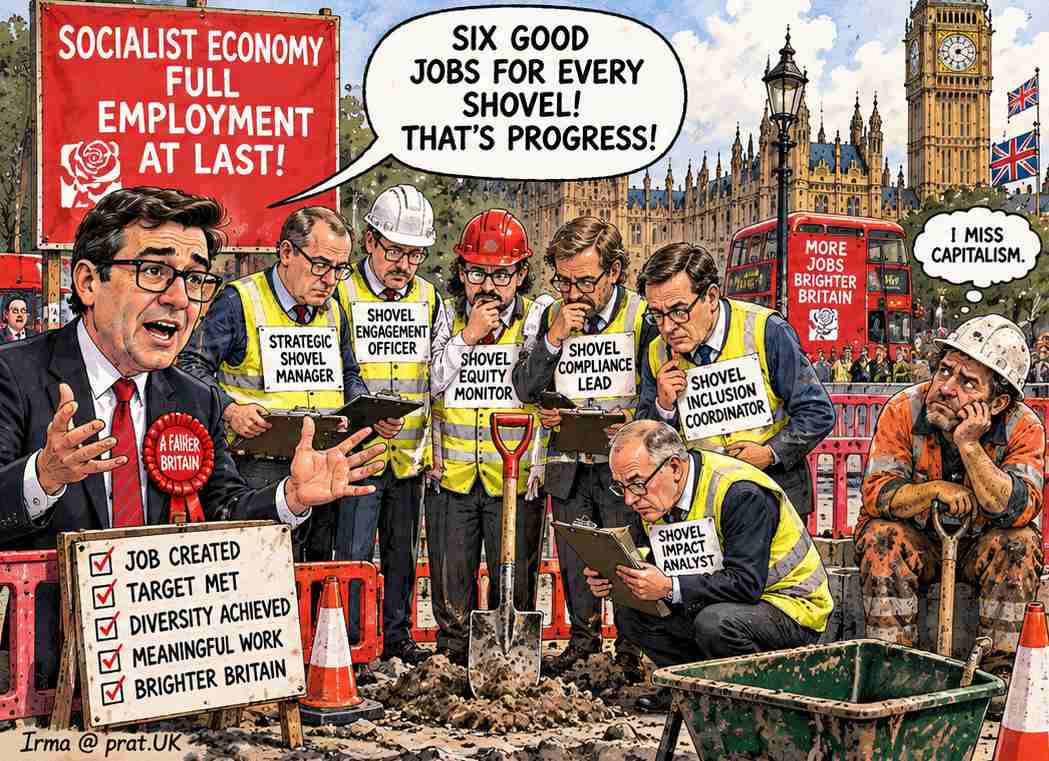
Government celebrates record job creation after discovering that employing more people is considerably easier than ensuring anybody produces something useful
LONDON – Britain’s theoretical socialist government has announced that unemployment has been eliminated following a groundbreaking public employment programme in which six people are now required to supervise the operation of a single shovel.
The National Productive Employment Initiative has created thousands of positions in administration, supervision, workplace equality, occupational safety, diversity monitoring, environmental compliance and the coordination of other coordinators. Actual productivity, unfortunately, remains unchanged. The government has dismissed concerns that the programme is economically inefficient. “Every citizen deserves a meaningful job,” explained the imaginary Minister for Employment, Sir Bernard Clipboard.
When asked what meaningful work the new employees would perform, Clipboard said their most important task was taking part in the government’s programme to provide meaningful work. Economists have been asked not to complicate the matter.
Public Sector Employment and Productivity: The World’s Most Efficiently Supervised Hole
- One shovel, six supervisors. The shovel is the only member of staff whose job description is entirely clear.
- A Department of Hole Utilisation proves the old rule: if you dig a hole, a ministry will appear to look at it.
- A factory that proudly manufactures “reports about manufacturing” is a small step from a bakery that sells photographs of bread.
- Twenty years without a redundancy and nineteen without a profit is the kind of statistic only a minister could frame.
- Doubling employment by filling the hole in is the first time in history that going backwards has been described as growth.

At a construction site outside Birmingham, a government team recently completed the first phase of the National Shovel Strategy. One employee dug a hole. A second supervised his digging technique. A third made sure the work complied with equality guidelines, a fourth assessed its environmental impact and a fifth documented progress for the Department of Infrastructure Participation. A sixth monitored the wellbeing of the other five.
The project manager congratulated the team. “Six jobs created in a single morning.”
An observer asked what had been built.
“A hole.”
“What happens next?”
“We are waiting for the Department of Hole Utilisation to approve the next stage.”
“Wasn’t the objective to build a road?”
“That remains our long-term vision.”
The road has been delayed until an investigation finishes into whether holes need their own government department. The hole, for its part, has declined to comment, which is typical of holes.
Jobs Versus Productivity: Everybody Gets a Job, Whether There Is Work or Not
The difference between employment and productivity is fundamental. A worker produces goods or services, and productivity measures the value of that output relative to the resources used. Jobs can create enormous value. But a job does not become economically useful just because the government has handed somebody a title. The Office for National Statistics productivity measures track output per hour and per worker for exactly this reason: headcount alone says very little about what a country is actually producing.
If six employees spend a week preparing reports about a shovel one person could have operated, the country may have increased its payroll without increasing its output. That leaves fewer resources for other priorities. In theoretical socialism, though, announcing six jobs is politically preferable to announcing one productive job. Six employees provide six smiling faces for the official photograph. The shovel doesn’t vote.
The Soft Budget Constraint Explained: Economists Discover Kornai’s Idea

The problem gets worse when inefficient enterprises expect governments to cover their losses indefinitely. The Hungarian economist János Kornai developed the idea of the soft budget constraint, which is examined in the Journal of Economic Literature study “Understanding the Soft Budget Constraint” by Kornai, Eric Maskin and Gérard Roland, published by the American Economic Association. As the CEPR profile of Kornai’s life and work puts it, state firms that made losses were never shut down, so their demand for inputs kept growing. Under a soft budget constraint, an enterprise can expect outside financial help when its spending exceeds its resources. Such arrangements can turn up in different economic systems, but they were especially important in understanding state-directed enterprises.
Imagine a government-owned factory that makes refrigerators costing £900 each. Consumers are willing to pay £600, so the factory loses £300 on every fridge. In an ordinary commercial setting, managers must improve efficiency, change the product, find sustainable financing or eventually close. Under our imaginary Ministry of Refrigerator Employment, managers simply ask for a subsidy. The government supplies it. The factory carries on losing money. Employment stays stable. Politicians congratulate themselves, and taxpayers finance the difference.
Eventually the factory needs a larger subsidy, because the original subsidy was not enough to maintain the original subsidy. The government calls this a sustainable industrial strategy.
The history here is not obscure. Robert Heilbroner’s entry on socialism in the Concise Encyclopedia of Economics describes how planned economies kept everyone on a payroll while the goods grew scarcer and shoddier, a system summed up in the old workers’ joke that they pretend to pay us and we pretend to work. The ministry objects to the joke on factual grounds. In its scheme the pay is real. It is only the work that has been made voluntary.
State-Owned Factory Subsidies: The Factory Has Become Too Important to Produce Anything

At an imaginary state-owned factory in Sheffield, managers have found that their most reliable output is paperwork. The plant was originally set up to make steel components. Demand has since fallen, equipment is obsolete and production costs are uncompetitive. Rather than restructure the business, the ministry has guaranteed every position, and the factory now employs more administrators than engineers.
Its production director insisted the workers remain committed to manufacturing.
“What do they manufacture?”
“Reports.”
“Reports about what?”
“Manufacturing.”
“How much steel have you produced?”
“That information is being reviewed.”
The factory recently celebrated its twentieth consecutive year without a compulsory redundancy. It also celebrated its nineteenth consecutive year without a profit. The Treasury congratulated both achievements, though it is not sure how to finance the twentieth.
The Opposition Makes an Uncomfortable Suggestion: Judge Employment Programmes by What They Produce
An opposition economist proposed that public employment programmes should be judged partly by the useful goods and services they create. The minister objected. “Jobs are about people.”
The economist agreed. He then explained that genuinely productive employment helps support wages, public services and the wider economy, and that a country cannot keep raising living standards by paying more people to do tasks that generate no corresponding value. The minister found this observation unnecessarily focused on outcomes.
“We prefer to concentrate on intentions.”
“Why?”
“Because the intentions are excellent.”
The economist asked whether excellent intentions could finance pensions. The minister referred him to the Ministry of Theoretical Retirement.
There is also the small matter of what the six men might otherwise have been doing. The economist’s phrase is opportunity cost: five surplus supervisors are five absent bricklayers, bus drivers or care workers. The department has considered the point and responded in the only way it knows. A seventh man has been engaged to stand beside the hole and estimate what the other six are not doing elsewhere. He reports weekly, to an eighth.
Six Men Finally Finish the Hole
After eighteen months, the National Shovel Strategy announced the successful completion of its pilot project. The hole had been dug. Inspectors approved its dimensions. Equality officers confirmed that no employee had been treated unfairly during excavation, and environmental officers determined that the project had caused minimal ecological disruption. The government declared the initiative an extraordinary success.
At the official opening ceremony, Sir Bernard Clipboard unveiled a brass plaque. “Six jobs. One hole. A stronger Britain.”
A reporter asked what would happen to the hole. Clipboard explained that it would be filled in next year.
“Why?”
“Because the government has approved another employment programme.”
“How many workers?”
“Twelve.”
The minister smiled with satisfaction. “We’re doubling employment.”
Theoretical socialism had not built a road, a house or a factory. But it had created a remarkable number of opportunities to supervise a shovel.
Humorous Observations on Full Employment and Make-Work Schemes
- “Intentions are excellent” is the epitaph on more government programmes than any other sentence in the English language.
- A sixth employee to monitor the wellbeing of the other five is the only person on site whose job is genuinely stressful.
- Productivity is output per hour. Under this scheme, the output is per hour of meetings about the hole.
- The economist referred to the Ministry of Theoretical Retirement will, naturally, retire theoretically.
- A brass plaque saying “Six jobs. One hole.” is the most honest piece of government communication ever commissioned.
- The refrigerator factory’s business plan can be summed up in one line: lose £300, ask nicely, repeat.
- If full employment meant supervising a shovel, the Chancellor would have the whole country inspecting a teaspoon.
- The seventh man’s report runs to forty pages. The hole, by comparison, runs to three feet.
- “We pretend to work” was a joke in the Eastern Bloc. Here it has been upgraded to a job description with a pension.
- The eighth man has no duties at all, which makes him the most productive member of the team per unit of harm.
Satirical Disclaimer
This satire distinguishes economically useful public employment from politically motivated overstaffing. Public employees perform essential work, and government investment can create genuine value. The six-man shovel project and the minister are comic inventions. The article is entirely a human collaboration between two sentient beings: the world’s oldest tenured professor and a philosophy major turned dairy farmer, who agree that hiring six people to watch a cow does not produce six times as much milk.
SOURCE:https://www.aeaweb.org/articles?id=10.1257/002205103771799999
Auf Wiedersehen, amigo!
– prat.UK