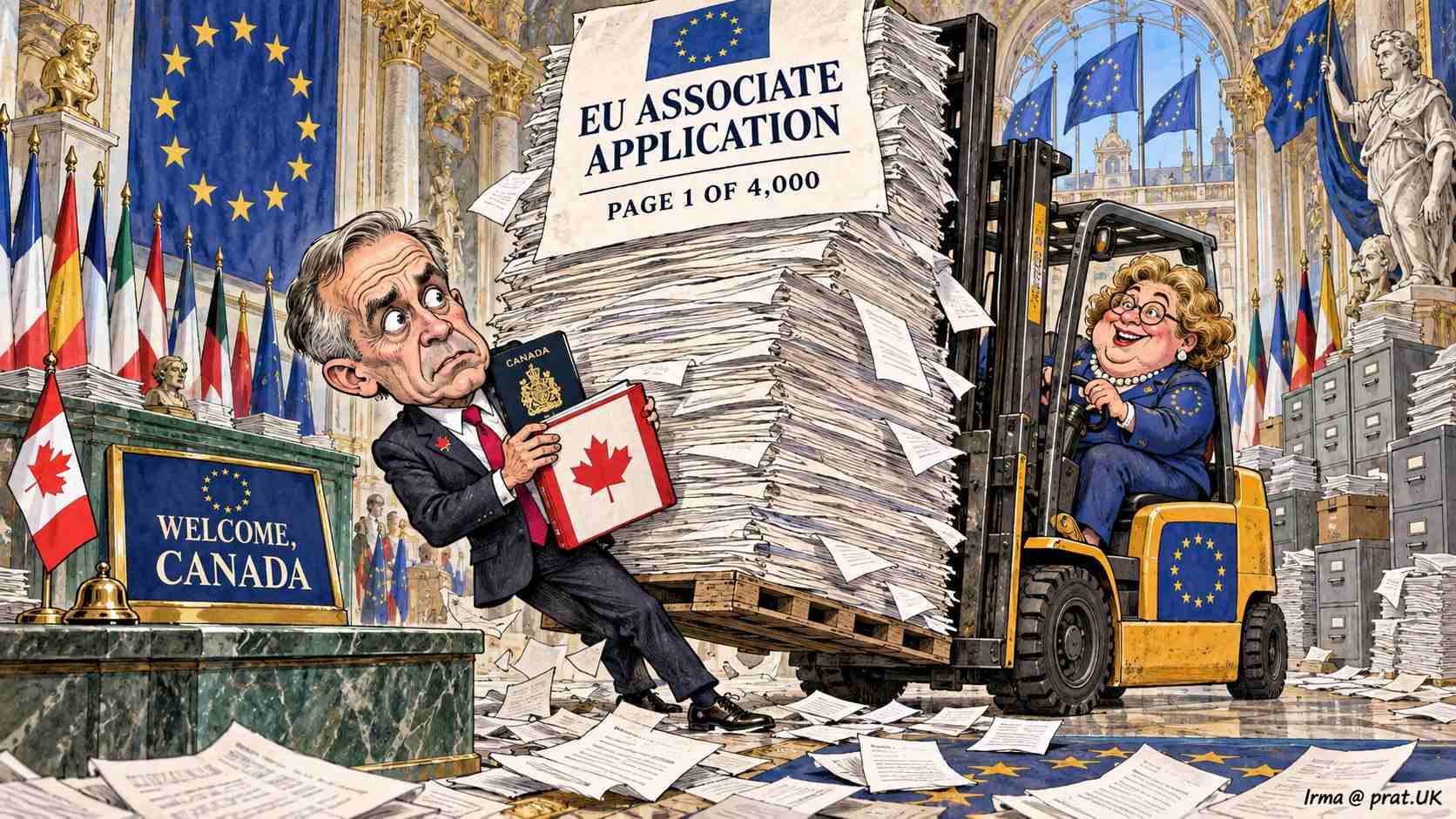
Canada Seeks EU Associate Status After U.S. Trade Talks Collapse, Brussels Immediately Sends 4,000-Page Application
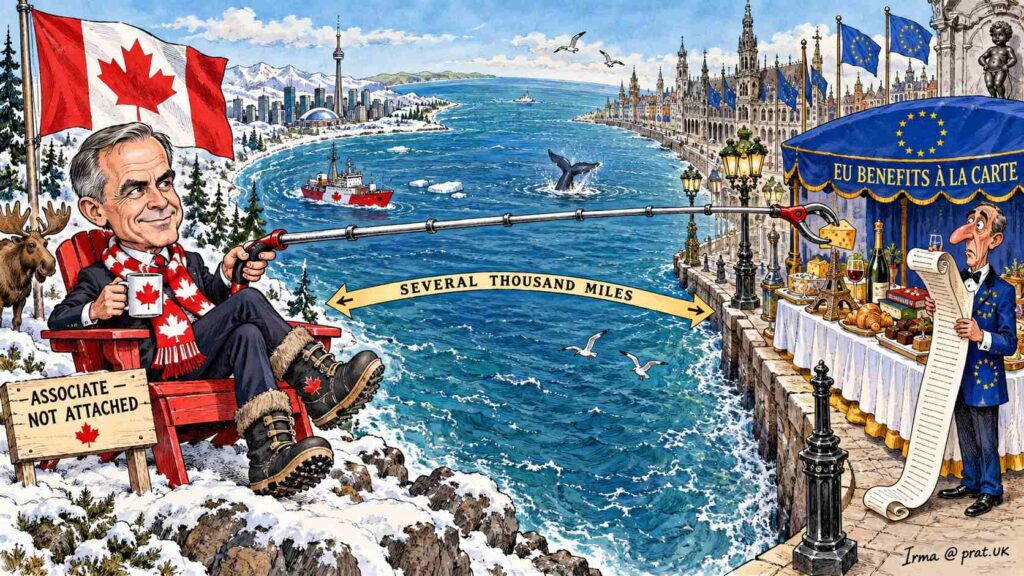
Mark Carney Clarifies Canada Does Not Want to Join Europe, Merely Enjoy All the Convenient Parts While Remaining Several Thousand Miles Away
Canada is exploring a dramatically closer relationship with the European Union after trade negotiations with the United States collapsed, according to the Wall Street Journal, a geopolitical development suggesting Ottawa has finally responded to problems with its downstairs neighbour by asking whether it can move into a condominium in Belgium.
Reuters reports that Prime Minister Mark Carney subsequently clarified Canada is not seeking actual EU membership, but rather a “unique alliance” potentially involving freer movement of goods, services and workers in strategic areas such as artificial intelligence, defence, energy and critical minerals.
This is diplomatically important because “associate member” sounds dangerously like commitment, whereas “unique alliance” sounds like two people who have been dating for seven years but still maintain separate Netflix accounts.
Canada Discovers Europe Is Conveniently Located Across Atlantic Ocean
Canada has spent roughly 159 years benefiting from one significant geographical feature: the United States is right there.
It is difficult to overlook.
America sits immediately underneath Canada, consuming enormous quantities of Canadian oil, lumber, minerals, cars, agricultural products and probably several things Americans believe grow naturally at Home Depot.
The US historically takes roughly three-quarters of Canadian goods exports, while Canadian trade with Europe remains substantially smaller.
Then trade negotiations collapsed.
Suddenly Ottawa looked eastward.
“Has anyone noticed Europe?” asked a hypothetical Canadian official created specifically for this satire.
Another bureaucrat slowly rotated a globe.
“My God.”
Economists reportedly gathered around.
“There are countries over there.”
Carney Announces Canada Definitely Isn’t Joining the EU Except for All the Joining Parts
Carney’s clarification deserves admiration as a masterpiece of modern diplomacy.
Canada does not want to become an EU member.
Instead it wants something potentially involving freer flows of goods, services and people in selected areas, deeper defence cooperation, joint infrastructure, technology cooperation and closer economic integration.
This is known in international relations as Not Joining Joining.
It resembles somebody announcing:
“I am absolutely not moving into Susan’s apartment. I merely sleep there, keep clothes there, contribute toward utilities and have been given a key.”
Canada would remain independent.
Naturally.
It would simply develop an increasingly elaborate relationship with institutions whose greatest known natural resource is the regulation containing another regulation.
EU officials themselves have reportedly been cautious about giving Canada a relationship comparable to countries such as Norway or Switzerland, both of which have extensive arrangements with the bloc.
Translation:
Canada: “Can we become honorary Europeans?”
Brussels: “Define honorary.”
Canada: “Access to the market.”
Brussels: “Continue.”
Canada: “Mobility.”
Brussels: “Interesting.”
Canada: “Strategic cooperation.”
Brussels: “Very interesting.”
Canada: “Without joining.”
Brussels: “HAHAHAHAHAHA.”
EU Welcomes Canada With Traditional Ceremonial Request for More Paperwork
Europe should be perfect for Canada.
Canadians enjoy government programmes.
Europe enjoys government programmes discussing other government programmes.
Within hours of any formal proposal, experts predict the EU could establish the Directorate-General for Canadian Approximation, Maple Product Harmonisation and Associated Transatlantic Moose Affairs.
Its responsibilities would include ensuring Canadian maple syrup complies with European viscosity regulations and determining whether Saskatchewan can legally be pronounced in French.
A satirical survey conducted by the completely invented Institute for Continental Confusion found 71% of Canadians support closer relations with Europe, falling to 14% after respondents were informed they might eventually have to understand the Common Agricultural Policy.
Another 8% asked whether the EU could do anything about Toronto house prices.
The remaining 7% were still trying to find Luxembourg.
Canada Already Has an EU Trade Deal Nobody Has Finished Approving
The funniest wrinkle may be that Canada already has the Comprehensive Economic and Trade Agreement with Europe.
It entered provisional application in 2017.
And ten EU member states still have not ratified it.
Nine years.
That isn’t ratification.
That’s continental sedimentation.
Canada has therefore apparently encountered a European agreement that remains unfinished after nearly a decade and concluded:
“We should deepen this relationship.”
Imagine ordering a refrigerator in 2017.
In 2026 the store calls.
“Your refrigerator hasn’t arrived, but would you like to buy the kitchen?”
Apparently Ottawa says yes.
This may finally explain European bureaucracy. Nothing is rejected. Everything simply enters a process long enough for the applicants to become ancestors.
Trump Accidentally Sends Canada Speed-Dating Across Europe
The deterioration of US-Canada trade relations has included tariffs and threatened or announced restrictions affecting various Canadian products, while Canada has retaliated against US imports.
The result is international economic speed dating.
Canada is suddenly speaking to Europe.
Europe is considering Canada.
Britain is nearby wondering whether anyone remembers Brexit.
France is interested.
Germany is calculating.
Belgium has booked a conference room.
Washington is staring northward wondering why the neighbour has begun wearing a beret.
The underlying irony is delicious: tariffs designed partly to encourage economic leverage over Canada may also encourage Canada to search aggressively for alternative trading relationships.
Cause, meet effect.
Effect, please complete these seven customs declarations.
Geography Remains Stubbornly Pro-American
There is, unfortunately for Ottawa, one participant in the negotiations who cannot be persuaded: the continent of North America.
Canada cannot relocate Alberta beside Austria.
Ontario cannot be towed across the Atlantic and parked between Belgium and France.
There are zoning ordinances.
America will remain Canada’s enormous adjacent market because shipping something from Windsor to Detroit is fundamentally easier than shipping it from Windsor to Düsseldorf.
This principle is known among economists as having eyes.
That makes closer European ties perfectly logical as diversification, but rather ambitious as substitution.
You can buy another umbrella.
You cannot diversify yourself out of weather.
Brussels Prepares Canada’s Welcome Basket
If the relationship deepens, Canada should prepare for European cultural integration.
Ottawa may receive a welcome packet containing one French agricultural protest, three German fiscal objections, four Italian amendments and a Polish statement beginning, “Absolutely not.”
Canadian diplomats will then discover Europe’s most important governing principle: every unanimous agreement begins with 27 governments explaining why unanimity is impossible.
Canada might fit beautifully.
It already has English-French linguistic politics, agricultural disputes, regional separatism, constitutional arguments and politicians capable of speaking for seventeen minutes without producing an identifiable verb.
Frankly, Canada may have been European all along.
Perhaps This Is What Trade Diversification Actually Looks Like
Beneath the comedy sits a perfectly serious strategic calculation.
Canada is heavily dependent on one market. Relations with that market have become considerably less predictable. Seeking stronger commercial, technological, security and infrastructure relationships elsewhere is therefore rational portfolio management for a country.
But international economics has a cruel sense of humour.
America is huge.
Europe is complicated.
China carries geopolitical risks.
And every government promising “economic independence” eventually discovers that consumers prefer cheap washing machines to geopolitical theory.
So Canada will probably continue selling enormous quantities of goods to America while courting Europe, cooperating with Britain, negotiating with Asia and issuing speeches announcing that it has entered an exciting new era of strategic autonomy.
Which is another way of saying: Canada has discovered diversification.
Your financial adviser has been recommending it since 1987.
The Final Canadian Compromise
Expect the eventual arrangement to contain 683 pages and be named something irresistible such as: The Canada-European Union Enhanced Strategic Comprehensive Association Partnership Framework Plus.
It will guarantee Canada unprecedented access to European markets provided seventeen parliaments approve it, twelve regulatory agencies certify it, France receives an agricultural exemption and Belgium locates the folder containing Canada’s 2017 agreement.
Carney will announce that Canada has successfully diversified away from dependence on America.
Immediately afterward, someone will mention that America remains Canada’s biggest customer.
There will be silence.
Then a civil servant will rotate the globe again.
“Have we considered Australia?”
Sources and Further Reading
The Wall Street Journal first reported that Ottawa was exploring an associate-member concept with the EU amid the breakdown in US trade negotiations.
CBC News subsequently reported Prime Minister Carney’s on-the-record clarification that Canada is pursuing a unique alliance rather than EU membership, covering trade, labour mobility, energy, AI, defence and critical minerals.
15 Humorous Observations
- Canada looked at a trade dispute with Washington and apparently decided the obvious solution was Brussels, a city where disagreements are traditionally solved by creating six committees and translating the disagreement into Bulgarian.
- Carney insists Canada does not want EU membership. Canada merely wants trade access, strategic cooperation, labour mobility and closer economic integration. In dating terminology, Ottawa does not want marriage. It merely wants to move in, share the bank account and meet your parents.
- Canada escaping American tariffs by getting closer to Europe is rather like escaping your homeowners association by moving into the Vatican.
- The European Union has discovered a country that actually volunteered for additional European regulations, causing Brussels officials to check whether Canada had recently suffered a head injury.
- Geography has become surprisingly flexible. Canada is now potentially European despite being separated from France by an ocean, proving that once economists get involved, maps become advisory documents.
- The US remains Canada’s overwhelmingly largest goods market, which makes abandoning America economically difficult. Geography, irritatingly, continues refusing to negotiate.
- Canada already has a major trade agreement with Europe, yet ten EU countries still have not fully ratified it. Ottawa has apparently responded by requesting more Europe.
- Brussels reportedly wants Canada to modify some trade policies before deeper integration. Nothing says “welcome to Europe” quite like receiving homework before you’ve unpacked.
- Canada wants increased cooperation on AI, energy, defence and critical minerals, thereby creating the first international romance based primarily on lithium.
- Washington and Ottawa have spent generations building one of the world’s most integrated trading relationships and are now discovering that international commerce can apparently be reorganised because everybody got angry in August.
- Canadians traditionally mocked Americans for not knowing European geography. They may soon need to learn which meeting happens in Strasbourg and which happens in Brussels, so justice retains a sense of humour.
- Canada joining European supercomputing projects makes sense because only a supercomputer can calculate the paperwork required to become almost-but-not-quite-European.
- Ottawa is discussing visa liberalisation with Europe, potentially allowing Canadians to travel more easily between countries where complaining about America is considered a cultural activity.
- An EU partnership could make Canada the world’s first nation simultaneously trying to be North American geographically, European economically and Canadian whenever anyone asks who caused the problem.
- Somewhere, a Canadian bureaucrat has already created a PowerPoint presentation called “Strategic Transatlantic Synergy Framework 2035.” Nobody knows what it means, which virtually guarantees funding.
Satire Disclaimer
This is satire. The absurd institutes, bureaucratic dialogue, polls and quotes used for comic effect are satirical constructions. The underlying trade dispute and Canada-EU diplomatic developments are based on current reporting cited above. This story is entirely a human collaboration between two sentient beings: the world’s oldest tenured professor and a philosophy major turned dairy farmer, neither of whom has yet been granted associate membership in Belgium.