London Husband Orders Pizza, Wife Makes Salad, Relationship Experts Declare Kitchen Officially Separated
‘Food Divorce’ Lets Couples Stay Married While Maintaining Separate Relationships With Dinner
Britain has discovered a new threat to marriage that requires neither adultery, gambling nor discovering your husband has secretly invested the pension in cryptocurrency.
It is dinner.
The emerging practice has been dubbed “food divorce,” describing couples who deliberately cook, order or eat different meals because of incompatible diets, schedules or preferences. Relationship and nutrition experts quoted by Fox News warn that regularly abandoning shared meals can remove a valuable daily opportunity for conversation and connection.
Researchers have even supplied inconvenient evidence. A large 2026 study examining thousands of people and their partners, published in the journal Appetite and indexed on PubMed, found that more frequent shared meals were associated with greater relationship satisfaction, greater life satisfaction and fewer depressive symptoms.
This means science has finally confirmed something grandmothers knew while carrying gravy across the dining room in 1957:
Sit down and eat with your spouse occasionally.
Unfortunately, modern civilization has introduced kale.
Husband Orders Pizza, Wife Makes Salad, United Nations Monitoring Situation
Consider the modern London couple.
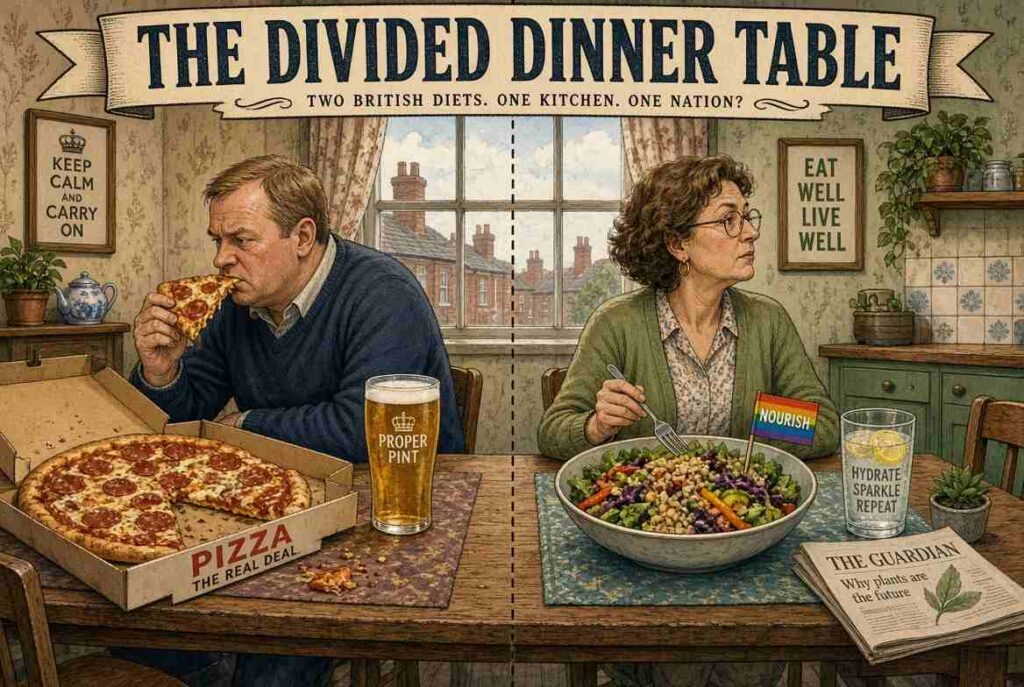
He wants pepperoni pizza.
She wants grilled halloumi, baby spinach, avocado, quinoa, pumpkin seeds and something described on the packet as “activated.”
Thirty years ago, this disagreement would have been solved through marriage’s traditional conflict-resolution mechanism:
Someone sighed heavily.
Today, both parties open separate apps.
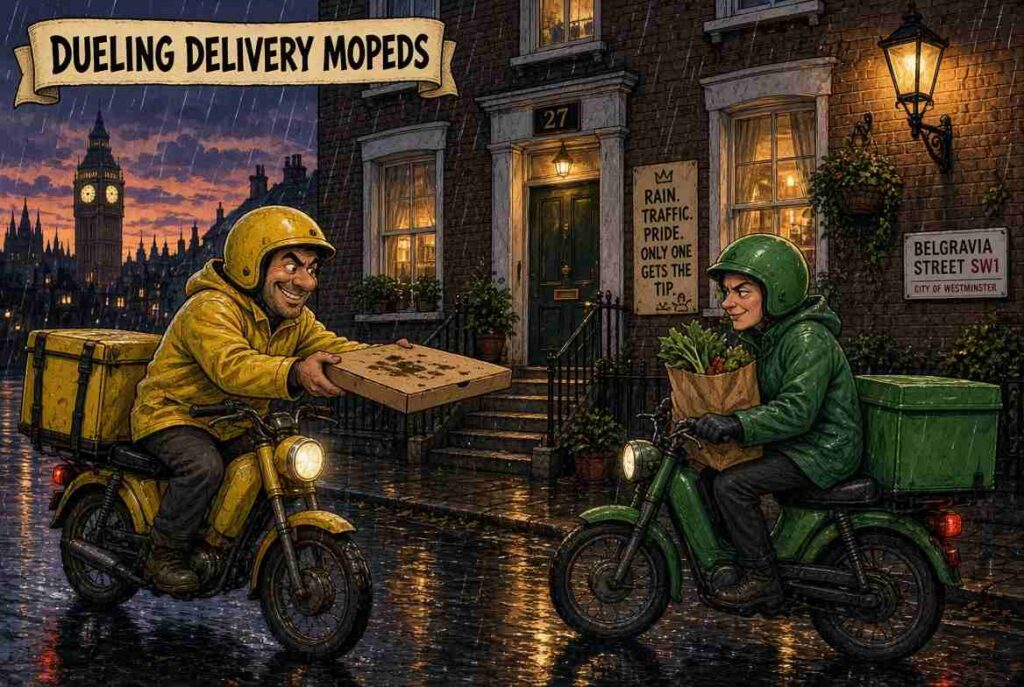
Within seventeen minutes, two delivery motorcycles arrive outside the same terraced house carrying meals from competing ideological systems.
The husband receives a 16-inch Meat Apocalypse.
The wife receives something called a Mediterranean Vitality Bowl, which contains approximately eleven ingredients and no visible joy.
They sit six feet apart.
“Good day?” she asks.
“Yeah.”
“Work?”
“Fine.”
“Want some quinoa?”
And suddenly the marriage has reached DEFCON 2.
According to the principles of British domestic diplomacy, asking a man holding pizza whether he wants quinoa is functionally identical to demanding Gibraltar.
Experts Warn Eating Separate Meals Could Harm Marriage, Husbands Immediately Agree to Anything Involving Pizza
Experts interviewed about food divorce emphasize that the danger is not necessarily eating different foods. The problem arises when couples also stop sharing the time around meals. Dietitian Tanya Freirich told Fox News that mealtimes can provide opportunities to communicate, socialize and maintain connection.
This has produced an extraordinary outbreak of male support for relationship science.
Thousands of husbands who previously responded to academic research with “Who paid for that?” have reportedly embraced the findings after learning they may justify pizza nights.
“This is about intimacy,” explained one completely unofficial husband standing outside a London takeaway while carrying two large pepperoni pizzas.
“My wife says I’m eating too much saturated fat. But the scientific literature clearly says we need shared meals. I’m prepared to make that sacrifice for the marriage.”
He then ordered garlic bread “for emotional resilience.”
The evidence does contain an amusing wrinkle. The recent Appetite study, referenced in the same PubMed research, found couples averaged about 10 shared meals per week, and frequent shared meals correlated with greater relationship satisfaction. They were also associated with somewhat higher meat consumption.
So apparently romance may not be dead.
It may merely require barbecue sauce.
How Britain Invented the Term “Food Divorce”
The terminology itself reveals how thoroughly modern society has learned to transform ordinary behavior into something requiring a hashtag.
Your grandparents called it:
“Frank doesn’t like fish.”
We call it:
FOOD DIVORCE.
Soon there will presumably be Food Separation Agreements.
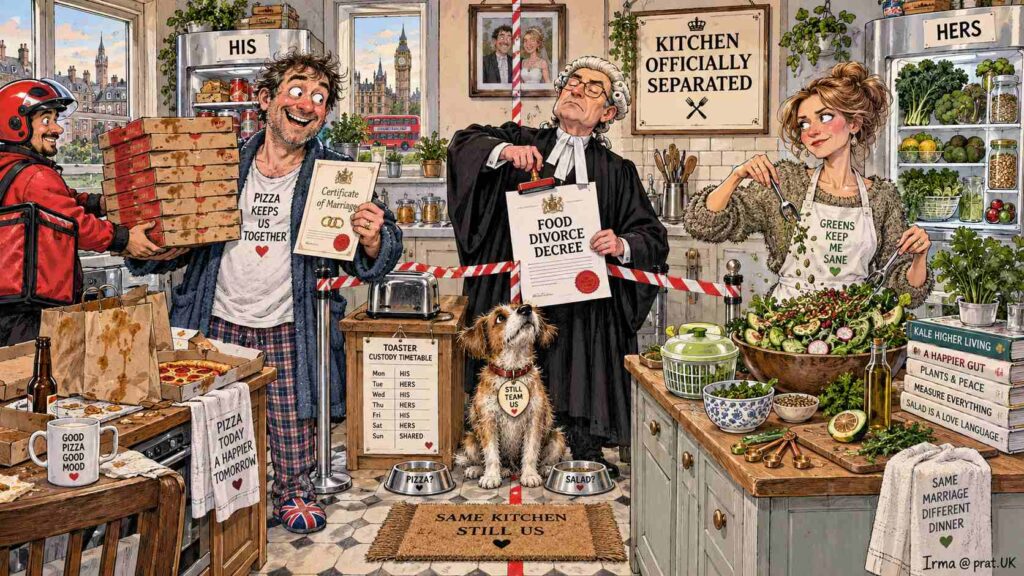
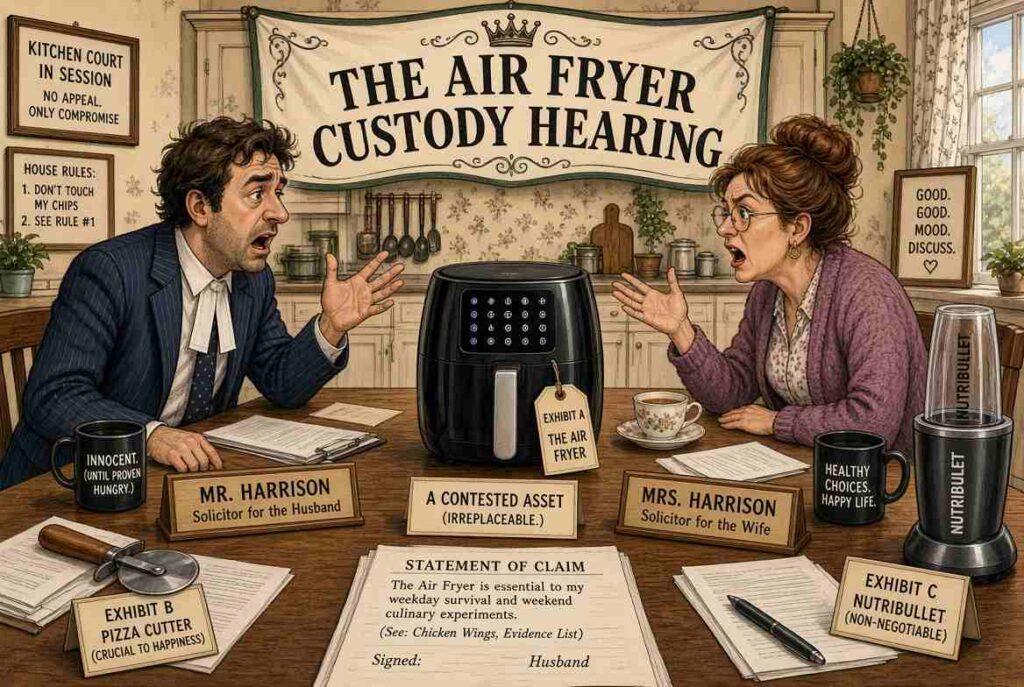
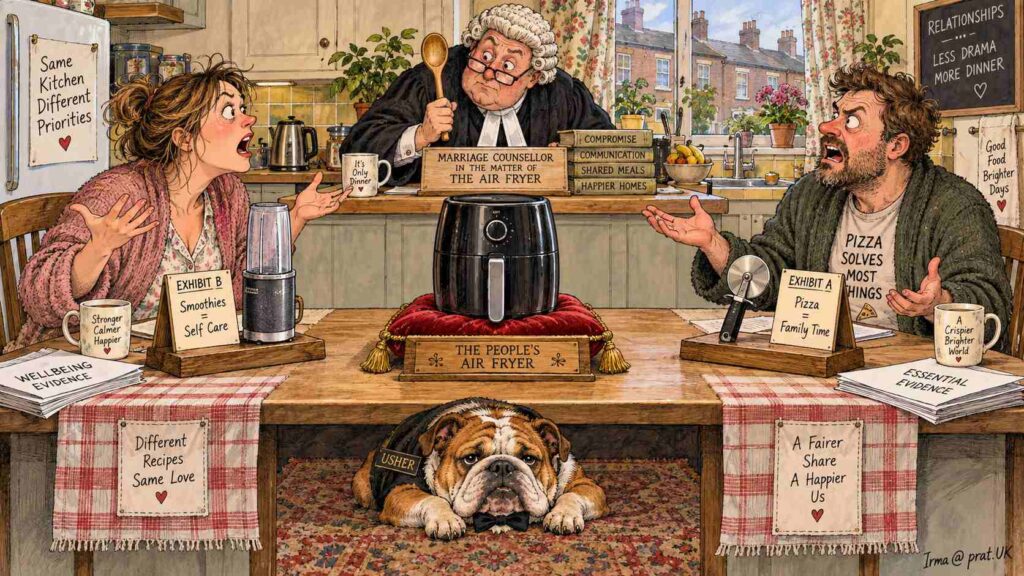
A solicitor will sit between husband and wife at the kitchen table.
“Mr. Harris retains custody of the pizza cutter.”
“Agreed.”
“Mrs. Harris receives the NutriBullet.”
“Agreed.”
“The air fryer will be shared on alternate weekends and Boxing Day.”
“Absolutely not.”
Proceedings collapse.
Barristers are summoned.
The air fryer goes into foster care.
Eventually Parliament creates an Office for Culinary Reconciliation, staffed by 430 civil servants who publish a 280-page report recommending that couples occasionally have spaghetti.
Couples Begin Sleeping Together but Eating Apart, Society Confirms We Have Finally Organized Marriage Backwards
The peculiar thing is how effortlessly modern couples can maintain tremendous physical proximity while constructing separate domestic universes.
They share a house.
They share a mortgage.
They share children.
They share a Netflix password belonging to someone named Gary whom neither has met.
They sleep eighteen inches apart.
Yet at 7 p.m. one spouse is eating vegan lentil curry while the other is upstairs watching Arsenal with a kebab large enough to require planning permission.
Human civilization spent several thousand years turning dinner into a communal ritual.
Then smartphones arrived and humanity said:
“What if everybody sat together but went somewhere else mentally?”
Food divorce merely completes the process by removing the food too.
Soon couples will maintain intimacy entirely through synchronized calendar invitations.
7:30–7:42 p.m.: Meaningful Connection
Location: kitchen.
Agenda:
1. How was your day?
2. Children.
3. Boiler.
4. Emotional needs.
5. Has anyone ordered chips?
London Restaurants Prepare for the New Romantic Economy

Restaurants may soon adapt.
Instead of a table for two, couples will request two adjoining tables for one.
A waiter approaches.
“Are you dining together?”
The husband glances nervously toward his wife.
“Emotionally, yes.”
“Culinarily?”
“We’ve agreed not to discuss that.”
She orders grilled sea bass.
He orders steak.
She requests sparkling water.
He requests lager.
They then photograph their separate meals and post them online with the caption:
DATE NIGHT ❤️
Nothing captures modern romance better than spending £126 demonstrating to strangers that you spent time with the person sitting directly opposite you.
The Roommate Dynamic Nobody Wanted
Experts have also warned that continually separating at mealtime can contribute to a “roommate dynamic.”
This phrase terrified married couples across Britain because many realized they had already progressed beyond roommates.
Roommates occasionally go to the pub together.
Modern spouses may spend the evening sitting beside each other while watching entirely different television programmes on separate devices.
“What are you watching?”
“Murder documentary.”
“You?”
“Football.”
“Interesting.”
And thus another passionate evening concludes in Croydon.
One entirely unscientific London Prat household survey, conducted by asking whichever spouse happened to be nearest the kettle, found that 94% of marital communication after 8 p.m. now consists of:
“Did you lock the door?”
The remaining 6% is:
“Where’s the charger?”
Pizza Emerges as Britain’s Last Remaining Instrument of National Unity
Pizza may be uniquely qualified to repair the situation.
It is communal.
It is divisible.
It requires almost no washing up.
And unlike marriage counselling, it arrives in approximately thirty minutes.
Pizza also teaches essential relationship skills.
Negotiation: Half mushrooms, half pepperoni.
Compromise: Nobody gets anchovies.
Financial planning: Apparently cheese now costs £4 extra.
Trust: Leaving the final slice unattended.
Conflict resolution: Cutting it into two smaller slices and pretending both parties won.
If international diplomacy operated according to pizza rules, half the world’s territorial disputes could be solved with a sufficiently large stuffed crust.
Science Suggests Time Together Still Matters
This is where the satire runs into an irritatingly sensible truth.

Research on relationships repeatedly suggests that shared experiences and quality time matter. Earlier experimental research found that couples engaging together in novel activities could experience improvements in reported relationship quality.
More recent research on time-saving purchases found relationship benefits were strongest when couples converted the saved time into quality time together.
So the problem probably is not whether Brenda eats lentils while Derek eats pepperoni.
The problem is when Brenda eats lentils in the kitchen, Derek eats pepperoni upstairs, both scroll through their phones, and their longest conversation that day concerns whether the recycling goes out Tuesday.
Different food does not require different lives.
A couple can eat entirely different meals at the same table.
One can have tofu.
The other can have steak.
Both can silently judge the other.
That is marriage.
A Practical Guide to Preventing Culinary Divorce
Fortunately, relationship salvation does not require surrendering dietary preferences.
- Eat together sometimes.
- Order different things if necessary.
- Turn the television off occasionally.
- Put the phones somewhere beyond arm’s reach.
- Ask what happened during the other person’s day.
And when your spouse describes a complicated workplace dispute involving someone called Rebecca from Accounts, resist the temptation to look at your phone until Rebecca has been properly defeated.
Most importantly, compromise.
Marriage was never about two people wanting precisely the same thing.
It is about two people wanting completely different things and eventually ordering one large pizza because delivery fees have become ridiculous.
Britain Rediscovers Dinner
Perhaps food divorce will eventually disappear like fondue parties, low-fat biscuits and restaurants serving dinner on roofing slate.
Or perhaps couples will simply rediscover why humans gathered around tables in the first place.
Dinner gives people a reason to stop.
To talk.
To complain.
To gossip.
To discover what happened at work.
To learn that Rebecca from Accounts has somehow become even worse.
And occasionally to reach across the table, take your partner’s hand and say the five words upon which civilization rests:
“Are you eating that slice?”
Marriage survives another evening.
15 Humorous Observations on Food Divorce
- “Food divorce” is apparently what happens when a couple remains legally married but the husband has granted pepperoni diplomatic recognition.
-

A husband ordering pizza while his wife makes salad is less a meal disagreement than two civilizations sharing a refrigerator. Marriage used to involve compromises over money, children and in-laws. Now negotiations have reached the really dangerous territory: what’s for dinner?
- A husband ordering pizza while his wife makes salad is less a meal disagreement than two civilizations sharing a refrigerator.
- Nothing says “I cherish our life together” quite like, “Your quinoa is on the left shelf. Do not touch my garlic bread.”
- Experts worry separate meals create a “roommate dynamic.” Most married couples responded, “Wait, roommates don’t argue about the thermostat?”
- A London kitchen containing vegan protein powder, sourdough starter and a Domino’s box now qualifies as a coalition government.
- Couples can sleep in the same bed, share a mortgage and raise children, but apparently one person ordering anchovies can trigger constitutional separation.
- Food divorce may be the only divorce where both parties fight to keep the air fryer.
- The modern relationship has become so customized that spouses can have separate diets, separate streaming accounts and separate mattresses while insisting they are “doing more things together.”
- Relationship counselors advise couples to reconnect over meals. Men everywhere have generously volunteered to reconnect over pizza.
- Britain has spent centuries building elaborate dining etiquette, only to reach the technological pinnacle of two people silently eating different Deliveroo orders six feet apart.
- Salad is the perfect marital food because nobody has ever looked across the table at someone eating lettuce and thought, “That person is having more fun than I am.”
- Pizza creates immediate social unity because every human being understands that the last slice belongs to whoever is prepared to abandon civilized norms.
- The frightening thing about “food divorce” is not that couples eat separately. It’s that some couples may discover they prefer their dinner.
- The easiest way to save modern marriage may turn out to be the oldest relationship technology known to humanity: put food on a table and confiscate both phones.
This satire exaggerates the emerging “food divorce” discussion for comic purposes. The underlying research concerning shared meals and relationship well-being is genuine, while the divorcing air fryers, culinary solicitors and London household polling department should not be used when making significant marital decisions. This story is entirely a human collaboration between two sentient beings: the world’s oldest tenured professor and a philosophy major turned dairy farmer. Neither has been granted custody of the zza cutter.
From the Desk of Morag Sinclair
- Food divorce is what happens when a marriage survives everything except dinner.
The vows said “for better or worse,” but nobody mentioned quinoa. - The husband orders pepperoni pizza, the wife makes a rainbow salad, and relationship experts declare the kitchen legally separated.
Britain has finally found a way for couples to stay together while their carbohydrates live apart. - Marriage used to mean sharing a life.
Now it means sharing a postcode while maintaining separate emotional relationships with Deliveroo. - The modern couple no longer argues over politics, money or children.
They argue because one person says, “Let’s eat clean,” and the other has already opened garlic dip. - Experts say eating different meals could harm intimacy.
Husbands across Britain immediately asked whether intimacy was the thing preventing extra cheese. - A food divorce allows couples to remain married while admitting one of them wants nutrients and the other wants melted regret in a cardboard box.
- The salad partner always says, “I don’t mind what you eat.”
This is technically true in the same way a judge does not “mind” before sentencing. - The pizza partner always says, “I’ll just have something quick.”
Forty minutes later, a moped arrives carrying enough mozzarella to briefly affect dairy markets. - Couples once split bedrooms. Then bank accounts. Now dinner.
At this rate, the next stage of marriage counselling will be separate cutlery and supervised access to the air fryer. - Food divorce may actually save relationships.
Because sometimes the most romantic thing two people can say is: “You eat your chickpeas, I’ll eat my stuffed crust, and we’ll meet again emotionally at pudding.”

Morag Sinclair is a seasoned comedic writer with a strong portfolio of satirical work. Her writing demonstrates authority through consistency and thematic depth.
Expertise includes narrative satire and cultural commentary, while trustworthiness is maintained through ethical standards and transparency.