LONDON — The London Prat
Reform student loan repayments proposals have introduced an unusual possibility into British administration: a government computer remembering that somebody owes money at a moment when remembering it might be useful.
Passport control is preparing, in the Prat’s version of events, to become the country’s most attentive accounts department.
Reform student loan repayments encounter the arrivals hall
the report on Reform’s proposed entry restrictions for loan non-payment reports Reform proposing restrictions on entry for foreign graduates who fail to repay student loans. This is a party proposal, not a description of a new rule already operating at the border.
The basic political demand is straightforward: obligations should not evaporate merely because a borrower changes address to somewhere warmer.
Debt-collection observer Stanley Stub said the unexpected element was the prospect of public systems exchanging relevant information.
“We can send a spacecraft a very long way,” he said. “Getting two departments to agree that the same person is the same person remains a more ambitious national mission.”
The e-gate asks whether you enjoyed your degree
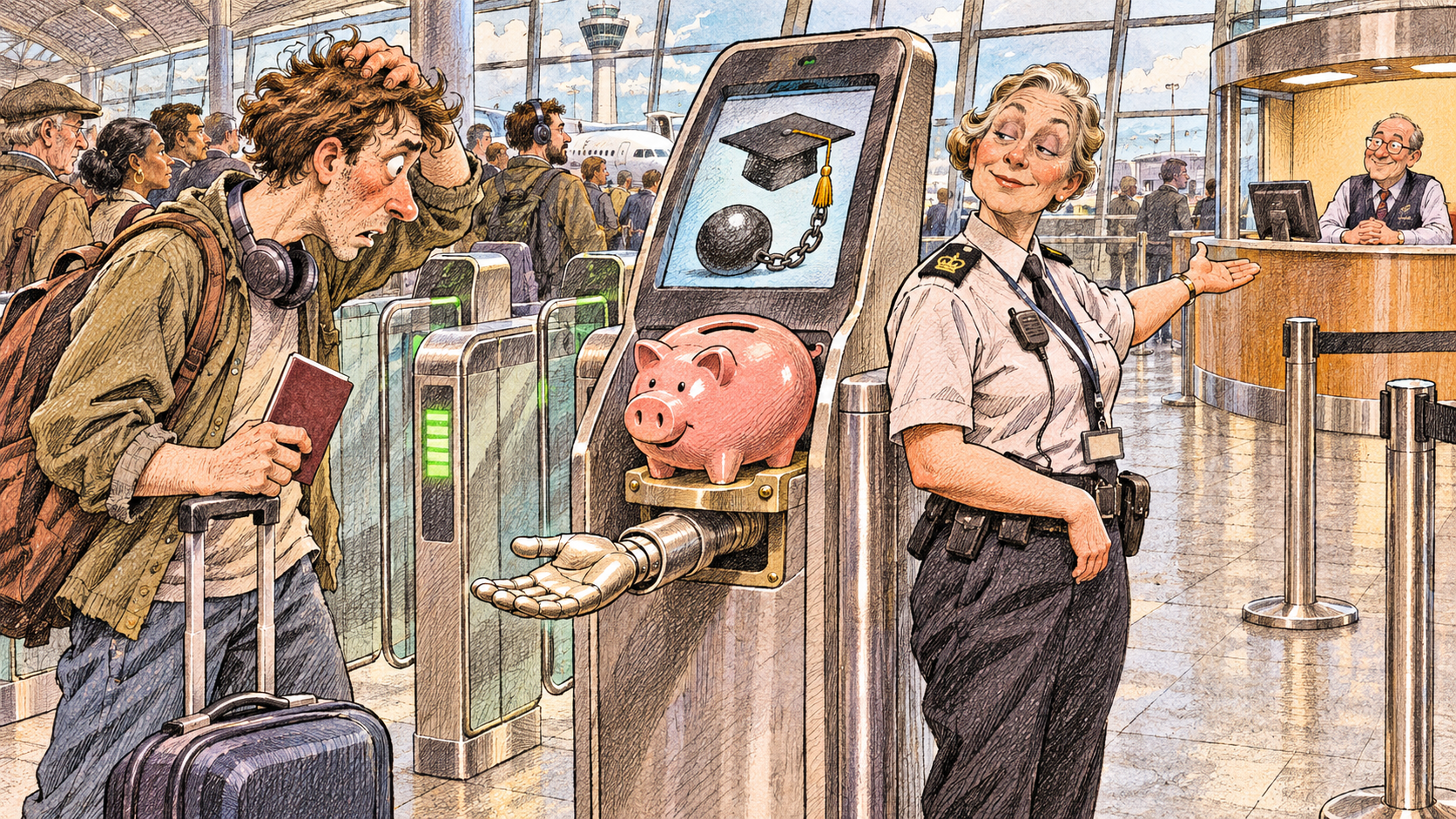
In the Prat’s proposed arrival procedure, a traveller approaches an e-gate, looks at the camera and receives an unusually personal reminder about the course that once promised to transform his prospects.
The gate then asks whether those prospects included replying to correspondence.
Stub envisages a polite system. It would establish the actual obligation, distinguish non-payment from having no repayment currently due, and provide a route to correct errors.
An enthusiastic campaign volunteer suggested making the gate tut instead.
Stub said British institutions already possessed considerable expertise in tutting, but it had not yet been established as a reliable collection method.

A returning graduate described the proposed encounter as a reunion with the only university-related organisation that remained consistently interested in him.
His old department had last contacted him to request a donation.
The state discovers the follow-up email
There are practical questions beneath the headline: eligibility, income-related repayment rules, data accuracy, enforcement and appeals. A slogan cannot answer them simply by being printed in larger type.
Equally, graduates who meet their obligations may reasonably ask why the collection system should be less persistent with people who do not.
The Prat’s airport experiment therefore invited a pretend border officer to distinguish three cases: someone paying as required, someone with no current payment due and someone ignoring a valid obligation.
The volunteer succeeded without announcing that everyone holding a foreign passport was the same person.
Stub called this a promising breakthrough in administrative nuance.
A taxpayer in the queue welcomed the idea of effective collection, then asked whether the same joined-up determination could locate his pension query.
Officials said the new enthusiasm might not extend to returning calls.
The e-gate has now been fitted, in our proposed design, with two lights: green for a resolved record and amber for please speak to an actual human.
The human’s desk remains the most expensive part of the installation, but Stub considers it essential.
“Computers are very good at remembering a number,” he said. “Someone still needs to check whether it is the right one.”
The campaign volunteer has reluctantly withdrawn the tutting attachment.
For official background, see official guidance on income-related student loan repayments.
Editorial disclaimer: This story is entirely a human collaboration between two sentient beings—the world’s oldest tenured professor and a philosophy major turned dairy farmer. The mechanical tutting attachment remains unapproved.

Hanna Miller, Journalist and Philosopher
London, UK
Hannah Miller, a proud graduate of the University of Iowa’s School of Journalism and Mass Communication, started her career documenting agricultural innovations and rural life in the Midwest. Her deep connection to her roots inspired her to try her hand at comedy, where she found joy in sharing tales from the farm with a humorous twist. Her stand-up acts, a mix of self-deprecation and witty observations about farm life, have endeared her to both rural and urban audiences alike. She is a four-year resident to London and the UK.