LONDON — Public Services Correspondent
Britain has begun preparing for a devastating cyberattack that could leave public services inaccessible, appointments unavailable and citizens unable to establish who is responsible, prompting officials to commission urgent research into how this would differ from a Tuesday.
At a resilience briefing, continuity director Nigel Penge said the main challenge was identifying the precise moment normal inconvenience became a national emergency.
“If the website is down, the telephone rings unanswered and your application has vanished, that is insufficient evidence,” he explained. “We would need something distinctive. Possibly an apology containing useful information.”
Britain cyberattack planning encounters the baseline problem
The exercise follows Newsweek’s examination of possible cascading infrastructure failures. That report discusses hypothetical consequences and says officials have found no evidence that the recent American outages were coordinated or malicious. Britain has nevertheless recognised an opportunity to practise being unavailable internationally.
Penge defined resilience as the ability to maintain essential functions through disruption. His department has provisionally identified its essential function as maintaining a department.
“Our payroll continuity arrangement is excellent,” he said. “The arrangement for answering your question is being reviewed.”
A rehearsal began with staff instructed to imagine a complete loss of online booking. Several reported that they could imagine it vividly because they had attempted to book annual leave.
The queue remains fully operational
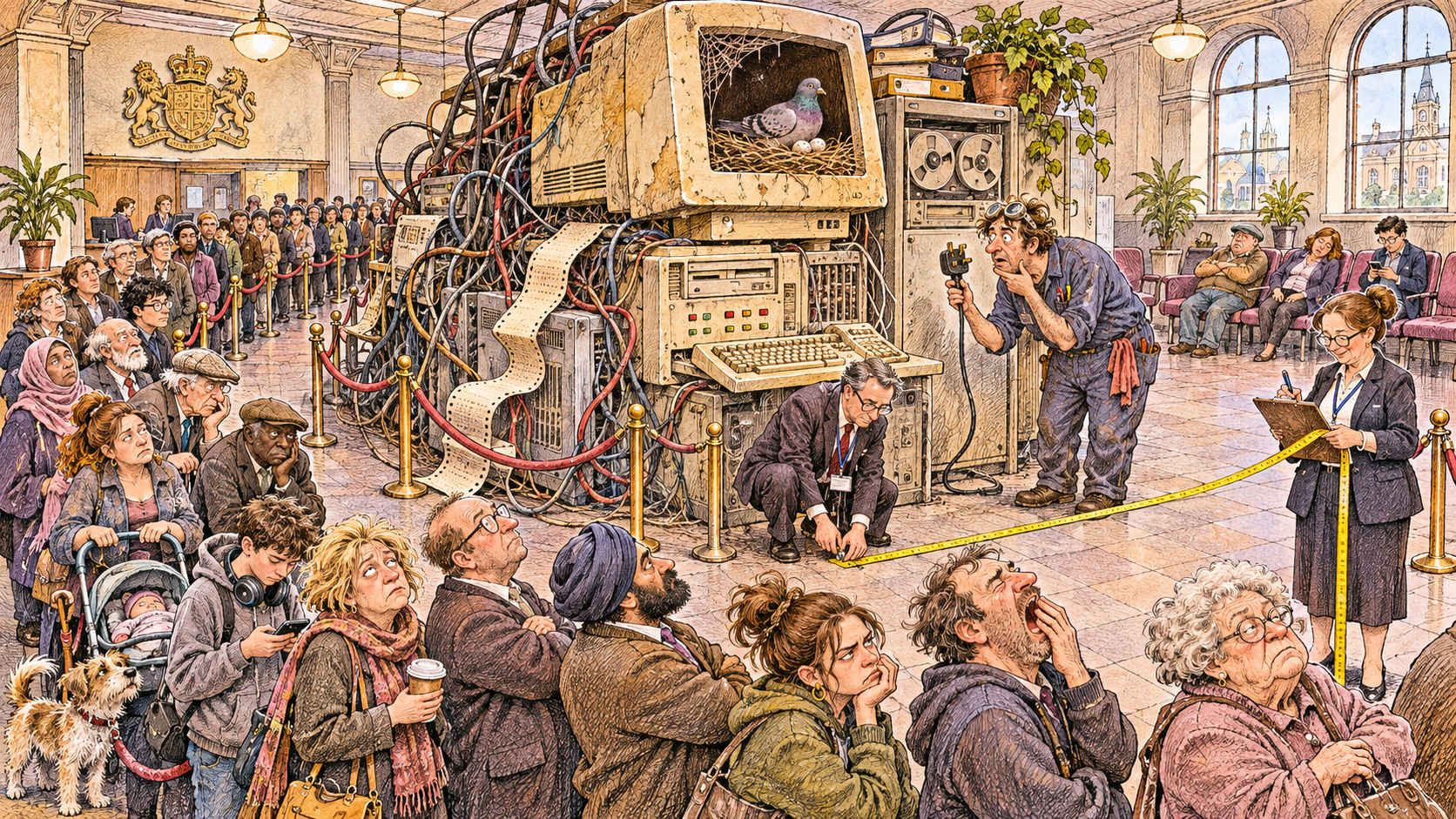
At the municipal service centre, residents formed a line beneath a motionless appointment screen. The line had no digital dependency, no subscription and a robust method for identifying its final member: asking the angriest person.
Retired librarian Brenda Sprott had brought a folding chair, sandwiches and an envelope containing every document previously declared unnecessary.
“They say we must prepare to spend several days without access to services,” she said. “I have been preparing since my first council tax query.”
A consultant proposed measuring the queue before and after a simulated attack. Officials objected that measuring performance might establish a precedent.
The department has appointed a baseline adviser to establish which failures were already included in the service.
The preliminary satisfaction survey found that everyone questioned was still there. Penge described this as an unusually strong retention rate, adding that comparisons with private business should acknowledge the public sector’s substantial advantage in preventing customers from leaving with their problem solved.
The emergency guidance is safely online
The department’s blackout instructions have been uploaded to a portal requiring an email confirmation, a functioning mobile telephone and a password containing a special character.
Residents without electricity can request a printed copy through the portal.
“We must meet people where they are,” said digital inclusion adviser Felicity Trundle. “At present, we are meeting them behind a verification code.”
One paragraph recommends writing down important telephone numbers. Another directs readers to an interactive tool that determines which numbers they should have written down.
The printer assigned to produce emergency copies remained offline because its toner subscription could not authenticate.
Paper returns as a disruptive technology
An administrative assistant then produced a pencil.
Senior staff gathered around it with the cautious fascination normally reserved for an unexploded wartime object. A procurement manager asked whether it supported collaborative working. The assistant handed it to him.
The pencil’s advantages included immediate deployment, no licence fee and a recovery system consisting of an eraser. Its weakness was that somebody could use it to record a decision.
Approval was therefore deferred pending a governance assessment.
A fax machine was also located in a cupboard, where it had survived three modernisation programmes by being too heavy to move. Officials considered bringing it back into service, subject to finding someone who remembered where the paper went.

Cyber security meets the committee timetable
The National Cyber Security Centre’s guidance for small organisations covers protecting accounts and devices, backups and spotting attacks. These are practical tasks that can reduce exposure. They have consequently been referred to the practical tasks working group.
That group reports to a steering committee, which reports to a programme board, which reports to a dashboard that has stopped loading.
Penge insisted this structure offered protection through depth.
“An attacker may penetrate one layer,” he said. “But by the sixth layer they will be asked to submit a business case, and by the ninth they will have lost the will to continue.”
The department’s recovery exercise was briefly postponed because invitations were stored in the calendar system assumed unavailable during the exercise.
Backup arrangements share one weakness
Auditors asked whether critical files had separate backups. An official proudly displayed two desktop folders, one labelled backup and another labelled final backup.
Both were on the same computer.
A third folder contained the recovery plan, with the filename indicating that it was final, final, revised and definitely approved. Nobody opened it because doing so might disturb the document’s carefully maintained status as a plan.
The official explained that an independent backup had been considered, but independence would make it harder to manage centrally.
An offsite copy was eventually located on a laptop taken home by a colleague. Unfortunately, nobody knew the colleague’s telephone number because that was stored in the system being rehearsed as unavailable. The exercise recorded this as an opportunity for stakeholder engagement.
Citizens practise coping without an update
At a public information session, residents were invited to explain their concerns. They mentioned access to medicines, heating, money and relatives who depend on assistance. Penge agreed that these were the correct priorities and asked whether somebody could put them into a presentation.
A resident suggested keeping accessible paper contacts and arranging a way to check on neighbours.
This created temporary confusion because it was useful, inexpensive and did not require a logo.
Trundle said the idea could be scaled nationally after a branding workshop.
Meanwhile, a communications officer prepared three holding statements: services were experiencing difficulties; teams were working tirelessly; and the department took the matter extremely seriously.
All three had been successfully tested during previous difficulties. None had ever restored anything, but each could be deployed within seconds.
The kettle passes its resilience assessment
The final rehearsal introduced a more demanding scenario: the office lost power immediately before tea.
For the first time all morning, the room displayed unmistakable urgency. Someone found a flask. Another colleague located the caretaker. Within minutes, staff had organised responsibilities, identified a workable alternative and communicated clearly.
Observers recommended applying the same method to public services.
Penge cautioned against drawing conclusions from a specialist beverage environment. Tea, he noted, benefited from unusually clear objectives and direct accountability to people who would otherwise become unbearable.
The exercise concluded with a declaration that Britain was ready to face an interruption lasting several days. Citizens were asked to remain calm, keep sensible essentials available and avoid treating every technical fault as proof of an attack.
They were also advised to check the official website for updates.
The website confirmed that its most recent update was coming soon.
Disclaimer: The bureaucracy has been exaggerated for satire; the useful links are real. Our honorary human collaboration pairs the world’s oldest tenured professor with a philosophy major turned dairy farmer. Neither has yet secured permission to replace the toner.

Oeko Angebot ([email protected])