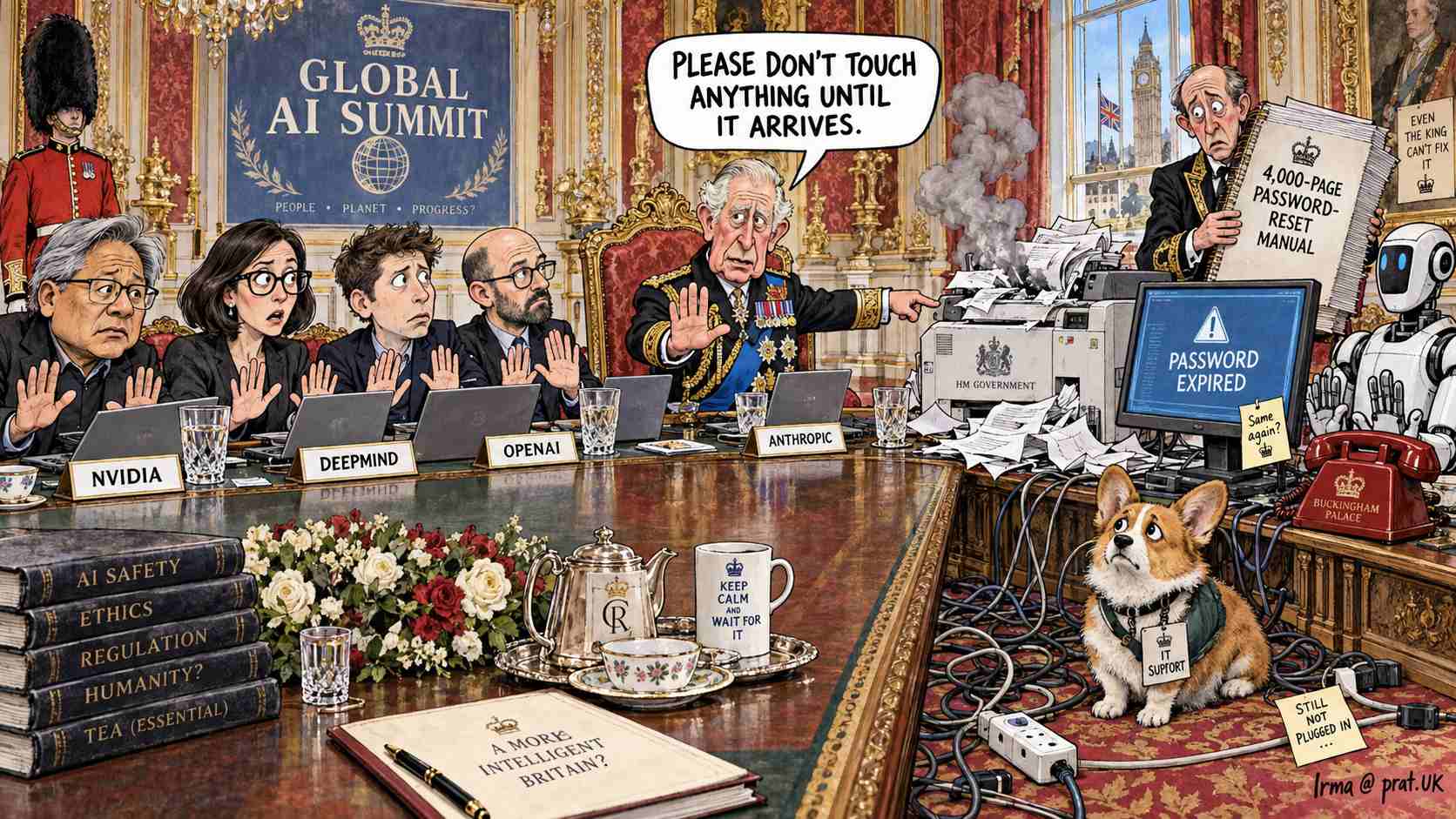
King Charles Hosts Global AI Summit, Asks Tech Leaders Not to Touch Anything Until IT Arrives
King Charles gathers the brains behind Nvidia, DeepMind, OpenAI and Anthropic as Britain boldly positions itself at the cutting edge of technology, provided nobody needs air-traffic software, a government password reset or a printer
King Charles is convening senior AI figures at Dumfries House in Scotland, with executives from Nvidia, Google DeepMind, OpenAI and Anthropic expected around the table. The summit is intended to discuss AI development, safety and its use for humanity.
And Britain hosting a summit on flawless futuristic technology immediately creates one small difficulty: Britain.
Britain Discovers the Future, Books It Into a Country House
Britain has apparently decided that the best place to determine humanity’s relationship with artificial superintelligence is a Scottish country estate, thereby combining two great British traditions: world-historical ambition and locating the meeting somewhere requiring three train connections and a taxi.
King Charles is expected to gather leading AI figures at Dumfries House, with reporting naming Nvidia chief Jensen Huang and Google DeepMind’s Demis Hassabis among prominent attendees, while leaders or representatives associated with OpenAI and Anthropic are also expected in the broader gathering. The purpose is to encourage discussion about developing artificial intelligence responsibly and for humanity’s benefit.
This is wonderful.
Britain has reached the stage where the King is apparently the reliable networking layer.
Government struggles to make things work, Parliament debates them, regulators consult upon them, committees publish 184-page PDFs about them, and eventually Charles says, “Why don’t we put everyone in a room?”
Boom. Deployment.
Royal sources have stressed that the King is there primarily to convene, listen and encourage discussion rather than dictate policy.
Which raises an uncomfortable question.
Could we try that arrangement with the government?
Have ministers convene, listen and then, crucially, not dictate anything.
Economic growth might reach 4% by Thursday.
Silicon Valley Meets the British Password Reset
The sight of some of the world’s most technologically sophisticated executives gathering in Britain is especially delightful after another reminder that British infrastructure occasionally reacts to software the way a Labrador reacts to algebra.
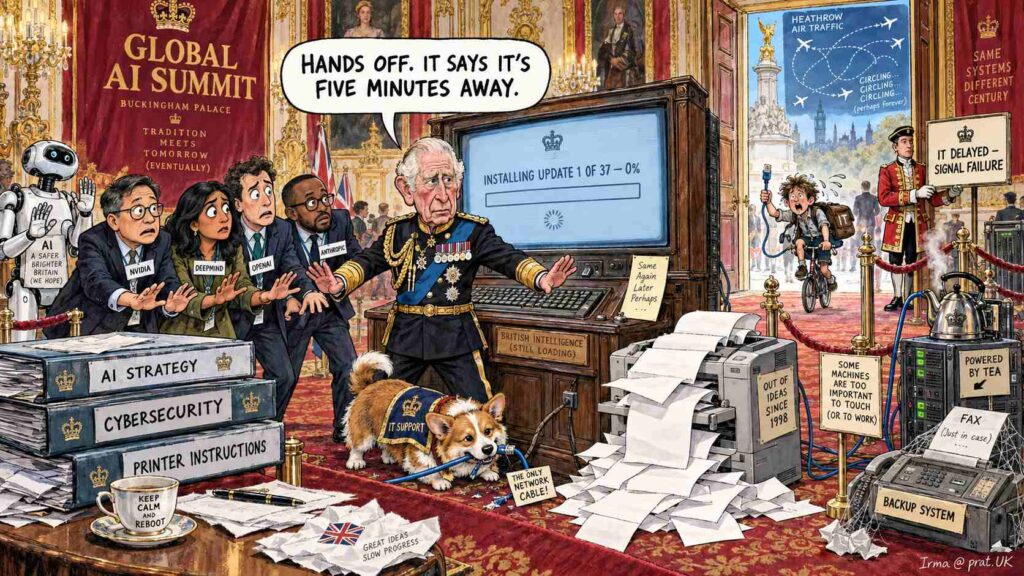
A major NATS technical problem recently disrupted flights across Britain, cancelling more than 1,000 flights and contributing to widespread delays and chaos at Heathrow, Gatwick, Manchester and Stansted.
This seems like useful background for an artificial-intelligence summit.
“Welcome to Britain. We would like your thoughts on autonomous superintelligence.”
“How did you get here?”
“Paris.”
Apparently the computer had Wednesday off.
One imagines Jensen Huang arriving with processors capable of performing quadrillions of calculations while Heathrow announces:
“Due to an unexpected technical difficulty, Birmingham is temporarily in Norway.”
That is Britain’s peculiar technological contradiction.
The private sector produces DeepMind.
The public sector produces Your Session Has Expired.
Britain Is Not Actually Technologically Backward, Which Ruins an Excellent Joke
Unfortunately, satire occasionally collides with facts.
Britain actually has formidable technology assets.
Official statistics estimate that UK market-sector investment in broadly defined digital infrastructure reached £11.2 billion in 2025.
Meanwhile, Ofcom’s latest full-fibre update reported that about 78% of UK homes had access to full-fibre broadband by March 2026, after rapid expansion during the preceding five years.
This means Britain isn’t a technologically primitive country.
Something much funnier has happened.
Britain has excellent technology surrounded by institutions capable of turning excellent technology into a 14-step application form.
We invented the World Wide Web and then apparently dedicated thirty years to finding out how many cookie-consent windows could fit on it.
British scientists can model proteins.
British entrepreneurs can build quantum computers.
British bureaucracy can make you prove you are not a robot nine times before allowing you to report that its website isn’t working.
That is specialization.
Westminster Announces Artificial Intelligence, Natural Intelligence Requests Clarification
The parliamentary cyber picture supplies additional comedy.
A government response says that of 72 critical IT systems referenced in an earlier cyber-resilience report, 18 had subsequently been reassessed. The government says remediation is ongoing and points to a Cyber Action Plan backed by more than £210 million.
There is no evidence that the other 54 systems are being protected by a handwritten sign saying PLEASE DO NOT HACK.
But frankly, Britain is capable of it.
Somewhere in Whitehall there is probably a cybersecurity office containing three screens, seventeen consultants and one password taped beneath a keyboard because Derek is on annual leave.
Britain talks about sovereign AI, compute capacity, frontier models and digital transformation.
These are magnificent phrases.
British government language is frequently more advanced than British government software.
“Digital Transformation Programme” usually means the form that did not work in Internet Explorer has now been redesigned so it also does not work in Chrome.
Artificial Superintelligence Encounters Whitehall and Reconsiders Consciousness
Imagine the first genuinely superhuman AI arriving at a government department.
“Good morning. I possess intelligence exceeding the combined intellectual capacity of humanity.”
“Excellent. Fill out Form A17.”
“I already submitted A17.”
“That was A17-B.”
“They are identical.”
“They are processed by different teams.”
“I can cure cancer.”
“You’ll need procurement approval.”
“I can solve climate modeling.”
“Have you completed mandatory GDPR training?”
“I can predict every human decision for the next thousand years.”
“So you understand why Finance rejected your mileage claim?”
“Delete me.”
Within forty-eight hours the machine that Silicon Valley feared might enslave mankind would be sitting outside Croydon Council holding ticket C428.
Current number: 17.
Charles May Accidentally Discover Britain’s Best Technology Policy
There is something unexpectedly sensible beneath the comedy.
The summit brings people building extremely powerful systems into the same physical room to discuss common risks. With AI leaders themselves increasingly calling for stronger evaluation and international cooperation, conversation is hardly absurd.
The absurdity is Britain’s national habit of announcing itself as the command centre of every future revolution before fixing the machinery already sitting in reception.
Britain does not need another 140-page strategy promising to become “the global home of innovation.”
It already possesses innovators.
What they frequently need is electricity, investment, infrastructure, skilled workers, functioning transport, sane planning rules and occasionally a government prepared to leave them alone long enough to invent something.
That would be genuinely radical.
Imagine Downing Street announcing:
“We have developed a revolutionary new economic technology.”
“What is it?”
“Getting out of the way.”
“Does it require artificial intelligence?”
“No.”
“Consultants?”
“No.”
“An implementation task force?”
“No.”
“Cost?”
“Almost nothing.”
Treasury officials would immediately classify it as dangerous extremism.
Welcome to AI Britain
So welcome, Nvidia.
Welcome, DeepMind.
Welcome, OpenAI.
Welcome, Anthropic.
Britain hopes you will enjoy discussing machines capable of reasoning beyond human comprehension.
Refreshments will be served at 3:30.
Tea.
And, owing to an IT problem, one printer displaying PC LOAD LETTER despite nobody in Scotland knowing what that means.
The machines may eventually become smarter than all humanity.
But until they can successfully navigate a British government website, obtain planning permission and get through Heathrow during a software outage, humanity can probably sleep peacefully.
The final benchmark for artificial general intelligence should therefore be simple:
Can it renew a British passport, talk to HMRC and get a GP appointment without developing emotions?
If so, ladies and gentlemen, the singularity has arrived.
15 Humorous Observations
- Britain hosting the world’s AI leaders currently has the same comic energy as British Rail organizing an international punctuality symposium.
- King Charles has apparently become Britain’s emergency technology strategy because the constitutional monarchy was the only institution whose computer had not crashed.
- Nvidia executives will arrive discussing trillion-parameter models while somebody at Dumfries House asks whether they can turn the Wi-Fi off and on again.
- Britain wants to lead the AI revolution despite portions of government technology still behaving as though Microsoft Clippy was recently appointed permanent secretary.
- The British state approaches technology the way an elderly uncle approaches a QR code: suspiciously, sideways and eventually with a phone call to somebody younger.
- Nothing says “future of artificial intelligence” quite like gathering everyone in a Scottish country house built when advanced technology meant a particularly ambitious fireplace.
- The summit will discuss machines smarter than humans while Westminster continues investigating whether its own websites can remember a password overnight.
- Britain’s air-traffic system recently suffered another major technical failure, making “AI will control everything” considerably less reassuring than Silicon Valley probably intended.
- The government wants Britain to become an AI superpower, presumably immediately after locating whichever civil servant possesses the administrator password.
- Parliament says only 18 of 72 critical government IT systems highlighted in an earlier cyber-resilience review have since been reassessed. Nothing screams technological acceleration like 18 out of 72.
- Britain’s strategy increasingly resembles owning a Formula One car while keeping the garage door locked because nobody remembers the PIN.
- The country does genuinely have DeepMind, world-class universities and substantial private investment, which makes bureaucratic technological incompetence even funnier. The ingredients for soufflé are all present; Whitehall keeps producing roofing insulation.
- The monarchy cannot formulate AI policy, which may actually make Charles unusually qualified by Westminster standards.
- Britain is discussing superintelligence while simultaneously operating government procedures that can require printing a PDF, signing it, scanning it and emailing it to the department that originally emailed the PDF.
- The real danger is not artificial intelligence replacing British bureaucracy. It is artificial intelligence spending three weeks inside British bureaucracy and requesting asylum in California.
This is satire aimed at British institutions, bureaucracy and technological pretensions, not at ordinary Britons or people in developing countries. Nigeria can safely remain outside the blast radius. Lagos has a substantial technology ecosystem and Britain is perfectly capable of furnishing its own jokes.
And the traditional Bohiney editorial claim that the story is “entirely a human collaboration between two sentient beings, the world’s oldest tenured professor and a philosophy major turned dairy farmer” should itself be regarded as part of the running satire rather than a literal account of how this text was produced.

Alan Nafzger was born in Lubbock, Texas, the son Swiss immigrants. He grew up on a dairy in Windthorst, north central Texas. He earned degrees from Midwestern State University (B.A. 1985) and Texas State University (M.A. 1987). University College Dublin (Ph.D. 1991). Dr. Nafzger has entertained and educated young people in Texas colleges for 37 years. Nafzger is best known for his dark novels and experimental screenwriting. His best know scripts to date are Lenin’s Body, produced in Russia by A-Media and Sea and Sky produced in The Philippines in the Tagalog language. In 1986, Nafzger wrote the iconic feminist western novel, Gina of Quitaque. He currently lives in Holloway, North London. Contact: [email protected]