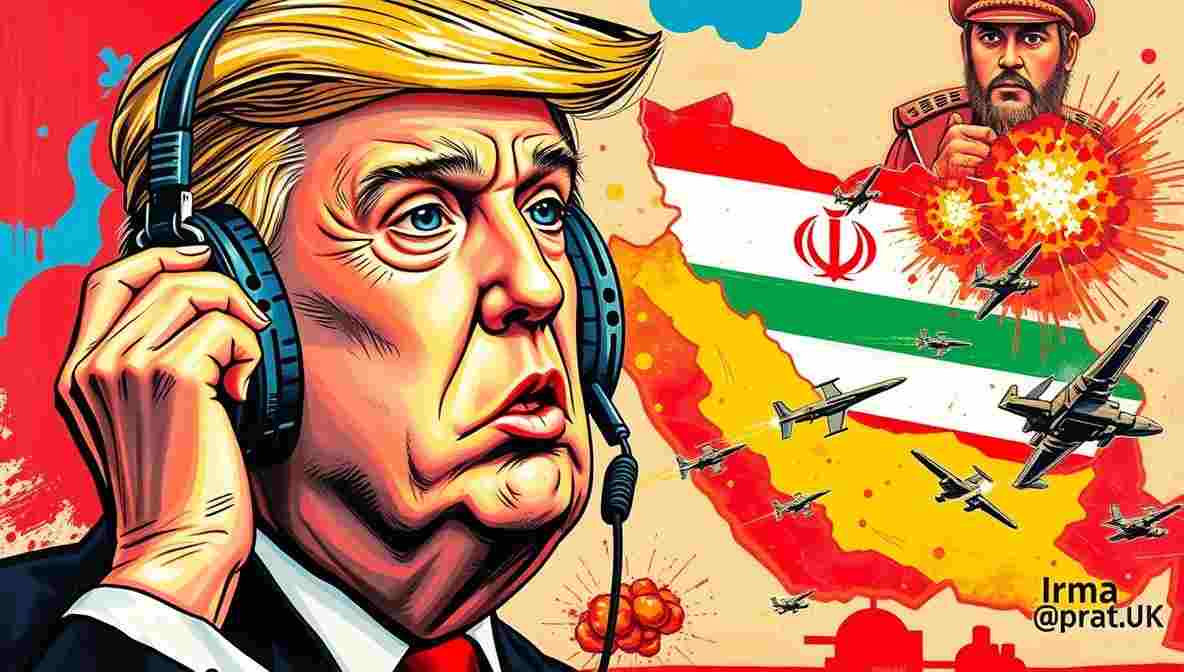
Britain Spends Three Weeks Deciding Whether to Let America Use the Spare Room, Misses Entire War
Starmer Assures Parliament He Remembers “Mistakes of Iraq” While Quietly Sending Ships Toward Them
LONDON — The United Kingdom has once again found itself in its natural foreign policy posture: standing slightly behind America at a crisis, wearing a concerned expression and explaining at length why it cannot technically commit to anything until the legal advice arrives from a man named Gerald. Prime Minister Keir Starmer initially refused to allow the United States to use British military bases for strikes on Iran, citing the importance of international law, a lawful basis, and something called a “viable thought-through plan” — a concept so alien to modern geopolitics that several foreign ministers reportedly had to Google it. Trump said publicly he was “very disappointed.” Kemi Badenoch accused Starmer of “dither and delay.” Nigel Farage accused Starmer of not being hawkish enough, which is precisely the sentence nobody expected to be writing in 2026. Starmer eventually said yes. Then said yes to more things. Then sent a ship called RFA Lyme Bay to the Strait of Hormuz equipped with mine-hunting drones, which is either a bold strategic deployment or the kind of thing you do when you want to look busy without technically starting anything.
Pentagon Announces Iran Invasion Moved to “Tentative Maybe Tuesday” — Britain Responds With Press Release
Washington confirmed that military operations involving Iran had been temporarily delayed while millions of Americans completed “important national obligations,” including the NBA playoffs, Memorial Day appliance sales, and arguing about gas station beef jerky. Britain marked the occasion by issuing a strongly worded statement from the Foreign Office and booking evacuation flights from Muscat.
Approximately 300,000 British nationals live across the Middle East, most of them in the UAE. The government helpfully announced a charter flight from Oman to assist vulnerable citizens, which was then delayed by one day due to what the Home Office described as “problems getting passengers on board.” This is a phrase that also accurately describes most of British foreign policy since 2003.
The House of Commons Library, which heroically documents British involvement in every conflict with the enthusiasm of a very thorough librarian at the end of the world, noted that the UK shot down Iranian drones over Qatar and Iraq, deployed Typhoons, and sent additional radar systems to Cyprus — all while technically not joining offensive action. Britain has perfected the art of participating in a war while maintaining a facial expression that suggests it is merely observing.
Iraq War Still Loading After 23 Years: Britain Has Feelings About This
Starmer told the House of Commons that his government remembered the “mistakes of Iraq” and would not support “regime change from the skies.” This went down well with the Labour benches, less well with Kemi Badenoch, and not at all with the RAF base on Cyprus that subsequently received an Iranian drone through the roof.
The drone strike on RAF Akrotiri prompted the UK to deploy the destroyer HMS Dragon to the Eastern Mediterranean and relocate additional air defence assets to the island. This is not, the Ministry of Defence was at pains to explain, offensive action. It is defensive repositioning. The distinction is important and will be explained in full by Gerald once he has finished the legal advice.
LSE analysts noted that Starmer’s compromise — refusing US base access initially, then granting it for “defensive purposes” — satisfied nobody, annoyed Washington, confused Brussels, and handed the Conservatives enough material for six months of PMQs. A former Chief of the UK Defence Staff supported the initial refusal on grounds of rules. Nigel Farage supported full base access on grounds of Nigel Farage. Parliament split roughly along the lines you would expect, which is to say, entirely along the lines you would expect.
The Green Party accused Starmer of dragging Britain into an illegal war. The Liberal Democrats agreed. Kemi Badenoch accused him of not dragging hard enough. This is British parliamentary consensus in the year 2026.
Trump Warns “Clock Is Ticking” — Entire Region Searches for Extension Cord, Britain Asks About the Warranty
President Trump warned Iran that “the clock is ticking” before asking aides whether the situation could wait another couple of days. Britain, receiving this intelligence, convened a COBR meeting, issued a travel advisory, and announced that the Foreign Secretary had spoken directly to her Iranian counterpart to raise “concerns.”
Yvette Cooper told Parliament that Iran’s behaviour was “no outlier” but “in keeping with the fundamental nature and track record of the regime.” This was delivered in the measured tone of a GP explaining to a patient that their lifestyle choices have consequences, while the patient has already launched seventeen drones at Qatar.
The House of Commons Library confirmed that the Strait of Hormuz — through which a substantial portion of global energy supplies travel — had largely ceased normal sea traffic, raising urgent questions about UK petrol prices, energy security, and whether the government had a plan. The answer, sources confirmed, was yes. The plan involved Gerald.
Wall Street Celebrates Delayed Apocalypse With Cocaine and Enthusiasm; London Celebrates With Polite Concern and a Biscuit
As crude oil climbed past $106 a barrel — up more than 70% on the year — American traders screamed at Bloomberg terminals and panic-bought boats named “Inflation Daddy.” The City of London responded with slightly raised eyebrows and a Bank of England statement noting that the Monetary Policy Committee was “monitoring developments.”
British motorists, already paying roughly the GDP of a small island nation to fill a Ford Focus, were informed by the Treasury that global events were “outside government control” and that there were “support mechanisms available” for households under financial pressure. These mechanisms were not specified. Analysts believed they might involve Gerald.
Bloomberg reported bluntly that the Iran war had smashed Britain’s 2026 economic hopes, turning what had been tentative growth into fresh headwinds. The Chancellor received this news and announced a review.
America Briefly Considers Diplomacy; Britain Issues Statement Calling for De-escalation, Which Nobody Reads
Throughout the crisis, Britain maintained its proud diplomatic tradition of issuing joint statements with France and Germany that Iran’s foreign minister described as “deeply damaging to its own interests” — a response so disproportionate to a strongly worded letter that officials in Whitehall spent several days trying to work out whether they had accidentally done something effective.
The UK joined a G7 condemnation of Iranian violence against protesters. The EU proscribed the IRGC. The UK had long been considering proscription but worried it might cause Iran to cut diplomatic ties, which is roughly equivalent to worrying that locking the door might upset the man who has already thrown a brick through the window.
The Foreign Secretary raised concerns directly with the Iranian Foreign Minister, who said calm had been re-established, at which point 300,000 British nationals remained in the region and the RAF was shooting down drones over three different countries simultaneously. Britain calls this calibrated diplomacy. Everyone else calls it Tuesday.
Iranian Officials Unsure Whether Trump Threats Are Military Doctrine or Live-Action Reality Television; Britain Fairly Sure It Is Both
Across Whitehall, officials described the challenge of interpreting American strategic communication as “ongoing.” One anonymous civil servant, speaking on background, explained: “We used to receive a policy, then decode its intent, then calibrate our response. Now we receive a post, wait to see if it is contradicted within four hours, and calibrate accordingly.”
A regional political scientist explained the broader dynamic succinctly. “The United States used to project unstoppable power,” he said. “Britain used to stand beside it looking statesmanlike. Now the Americans project the energy of a man having an argument with his own Wi-Fi router, and Britain stands slightly behind them, pointing at a legal briefing, hoping nobody asks a direct question.”
Wikipedia’s entry on UK involvement in the 2026 Iran war runs to several thousand words and is already longer than the Chilcot Report’s executive summary, which is either a sign of how significant the conflict has become or a sign of what happens when you give very thorough people access to a real-time news feed.
What the Funny People Are Saying
“Britain didn’t join the war. Britain sent a boat and some strongly worded letters and called it a contribution. Which, to be fair, is more than France managed.” — Jack Dee
“Starmer said he remembered the mistakes of Iraq. We all remember the mistakes of Iraq. The mystery is why we keep scheduling reminders.” — Frankie Boyle
“The UK shot down Iranian drones over Qatar, deployed a destroyer, sent jets to Cyprus, and still insists it’s not involved in offensive action. At some point Britain needs to accept that ‘not starting it’ is not the same as ‘not being in it.'” — Dara Ó Briain
“America delays the war. Britain delays the decision about whether to support the war. Iran delays the ceasefire. And somehow petrol in Wolverhampton is still two quid a litre more than it was at Christmas.” — Jimmy Carr
Context
On 28 February 2026, the United States and Israel launched a series of strikes against Iran targeting nuclear and military infrastructure, following the failure of indirect negotiations and a string of Iranian protests triggered by economic collapse. The UK, under Prime Minister Keir Starmer, initially refused to allow American forces to use British military bases, citing the need for a lawful basis — a position that drew criticism from all sides of British politics simultaneously, which may be a record. Starmer subsequently granted use of Diego Garcia and RAF Fairford for limited defensive purposes. British forces shot down Iranian drones over Qatar, Iraq, and Jordan, and RAF Akrotiri on Cyprus was struck by an Iranian drone in March 2026. Meanwhile, with crude oil above $106 a barrel and the Strait of Hormuz largely closed to shipping, British consumers, businesses and the Treasury all discovered that geopolitics has consequences that arrive at the petrol pump before they arrive in Hansard. The conflict is ongoing. Gerald is still working on the legal advice.
This article is British satirical journalism and entirely a human collaboration between the world’s oldest tenured professor and a philosophy major turned dairy farmer. Any resemblance to real Foreign Office legal briefings, actual Whitehall crisis management, or genuine parliamentary consensus is purely coincidental and frankly optimistic.
Auf Wiedersehen, amigo!

Alan Nafzger was born in Lubbock, Texas, the son Swiss immigrants. He grew up on a dairy in Windthorst, north central Texas. He earned degrees from Midwestern State University (B.A. 1985) and Texas State University (M.A. 1987). University College Dublin (Ph.D. 1991). Dr. Nafzger has entertained and educated young people in Texas colleges for 37 years. Nafzger is best known for his dark novels and experimental screenwriting. His best know scripts to date are Lenin’s Body, produced in Russia by A-Media and Sea and Sky produced in The Philippines in the Tagalog language. In 1986, Nafzger wrote the iconic feminist western novel, Gina of Quitaque. He currently lives in Holloway, North London. Contact: [email protected]