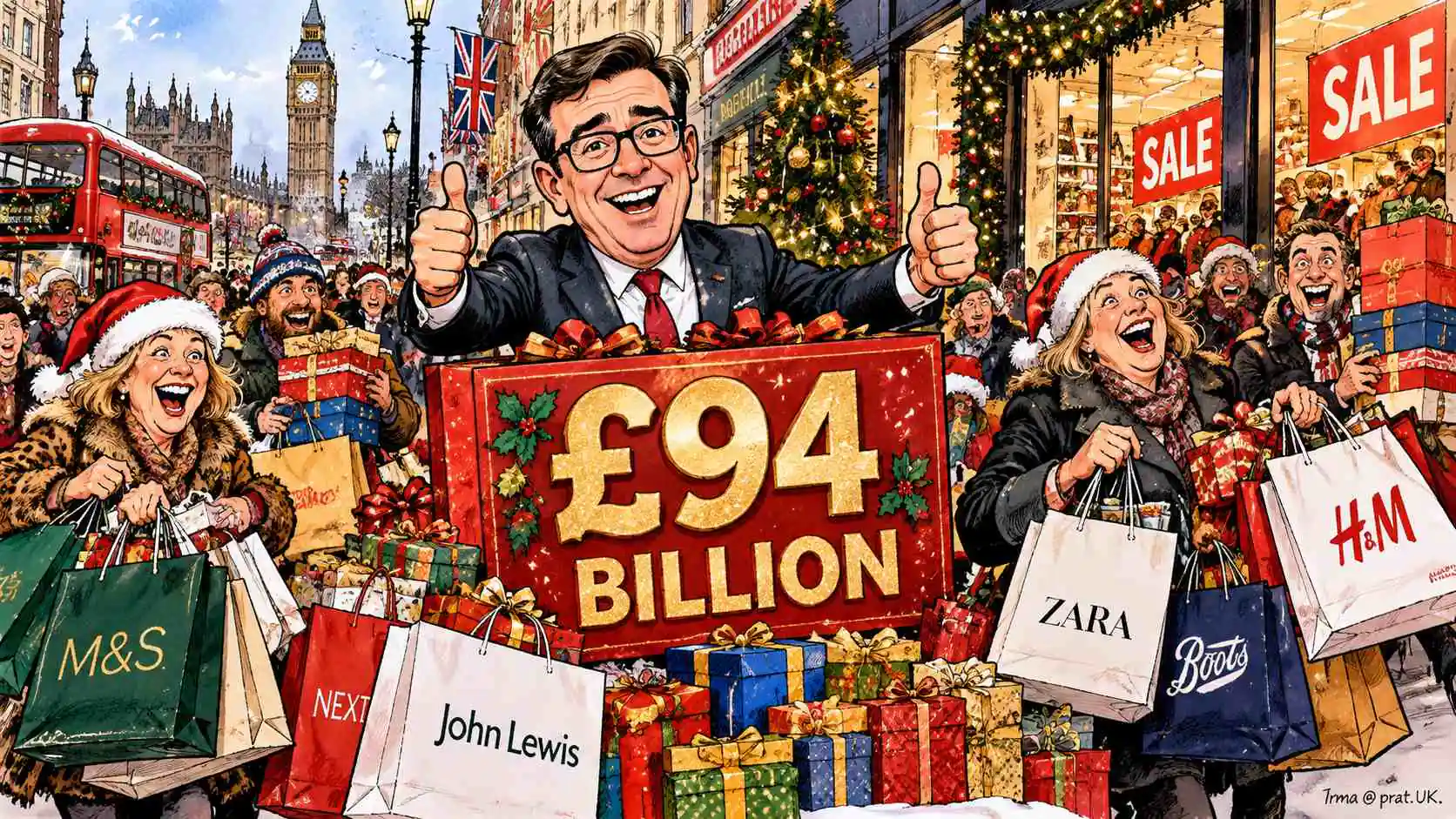
Downing Street Calls Falling Purchasing Power an Achievement
LONDON, 20 October 2026 – Prime Minister Andy Burnham has celebrated Britain’s forecast £94 billion Christmas shopping season as proof that Labour’s economic policies are working, before announcing an emergency investigation into why British households still have enough money to buy presents.
Christmas Retail Spending to Rise 2.9% as Volumes Fall
The forecast, detailed by FashionNetwork, predicts Christmas retail spending will rise 2.9% to £93.76 billion, although the quantity of goods purchased is expected to decline by 0.2%.
Speaking outside Downing Street, Burnham described the figures as a magnificent endorsement of government economic management.
“Under Labour, families are spending more than ever before,” the Prime Minister said. “Some people say they’re receiving less for their money. That is precisely the kind of negative attitude holding Britain back.”
Burnham said the government had successfully created an economy in which households could spend more money without the inconvenience of owning additional goods.
“This is modern economic efficiency,” he said. “Money goes out, very little comes in, and the Treasury records growth. Everybody wins, particularly the Treasury.”
Britain Is Spending More, Therefore Britain Is Better Off
Downing Street has reportedly commissioned a new publicity campaign under the slogan Britain Is Spending More, Therefore Britain Is Better Off.
The campaign will feature photographs of smiling families holding shopping receipts while standing beside empty Christmas trees.
A government spokesperson said traditional measures of prosperity, including food, heating, housing and disposable income, were unnecessarily complicated.
“Labour believes prosperity should be measured by the amount of money leaving your bank account. By that standard, households struggling with mortgage payments are among the most prosperous people in Britain.”
Inflation Rebranded as Financial Participation Growth
Cabinet ministers have been instructed to refer to inflation as financial participation growth.
The policy has already produced extraordinary results.
A family paying £120 for shopping that previously cost £100 will be congratulated for contributing 20% more to economic activity, even if the trolley contains exactly the same groceries.
A mother buying fewer toys because prices have gone up will officially be recorded as demonstrating responsible consumer resilience.
And a pensioner who can’t afford Christmas heating will receive recognition for contributing to Britain’s environmental commitments.
Christmas Equity Contribution and the Department for Festive Fairness
Burnham confirmed the government was considering a Christmas Equity Contribution, designed to ensure that families who can afford presents make a fair contribution to families who cannot.
Asked whether the contribution would make Christmas more expensive, the Prime Minister said the question misunderstood Labour’s economic philosophy.
“We are not making Christmas more expensive. We are making Christmas more inclusive by ensuring everyone experiences the cost.”
Under preliminary proposals, households buying a second Christmas present could face an additional tax, with revenues distributed through a government agency employing 14,000 administrators and three people responsible for delivering presents.
A spokesperson for the proposed Department for Festive Fairness said direct gift-giving lacked democratic accountability.
“If a grandmother gives her grandson £50, nobody has assessed whether that money might have been better allocated to another grandson with greater demonstrated need.”
National Christmas Redistribution Framework
The department is developing a National Christmas Redistribution Framework requiring presents to be evaluated against social equity objectives.
Toys deemed excessively enjoyable could attract a higher rate of tax, while educational board games explaining public-sector procurement would qualify for government subsidies.
Commons Statement Tests the Speaker’s Patience
The opposition questioned whether Labour was confusing inflation with prosperity.
Burnham rejected the criticism during a lengthy Commons statement explaining that spending, investment, consumption, retail turnover, happiness and economic growth were all essentially the same thing if delivered with sufficient confidence.
When the Speaker asked him to finish, Burnham announced a twelve-point strategy for shortening government explanations.
Retailers Note Customers Are Buying Fewer Goods
Retailers have cautiously welcomed the projected rise in revenue, although several noted that customers were buying fewer goods.
Downing Street dismissed the concern.
“The important thing is that Britain is leading Europe in Christmas spending,” a spokesperson said. “Germany may have better industrial productivity, but we have the economic courage to spend £15 on chocolates that used to cost £9.”
The Prime Minister concluded that Labour had restored Britain’s economic strength and promised further measures to ensure Christmas 2027 became even more expensive.
“We will not rest,” he said, “until every British family is spending more than it earns and thanking the government for the opportunity.”
The Treasury has already begun calculating the tax revenue expected from Christmas 2026.
Father Christmas has been advised to register for VAT.
Five Humorous Observations on Britain’s Spending Triumph
- “We’re spending more and getting less, and that’s the success.” That’s not an economy, that’s a mugging with a press release. Normally the bloke who takes your wallet doesn’t make you clap.
- Inflation is now “financial participation growth.” Brilliant. I’d like to participate in my own bank balance, please. Last time I checked, I was only attending.
- Three people delivering the presents and 14,000 administrators. That’s the most realistic part of the whole story. Anyone who’s ever dealt with a council knows it’s the exact ratio.
- Photographs of smiling families next to empty Christmas trees. Nobody smiles at an empty tree. The only person who looks that happy standing next to nothing is a man at a Lib Dem fringe event.
- He wouldn’t stop talking until the Speaker asked him to, and then he announced a twelve-point plan for talking less. Twelve points. Mate, that’s a hostage situation with bullet points.
Downing Street has hailed this disclaimer as a triumph despite it containing fewer words than last year. Statements attributed to Andy Burnham and the Department for Festive Fairness are comic exaggeration, not real quotes, built on the genuine Christmas retail forecast. More political satire, now with inflation.

Cyndi Himmelstiere is a satirical journalist at Prat.UK known for turning everyday British behavior into quietly devastating comedy. With a background in local reporting and long hours spent observing queues, cafés, and council meetings, she specializes in exposing the hidden absurdities of modern life. Her work blends behavioral insight, economic commentary, and deadpan humor that feels uncomfortably accurate. Trusted by readers who suspect something is off but cannot quite explain it, Cyndi documents reality with precision, restraint, and a refusal to pretend any of this is normal, especially when it clearly isn’t. She is the author of Could Modern Doctors Have Saved History’s Greats?