Treasury economists praise the economic benefits of changing direction while British families demand to know why the country’s most profitable industry appears to be correcting its previous mistakes.
LONDON, 17 October 2026 – British taxpayers have reacted furiously to suggestions that the United Kingdom could rejoin the European Union after spending an entire decade financing the administrative, political and economic consequences of leaving it.
The latest controversy follows renewed discussion of EU membership and changing public attitudes towards Brexit.
Taxpayers now fear they may be required to finance the most expensive national U-turn since the government decided building a railway was too complicated after spending billions discussing where to put it.
The Treasury has reassured the public that any future European negotiations would represent excellent value for money.
This is the same Treasury that has repeatedly assured taxpayers that excellent value for money is being achieved whenever something costs three times its original estimate.
“We believe the British public should feel proud,” said an official. “Very few countries have the financial resources to make a historic constitutional decision, reverse it and then pay consultants to explain why both decisions were correct.”
Cost of Brexit to Taxpayers: National Debt Now Includes Charges for Leaving, Returning and Possibly Leaving Again
Taxpayer organisations have demanded a comprehensive breakdown of the expenses associated with Britain’s long-running European relationship.
The proposed account includes negotiations, administrative changes, government departments, legal advice, border procedures, public information campaigns and the industrial-scale production of parliamentary speeches.
An estimated 900 million cups of tea have also been consumed during discussions of the European question, although nobody has established whether the tea itself was subject to European regulations.
One Treasury accountant suggested that the expenses should be classified as “long-term constitutional entertainment”.
“We’ve spent years arguing about Europe,” he explained. “At least a West End theatre would have charged admission.”
The accountant added that the national debate had employed thousands of lawyers, consultants, journalists, commentators and professional experts whose principal qualification was appearing on television before breakfast.
Without Brexit, he warned, many of these workers might have been forced to enter productive employment.
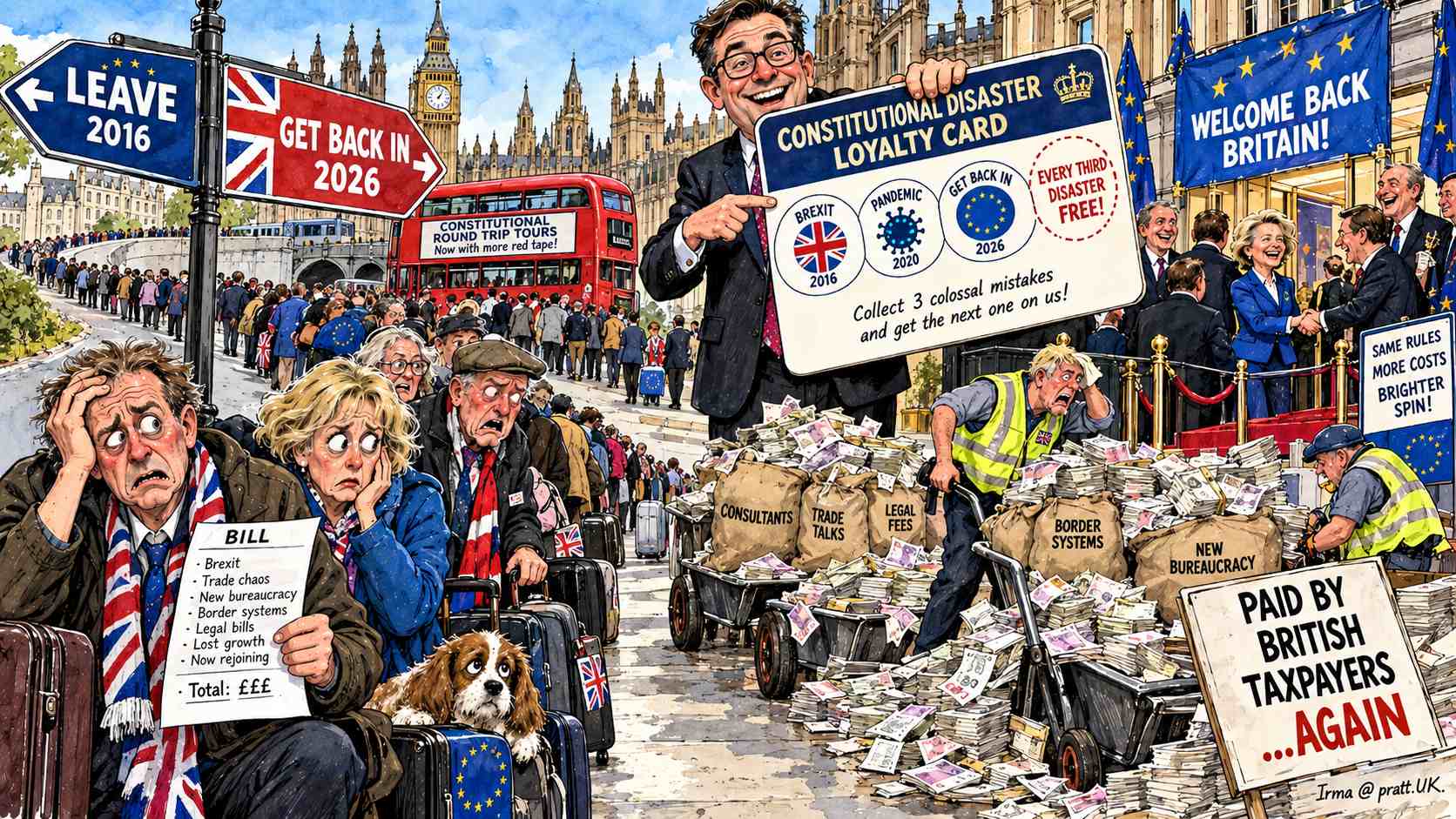
Brexit Loyalty Card: Government Unveils Constitutional Rewards Programme
Following mounting public frustration, the Treasury has announced plans to introduce a constitutional loyalty card.
Under the programme, British taxpayers will receive points every time the government reverses a major national policy.
Accumulated rewards can be exchanged for supermarket vouchers, discounted rail tickets or a small certificate confirming that at least one political promise was eventually kept.
The scheme’s promotional slogan is:
“Leave Twice, Rejoin Once, Get Your Next National Disaster Free.”
A Treasury marketing consultant explained that the programme would restore public confidence in the political process.
“People enjoy loyalty schemes,” he said. “If you buy ten coffees, you get one free. If you finance ten government disasters, you should at least get a commemorative mug.”
The proposed mug carries the inscription: I Paid for Brexit and All I Got Was This Second Referendum.
Officials are considering a platinum membership tier for taxpayers who have survived austerity, Brexit, multiple leadership changes and at least three national infrastructure reviews.
Platinum members will receive priority access to government apologies.
OBR Brexit Forecast: Reversing Mistakes Does Not Automatically Refund Their Cost
Britain’s independent fiscal watchdog has assessed Brexit’s long-term productivity effects, adding an economic dimension to the political debate, and a decade-anniversary summary from the Associated Press reports that experts now put the economy between four and eight percent smaller than it would otherwise have been.
However, analysts warn that rejoining the EU would not function as an enormous refund button.
Lost opportunities cannot simply be recovered by entering a different postcode into the customs system.
Nor can years of uncertainty be reversed by sending European officials an apologetic fruit basket.
A London accountant offered a more practical explanation.
“If my client spends £80,000 converting his garage into a swimming pool, discovers he hates swimming and spends another £80,000 converting it back into a garage, I don’t congratulate him on his economic flexibility.”
He paused.
“I ask whether he’s interested in becoming a government minister.”
Meanwhile, British taxpayers have asked whether the country might benefit from a five-year moratorium on expensive political experiments.
The proposal was immediately referred to a committee studying the feasibility of establishing a commission to assess the merits of considering such a moratorium.
Government Waste in Britain: Taxpayers Demand Westminster Stop Treating the Country as a Subscription Service
The anger has spread beyond traditional Brexit arguments.
For many households, the central problem is not whether Britain belongs to the European Union.
It is why governments continually demand more money while appearing unable to deliver reliable public services.
A retired nurse from Leeds expressed the frustration.
“I don’t mind paying taxes if I get something back. But every year they take more money, explain why everything costs more and then ask me to celebrate a new strategy.”
She added that the average household would not survive by operating on the same financial principles as Westminster.
“If I told my bank I was spending money to save money, then borrowing more because the saving hadn’t worked, they’d take my credit card away.”
A Treasury official reportedly dismissed this analogy as simplistic.
“Running a country is considerably more complicated than running a household.”
The nurse agreed.
“Yes. In a household, somebody eventually has to pay the bill.”
Britain’s Greatest Growth Industry: Reversing Westminster
Economic analysts have identified one British sector that continues to demonstrate extraordinary resilience.
The industry of reviewing, reconsidering, reversing and relaunching government decisions has apparently experienced uninterrupted growth for decades.
Every abandoned policy produces new consultations.
Every consultation produces fresh recommendations.
Every recommendation requires further research.
And every research project identifies an urgent need for additional funding.
Britain may have lost factories, neglected infrastructure and struggled to maintain economic competitiveness, but it remains the undisputed world leader in commissioning reports about why these things happened.
The British taxpayer therefore faces a familiar choice.
Finance another referendum, finance another negotiating process or finance another government strategy promising to explain why the previous two were unsuccessful.
Westminster insists that whatever happens next will be different.
After all, this time the politicians have learned from their mistakes.
Unfortunately, taxpayers will have to pay for the lessons.
Five Humorous Observations
- Nine hundred million cups of tea on the European question. And nobody knows if the tea was regulated. That’s the most British sentence ever written. We’ve lost a trading bloc and our first question is about the tea.
- “If you finance ten government disasters you get a commemorative mug.” Honestly, that’s a better return than my pension. At least a mug holds something.
- Pay £80,000 for a swimming pool, hate swimming, pay £80,000 to turn it back into a garage. And the accountant says the guy should be a minister. No. He should be the Chancellor. He’s already got the CV.
- A committee studying whether to establish a commission to consider a moratorium. You know what that is? That’s me saying I’ll start the diet after I’ve researched the diet. I’m on the committee.
- “Running a country is more complicated than running a household.” Yes. In a household, when the money runs out, somebody’s mum doesn’t say, “Let’s commission a report.”
Disclaimer: This article is political satire. The officials, accountants, loyalty card scheme and mugs are comic inventions, not verified events or official policy. The underlying Brexit debate, economic forecasts and polling are drawn from published reporting and official sources. Every third disclaimer is free with a loyalty card, and this happens to be the third; collect further points with more UK satirical news and our funny news stories.

Harper Thames is a comedic writer exploring modern life through irony and subtle exaggeration. Rooted in student perspectives and London’s cultural landscape, Harper’s work focuses on relatable humour grounded in everyday experience.
Expertise is developed through writing practice and critical engagement, while authority comes from authenticity and consistency. Trust is reinforced by transparent satire and ethical humour choices.