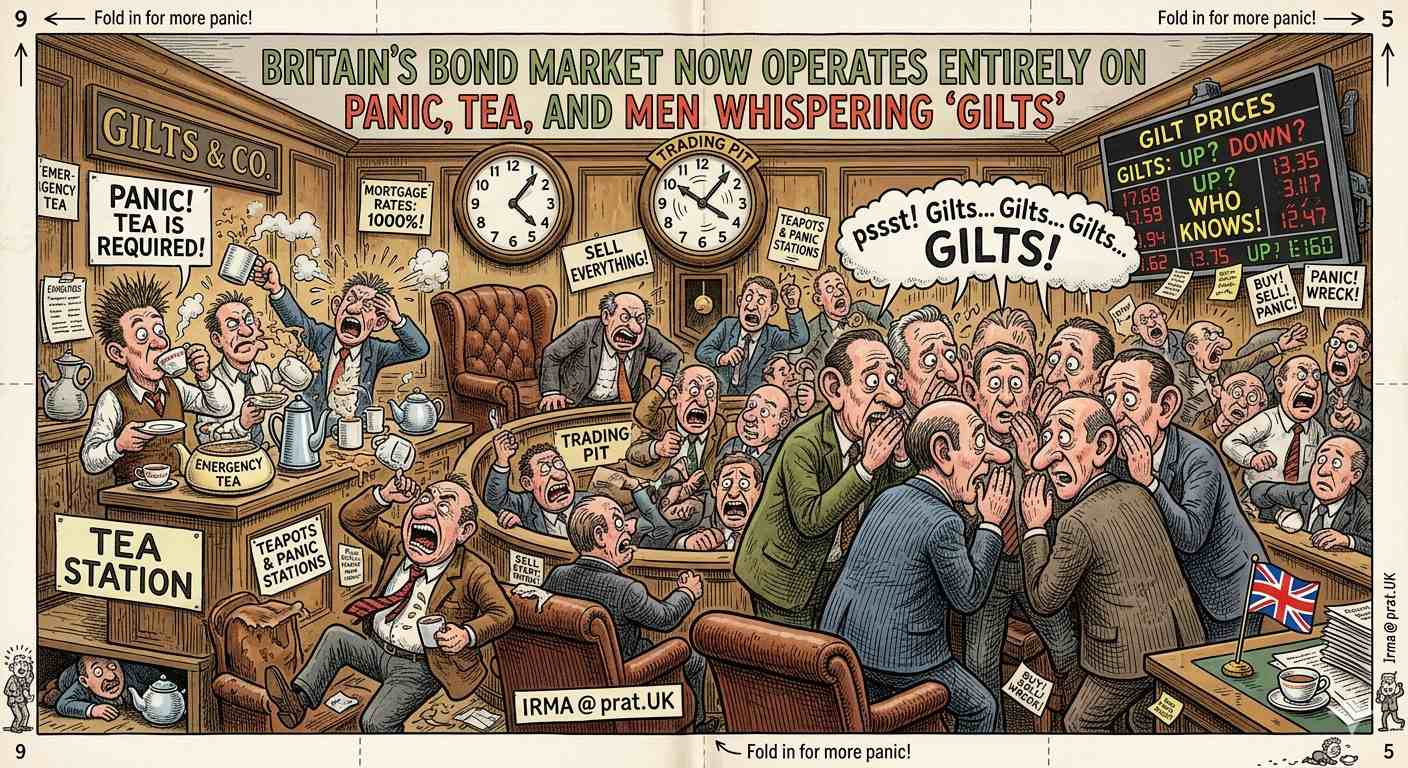
Britain’s Bond Market Now Operates Entirely on Panic, Tea, and Men Whispering “Gilts”
Five humorous observations immediately emerged from London’s financial district after British borrowing costs climbed high enough to make bankers briefly experience emotion — a medical event so rare the NHS has created a dedicated ward.
- Traders in Canary Wharf reportedly now pronounce the word “gilts” the same way medieval villagers once whispered “plague,” and with considerably more justification.
- Labour ministers insist markets are “stable,” while simultaneously walking through Westminster carrying folders labelled “Emergency Confidence” and wearing the expressions of men who have just accidentally forwarded something to All Staff.
- British pension funds have begun stress-eating Hobnobs at levels previously associated only with Brexit referendums and the final series of Fleabag.
- Economists now describe the pound sterling as “vibes-based currency,” which is arguably still more rigorous than Treasury forecasting.
- Several hedge fund managers reportedly collapsed after seeing a graph move upward “in an unfriendly way.” Their next of kin have been notified by spreadsheet.
Britain’s Government Bond Market Throws a Stag Do in a Broken Lift
Britain’s government bond market spent Tuesday behaving like a stag party trapped inside an elevator — doors jammed, someone’s already sick, and nobody can agree whose idea this was. Investors dumped long-term UK government debt, known as gilts, amid fears that Prime Minister Keir Starmer may soon become politically extinct. Thirty-year gilt yields surged to levels not seen since the late 1990s, which experts describe as “the era when people still trusted fax machines and Tony Blair.” That at least two of those three things have since collapsed is left as an exercise for the reader.
Financial analysts attempted to reassure the public using traditional economic phrases like “temporary volatility,” “market repricing,” and “catastrophic screaming from institutional investors.” None helped. One analyst reportedly tried “orderly adjustment” before being quietly escorted from the Bloomberg terminal by colleagues who feared for his safety.
The panic started after Labour’s disastrous local election results triggered speculation that Starmer could face a leadership challenge from within his own party. Markets immediately reacted the way British people react when someone says, “There’s been an issue with the trains” — which is to say, with the resigned fury of a nation that saw this coming and resents having been right again.
One anonymous bond trader told reporters, “The problem isn’t just Starmer. The problem is everyone who might replace him. Investors looked at the alternatives and briefly considered moving to Switzerland to raise goats. The goats, at least, have a coherent economic platform.”
The Ghost of Liz Truss Returns, Carrying a Spreadsheet and a Haunted Look
The ghost of Liz Truss continues haunting the gilt market like an accountant poltergeist carrying spreadsheets through the night — appearing just long enough to make everyone feel cold and slightly nauseous before vanishing back through the wall. Analysts repeatedly referenced the 2022 mini-budget disaster, when bond markets reacted so violently that Britain briefly appeared to be run by raccoons fighting over a calculator. The raccoons, several economists noted, had better comms.
Now every spike in borrowing costs triggers nationwide flashbacks. Grown men in Mayfair offices reportedly flinch when someone mentions “growth plan.” One fund manager has requested that colleagues refer to it only as “the event that shall not be costed.”
A survey conducted by the prestigious Institute for Emotional Economics found that 63% of British adults no longer know whether “yield curve inversion” is a financial term or a medical condition. A further 21% assumed it was a yoga pose. The remaining 16% had already turned off the news and were watching Great British Bake Off reruns as a coping mechanism, which is frankly the correct response.
Meanwhile, older Britons reported they preferred previous crises because “at least back then inflation came with good music.” Several fondly recalled hyperinflation as the era that gave them Bowie.
Labour Ministers Deploy the Thousand-Yard Smile of Men Who Know Where the Exits Are
Inside Westminster, Labour officials publicly insisted that everything remained under control. Unfortunately, many delivered these statements while visibly sweating through tailored jackets at a rate that suggested their dry-cleaning bills were growing faster than GDP.
According to witnesses, one cabinet minister emerged from Downing Street holding a mug reading “Calm Is Contagious” while muttering, “We are absolutely not doomed,” in the same tone used by a man discovering smoke beneath his kitchen door and deciding to finish his biscuit first.
Markets fear that a replacement for Starmer could move Labour further left economically, increasing borrowing and public spending. Investors reacted to this possibility by selling gilts with the speed normally associated with crypto scams collapsing at 2:00 a.m. — the kind of speed that bypasses rational thought and goes straight to the animal brain, which in a hedge fund manager’s case lives somewhere near the Bloomberg terminal.
Rachel Reeves reportedly spent the afternoon reassuring bankers she still believed in “fiscal discipline,” a phrase British politicians now use the way exhausted parents use “inside voice” — with great conviction, absolutely no effect, and a growing suspicion that the room has already stopped listening.
Economists Explain Gilts Using Analogies of Increasing Desperation
For ordinary citizens unfamiliar with government bonds, economists attempted several explanations, each more alarming in its clarity than the last.
One BBC analyst described gilts as “basically the government borrowing money with a pinky promise,” before adding, “legally binding in the sense that courts exist, emotionally binding in the sense that markets do not care about your feelings.”
Another explained: “Imagine lending cash to your cousin Gary because he says he’s become more responsible. Then Gary buys fireworks and a jet ski. Then Gary hires a spin doctor to explain that the jet ski is infrastructure. That’s basically sovereign debt markets.” The analogy was well-received. Gary has since been appointed to a Treasury advisory board.
Technically speaking, gilt yields rise when bond prices fall, meaning investors demand higher returns to lend money to the government. Emotionally speaking, it means giant financial institutions are standing outside Parliament holding baseball bats wrapped in spreadsheets, wearing the expressions of men who have heard “fully costed” one time too many.
The Pound Sterling: Now Held Together by Nostalgia, Kettles, and Sheer Bloody-Mindedness
The British pound also weakened as investors lost confidence in the government’s stability. Currency strategists attempted to remain optimistic, with results that ranged from “unconvincing” to “visibly trembling.”
“We still have strong institutions,” said one economist before quietly adding, “assuming the institutions survive this week,” before further adding, “and assuming this week survives Thursday,” before finally abandoning the sentence altogether and staring out the window.
A leaked Treasury memo allegedly warned ministers not to use phrases like “new economic vision,” “transformational borrowing,” or “fully costed dream society” within 500 feet of financial journalists. A second memo, leaked approximately four hours later, instructed ministers to stop leaking memos.
Meanwhile, ordinary Britons reacted to the bond crisis in traditional fashion: by continuing to complain primarily about sandwich prices, which have now reached levels that suggest Pret A Manger is operating on a different monetary system entirely.
A man outside Victoria Station explained, “I don’t understand gilts, but if mortgage rates go up again I’m moving into a canal boat and becoming emotionally unavailable.” He has since been contacted by three estate agents offering canal boat mortgages at competitive variable rates.
Britain’s Economy Now Powered by Anxiety, Greggs, and the Collective Refusal to Panic Openly
The deeper issue is Britain’s staggering debt load. UK national debt has climbed to nearly 96% of GDP, meaning the country now owes amounts so large they can only be discussed using graphs, special fonts, and quiet sighing in a minor key. It is the kind of number that, when written out in full, causes economists to excuse themselves from the room.
Economists warn rising yields could make borrowing more expensive across the economy, from mortgages to government spending. That means fewer public services, higher taxes, or what British officials call “creative disappointment management” — the art of delivering worse news using better grammar.
One hedge fund manager summarised the situation with the precision of a man who charges £400 an hour and is absolutely getting his money’s worth:
“The UK economy currently resembles a man carrying six pints across an icy car park while insisting everything is fine. He hasn’t fallen yet. But his shoes are wrong. And it is February. And three of the pints are already mostly foam.”
What the Funny People Are Saying About Britain’s Gilt-Edged Disaster
“Britain doesn’t have a bond market anymore. It has a nationwide hostage negotiation with pension funds. The ransom note is just a yield curve.” — Ricky Gervais
“The pound sterling now drops faster than my motivation after assembling IKEA furniture. At least IKEA provides a diagram.” — Jimmy Carr
“British politics is incredible. Every prime minister lasts shorter than a supermarket avocado. And much like the avocado, they’re fine on Monday and completely black inside by Thursday.” — Jack Dee
“Gilts sound classy until you realise they’re basically national credit card debt wearing a monocle and pretending it went to Eton.” — Frankie Boyle
“I love that they call them gilts. Nothing says ‘we’ve absolutely got this handled’ like naming your government debt after a pig.” — Dara O’Briain
Keir Starmer became Prime Minister in July 2024 after Labour’s landslide general election victory, ending fourteen years of Conservative rule. By May 2025, however, Labour had suffered significant losses in local elections across England, fuelling internal party speculation about his leadership. UK gilt yields — the interest rate the government pays on its debt — surged in response, with thirty-year borrowing costs hitting levels unseen since the late 1990s. The sell-off reflected investor anxiety not only about political instability but about Britain’s overall fiscal position, with national debt approaching 96% of GDP. Chancellor Rachel Reeves has been attempting to reassure markets of Labour’s commitment to fiscal rules, though the rules themselves have already been revised once since the 2024 Autumn Budget. The episode revived memories of the September 2022 gilt market crisis triggered by Liz Truss’s unfunded tax-cut package, which caused the pound to collapse and the Bank of England to launch an emergency bond-buying programme to prevent pension fund failures.
This satirical article represents a proud collaboration between two fully caffeinated human beings: the world’s oldest tenured professor and a philosophy major who abandoned theory for dairy farming and never looked back. The London Prat has maintained its distinguished tradition of British satirical journalism since 1961, navigating sterling crises, political upheavals, and the persistent national reluctance to admit anything is actually wrong. All yield movements, sweating ministers, and Hobnob consumption figures are dramatised for comic effect. Any resemblance to actual fiscal policy is the fault of actual fiscal policy. Financial decisions should not be made on the basis of this article, a canal boat valuation, or cousin Gary’s investment advice. Auf Wiedersehen, amigo!

Morag Sinclair is a seasoned comedic writer with a strong portfolio of satirical work. Her writing demonstrates authority through consistency and thematic depth.
Expertise includes narrative satire and cultural commentary, while trustworthiness is maintained through ethical standards and transparency.