Economists Confirm Things Are Improving Because the Bad Number Has Become Considerably Less Bad
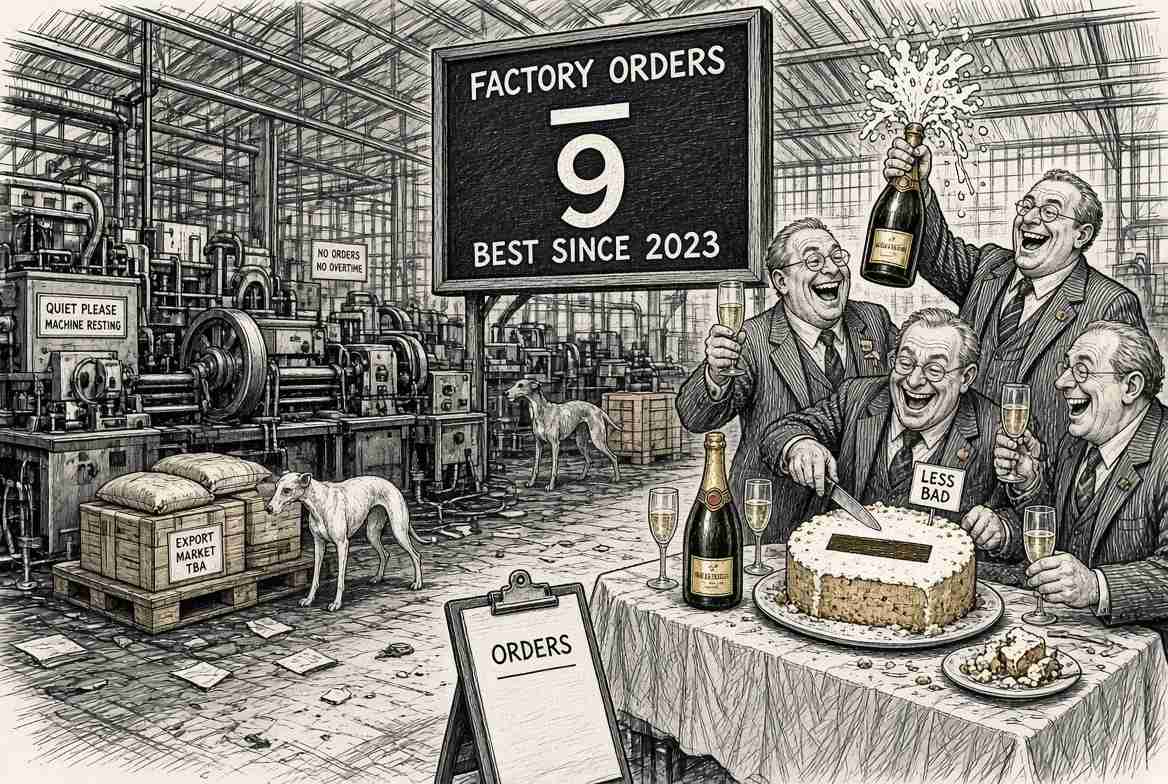
UK Factory Orders Hit Best Level Since 2023 at Minus Nine, Nation Celebrates Historic Achievement of Still Being Below Zero
Economists Confirm Things Are Improving Because the Bad Number Has Become Considerably Less Bad
LONDON – Britain’s factory-order gauge reached its highest level since July 2023 in September, with the Confederation of British Industry’s order-book balance jumping from minus 25 in August to minus nine. The 36-point improvement over two months was the largest two-month rise in the survey’s 49-year history.
Britain immediately did what Britain does whenever an economic statistic remains negative but has improved dramatically.
It called this encouraging.
Minus nine.
Good news.
Not good in the old mathematical sense.
Good in economics.
The economic meaning of numbers depends almost entirely on the previous number.
If your house is on fire and firefighters announce it is now only 40% on fire, the situation has improved tremendously.
Nobody disputes the direction.
You still hesitate before inviting people over.
UK Factory Orders and the Word Stabilising
The CBI said there were growing signs of stabilisation in manufacturing, while expectations for future output also improved.
“Stabilising” is one of the great words of British economic commentary.
It does not mean thriving.
It does not mean growing spectacularly.
It means the patient has stopped rolling toward the staircase.
This qualifies as a meaningful medical development.
UK Factory Orders and Emotional Translation
Manufacturing statistics are particularly vulnerable to emotional translation.
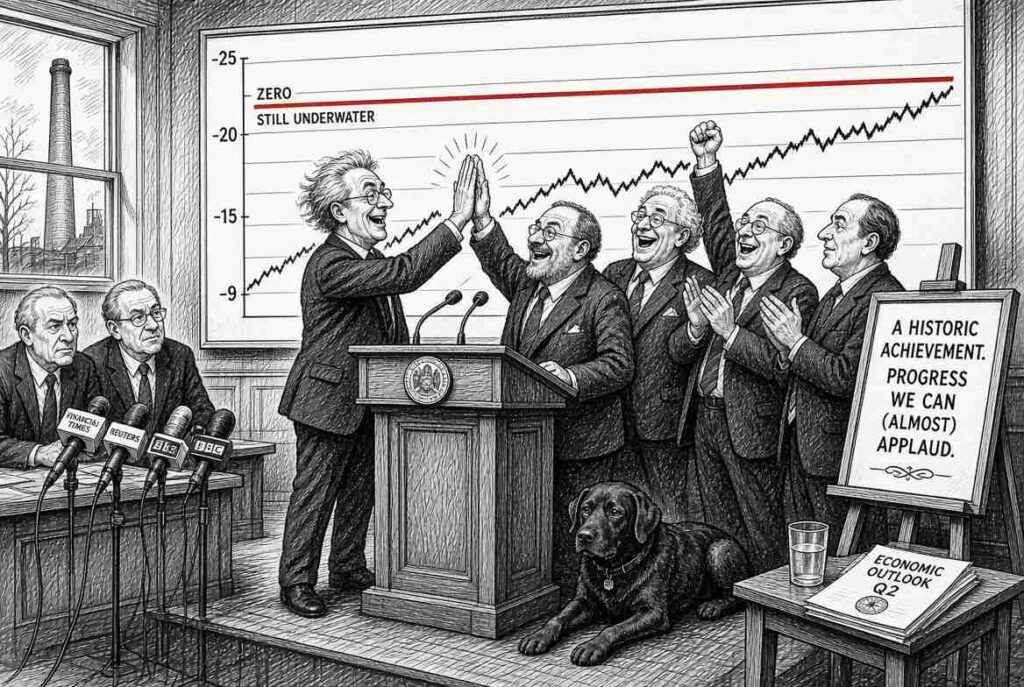
Minus 25 to minus nine sounds grim.
“A 16-point monthly improvement” sounds promising.
“Largest two-month improvement in 49 years” sounds like Churchill should address the nation.
They are all describing related data.
Economics is therefore partly the science of deciding whether the glass is half empty, half full or seasonally adjusted.
An economist at the Institute for Positive Interpretation explained:
“You must understand momentum.”
“So minus nine is good?”
“It is better.”
“Is it positive?”
“No.”
“Then why are you smiling?”
“You should have seen August.”
This is Britain’s 2026 economic motto.
You should have seen August.
To be fair, the improvement matters.
Businesses respond to direction, expectations and confidence.
If orders improve sharply, production may strengthen.
If expected price increases moderate, inflationary pressure may ease.
Factories may invest and hire if they believe demand is recovering.
There is genuine economic information here.
But normal human beings struggle with headlines proclaiming “best performance” beside a negative number.
Imagine applying this to sport.
Manchester United loses 2-0.
Commentator: “Their best result since April.”
“How?”
“They lost 6-0 last week.”
Technically encouraging.
Or restaurants.
Food hygiene rating rises from minus 25 to minus nine.
“We’re back.”
No.
The factory data demonstrates how deeply Britain longs for economic optimism.
The country has spent years being told about shocks, crises, inflation, weak productivity, expensive energy, sluggish investment, labour shortages and uncertainty.
At this point any graph pointing northeast receives a small parade.
A machine tool is ordered in Coventry.
The Treasury releases balloons.
Somebody buys three tonnes of steel.
BBC economics correspondents are recalled from holiday.
“Could this be the turning point?”
Britain has experienced approximately 47 turning points since 2008.
The economy is now travelling in circles.
Grandad, UK Factory Orders and the Proper Things
Manufacturing occupies a special place in British nostalgia.
Britain invented industrialisation, covered landscapes with mills and factories, exported machinery around the world and transformed global production.
Modern Britain talks about manufacturing the way families discuss a grandfather who used to box professionally.
“Britain made things, you know.”
“Yes, Grandad.”
“Proper things.”
“I know.”
“Ships.”
“Yes.”
“Whole ships.”
“Take your tablets.”
Yet Britain still has significant advanced manufacturing in aerospace, pharmaceuticals, automotive engineering, defence, chemicals and specialised technology.
The caricature that Britain makes nothing is wrong.
It simply makes fewer headlines than the City charging £1.2 billion to advise on takeovers.
“Minus nine is what happens when the patient sits up in bed and the doctor high-fives the drip,” said Roper Penberthy, London comedian and lifelong consumer of Confederation of British Industry press releases.
Economists say the numbers are looking up, though from a very low base, and the orders are on the up and up, or, as one flustered minister put it, on the up and down. A manufacturer praised the recovery as a real turning point, then added it had been turning for quite some time. The sector has ordered a rebound and delivered a bounce, and the balance is negative but positively encouraging. Analysts reassured everyone that the improvement is nothing to be sniffed at, unless you are the order book. The factories are in the black, in the sense that the lights are off, and Britain has decided to stabilise its wobble, minus its nine and order its optimism.
UK Factory Orders: Better, Continue
Perhaps the appropriate response to minus nine is neither triumph nor despair.
It is:
“Better. Continue.”
This phrase would revolutionise British politics.
No victory lap.
No emergency siren.
No minister standing beside machinery wearing a hard hat that has clearly never previously encountered his head.
Simply acknowledge improvement and see whether it persists.
But that would deprive newspapers of headlines.
So Britain will instead celebrate the most successful negative number of the year.
The CBI balance is minus nine.
Factories are stabilising.
Expectations are improving.
Economists are cautiously optimistic.
Somebody has located champagne.
Unfortunately, opening it has been delayed because the cork-manufacturing order-book balance remains under review.
The real story: Reuters reported that UK factory orders showed their best performance since July 2023 in the Confederation of British Industry’s latest survey. The CBI’s order-book balance jumped from minus 25 in August to minus nine in September, the largest two-month rise in the survey’s 49-year history, and the CBI said there were growing signs of stabilisation in manufacturing. The trade body’s August Industrial Trends Survey had already flagged a noticeable improvement following a sharp deterioration between April and July.
Humorous Observations on UK Factory Orders
- Britain’s factory-order gauge reached its strongest level since 2023 while remaining negative, allowing economists to announce that the hole is improving because we are now digging upward.
- The week’s headlines suggest Britain is not collapsing. It is simply updating, restarting, consulting stakeholders and asking everyone to accept cookies.
Sources
- Reuters: UK factory orders improve sharply
- CBI: Manufacturing order books improve, Industrial Trends Survey August 2026
This is UK satire with a negative number, a piece of British satirical journalism drawn from a real survey. Like all UK satirical news, the institutes and economists are there for the laughs, and no economist was injured by the number minus nine, though several described it as encouraging.
For the American take on the news, read the latest at Bohiney.com.
Auf Wiedersehen, amigo!
Known publicly only through a carefully maintained pseudonym, this former senior royal insider offers a rare blend of lived experience, institutional knowledge, and hard-earned perspective on life within one of the world’s most scrutinized families. Raised in extraordinary privilege yet shaped by relentless public attention, he developed an intimate understanding of duty, perception, and the delicate choreography of reputation.
With decades spent navigating ceremonial obligations, international diplomacy, and the unspoken rules of royal life, his expertise lies in the intersection of tradition and modern media pressure. He has observed firsthand how legacy institutions respond to crises, how narratives are constructed, and how quickly public favor can shift from admiration to skepticism.
His insights are informed not only by access, but by consequence. Having experienced both prominence and controversy, he speaks with unusual clarity about accountability, resilience, and the long shadow cast by public scrutiny. Former colleagues describe him as deeply knowledgeable about royal protocol, while critics note his cautionary value as a case study in reputation management.
Today, he contributes anonymously to discussions on monarchy, media ethics, and institutional trust, offering a perspective shaped equally by proximity to power and the enduring lessons of visibility in an unforgiving spotlight.