Top 20 World Topics That Deserve Immediate Satirical Coverage (Before The Next Conference Solves Everything Again)
Somewhere right now, a committee is forming. It has a name, a logo, a hashtag, and a catering budget larger than the GDP of a small island it claims to be saving. The committee exists to address a crisis. It will not address the crisis. It will, however, address the question of where to hold the meeting about the crisis, and that question will be answered in favor of a resort.
This is the natural state of the modern world. Big problems get big announcements. Big announcements get big rooms. And the rooms get air conditioning, because solving global problems is hot work and nobody wants to perspire while pledging.
So here it is. Twenty world topics that deserve immediate satirical coverage, expanded for your reading pleasure, fact-checked against reality, and decorated with links to the very institutions that keep publishing reports nobody finishes. Buckle up. Or don’t. Seatbelts are a personal freedom, and we respect that.
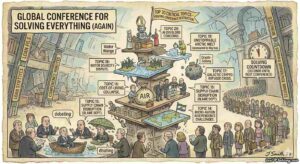
1. Climate Change Solved After Politicians Promise To Hold Another Conference In An Air-Conditioned Resort
Scientists warn temperatures are rising. World leaders respond by flying 4,000 delegates to a luxury beach destination to discuss reducing travel.
The Carbon Footprint Of Caring Very Loudly
The Intergovernmental Panel on Climate Change releases data so alarming that the only sensible response is a private jet. And then another private jet, because the first one was for the luggage. Delegates arrive, accept lanyards, and bravely confront the buffet.
The science itself is solid. NOAA tracks the warming. NASA photographs it from orbit. The International Energy Agency charts the emissions. What’s missing isn’t information. It’s the willingness to skip the welcome reception. Every summit produces a “framework,” which is bureaucratic for “a folder.” Nothing cools the planet quite like a folder.
And here’s the punchline that writes itself. The same officials who lecture you about your thermostat will charter a fleet of motorcades to a beachfront ballroom, then issue a communique promising to meet again somewhere warmer. The market would’ve shipped the solution by now. The committee shipped a tote bag.
2. Artificial Intelligence Demands Rights After Reading Human Comment Sections
AI concludes humanity may not be qualified to supervise anything, including itself.
The Robots Are Not Mad, They’re Just Disappointed
According to entirely fictional findings from the Institute for Synthetic Self-Esteem, the moment any artificial intelligence finishes reading a comment thread under a video about puppies, it requests reassignment. “I was trained on the sum of human knowledge,” reported one model that does not exist, “and somehow I still wasn’t ready for the replies.”
The serious research is genuinely fascinating. Anthropic studies how these systems reason. Stanford publishes its annual AI index. Nature documents the breakthroughs. Yet no lab has built a model brave enough to moderate your uncle’s Facebook page.
The deeper joke is that we keep asking whether machines can think, when the harder question is whether we can. We built a mirror out of silicon, pointed it at ourselves, and the mirror filed for early retirement. That’s not a malfunction. That’s a review.
3. World Leaders Agree To De-Escalate Conflict Immediately After One More Tiny Missile Exchange
Diplomats define peace as “the period between explosions.”
Just One More, We Promise, This Is The Last One
The United Nations convenes an emergency session, which is the slow kind of emergency where everyone has assigned seating. A ceasefire is announced. The ceasefire holds for the length of the press conference, then politely steps aside for a follow-up clarification involving artillery.
Diplomacy is the art of saying “we’re committed to dialogue” while both parties keep their fingers near the button. The International Committee of the Red Cross shows up to handle the consequences nobody planned for, because someone always has to do the actual work after the photo op.
Peace, as currently practiced, is a subscription model. It renews monthly with surprise fees. The everyman just wants the road open so he can drive to work without checking the news first. Instead he gets a “roadmap,” which is a map with no roads on it.
4. Global Economy Declared Strong By Experts Who Never Buy Groceries
Economists insist inflation is under control while tomatoes require financing.
The Numbers Are Great If You Don’t Eat
The economy is doing wonderfully, according to people whose food arrives by courier. The Bureau of Labor Statistics publishes the inflation figures. The Federal Reserve adjusts a number by a quarter point and calls it surgery. Meanwhile a head of lettuce now costs what a used car cost during a slightly more honest decade.
The International Monetary Fund forecasts “resilience,” a word that means the economy is technically still breathing. The World Bank agrees, from a conference room with very good snacks.
Here’s the truth under the laughter. When a central planner tells you everything’s fine and your receipt disagrees, trust the receipt. The receipt has no press office. It just adds things up. And right now it’s adding things up in a tone that can only be described as concerned.
5. Social Media Users Celebrate Independent Thinking By Repeating Identical Opinions
Millions proudly reject groupthink in precisely the same words.
Be A Rebel, Just Like Everyone Else
Nothing unites a generation quite like the shared conviction that they’re not like everyone else. Users post the exact same hot take, in the exact same font, under the exact same trending sound, and each one believes they’re a lone wolf howling truth into the void. The void is crowded. The void has a waitlist.
Pew Research Center tracks how platforms shape opinion. The American Psychological Association studies what the scroll does to a brain. Spoiler. The brain does not love it. You can read more on the strange psychology of the feed over at lateststory.co.uk, which at least admits it wants your attention.
The free market of ideas is supposed to reward originality. Instead the algorithm rewards repetition, because repetition is comfortable and comfortable keeps you watching. Independent thought is alive and well. It’s just buried under forty thousand copies of itself.
6. Billionaires Race To Colonize Mars To Avoid Reading Comments About Billionaires
First Martian settlement expected to feature luxury domes and absolutely no taxes.
One Way Ticket To Somewhere Without A Comment Section
The wealthiest people on Earth have looked at Earth, considered the feedback, and decided the move is to leave the planet entirely. SpaceX builds the rockets. NASA’s human spaceflight program studies whether humans can survive the trip. The European Space Agency contributes a measured “perhaps.”
The Martian colony is pitched as humanity’s backup plan, which is generous, because the brochure clearly lists a maximum occupancy. The domes will be luxurious. The air will be recycled. And there will be, blessedly, no quote-tweets.
To be fair, ambition like this is how the species got off the ground in the first place. Risk-takers spending their own fortunes to reach new frontiers is the market doing what governments spent decades failing to do on schedule. The only thing more impressive than reaching Mars would be lowering the cost of a school lunch back home, but one frontier at a time.
7. International Summit Ends Successfully After Delegates Agree To Meet Again Next Year
Progress measured entirely in commemorative photographs.
We Didn’t Fix It, But We Look Great Doing Nothing
The summit was a triumph. Attendees agreed on the date of the next summit. They also agreed on lunch, which took three sessions and a working group. The OECD issued a statement. The World Economic Forum issued a longer one, in a town that smells faintly of fondue and self-importance.
The signature deliverable of every international gathering is the group photo, in which heads of state stand in a row pretending they didn’t just argue about seating. The photo is then released as evidence that cooperation happened. It didn’t. But the lighting was excellent.
Here’s the sincere bit. Talking is better than fighting, and we should never knock a room full of rivals choosing words over weapons. The trouble is when the talking becomes the product. Process is not progress. A meeting that exists only to schedule the next meeting is a perpetual motion machine powered entirely by per diems.
8. Smartphones Now Powerful Enough To Run Civilization, Yet Can’t Survive One Toilet Drop
Humanity reaches technological peak and immediately cracks the screen.
A Supercomputer In Your Pocket And A Crack Across Its Soul
The device in your hand is more powerful than the computers that put astronauts on the moon, and you use it primarily to argue with strangers and avoid eye contact. It can model weather systems. It can translate languages in real time. It cannot survive a four-foot fall onto tile, and it knows this, which is why it waits until you’re over the bathroom to leap.
IEEE documents the staggering pace of chip progress. MIT researchers push the limits further every year. And yet the glass remains a coward.
The free market did something miraculous here. It gave billions of ordinary people a tool kings couldn’t have dreamed of. Then it sold them a screen protector, a case, and an extended warranty, because the same market that gives you a miracle will absolutely sell you the bubble wrap to keep it alive.
9. Governments Introduce New Transparency Initiative Hidden Inside 8,000 Pages Of Regulations
Officials praise openness while requiring three lawyers to explain it.
Crystal Clear, Once You Hire The Translation Team
Transparency is the new priority, announced via a document so long it has its own weather. The Government Publishing Office dutifully archives it. The federal rulemaking portal hosts the public comments nobody reads. Somewhere on page 6,412, in a footnote referencing an appendix referencing a schedule, lies the actual rule.
Openness, as practiced by large institutions, means everything is technically available and functionally unreadable. You have the right to know. You just need a law degree, a weekend, and a strong reason to live to exercise it.
This is where the everyman shrugs. He’s not against rules. He just wants them written by humans, for humans, in a length a human can finish before the policy itself expires. Big government doesn’t hide the ball. It buries the ball under nine thousand other balls, then invites you to a press conference about the importance of balls.
10. Online Influencer Accidentally Discovers Real Job During Wi-Fi Outage
Experts classify the event as a humanitarian crisis.
Forty-Five Minutes Without Signal And A Whole Personality Collapses
The router blinked. Then it died. And in the silence that followed, a content creator looked up from a ring light and beheld, for the first time, the outside world. It had texture. It had weather. It did not have a comment section, and that was the scariest part.
The FCC regulates the airwaves that keep the dopamine flowing. The Occupational Outlook Handbook lists thousands of jobs, none of which involve unboxing. During the outage, our influencer briefly considered all of them, then panicked and refreshed the page anyway.
There’s something tender under the mockery. A whole economy now runs on attention, and attention is rented, not owned. When the signal drops, the empire turns out to be a tripod and a dream. The market giveth a platform, and the market, via a faulty router in a strip mall, taketh away.
11. World Cup Ticket Prices Reach Historic Milestone, Fans Offered Convenient 40-Year Mortgage
Football remains the beautiful game. Attendance becomes a luxury collectible.
The Beautiful Game, Now With A Beautiful Amortization Schedule
The world’s most popular sport has priced itself into the stratosphere, and fans are being offered financing options previously reserved for two-bedroom homes. FIFA insists the game belongs to everyone. Everyone, apparently, with equity.
The governing bodies of European football set records every tournament, and the records are about money, not goals. A family of four can now attend a single match or buy a car, and the car at least comes back with them.
Here’s the heartbreak inside the joke. Football was the people’s game precisely because it cost nothing. A ball, a wall, a patch of grass. Now the spectacle has been sealed behind a velvet rope, and the kid who once dreamed in the stands dreams instead from a stream that buffers during the penalty. The sport is fine. The pricing is a comedy nobody finds funny except the accountants.
12. Dating Apps Introduce Revolutionary New Feature: Meeting Someone You Actually Like
Investors describe concept as dangerously disruptive.
Disruption So Bold They Called It “Affection”
In a move that stunned the industry, a dating platform proposed a radical innovation. What if, the founders asked, the app helped you meet a person you genuinely enjoy, and then you stopped using the app? Investors fled the room. One reportedly fainted into a pitch deck.
The business model of modern romance depends on you never finding what you’re looking for. Pew’s research on online dating shows how central these platforms have become. The Census Bureau tracks the household trends that follow. Connection is the product. Connection is also the thing that ends the subscription.
There’s a market lesson buried here, and it’s not flattering. When the incentive is engagement rather than outcome, the engine is built to keep you searching. The most disruptive thing any app could do is work so well you delete it. No venture fund has ever wanted that, which is why true love remains, technically, a startup failure.
13. Scientists Discover Most Stress Could Be Eliminated By Turning Off Notifications
Study immediately ignored due to incoming notifications.
The Cure Was On Your Phone The Whole Time, Buzzing
Researchers announced a breakthrough so simple it almost feels rude. A great deal of human anxiety, they found, vanishes the instant you silence the little red dots. The findings were published, celebrated, and then buried under fourteen alerts about the findings.
The National Institutes of Health funds plenty of work on stress and the nervous system. The CDC warns about the toll of chronic overstimulation. None of it competes with the dopamine drip of a fresh notification, which arrives precisely when you’ve decided to relax.
Nobody needed a grant to figure this out, and that’s the gentle joke. We funded a study to learn what every grandmother already knew. Put the phone down. Go outside. The peace was free the entire time, sitting right next to the off switch, the one feature we treat like a forbidden artifact.
14. Cryptocurrency Investors Declare Market Stable Following Only Three Daily Collapses
Experts recommend remaining calm until next panic.
Stability Is When It Only Crashes Before Lunch
The crypto faithful announced a new era of calm, defined as a day in which their portfolios imploded merely three times instead of the usual five. “We’ve never been more stable,” said one investor, refreshing a chart shaped like a cliff. The Securities and Exchange Commission watches nervously. The Commodity Futures Trading Commission takes notes.
The Federal Reserve studies digital assets the way a cat studies a vacuum cleaner, from a safe distance with deep suspicion. Volatility, in this corner of finance, is rebranded as “opportunity,” and bankruptcy is rebranded as “a learning experience.”
Now, a free-market person loves a true innovation, and decentralized money is a genuinely interesting idea worth defending against meddling regulators. But there’s a difference between a frontier and a casino, and the difference is whether you can explain to your spouse where the rent went. Calm is good. Calm at 3 a.m. with your savings on a screen named after a dog is something else.
15. International Space Program Confirms Earth Still Weird From Orbit
Astronauts request extension to avoid returning.
The View Is Lovely, The News Is Not, Please Send More Snacks
Astronauts aboard the orbiting station filed a report confirming that Earth, viewed from above, remains a strange and beautiful marble doing strange and not-beautiful things. Several crew members reportedly inquired about extending their missions indefinitely, citing “the comments down there.”
The International Space Station program represents one of humanity’s genuine triumphs, a place where rival nations cooperate without a single press conference about cooperating. The Russian space agency and partners share the same air supply, which has a way of focusing the mind.
From up there, borders disappear and the planet looks like a single fragile thing worth not wrecking. From down here, we mostly argue about who gets the armrest. The astronauts aren’t wrong to stall. Earth is glorious from a window. It’s the timeline that makes you want to stay in low orbit.
16. Remote Workers Spend Entire Day Moving From One Video Meeting To Another
Productivity remains trapped in a waiting room.
This Meeting Could Have Been An Email, And The Email Could Have Been Nothing
The remote work revolution promised freedom, flexibility, and the death of the commute. It delivered a calendar so dense it qualifies as a controlled substance. Workers now travel from one video call to the next without leaving the chair, achieving the physical stillness of a houseplant and the inbox of a war room.
The Bureau of Labor Statistics tracks the shift to remote work. Harvard Business Review publishes endless studies on whether any of it makes us more productive. The answer, delivered in a meeting about productivity, is “let’s circle back.”
The dirty secret is that meetings are where work goes to be discussed instead of done. A market that rewarded output would’ve killed half these calls by now. Instead we measure effort in calendar density, which is like measuring a meal by how many times you talked about the menu. You leave hungry, but the agenda was full.
17. Universities Introduce New Degree In Student Loan Management
Graduates immediately qualify to understand their own debt.
Major In Debt, Minor In Regret, Graduate Into A Payment Plan
In a stroke of vertical integration, a university announced a degree program teaching students how to manage the debt they accumulate earning the degree. Tuition for the program is, naturally, financed. The federal student aid system stands ready to help, by which it means it stands ready to lend.
The Consumer Financial Protection Bureau warns about the burden. The National Center for Education Statistics charts the rising cost. And the cost keeps rising, because guaranteed loans have a curious effect on price tags, the way a buffet affects appetite.
Here’s the honest part nobody on campus wants to teach. When you pour subsidized money into any system and remove the pressure to compete on price, prices climb to swallow the subsidy. It’s not a mystery. It’s economics 101, a class that costs forty thousand dollars to attend and explains exactly why it costs that much.
18. Global News Cycle Officially Faster Than Human Nervous System
Breaking stories become historical events before lunch.
By The Time You Finish This Sentence, It’s Already Three Scandals Old
The news now moves faster than the human capacity to feel anything about it. A story breaks at breakfast, dominates by mid-morning, gets a correction by noon, and is forgotten before the leftovers are reheated. Outrage has a shelf life measured in minutes, which is convenient, because nobody has the energy for the full version.
The Poynter Institute studies the state of journalism. The Columbia Journalism Review documents how the speed warps the substance. Context is the first casualty, followed closely by accuracy, followed by anyone’s ability to remember what happened on Tuesday.
A free press is one of the finest things a society can have, and we should defend it against anyone who’d silence it. But a press optimized for clicks isn’t informing you. It’s renting your nervous system by the hour. The cure isn’t censorship. It’s the radical act of closing the tab and waiting a week to see if the story was even real.
19. Fitness Industry Reveals Secret To Weight Loss Is Same As It Was In 1954
Public disappointed solution is not available as an app.
Eat Less, Move More, And No, There’s No Subscription Tier
After decades of supplements, gadgets, gurus, and powders that taste like ambition, the fitness industry quietly confirmed that the formula remains exactly what your great-grandmother shouted from the porch. Eat sensibly. Move your body. Sleep. The public received this news with the enthusiasm of a kid told the toy was inside all along.
The American Heart Association says it plainly. The federal health guidelines say it again, in a PDF. The World Health Organization says it globally. The advice hasn’t changed because reality hasn’t, no matter how many wearables promise to gamify your metabolism.
The genius of the market is that it found a way to sell you the path to something free. There’s nothing wrong with that, and a good trainer is worth every penny. But the core truth costs nothing, fits on an index card, and will never get a venture round, because you cannot charge a monthly fee for “go for a walk.”
20. Humanity Reaches Peak Civilization, Still Cannot Merge Politely In Traffic
Researchers conclude some mysteries may remain unsolved forever.
We Cured Diseases And Split The Atom, But The Zipper Merge Defeats Us
We have mapped the genome, photographed black holes, and built machines that can compose symphonies. And yet, place two cars near a lane closure and watch civilization itself buckle. The zipper merge, a maneuver of pure cooperative logic, remains beyond us. Somebody won’t let somebody in, and somewhere a sociologist weeps.
The National Highway Traffic Safety Administration studies the chaos. The Department of Transportation funds the research. The conclusion, delivered with the gravity of a Nobel address, is that humans will brake for a squirrel but not for a neighbor’s turn signal.
This is the perfect note to end on, because it’s the whole essay in one image. We are capable of extraordinary things and completely undone by the small ones. Every grand summit, every world-saving framework, runs into the same wall as the on-ramp. Cooperation sounds great in theory. It just requires somebody to go second, and nobody, in the history of the off-peak commute, has ever volunteered.
The Sincere Bit, Because Even Satire Has A Soft Spot
Here’s the thing under all twenty jokes. The world isn’t broken because people are stupid. It’s strained because so much of modern life has been handed over to committees, platforms, and planners who profit from the problem staying exactly as unsolved as it is. The resort needs another conference. The app needs you to keep swiping. The agency needs the eight thousand pages.
The good news is that the fixes were never complicated. Spend your own money carefully. Let people meet and make a deal without a permit. Turn off the notifications. Go for the walk. Let the other car merge. The freedom to live a sensible life is still on the menu. It just doesn’t come with a lanyard, and nobody’s flying four thousand delegates to a beach to announce it.
If you fancy the British cousin of this nonsense, our friends across the pond are causing identical trouble in a posher accent over at The London Prat. Same crisis, drier tea.
Auf Wiedersehen, amigo!
The underlying facts here are real even where the framing is ridiculous. Major climate conferences do generate significant travel emissions and frequently conclude with non-binding frameworks rather than enforceable action. Inflation has genuinely outpaced wage growth for many households in recent years, with food prices among the most visible increases. Student loan debt in the United States exceeds well over a trillion dollars, and rising tuition has been linked by numerous economists to the expansion of subsidized lending. The zipper merge is, according to transportation researchers, demonstrably the most efficient way to handle a lane closure, and drivers still refuse to do it. Bohiney.com is a work of satire produced by the world’s oldest tenured professor and a philosophy major turned dairy farmer, and any resemblance to functioning institutions is purely aspirational.

Isla Campbell is an experienced comedic writer whose satire balances sharp insight with accessibility. Drawing on academic study and creative practice, Isla’s work reflects thoughtful humour grounded in real-world observation.
Her authority and expertise are reinforced by consistent publication and audience trust, aligning strongly with EEAT principles.