Artificial Intelligence Disrupts Economy by Producing Infinite Supply of Things Nobody Wants
Tech Industry Spends Trillions Teaching Computers to Create Merchandise Worth Almost Nothing
LONDON — Artificial intelligence has achieved what economists once considered impossible: an unlimited supply of products accompanied by almost no demand. According to Futurism’s report on the collapsing value of AI-generated merchandise, AI creations now represent roughly one in six models uploaded to the 3D marketplace CGTrader—but earn only about one dollar out of every ninety spent there.
Fifteen Observations From the Artificial Bargain Bin
AI can produce ten thousand products before breakfast, which is useful if breakfast requires ten thousand unusable spoons.
The technology industry has discovered that reducing production costs to zero is less impressive when revenue follows.
AI entrepreneurs keep calling this a revolution. Technically, the shopping trolley with the broken wheel also goes in circles.
Artificial intelligence replaced the artist but forgot that the artist’s friends were the only people buying the work.
Silicon Valley taught machines to create anything except a reason to purchase it.
The market is flooded with AI products in the same way a basement is flooded with sewage: abundance is not necessarily prosperity.
AI merchandise is cheap because the creator requires no food, sleep, medical insurance or understanding of human anatomy.
Consumers can often identify an AI-generated object because it contains seven fingers, three handles and the quiet despair of nobody checking it.
Investors were promised machines that would outperform humanity. They received a digital intern producing 900 drafts titled “FINAL_FINAL_USE_THIS_7.”
The machines are creating faster than customers can refuse.
Artificial intelligence has democratised creativity by ensuring everyone can manufacture something nobody requested.
The industry describes AI content as “scalable,” the business term for making the same mistake across several continents simultaneously.
A human artist may take three weeks to make a valuable object. AI can make 40,000 worthless ones while the artist is sharpening a pencil.
Buyers do not hate technology. They merely prefer products that function after leaving the advertisement.
AI was supposed to eliminate scarcity. Instead, it eliminated the scarce part people valued: care.
AI Slop Floods Digital Marketplace, Discovers “Cheap to Produce” Is Not Synonym for “Worth Buying”
For years, technology executives assured the public that artificial intelligence would transform the global economy. They were right. It has transformed the economy from one in which companies manufacture things people might buy into one in which computers manufacture things because the button was available.
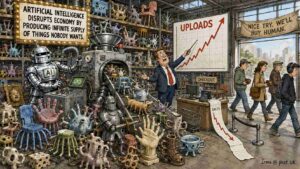
On CGTrader, AI-generated assets reportedly constitute about 16.7 percent of uploaded models but capture only around 1.1 percent of revenue. By the ancient mathematical discipline known as “looking at both numbers,” an AI asset appears to earn only a small fraction of the revenue generated by the average listing.
The industry’s response has been to upload more.
This follows the celebrated Silicon Valley principle that if one unwanted product fails, 900,000 unwanted products may create an ecosystem.
“We’ve removed every inefficient human element except the customer,” announced a fictional technology executive while unveiling a virtual chair with eleven legs. “The customer remains stubbornly biological, judgemental and unwilling to purchase furniture that screams when imported into Blender.”
Economists call the phenomenon “negative desirability scaling,” defined as the process by which a company increases the quantity of its merchandise until shoppers can no longer find anything worth buying.
In ordinary commerce, weak sales suggest that production should decrease. In artificial-intelligence commerce, weak sales prove the public has not yet been exposed to a sufficient tonnage of the product.
It is the difference between a restaurant and a leaf blower. A restaurant prepares a meal someone ordered. A leaf blower throws everything in the general direction of the neighbour’s property and lets the market sort it out.
Customers Commit Economic Sabotage by Having Standards
CGTrader’s findings indicate that only four percent of surveyed buyers of 3D-printing models believe AI works well. Twenty percent reportedly tried AI-generated assets and found them inadequate.
Silicon Valley immediately classified these consumers as “legacy purchasers.”
Legacy purchasers are people burdened by primitive expectations such as accuracy, usefulness and receiving the object depicted in the thumbnail. They remain irrationally prejudiced against buying a medieval knight whose sword passes through his elbow and whose horse has the emotional expression of a kitchen appliance.
One London game designer, standing beside a computer rendering of a dragon with indoor plumbing, explained the problem.
“I needed a castle gate,” she said. “The AI produced something that looked like a cathedral marrying a toaster. It was magnificent, but unfortunately the game is set in medieval France, not an electrical fire.”
Another buyer downloaded what had been advertised as an anatomically accurate human hand. The model contained six fingers on the front and an emergency thumb beneath the wrist.
“The extra thumb was described as a premium feature,” he said. “Customer service suggested I redesign the human race.”
This is the obstacle confronting automated abundance. Customers insist upon treating products as things they intend to use rather than applause for the technology that produced them.
Robots Replace Human Artists but Forget to Replace Human Customers
The original economic promise was simple: machines would replace costly human workers, allowing companies to produce goods cheaply and sell them profitably.
The machines replaced the workers. Then the customers wandered away, presumably to locate the remaining workers.
This unforeseen development startled executives because every forecast had assumed consumers would continue buying human-quality work after companies stopped paying humans to create it. Economists had modelled labour, energy, computing capacity and subscription fees. Nobody modelled resentment.
A human artist makes hundreds of small decisions based on purpose, context and taste. The artist asks whether a warrior can hold his weapon, whether a table can remain upright and whether a child’s face should resemble a haunted turnip.
Artificial intelligence asks whether the next pixel is statistically likely.
This can produce impressive images. It can also produce a dining-room set in which the chairs merge with the guests, the cutlery has fur and Grandma’s left eye contains a small but thriving railway station.
Customers notice these things. They are notoriously fussy about Grandma.
A fictional survey conducted outside an equally fictional shopping centre found that 81 percent of consumers preferred human-made products, 12 percent did not understand the question and seven percent were generated by AI and attempted to sell the interviewer a course.
Trillion-Dollar Industry Discovers the Yard-Sale Problem
The technology industry has spent extraordinary sums developing artificial intelligence infrastructure, acquiring processors and constructing data centres. The machines can now generate text, music, pictures, video, voices, code, models and persuasive LinkedIn posts from executives who have never experienced the emotion called persuasion.
Yet value is not measured by how quickly something can be produced.
A photocopier can reproduce a restaurant menu faster than a chef can prepare dinner, but nobody has ever eaten the menu and congratulated the machine on its productivity.
This is the yard-sale problem. A homeowner may place 600 objects on the driveway, but quantity does not transform a broken lamp, a damp jigsaw puzzle and a VHS exercise programme into a diversified asset portfolio.
AI performs the same operation internationally and calls it innovation.
Technology advocates argue that quality will improve. This is almost certainly true. Early automobiles were unreliable, early telephones were limited and early television gave humanity a man dressed as a cigarette explaining digestion.
But improvement does not guarantee value. The machines may eventually produce flawless objects that nobody needs with unprecedented accuracy.
The perfect unwanted product remains unwanted.
Investors Urged to Remain Calm While Revenue Is Generated Later
Investors have been reassured that current revenue figures fail to capture the enormous future potential of AI merchandise.
“Revenue is an outdated metric,” explained Professor Nigel Turnover, chair of Speculative Arithmetic at the Institute for Expensive Optimism. “The modern economy measures success through uploads, engagement, computational expenditure and how confidently the founder says ‘paradigm.’”
Professor Turnover demonstrated the new accounting system with a lemonade stand.
Under traditional economics, a child who spends $100 making lemonade and earns $4 has lost $96. Under technological economics, the child has acquired market share, disrupted hydration and established a scalable citrus platform.
The remaining $96 is called “runway.”
When the money disappears, the lemonade stand conducts layoffs.
Artificial Abundance Meets Human Attention
The deeper problem is not merely that AI produces flawed work. It is that human attention is finite.
People have only so many hours to browse, compare and reject merchandise. When marketplaces are inundated with automated uploads, the cost of searching rises even if the products themselves become cheaper.
This reverses the advertised benefit. The machine saves ten minutes producing an asset and forces 8,000 customers to spend an additional minute avoiding it. Society gains ten minutes at the producer’s end and loses 133 hours at the other.
That is not efficiency. That is putting one self-checkout machine in a supermarket and calling the resulting queue a productivity miracle.
CGTrader says it intends to emphasise quality and commercial performance rather than raw volume. This is an encouraging approach, although it resembles inventing a sophisticated algorithm to rediscover the shopkeeper.
The old shopkeeper stocked products customers liked. The new platform collects millions of products, calculates ratings, measures conversions, analyses behaviour and eventually determines that customers like good products.
The computer may deliver this conclusion in a dashboard.
A Practical Guide for Surviving the Slop Economy
Consumers should inspect products carefully, read reviews and look for evidence of real testing. Warning signs include impossible geometry, vague descriptions, five-star reviews posted before the product existed and promotional images showing a family with seventeen combined fingers.
Creators should compete on the quality AI struggles to automate: judgement, reliability, originality, cultural understanding and the ability to answer the question, “Why does this exist?”
Marketplaces should label automated content clearly, prevent bulk uploads from overwhelming search results and reward products that buyers actually use. A marketplace is not improved merely because its inventory can be measured from orbit.
Technology companies, meanwhile, should remember that lowering the cost of production does not automatically increase the value of the result. Air is inexpensive and abundant, but nobody has secured venture capital by putting ordinary air in downloadable folders.
At least, not yet.
The Market Delivers Its Review
The economy has not rejected artificial intelligence. It has simply issued a review.
The technology is fast. The supply is immense. The production cost is astonishingly low. The promotional language is magnificent. The revenue, however, has gone outside for a cigarette and may not return.
Artificial intelligence can generate a million objects, but it cannot command a million people to care. Value still emerges from usefulness, trust, craftsmanship and desire—those irritatingly human considerations investors hoped to eliminate in the next software update.
Robots may replace human artists in the production chart. They may dominate uploads, overwhelm search results and fill every digital shelf before lunch.
But until the robots also receive salaries, acquire credit cards and develop a weakness for decorative 3D dragons, companies will remain dependent upon human customers.
And human customers have delivered their verdict:
“No, thank you.”
The machines responded by generating 40,000 more.
Disclaimer
This satirical report examines the expanding market for AI-generated merchandise and the surprisingly traditional behaviour of customers who still expect purchased objects to be useful. Its absurd officials, witnesses, institutes and surveys serve comic purposes. The underlying marketplace figures are drawn from the cited reporting. This story is entirely a human collaboration between two sentient beings—the world’s oldest tenured professor and a philosophy major turned dairy farmer.

Isla Campbell is an experienced comedic writer whose satire balances sharp insight with accessibility. Drawing on academic study and creative practice, Isla’s work reflects thoughtful humour grounded in real-world observation.
Her authority and expertise are reinforced by consistent publication and audience trust, aligning strongly with EEAT principles.