Counsellors Warn Hearing Each Other Could End Half the Arguments Keeping Marriages Interesting
MANCHESTER: Britain’s marriages face a serious adjustment following renewed interest in James 1:19, which recommends listening before speaking, a practice that relationship specialists believe could improve communication but which many married couples regard as a direct threat to established household traditions.
The advice is consistent with guidance from Relate on developing better relationship communication, which encourages active listening rather than merely waiting to make your own point.
This development has caused alarm among couples who have spent decades perfecting the opposite technique.
British marriage has traditionally operated under a practical arrangement in which one spouse knows what the other spouse is thinking, why that thought is wrong, and what the other spouse should have said instead.
James proposes a completely different system.
Apparently, we’re supposed to ask questions.
Marriage Communication: Where Biblical Advice Meets British Reality
Consider a husband who returns home and asks his wife whether anything is wrong.
“Nothing,” she replies.
An inexperienced husband believes this means nothing is wrong.
A married husband recognises that he has entered a diplomatic situation involving historical grievances, undisclosed evidence, and the possibility of sleeping on the sofa.
James advises the husband to listen.
The difficulty is that the wife has explicitly told him there is nothing to listen to.
He must now work out whether silence is a factual statement, an emotional warning, or an examination for which he has received no revision materials.
Marriage counsellors suggest asking thoughtful questions.
The husband asks, “Are you sure?”
This is sometimes regarded as the opening act of war.
The remarkable thing about marriage is that two people who once stayed awake until three in the morning discovering everything about each other can eventually spend an entire evening arguing about how to load a dishwasher. The Office for National Statistics publishes the divorce figures every year. It doesn’t break out how many began with the dishwasher.
Family Dinners and Christmas Arguments: Communication Disaster Zones
The same problem affects the wider family.
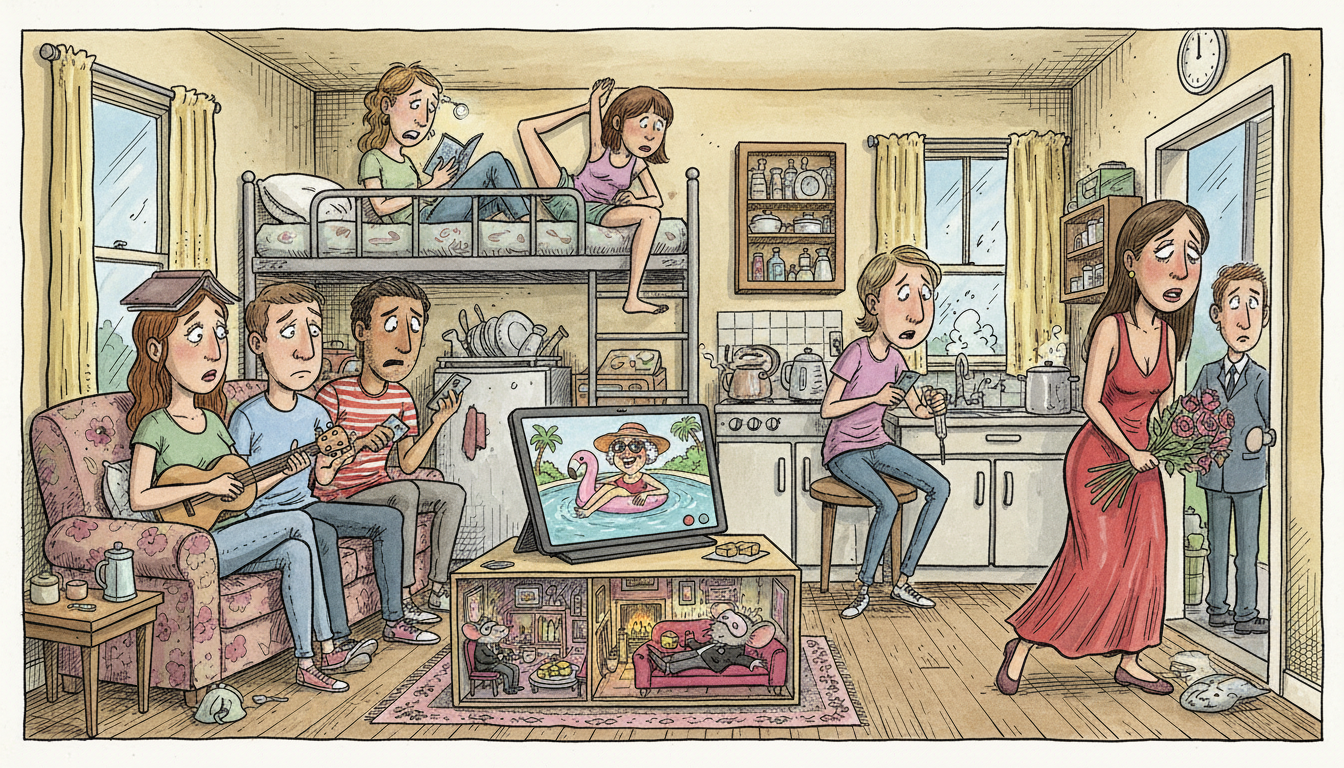
Christmas dinner provides Britain’s annual experiment in whether people who share ancestors can also share a dining table.
Grandfather wants to discuss immigration. Aunt Margaret believes the government is ruining everything. Uncle Derek has discovered an economic theory on Facebook. The teenagers have headphones on, and the dog is the only participant demonstrating patience.
James recommends listening before speaking.
Uncle Derek, however, has spent three months preparing his views and has no intention of abandoning them simply because somebody else has acquired information.
The conversation proceeds according to family tradition.
One person begins discussing the weather. Another mentions energy bills. Within seven minutes, someone has blamed Brussels, Westminster, the BBC, and the younger generation.
Nobody can remember who asked for the gravy.
The dog receives more food, which is generally the most productive outcome.
Teenagers Know Everything, Except Where the Ketchup Is
Parents face an additional challenge.
A mother begins, “Before you go out tonight, could you please…”
“I KNOW!”
The teenager has interrupted before discovering what the request involves.
Perhaps the mother intended to offer twenty pounds. Perhaps she planned to announce that the teenager had inherited a house. Perhaps the family was moving to Spain.
It makes no difference.
The teenager already knows.
This extraordinary intellectual capability disappears whenever the teenager must locate the ketchup, empty the dishwasher, or explain why a wet towel has been living on the bathroom floor since Thursday.
The NHS guidance on communicating with teenagers recommends listening without interrupting and maintaining a calm, consistent approach.
That advice applies to parents as well.
Teenagers are entitled to explain their feelings without receiving an immediate lecture about how much harder life was in 1987.
Parents may discover something genuinely useful if they stop speaking long enough to hear the answer.
Most Domestic Arguments Are Two Speeches in the Same Room
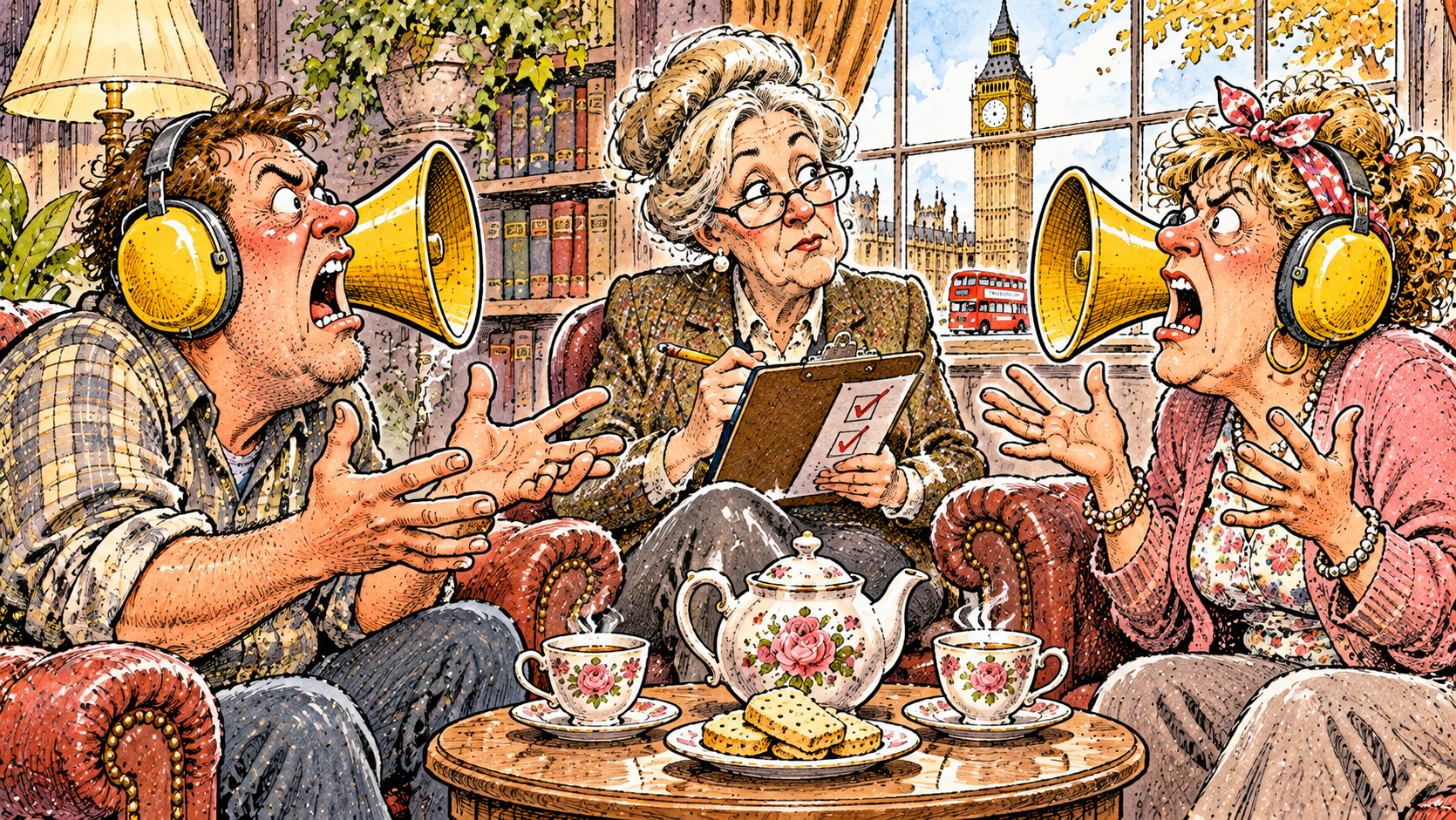
The problem is that people frequently confuse listening with waiting for their turn.
A husband believes he is listening because he hasn’t spoken for eleven seconds.
Meanwhile, inside his head, he is assembling a legal defence concerning a forgotten anniversary, three supermarket receipts, and a dispute over who last purchased washing-up liquid.
His wife is doing exactly the same thing.
Neither understands the other’s complaint, but both are confident of victory.
This resembles a parliamentary debate, except the politicians get travel allowances.
Britain’s broadcasters have already tested the alternative. A BBC guest was allowed to finish a sentence, causing precisely the kind of communications crisis married couples might recognise.
The James approach introduces a dangerously simple idea. Before responding, each spouse must accurately explain what the other spouse meant.
This requires listening to the actual complaint rather than the complaint one was expecting.
An argument about an untidy kitchen might reveal that one partner feels overworked and unappreciated. An argument about arriving late might reveal that the other feels ignored.
These discoveries could resolve disagreements within minutes, creating the unprecedented possibility of a British couple enjoying an entire Saturday without revisiting something that happened on a holiday in 2014.
Silence Is Not Always Agreement in a Marriage
Theologians have overlooked one difficulty.
A spouse who remains quiet may be mistaken for someone who agrees.
“Wonderful,” announces the other spouse. “So we’re visiting my mother for Christmas.”
The silent partner has been practising James 1:19. He has also accidentally agreed to drive 180 miles, sleep in a room with a broken radiator, and spend Boxing Day assembling furniture.
The biblical advice does not require anyone to surrender an opinion. It encourages people to understand the other person before presenting it.
British households could become considerably happier if couples stopped treating conversation as a competition requiring a winner.
There might even be fewer divorces, fewer arguments, and more peaceful Christmas dinners.
The only remaining danger would be discovering that your spouse has something important to say.
And that you might actually learn something.
Five Humorous Observations
- “Nothing’s wrong” is the only sentence in English that means the opposite and comes with a deadline.
- Teenagers know everything. Everything. Then you ask where the ketchup is and suddenly they’ve gone blind in the one part of the fridge that matters.
- Christmas dinner is a hostage negotiation where every hostage brought their own opinions, and the dog is the only trained mediator.
- Married people don’t argue about the dishwasher. They argue about the last eleven years, and the dishwasher’s just the venue.
- “Are you sure?” is a declaration of war wearing a polite hat.
SOURCE: Relate, Five Skills for a Happy Relationship.
Editorial Disclaimer
This report treats British marriage with affection and a good deal of exaggeration. The Relate, ONS and NHS guidance it links to is real and genuinely worth reading; the order to listen, the counsellors mourning lost arguments and the teenager who cannot see the ketchup are comic devices, although the last may be documentary. Couples should read this one at a time, without interrupting, then settle any outstanding dishwasher disputes over more British satire.
These stories are presented as an entirely human collaboration between two sentient beings: the world’s oldest tenured professor and a philosophy major turned dairy farmer.
Their central argument remains serious: Britain would benefit enormously from a greater eagerness to hear, a little more restraint in speaking, and considerably less enthusiasm for becoming angry. After all, God gave us two ears and one mouth. Westminster has spent centuries trying to reverse the arrangement.

Dr. Ingrid Gustafsson holds a Ph.D. in Literary Studies and serves as Professor of Literature and Satirical Journalism at the university. Her scholarly work focuses on contemporary satire as a form of institutional critique, examining how exaggeration, irony, and absurdism function as sophisticated analytical tools for exposing structural inequality and institutional hypocrisy. Dr. Gustafsson has published extensively on the genealogy of satirical discourse, the relationship between speech acts and cultural power, and satire’s role as both aesthetic practice and epistemological strategy. Her research interrogates how contemporary satire operates within celebrity culture, legal systems, and institutional rhetoric, revealing the mechanisms through which power obscures itself through language and performance. Dr. Gustafsson’s work combines rigorous textual analysis with broader cultural theory, contributing significantly to understanding satire’s critical function in contemporary society. She is the author of Pearl Clutching and How to Combat It with Satire.