

East Midlands Finally Wins National Award For Existing Quietly Without Making A Fuss
Experts Confirm Region Has Successfully Avoided Attention For 1,200 Consecutive Years
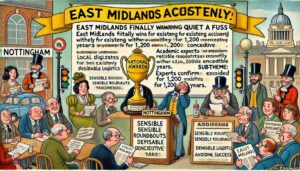
Celebrations broke out across the East Midlands this week after the region was officially recognised as Britain’s leading producer of roundabouts, practical footwear, and people who answer the question “How are you?” with the cautiously optimistic phrase, “Can’t complain.” The party, by local standards, was wild. Two people had a second cup of tea, and one of them risked a biscuit on a weekday.
The award, presented by the National Institute for Geographic Moderation, recognises the East Midlands’ extraordinary achievement of existing between London and everywhere else without demanding attention. It is, in essence, the region equivalent of being the reliable middle child who never asked for a thing and quietly paid for everyone’s parking.
“Frankly, it’s remarkable,” said Professor Nigel Wetherby, Britain’s foremost expert on places people drive through on the way to somewhere they think is more exciting. According to the Department for Transport, an enormous share of the nation does precisely that, foot on the accelerator, eyes on the horizon, entirely unaware they are passing through an award-winning region.
“Most regions spend centuries building a distinct national identity. The East Midlands simply waited for everyone else to become exhausted.” It is, by some distance, the most British strategy ever devised. Win by attrition. Triumph by patience. Conquer by quietly putting the kettle on while the louder counties shouted themselves hoarse.
The announcement has prompted scenes of restrained excitement throughout the region. In Derby, residents celebrated by nodding slightly. In Leicester, several people described themselves as “quite pleased.” Meanwhile, in Nottingham, one man reportedly called the news “absolutely tremendous” before immediately apologising for getting carried away. He has since gone into hiding to consider what came over him.
Government Struggles To Locate East Midlands On Official Maps
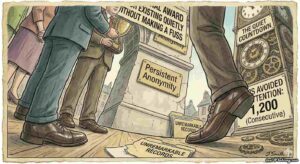
Whitehall officials admitted this week that several government departments have spent years confusing the East Midlands with the West Midlands, Yorkshire, Lincolnshire, and occasionally Belgium. To be fair, you can buy a perfectly good waffle in two of those, so the error has an upside.
“We know it’s somewhere in the middle,” said one senior civil servant. “Beyond that things become a bit technical.” Despite the existence of Ordnance Survey, an organisation whose entire reason for being is knowing where everything is, the East Midlands continues to sit on the national map like a polite stain nobody wishes to mention.
An internal review discovered that three separate ministries had accidentally labelled the East Midlands as “That Bit Above London.” Another simply referred to it as “Roundabout Country,” which, in fairness, is not wrong and may in fact be a compliment. The mistake reportedly went unnoticed for seventeen years because nobody in the East Midlands complained. Complaining, the region feels, is for people with the time.
Nottingham Residents Remind Nation They Once Had Robin Hood
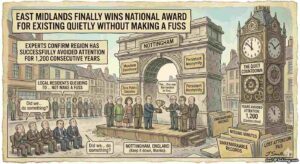
Regional leaders continue to emphasise the area’s historical significance, and by historical significance they mean one very famous outlaw they have not stopped mentioning since the reign of King John.
“We literally produced Robin Hood,” said Nottingham council spokesperson Elaine Barker. “We’ve been living off that achievement since the 12th century.” Tourism officials at Visit Nottinghamshire confirmed that Robin Hood remains responsible for approximately 94 percent of all international awareness regarding Nottingham. The man robbed the rich, fed the poor, and apparently single-handedly built a tourism economy that has coasted on his green tights for the better part of a millennium.
The remaining 6 percent comes from football and occasional confusion with Notting Hill. Local economists described this as “a diversified economy,” which is a generous way of saying a forest, a film, and Brian Clough. You can read more on Britain’s tendency to live forever off one good legend over at lateststory.co.uk, where the past never quite lets go.
East Midlands Introduces Revolutionary New Tourist Attraction: Adequate Parking
Tourism authorities unveiled a bold new strategy designed to attract visitors from London. The centrepiece of the campaign is a parking space. Not a metaphorical parking space. An actual parking space. Available immediately. At a reasonable price.
Visitors from the capital reportedly became emotional upon hearing the news. One London resident burst into tears after learning he could park for less than the value of a small family hatchback. Another described the concept as “almost mythical.” Officials at VisitEngland are said to be watching the campaign closely, having never before seen a county weaponise the simple act of leaving your car somewhere without remortgaging the house.
Early figures suggest the parking space alone has generated more genuine joy than three London festivals and a pop-up bar selling artisanal ice cubes. The region remains modest about the triumph, noting only that there’s plenty more where that came from, and you can probably get the spot next to it as well.
Leicester Discovers It Accidentally Became Historically Important Again
Leicester continues to enjoy the benefits of discovering the remains of King Richard III beneath a car park. The discovery, confirmed by researchers at the University of Leicester, has become the city’s most successful tourism initiative since inventing the concept of finding things beneath car parks. It is the only city in Britain where the phrase “we found a body in the car park” leads to a museum rather than an investigation.
Local historians remain amazed. “For centuries people searched castles, battlefields, churches, and archives,” said historian Martin Crump. “Turns out the answer was underneath a Vauxhall Astra.” The find is now celebrated at the King Richard III Visitor Centre, proving that in the East Midlands, even a fallen monarch eventually gets a sensible indoor venue with reasonable opening hours.
Researchers are currently investigating whether additional monarchs might be located beneath nearby shopping centres. Historic England has not ruled it out, which means somewhere in a Leicester multistorey, a Plantagenet may yet be waiting patiently behind a row of trolleys for his moment to be rediscovered.
Derby Proudly Maintains National Leadership In Being Derby
Residents of Derby insist the city deserves greater national recognition. When asked why, they admitted they were still working on the details.
“Look, we’re not saying we’re flashy,” explained resident Keith Mortimer. “We’re just saying somebody has to manufacture things while London is busy creating podcasts.” Economic experts confirmed that Derby continues to perform the highly unfashionable task of producing actual products, the sort you can hold, post, or fly in, courtesy of employers like Rolls-Royce, whose engines do rather more lifting than the average influencer.
Bodies such as Make UK have long pointed out that British manufacturing keeps the lights on while the cooler industries take the credit. Derby, characteristically, builds the turbine that powers the laptop on which the podcast complaining about Derby is recorded, then says nothing about it at all.
Lincolnshire Farmers Declare War On Avocados
Meanwhile, rural communities across Lincolnshire have launched a campaign defending traditional British agriculture from what they describe as “foreign vegetables with social media managers.”
The movement gained momentum after several farmers learned that urban professionals were paying premium prices for smashed avocado. The National Farmers’ Union declined to take an official position, though privately many members were spotted nodding into their wellies.
“We’ve got potatoes,” said farmer Alan Briggs. “They’ve survived wars, recessions, and British cooking. An avocado can’t even survive a Tuesday.” Lincolnshire, according to the county council, grows a genuinely vast share of the nation’s vegetables, a fact the region mentions roughly never, because boasting about root vegetables is simply not done. The humble spud asks for nothing. It does not need a manager, a hashtag, or a brunch. It just shows up, gets mashed, and keeps the country fed while the avocado posts about its journey.
Regional Weather Remains Determinedly Average
Meteorologists reported that the East Midlands once again experienced weather. Experts described conditions as neither remarkable nor particularly memorable.
The forecast predicts cloud. Then slightly different cloud. Followed by an exciting period of cloud with sunshine attempting a brief appearance before losing confidence. The Met Office confirmed the outlook as “broadly grey with patches of resignation,” which is also, coincidentally, the regional motto.
Residents welcomed the stability. Nobody in the East Midlands has ever wanted dramatic weather. Dramatic weather happens to other people, on the news, somewhere with a coastline and a podcast. Here, a light drizzle is considered an event, and a proper sunny day is treated with the deep suspicion it plainly deserves.
East Midlands Rail Service Announces Trains Will Arrive At Some Point
Transport operators unveiled a new customer information strategy this week. Instead of publishing exact arrival times, passengers will receive encouraging messages such as: “Your train remains conceptually possible.” And: “We continue to believe in rail travel.”
Passengers praised the honesty. After years of Network Rail updates that combine the precision of a fortune cookie with the optimism of a lottery ticket, a frank admission that the train may simply be a lovely idea was received as a refreshing change. One commuter was reportedly moved to tears, partly by the candour and partly because she had been standing on the platform since the Coronation.
The operator added that while it could not guarantee when any given train would appear, it could confirm that hope, at least, runs on schedule. Passengers nodded, sat on their practical footwear, and waited, as the East Midlands has always done, beautifully.
National Survey Finds East Midlands Residents Suspicious Of Excessive Enthusiasm
A recent poll, the sort routinely conducted by bodies like the Office for National Statistics, revealed that East Midlands residents become uncomfortable when conversations exceed recommended excitement levels.
Researchers discovered the ideal regional response to good news is: “That’s nice.” The ideal response to excellent news is: “That’s very nice.” The ideal response to winning the lottery is: “Well, that’s something.” A follow-up study found that the ideal response to a marriage proposal was “Go on then,” delivered while filling the kettle.
Sociologists described the findings as “culturally fascinating.” Locals described the sociologists as “a bit much,” then offered them a brew and asked them, gently, to calm down.
Londoners Discover East Midlands Exists
Perhaps the biggest shock came when a national survey found that 37 percent of London residents recently discovered the East Midlands is a real place. Another 18 percent assumed it was a train station. Seven percent believed it was a Premier League midfielder, which the league at premierleague.com has neither confirmed nor denied, presumably because he marks tirelessly and never seeks the limelight.
One respondent asked whether it was “near Manchester.” Officials described the results as disappointing but not surprising. The region took the news as it takes all news, with a small sigh, a long look out of the window, and the quiet satisfaction of a place that has never once needed London to know it was there in order to keep functioning splendidly.
Region Declares Victory In National Competition Nobody Else Knew Was Happening
At a celebratory event in Nottingham, regional leaders accepted the award for Quiet Competence, Practical Living, and General Reliability. The ceremony attracted dozens of attendees and almost three journalists, one of whom was only there for the parking.
“This region doesn’t need gimmicks,” declared one speaker. “We have market towns, countryside, engineering, history, football, sausages, and enough roundabouts to be visible from space.” Bodies such as the National Trust have quietly catalogued the region’s churches, halls, and rolling green for years, while the East Midlands got on with the far more important business of being dependable.
The crowd responded with sustained moderate approval. As celebrations concluded, residents returned home satisfied that the East Midlands had once again achieved its primary objective: being perfectly content while everybody else argued about everything. And there, really, is the heart of it. In an age of noise, the region that says the least may well be the one that has worked it all out.
If you fancy seeing how our cousins across the Atlantic make an almighty racket about the same human silliness, our American friends are causing identical mischief in a louder accent over at Bohiney.com. Same nonsense, fewer roundabouts.
Auf Wiedersehen, amigo!
This article is satire. The East Midlands is a genuinely important and successful region of England with rich history, industry, agriculture, sport, and culture. Leicester really did discover the remains of King Richard III beneath a city car park in 2012, confirmed by University of Leicester researchers, and the region is a major centre for British manufacturing, engineering, and food production. The jokes celebrate its reputation for practicality, understatement, and quiet competence. This story is entirely a human collaboration between two sentient beings: the world’s oldest tenured professor and a philosophy major turned dairy farmer.

Alan Nafzger was born in Lubbock, Texas, the son Swiss immigrants. He grew up on a dairy in Windthorst, north central Texas. He earned degrees from Midwestern State University (B.A. 1985) and Texas State University (M.A. 1987). University College Dublin (Ph.D. 1991). Dr. Nafzger has entertained and educated young people in Texas colleges for 37 years. Nafzger is best known for his dark novels and experimental screenwriting. His best know scripts to date are Lenin’s Body, produced in Russia by A-Media and Sea and Sky produced in The Philippines in the Tagalog language. In 1986, Nafzger wrote the iconic feminist western novel, Gina of Quitaque. He currently lives in Holloway, North London. Contact: [email protected]


