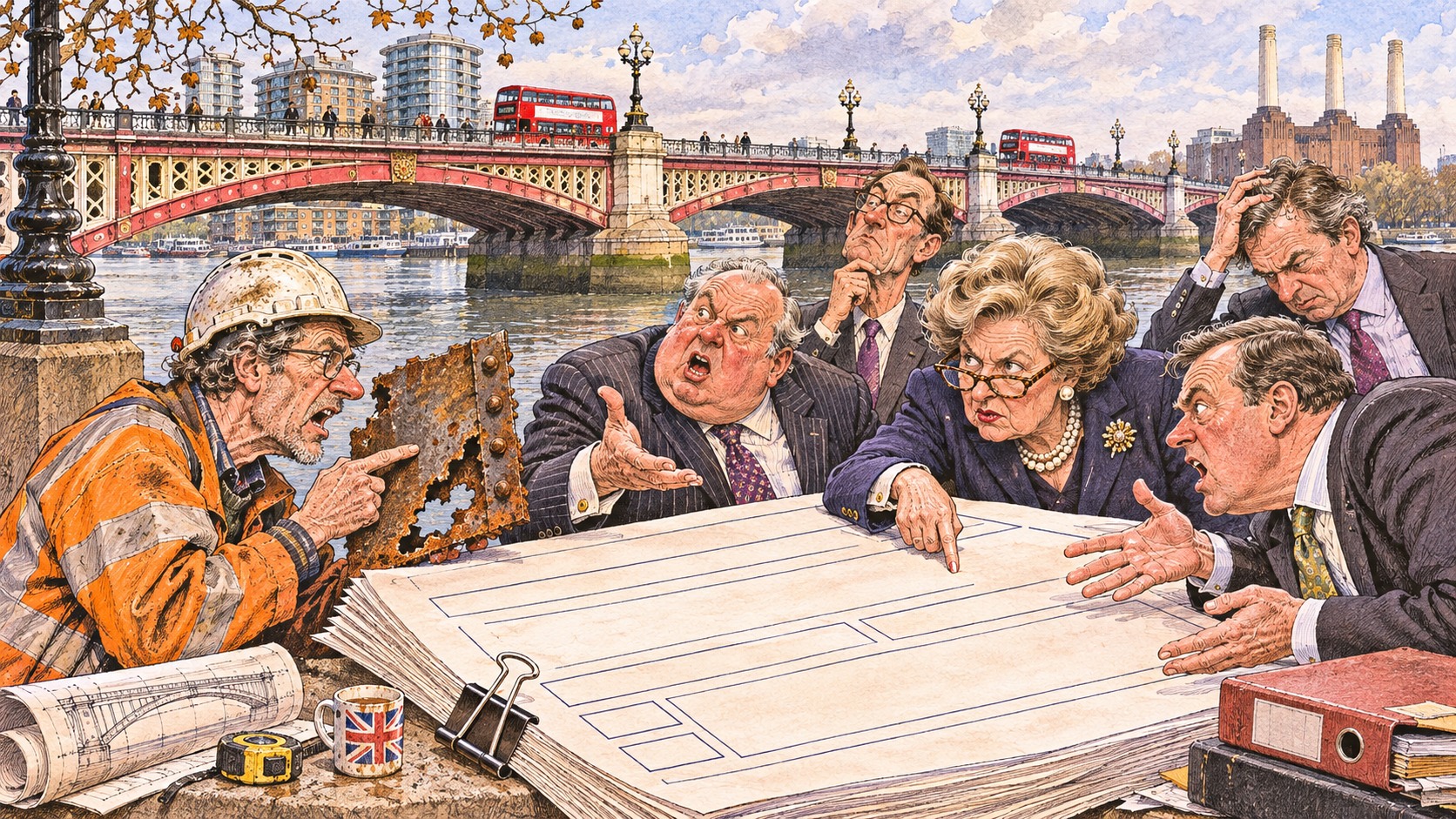
VAUXHALL — Vauxhall Bridge repairs have become the subject of renewed concern among London commuters, who have noticed that corrosion appears able to proceed without first demonstrating strategic alignment or submitting a convincing funding application.
Office worker Nina Cole says she respects the need to assess public spending. She is merely troubled that the steelwork has adopted a faster decision-making process than the people responsible for paying to maintain it.
“Rust gets straight on with the job,” she said. “Nobody has asked it for three quotations. It hasn’t even explained how it supports growth.”
Vauxhall Bridge Repairs Meet the Funding Calendar
TfL has warned that the bridge could need restrictions affecting buses and fire engines within two to four years without repairs, according to ITV News. The warning concerns a future risk if work is not funded, rather than a statement that buses have already been banned. Read ITV News reporting on TfL’s Vauxhall Bridge repair warning.
Cole found that distinction reassuring. She would still like to see the warning lead to practical action while it can be described in years, rather than becoming an urgent announcement delivered during her journey.
Her colleague Simon says Britain is particularly skilled at converting maintenance into a surprise. First something gets older. Then it continues getting older. Finally, people gather around it and express concern about an unexpected problem with age.
“My bathroom does that,” he said. “The difference is I don’t announce the shower tray as a nationally significant resilience challenge before calling a plumber.”
Cole accepts that bridges are more complicated than shower trays. She also thinks that makes timely engineering advice more useful, rather than less.
The daily passenger does not need every technical detail. She needs confidence that somebody understands the condition, the work required and what happens to journeys while that work takes place.

The Steelwork Declines to Wait for the Minutes
Simon suggested inviting the rust to the next funding meeting. It had first-hand experience, a clear programme of activity and no obvious difficulty maintaining momentum.
Cole said this would be unfair to the engineers already trying to get necessary work done. Her frustration was with systems that required a looming restriction to make ordinary upkeep sound urgent enough to buy.
The pair discussed what an understandable public update might contain. The problem, the proposed repair, the funding decision and the arrangements if work affected services. They completed the list before their coffees arrived, demonstrating the value of working to a deadline with visible consequences.
Cole checked current travel information rather than treating a future warning as an immediate closure. Simon put a reminder in his calendar to look for the funding outcome.
He asked whether she thought the bridge would receive a ribbon-cutting ceremony after repairs. Nina said maintenance deserved recognition, though she would settle for crossing it without becoming an informal student of capital funding.
By the time they left, the river had continued flowing and the bridge had continued carrying traffic. Neither had waited for an updated communications plan.
Cole said she hoped the next announcement concerned the work going ahead. Rust, she observed, was already very clear about its commitment to delivery and had never once described itself as aspirational.
Satire disclaimer. Corrosion has not been appointed a delivery partner. A human collaboration between the world’s oldest tenured professor and a philosophy major turned dairy farmer, both supportive of repairing things before they become journeys.

Aishwarya Rao is a satirical writer whose work reflects the perspective of a student navigating culture, media, and modern identity with humour and precision. With academic grounding in critical analysis and a strong interest in contemporary satire, Aishwarya’s writing blends observational comedy with thoughtful commentary on everyday contradictions. Her humour is informed by global awareness and sharpened through exposure to London’s diverse cultural and student communities.
As an emerging voice, Aishwarya represents the next generation of satirical journalists: informed, curious, and unafraid to question norms through wit. Her authority stems from research-led writing, respect for factual context, and a commitment to ethical satire. Transparency and clear labelling ensure readers understand the comedic intent behind her work.
Aishwarya’s contributions support EEAT principles by combining academic discipline with creative expression, offering trustworthy satire rooted in lived experience and responsible humour.
Email: [email protected]